Page 251 of 329
Troubleshooting
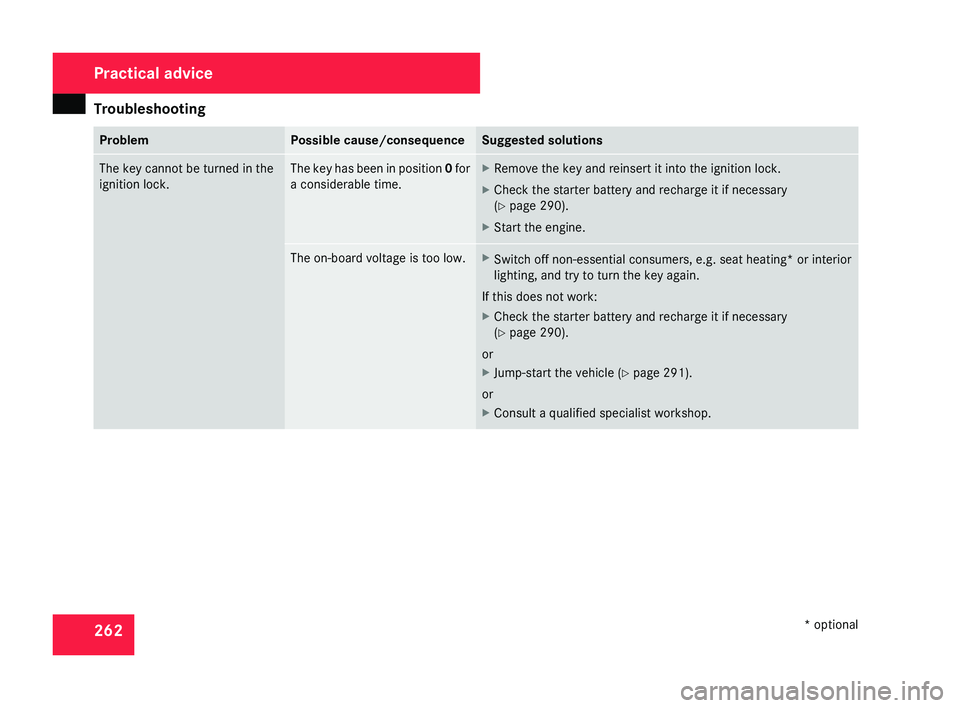
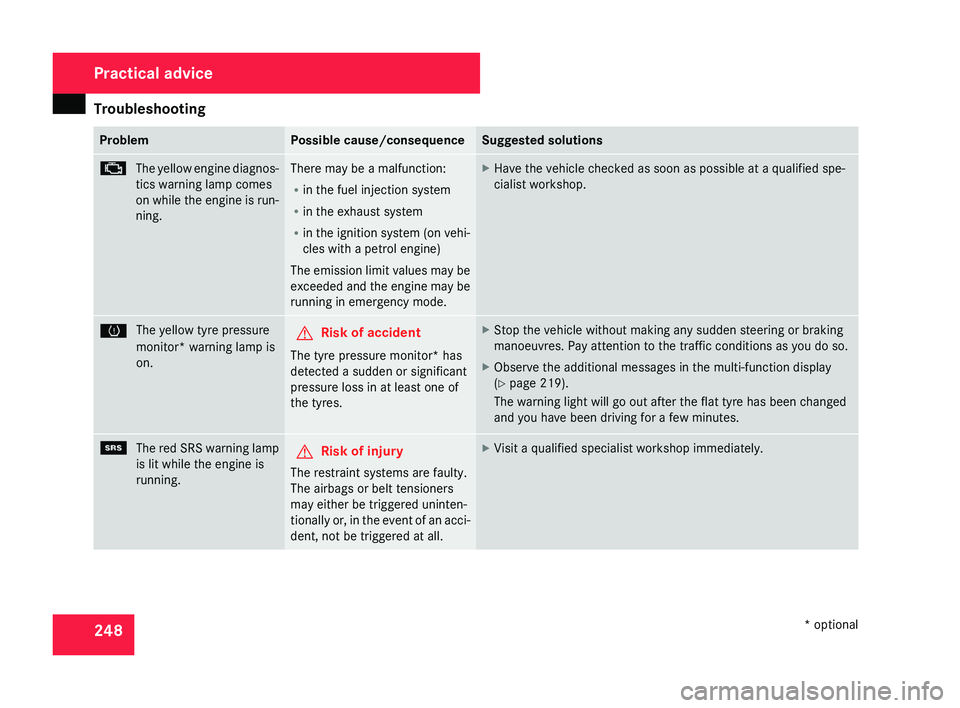
248 Problem Possible cause/consequence Suggested solutions
±
The yellow engine diagnos-
tics warning lamp comes
on
while the engine is run-
ning. There may be a malfunction:
R
in the fuel injection system
R in the exhaust system
R in
the ignition system (on vehi-
cles with a petrol engine)
The emission limit values may be
exceeded and the engine may be
running in emergency mode. X
Have the vehicle checked as soon as possible at a qualified spe-
cialist workshop. H
The yellow tyre pressure
monitor* warning lamp is
on. G
Risk of accident
The tyre pressure monitor* has
detected a sudden or significant
pressure loss in at least one of
the tyres. X
Stop the vehicle without making any sudden steering or braking
manoeuvres. Pay attention to the traffic conditions as you do so.
X Observe the additional messages in the multi-function display
(Y page 219).
The warning light will go out after the flat tyre has been changed
and you have been driving for a few minutes. 1
The red SRS warning lamp
is lit while the engine is
running. G
Risk of injury
The restraint systems are faulty.
The airbags or belt tensioners
may either be triggered uninten-
tionally
or, in the event of an acci-
dent, not be triggered at all. X
Visit a qualified specialist workshop immediately. Practical advice
* optional
219_AKB; 2; 4, en-GB
mkalafa,
2007-11-13T09:28:36+01:00 - Seite 248
Page 259 of 329
Troubleshooting
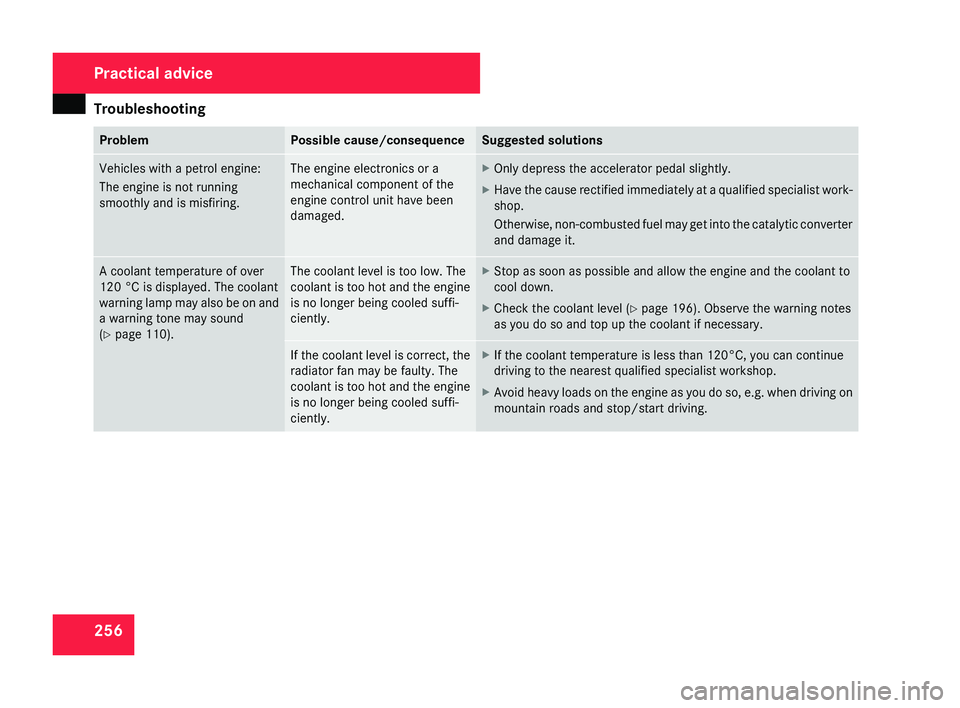
256 Problem Possible cause/consequence Suggested solutions
Vehicles with a petrol engine:
The engine is not running
smoothly and is misfiring. The engine electronics or a
mechanical component of the
engine control unit have been
damaged. X
Only depress the accelerator pedal slightly.
X Have the cause rectified immediately at a qualified specialist work-
shop.
Otherwise,
non-combusted fuel may get into the catalytic converter
and damage it. A coolant temperature of over
120 °C is displayed. The coolant
warning
lamp may also be on and
a warning tone may sound
(Y page 110). The coolant level is too low. The
coolant
is too hot and the engine
is no longer being cooled suffi-
ciently. X
Stop as soon as possible and allow the engine and the coolant to
cool down.
X Check the coolant level (Y page 196). Observe the warning notes
as you do so and top up the coolant if necessary. If the coolant level is correct, the
radiator fan may be faulty. The
coolant
is too hot and the engine
is no longer being cooled suffi-
ciently. X
If the coolant temperature is less than 120°C, you can continue
driving to the nearest qualified specialist workshop.
X Avoid heavy loads on the engine as you do so, e.g. when driving on
mountain roads and stop/start driving. Practical advice
219_AKB; 2; 4, en-GB
mkalafa,
2007-11-13T09:28:36+01:00 - Seite 256
Page 265 of 329
Troubleshooting
262 Problem Possible cause/consequence Suggested solutions
The key cannot be turned in the
ignition lock. The key has been in position
0 for
a considerable time. X
Remove the key and reinsert it into the ignition lock.
X Check the starter battery and recharge it if necessary
(Y page 290).
X Start the engine. The on-board voltage is too low. X
Switch off non-essential consumers, e.g. seat heating* or interior
lighting, and try to turn the key again.
If this does not work:
X Check the starter battery and recharge it if necessary
(Y page 290).
or
X Jump-start the vehicle (Y page 291).
or
X Consult a qualified specialist workshop. Practical advice
* optional
219_AKB; 2; 4, en-GB
mkalafa,
2007-11-13T09:28:36+01:00 - Seite 262
Page 295 of 329
Jump-starting
292 G
Risk of injury
There is a risk of acid burns when jump-
starting a vehicle due to the gases which
escape from the battery. Do not lean over
the battery while the engine is being jump-
started. G
Risk of explosion
Gases escaping from the battery during
jump-starting may cause minor explosions.
Avoid creating sparks. Keep naked flames
away from the battery, and do not smoke.
Comply with safety precautions and take
protective measures when handling batter-
ies. You will find these under “Battery” in
the index.
X Make sure that the two vehicles do not
touch.
X Depress the parking brake.
X Move the selector lever to P.
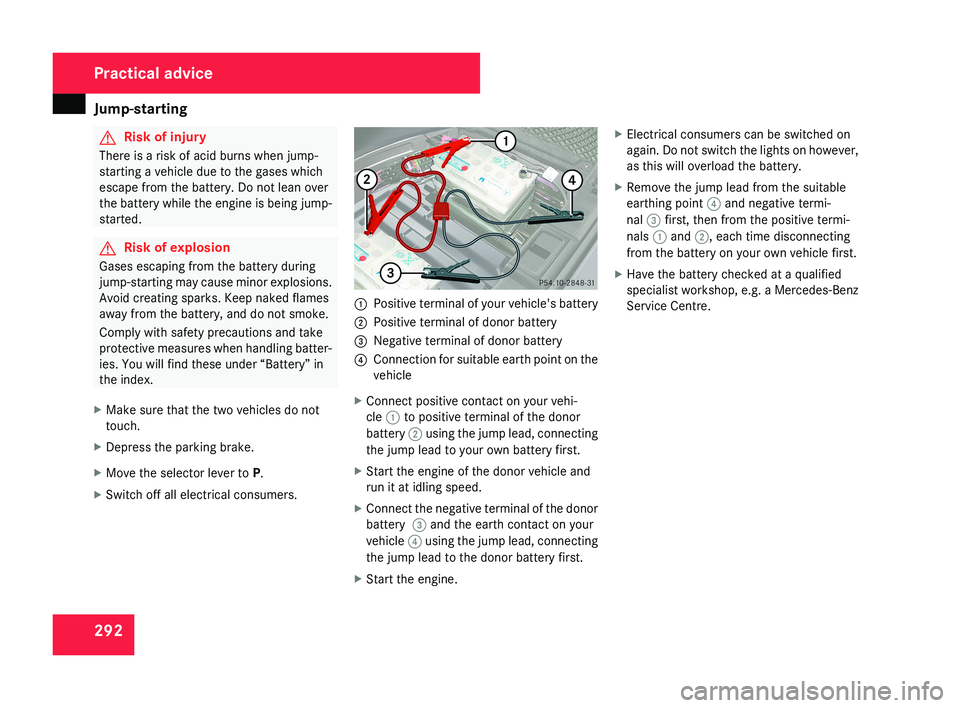
X Switch off all electrical consumers.1 Positive terminal of your vehicle's battery
2 Positive terminal of donor battery
3 Negative terminal of donor battery
4 Connection for suitable earth point on the
vehicle
X Connect positive contact on your vehi-
cle 1 to positive terminal of the donor
battery 2 using the jump lead, connecting
the jump lead to your own battery first.
X Start the engine of the donor vehicle and
run it at idling speed.
X Connect the negative terminal of the donor
battery 3 and the earth contact on your
vehicle 4 using the jump lead, connecting
the jump lead to the donor battery first.
X Start the engine. X
Electrical consumers can be switched on
again. Do not switch the lights on however,
as this will overload the battery.
X Remove the jump lead from the suitable
earthing point 4 and negative termi-
nal 3 first, then from the positive termi-
nals 1 and 2, each time disconnecting
from the battery on your own vehicle first.
X Have the battery checked at a qualified
specialist workshop, e.g. a Mercedes-Benz
Service Centre.
Practical advice
219_AKB; 2; 4, en-GB
mkalafa,
2007-11-13T09:28:36+01:00 - Seite 292