Page 2921 of 3924

GW-8
< SERVICE INFORMATION >
SQUEAK AND RATTLE TROUBLE DIAGNOSES
Most of these incidents can be repaired by adjusting, securing or insulatingthe item(s) or component(s) caus-
ing the noise.
SUNROOF/HEADLINING
Noises in the sunroof/headlining area c an often be traced to one of the following:
1. Sunroof lid, rail, linkage or seals making a rattle or light knockingnoise
2. Sunvisor shaft shaking in the holder
3. Front or rear windshield touching headlining and squeaking
Again, pressing on the components to stop the noise while duplicatingthe conditions can isolate most of these
incidents. Repairs usually consistof insulating with felt cloth tape.
SEATS
When isolating seat noise it's important to note the pos ition the seatis in and the load placed on the seat when
the noise is present. These conditionsshould be duplic ated when verifying and isolating the cause of the
noise.
Cause of seat noise include:
1. Headrest rods and holder
2. A squeak between the seat pad cushion and frame
3. The rear seatback lock and bracket
These noises can be isolated by moving or pressing on the suspectedcomponents while duplicating the condi-
tions under which the noise occurs.Most of these incidents can be repaired by repositioning the component
orapplying urethane tape to the contact area.
UNDERHOOD
Some interior noise may be caused by components under the hood or onthe engine wall. The noise is then
transmitted into the passenger compartment.
Causes of transmitted underhood noise include:
1. Any component mounted to the engine wall
2. Components that pass through the engine wall
3. Engine wall mounts and connectors
4. Loose radiator mounting pins
5. Hood bumpers out of adjustment
6. Hood striker out of adjustment
These noises can be difficult to isolate since they cannot be reached from the interior of the vehicle. The best
method is to secure, move or insulate one component at a time and test drive the \
vehicle. Also, engine RPM
or load can be changed to isolate the noise. Repairs can usually be made by moving, adjusting, securing, or
insulating the component causing the noise.
3AA93ABC3ACD3AC03ACA3AC03AC63AC53A913A773A893A873A873A8E3A773A983AC73AC93AC03AC3
3A893A873A873A8F3A773A9D3AAF3A8A3A8C3A863A9D3AAF3A8B3A8C
Page 2963 of 3924
GW-50
< SERVICE INFORMATION >
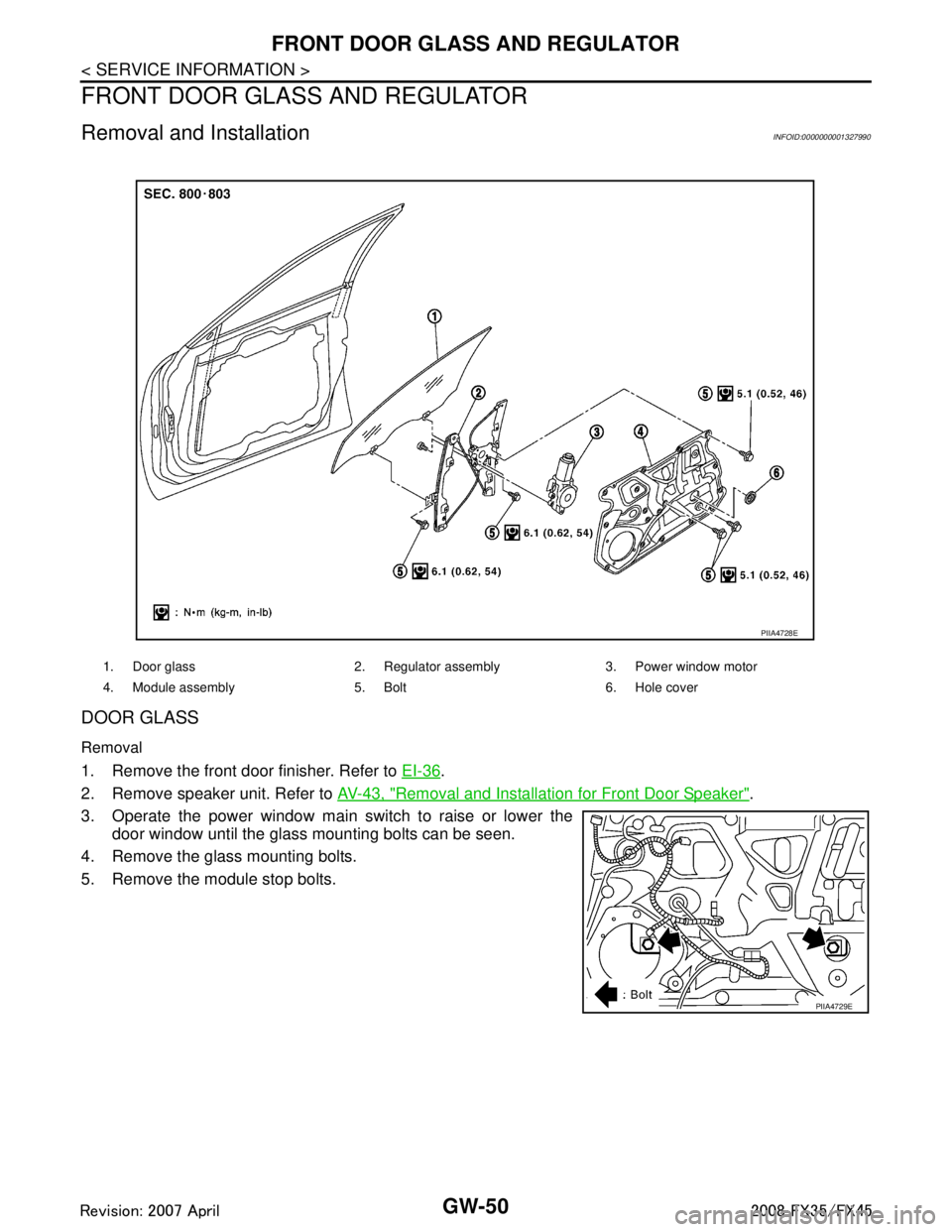
FRONT DOOR GLASS AND REGULATOR
FRONT DOOR GLASS AND REGULATOR
Removal and InstallationINFOID:0000000001327990
DOOR GLASS
Removal
1. Remove the front door finisher. Refer to EI-36.
2. Remove speaker unit. Refer to AV-43, "
Removal and Installation for Front Door Speaker".
3. Operate the power window main switch to raise or lower the door window until the glass mounting bolts can be seen.
4. Remove the glass mounting bolts.
5. Remove the module stop bolts.
1. Door glass 2. Regulator assembly 3. Power window motor
4. Module assembly 5. Bolt 6. Hole cover
PIIA4728E
PIIA4729E
3AA93ABC3ACD3AC03ACA3AC03AC63AC53A913A773A893A873A873A8E3A773A983AC73AC93AC03AC3
3A893A873A873A8F3A773A9D3AAF3A8A3A8C3A863A9D3AAF3A8B3A8C
Page 2964 of 3924
FRONT DOOR GLASS AND REGULATORGW-51
< SERVICE INFORMATION >
C
DE
F
G H
J
K L
M A
B
GW
N
O P
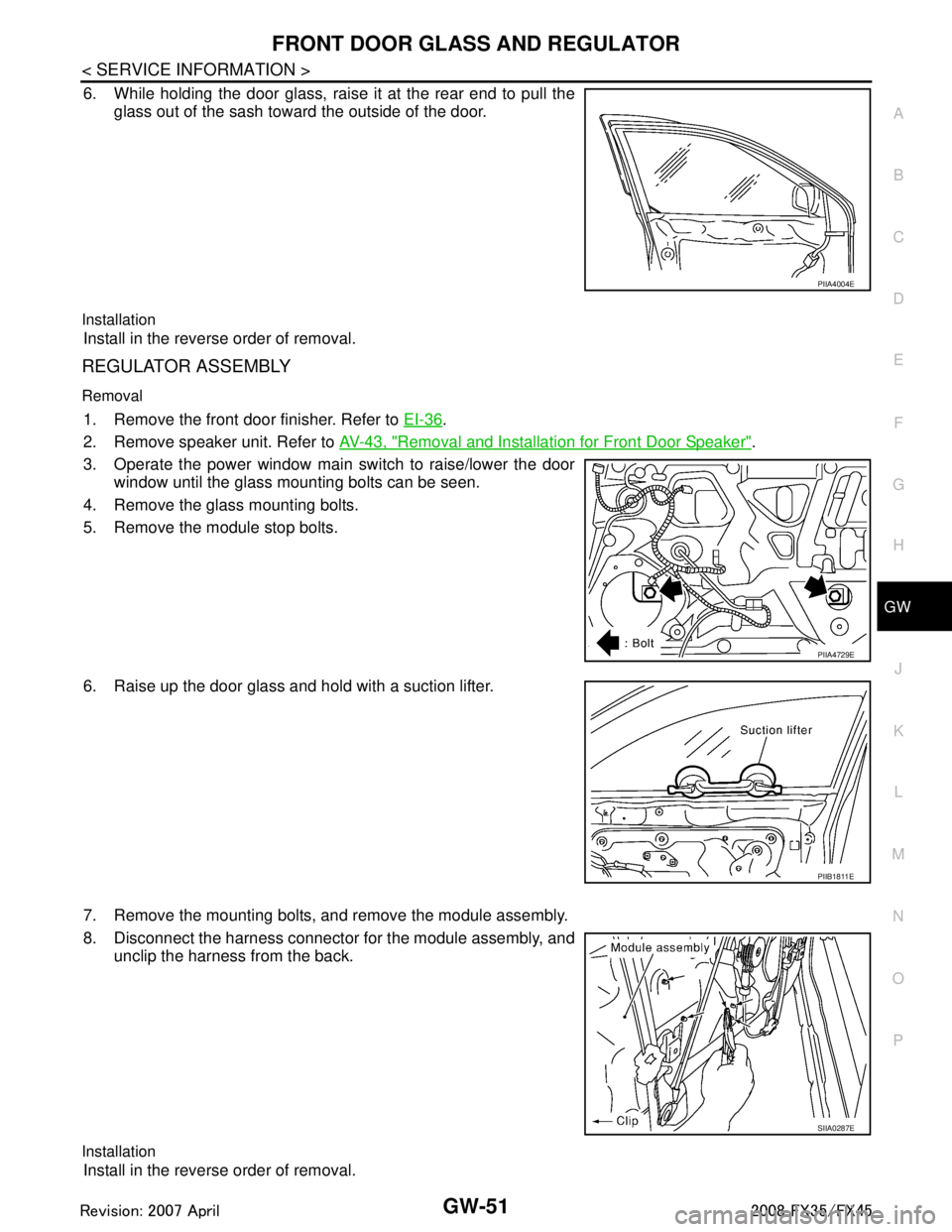
6. While holding the door glass, raise it at the rear end to pull the glass out of the sash toward the outside of the door.
Installation
Install in the reverse order of removal.
REGULATOR ASSEMBLY
Removal
1. Remove the front door finisher. Refer to EI-36.
2. Remove speaker unit. Refer to AV-43, "
Removal and Installation for Front Door Speaker".
3. Operate the power window main switch to raise/lower the door window until the glass mounting bolts can be seen.
4. Remove the glass mounting bolts.
5. Remove the module stop bolts.
6. Raise up the door glass and hold with a suction lifter.
7. Remove the mounting bolts, and remove the module assembly.
8. Disconnect the harness connector for the module assembly, and
unclip the harness from the back.
Installation
Install in the reverse order of removal.
PIIA4004E
PIIA4729E
PIIB1811E
SIIA0287E
3AA93ABC3ACD3AC03ACA3AC03AC63AC53A913A773A893A873A873A8E3A773A983AC73AC93AC03AC3
3A893A873A873A8F3A773A9D3AAF3A8A3A8C3A863A9D3AAF3A8B3A8C
Page 2966 of 3924
FRONT DOOR GLASS AND REGULATORGW-53
< SERVICE INFORMATION >
C
DE
F
G H
J
K L
M A
B
GW
N
O P
Lower the glass slightly [approx. 10 to 20 mm (0.39 to 0.79 in)] and make sure the clearance to the sash is parallel. If the clearance between the glass and sash is not parallel, loosen the regulator mounting bolts,
guide rail mounting bolts, and glass and guide rail mounting bolts to correct the glass position.
3AA93ABC3ACD3AC03ACA3AC03AC63AC53A913A773A893A873A873A8E3A773A983AC73AC93AC03AC3
3A893A873A873A8F3A773A9D3AAF3A8A3A8C3A863A9D3AAF3A8B3A8C
Page 2968 of 3924
REAR DOOR GLASS AND REGULATORGW-55
< SERVICE INFORMATION >
C
DE
F
G H
J
K L
M A
B
GW
N
O P
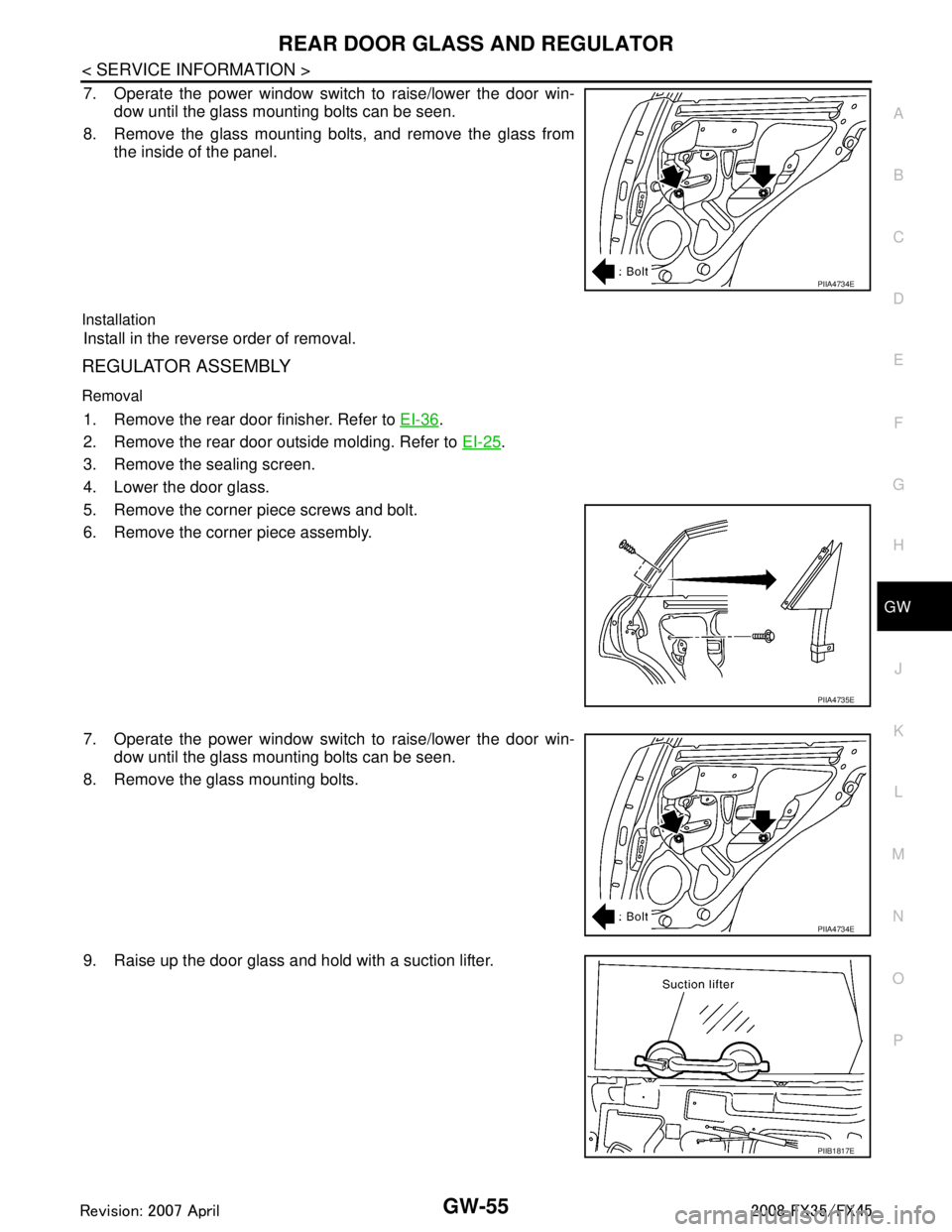
7. Operate the power window switch to raise/lower the door win- dow until the glass mounting bolts can be seen.
8. Remove the glass mounting bolts, and remove the glass from the inside of the panel.
Installation
Install in the reverse order of removal.
REGULATOR ASSEMBLY
Removal
1. Remove the rear door finisher. Refer to EI-36.
2. Remove the rear door outside molding. Refer to EI-25
.
3. Remove the sealing screen.
4. Lower the door glass.
5. Remove the corner piece screws and bolt.
6. Remove the corner piece assembly.
7. Operate the power window switch to raise/lower the door win- dow until the glass mounting bolts can be seen.
8. Remove the glass mounting bolts.
9. Raise up the door glass and hold with a suction lifter.
PIIA4734E
PIIA4735E
PIIA4734E
PIIB1817E
3AA93ABC3ACD3AC03ACA3AC03AC63AC53A913A773A893A873A873A8E3A773A983AC73AC93AC03AC3
3A893A873A873A8F3A773A9D3AAF3A8A3A8C3A863A9D3AAF3A8B3A8C
Page 2969 of 3924
GW-56
< SERVICE INFORMATION >
REAR DOOR GLASS AND REGULATOR
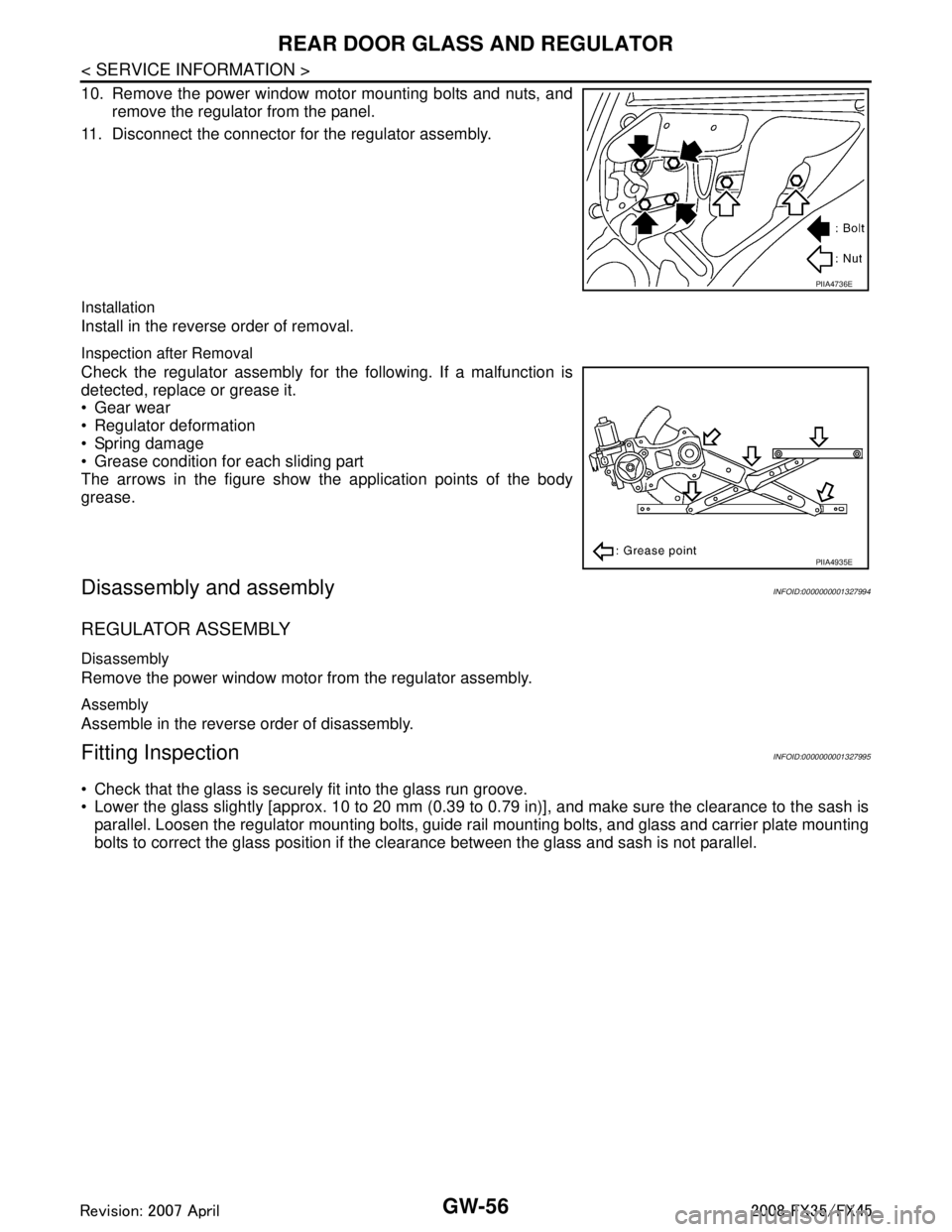
10. Remove the power window motor mounting bolts and nuts, andremove the regulator from the panel.
11. Disconnect the connector for the regulator assembly.
Installation
Install in the reverse order of removal.
Inspection after Removal
Check the regulator assembly for the following. If a malfunction is
detected, replace or grease it.
Gear wear
Regulator deformation
Spring damage
Grease condition for each sliding part
The arrows in the figure show the application points of the body
grease.
Disassembly and assemblyINFOID:0000000001327994
REGULATOR ASSEMBLY
Disassembly
Remove the power window motor from the regulator assembly.
Assembly
Assemble in the reverse order of disassembly.
Fitting InspectionINFOID:0000000001327995
Check that the glass is securely fit into the glass run groove.
Lower the glass slightly [approx. 10 to 20 mm (0.39 to 0.79 in)], and make sure the clearance to the sash is
parallel. Loosen the regulator mounting bolts, guide rail mounting bolts, and glass and carrier plate mounting
bolts to correct the glass position if the clearance between the glass and sash is not parallel.
PIIA4736E
PIIA4935E
3AA93ABC3ACD3AC03ACA3AC03AC63AC53A913A773A893A873A873A8E3A773A983AC73AC93AC03AC3
3A893A873A873A8F3A773A9D3AAF3A8A3A8C3A863A9D3AAF3A8B3A8C
Page 2972 of 3924
INSIDE MIRRORGW-59
< SERVICE INFORMATION >
C
DE
F
G H
J
K L
M A
B
GW
N
O P
Apply Genuine Mirror Adhesive or equivalent to bonding surface of mounting bracket. Refer to GI-
44.
3AA93ABC3ACD3AC03ACA3AC03AC63AC53A913A773A893A873A873A8E3A773A983AC73AC93AC03AC3
3A893A873A873A8F3A773A9D3AAF3A8A3A8C3A863A9D3AAF3A8B3A8C
Page 2991 of 3924
GW-78
< SERVICE INFORMATION >
REAR WINDOW DEFOGGER
Conductive silver composition (Dupont No. 4817 or equivalent)
Ruler 30 cm (11.8 in) long
Drawing pen
Heat gun
Alcohol
Cloth
REPAIRING PROCEDURE
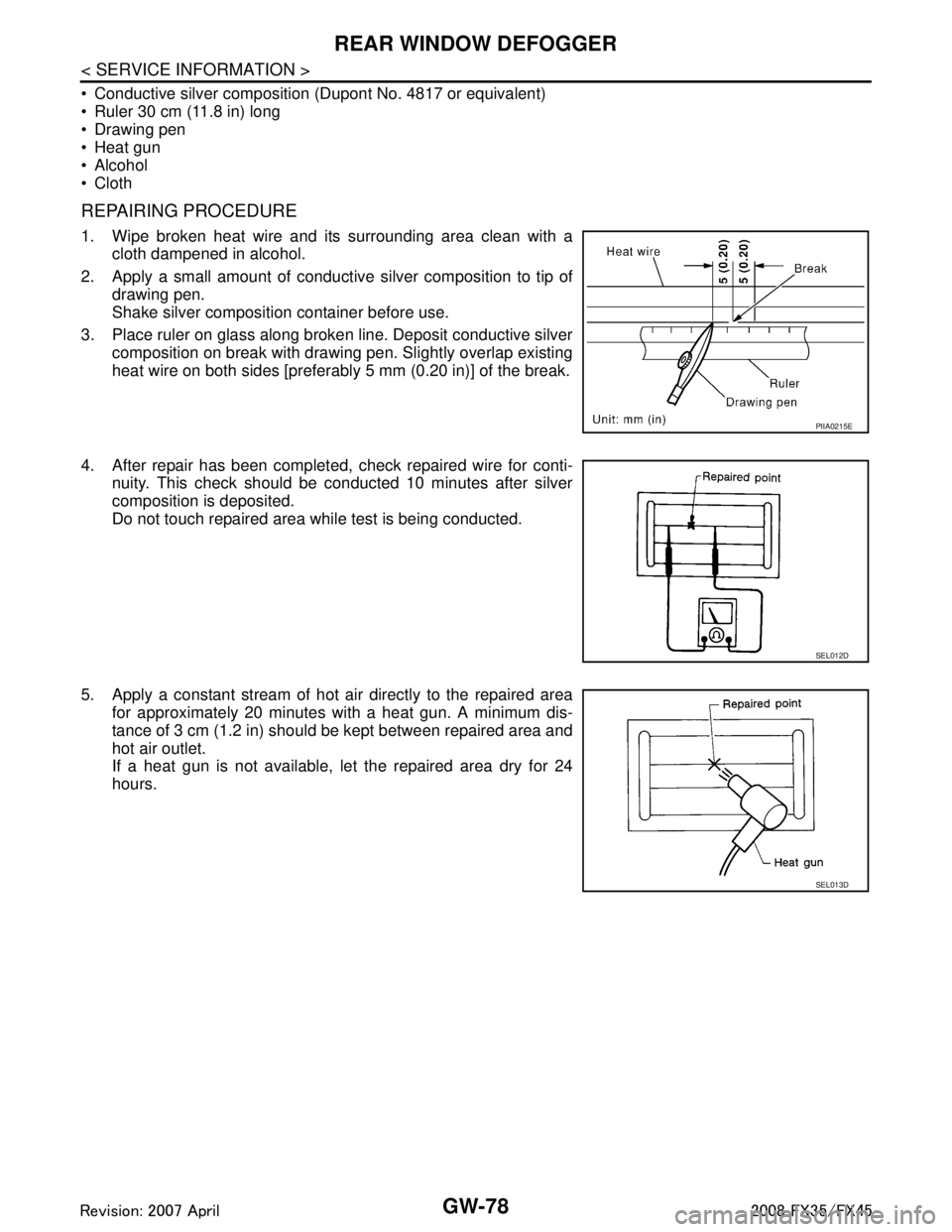
1. Wipe broken heat wire and its surrounding area clean with acloth dampened in alcohol.
2. Apply a small amount of conductive silver composition to tip of
drawing pen.
Shake silver composition container before use.
3. Place ruler on glass along broken line. Deposit conductive silver composition on break with drawing pen. Slightly overlap existing
heat wire on both sides [preferably 5 mm (0.20 in)] of the break.
4. After repair has been completed, check repaired wire for conti- nuity. This check should be conducted 10 minutes after silver
composition is deposited.
Do not touch repaired area while test is being conducted.
5. Apply a constant stream of hot air directly to the repaired area for approximately 20 minutes with a heat gun. A minimum dis-
tance of 3 cm (1.2 in) should be kept between repaired area and
hot air outlet.
If a heat gun is not available, let the repaired area dry for 24
hours.
PIIA0215E
SEL012D
SEL013D
3AA93ABC3ACD3AC03ACA3AC03AC63AC53A913A773A893A873A873A8E3A773A983AC73AC93AC03AC3
3A893A873A873A8F3A773A9D3AAF3A8A3A8C3A863A9D3AAF3A8B3A8C
![INFINITI FX35 2008 Service Manual
FRONT DOOR GLASS AND REGULATORGW-53
< SERVICE INFORMATION >
C
DE
F
G H
J
K L
M A
B
GW
N
O P
Lower the glass slightly [approx. 10 to 20 mm (0.39 to 0.79 in)] and make sure the clearance to the sash](/manual-img/42/57017/w960_57017-2965.png "INFINITI FX35 2008 Service Manual
FRONT DOOR GLASS AND REGULATORGW-53
< SERVICE INFORMATION >
C
DE
F
G H
J
K L
M A
B
GW
N
O P
Lower the glass slightly [approx. 10 to 20 mm (0.39 to 0.79 in)] and make sure the clearance to the sash")