2008 GREAT WALL FLORID battery
[x] Cancel search: batteryPage 151 of 281

Downloaded from www.Manualslib.com manuals search engine GWFLORID Maintenance Manual144
Double-colored wire: Primary color is Red, secondary color is Blue, mark\
ed as RBl.
0.5BrGr means Brown wire with a Gray fine wire, and sectional area is 0.\
5 mm2.
Areas of importance in circuit maintenance
1. Before operating any electronic devices, and when tools or maintenance devices may easily make
contact with an uncovered electronic terminal, please make sure to turn the ignition switch to the LOCK
position, and then disconnect the battery's negative cable to avoid injury or vehicle damage. When the
ignition switch is on the ON position, please do not disconnect the battery's connecting wire or take out
the power's fuse, regardless if the engine is running or not.Otherwise it would seriously damage the
ECU and related microelectronic devices such as sensors.
2. When changing the fuse, please make sure that the new fuse possesses the proper current rating,
and is not above or below this rating.
3. When repairing the wire harnesses of the airbag and pretensioner, only specified contact points,
plugs, and wires are allowed to be used.
4. Before repairing the wire harness, make sure to eliminate any factor that might cause damage,
for example, the edge of a vehicle body part is too sharp, or the used electronics are damaged or
corroded.
5. Shielded wire should not be repaired, it must be replaced entirely once it is damaged.
6. Unless it is specified during the test, please do not use an analog multimeter to test the ECU and
sensor, instead use a high-impedance digital multimeter (internal resistance should be ≥10 kΩ) or a
vehicle multimeter for inspection.
7. When inspecting the connector with a digital multimeter, take the waterproof rubber cover off the
connector, and tightly insert the test pen along the connecting terminal. Don't use too much force, as
to avoid cracking the connector.
Circuit inspection steps
The principle of troubleshooting is to confirm the "possible cause". Once the possible cause is confirmed, the
components that need to be inspected are limited to the components that are related to the possible cause. The
confirmed possible cause should be based on theory and be supported by facts, but not just by intuition. If
one tries to solve the problem but does not adopt the proper troubleshooting steps, it may make the problem
worse. Then the possible cause not only can't be confirmed, but also maintenance can't be performed properly.
Troubleshooting should adhere to the four steps below:
1. Observe the symptoms carefully, inspect if there is anything else abnormal, and record it.
2. While confirming the possible causes, study the circuit diagram carefully, and regard it as a whole
system in order to understand the circuit. Thorough knowledge of switches, relays, and other
electronic components is obligatory for proper analysis.
3. Inspect and eliminate the problems one by one until the cause is found.
4. After the malfunction is fixed, make sure to check if the inspected system is working properly, and also
check if the maintenance may have caused any new problems.
Compres-
sor relay
Reserve
Sunroof (Elite) Lamplet
Reserve
Reserve
Reserve
Reserve Door and window Reserve Blower
Lamplet
relay Flasher relay Blower high
speed relay (Elite) Door and
window relay (Comfort, Luxury) Blower relay
Reserve
Front fog lamp
Combination
meter
Interior
lighting
central
door lock
brake lamp
CD player
Reserve
Reserve
Reserve
Cigarette
lighter
Rearview
mirror
Front wiper
Charge
Airbag
Reserve
Reverse lamp Rear fog lamp
Rear wiper
Defroster Compressor
ACC relay
IG relayRear wiper
relay Defroster
relay
Front fog
lamp relay Rear fog
lamp relay
Warning lamp
Turn signal lamp
Cab No.1 fuse box
Fuse Box
Page 152 of 281
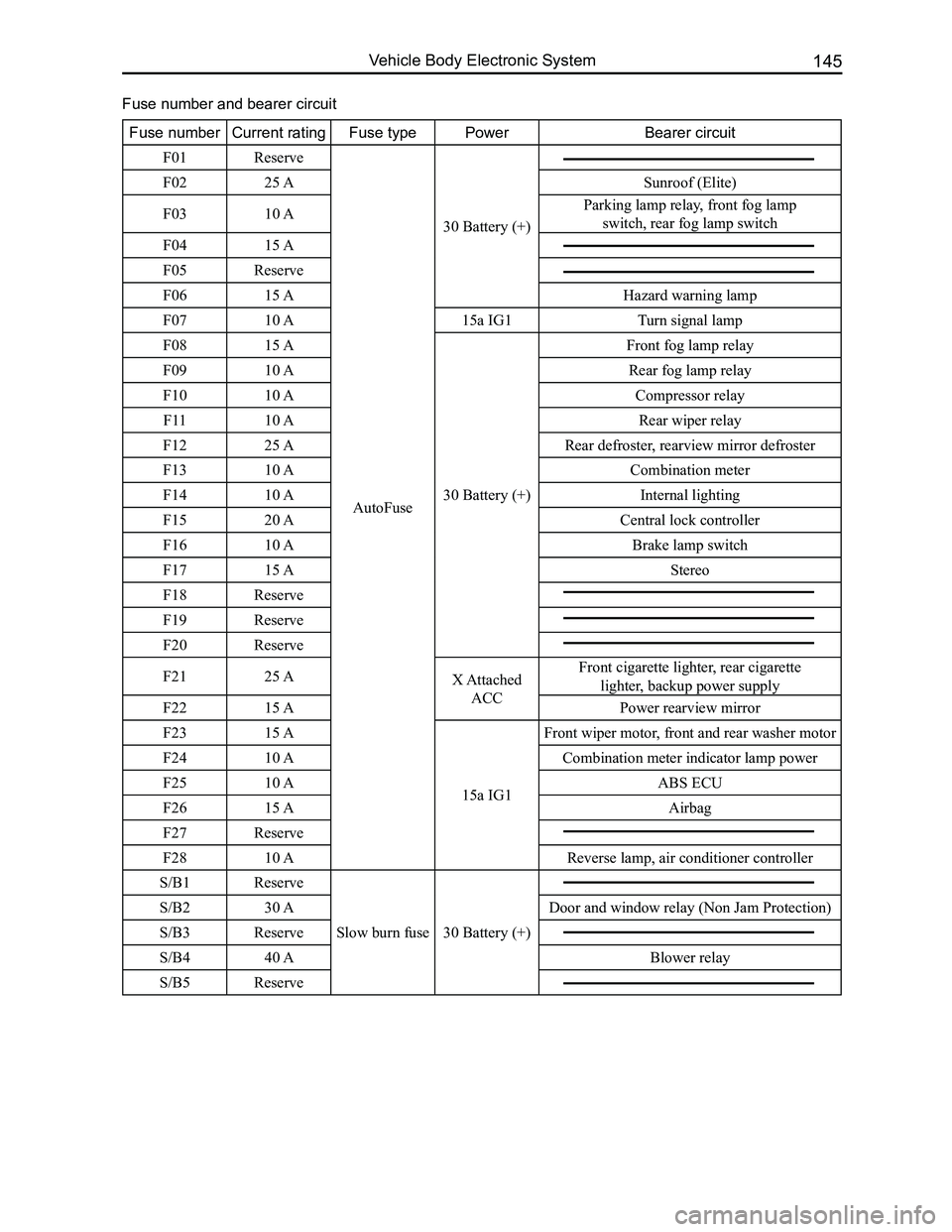
Downloaded from www.Manualslib.com manuals search engine 145Vehicle Body Electronic System
Fuse numberCurrent ratingFuse typePowerBearer circuit
F01Reserve
AutoFuse
30 Battery (+)
F0225 ASunroof (Elite)
F0310 AParking lamp relay, front fog lamp
switch, rear fog lamp switch
F0415 A
F05Reserve
F0615 AHazard warning lamp
F0710 A15a IG1 Turn signal lamp
F0815 A
30 Battery (+)
Front fog lamp relay
F0910 ARear fog lamp relay
F1010 ACompressor relay
F1110 ARear wiper relay
F1225 ARear defroster, rearview mirror defroster
F1310 ACombination meter
F1410 AInternal lighting
F1520 ACentral lock controller
F1610 ABrake lamp switch
F1715 AStereo
F18Reserve
F19Reserve
F20Reserve
F2125 AX Attached
ACC
Front cigarette lighter, rear cigarette
lighter, backup power supply
F2215 APower rearview mirror
F2315 A
15a IG1
Front wiper motor, front and rear washer motor
F2410 ACombination meter indicator lamp power
F2510 AABS ECU
F2615 AAirbag
F27Reserve
F2810 AReverse lamp, air conditioner controller
S/B1Reserve
Slow burn fuse 30 Battery (+)
S/B230 ADoor and window relay (Non Jam Protection)
S/B3Reserve
S/B440 ABlower relay
S/B5Reserve
Fuse number and bearer circuit
Page 153 of 281

Downloaded from www.Manualslib.com manuals search engine GWFLORID Maintenance Manual146
Main relay
10A backup 15A backup 25A backup
Compressor relay
Reserve
Reserve
Fuel pump
Starter relay Main
relay High
beam Low
beam
Engine ECU
Fan relay High
Starter relay High beam relay Low beam relay Reserve
Horn Reserve Reserve Fan relay Low
Fan relay Low
Fan relay High
Horn relay
Engine compartment No.2 fuse box
Fuse number and bearer circuit
Fuse numberCurrent ratingFuse typePowerBearer circuit
F2930 A
AutoFuse
30 Battery (+)
Starter relay
F3025 AMain relay
F3115 AFuel pump relay
F3230 ASlow burn fuse Low speed fan relay
F33ReserveAutoFuse
F3430 ASlow burn fuse High speed fan relay
F3515 A
AutoFuse
High & low pitched horn
F3615 AHigh beam light relay
F3715 ALow beam light relay
F3810 AEngine ECU, diagnostic port
F3925 AABS ECU
F40Reserve
F4115 AAM2
F42Reserve
F43Backup 10 A
F44Backup 15 A
F45Backup 25 A
Page 162 of 281

Downloaded from www.Manualslib.com manuals search engine 155Vehicle Body Electronic System
Condenser fan motor
Connected compressor
Oil pressure switch
Front oxygen sensor
Connected reverse switch
Connected engine speed sensor Connected
ignition coil
Connected speed sensor Connected coolant temp. sensor
Canister control valve
Connected combination meter A
Connected antenna
Diagnostic port
Connected AC switch Connected air conditioner temperature sensor
Front passenger side airbag
Connected speed adjustive resistance, blower
Front window regulator RH
Front window regulator switch RH
Front medium woofer RH
Front tweeter LH Right outer electric mirror
Front passenger side central door lock switch
Front door lamp switch RH
Front passenger seat belt pretensioner Front door lock motor RH
Ground
plate 3
Connected cigarette lighter (lighting)
Connected cigarette lighter
Front passenger seat belt switch
Connected parking brake switch Connected air conditioner governor & front
passenger seat belt unfastened indicator lamp
Connected CD player
Connected engine ECUConnected ground P1#
Connected ground P2#
Connected starter
Connected knock sensor
Connected starter field coil
Connected inlet
temperature pressure
sensor
connected
electronic throttle
Rear oxygen sensor
Connected 4th
cylinder injection
nozzle
Connected 3rd
cylinder injection
nozzle
Connected 2nd
cylinder injection
nozzle
Connected 1st
cylinder
injection nozzle
Connected generator
Connected engine armature Connected front combination lamp RH
Connected front fog lamp RH
Connected rear washer motor
Connected front washer motor
Connected front wheel speed sensor RH
Right ground
Connected A/C pressure switch
Connected phase sensor
Connected low
pitched horn
Connected front
combination lamp LH
Rediator fan motor
Connected front
fog lamp LH
Connected high pitched horn
Battery
negative
Body
ground
Battery
Left ground Connected
brake lamp
switch Connected brake fluid warning switch
Connected theft deterrent indicator Theft deterrent ECU 1Connected lock
cylinder lightConnected ignition
switch (white)
The key is inserted into the switch
Right combination switch (wiper) Connected airbag ECU (yellow)Ground
plate 2
Ground
plate 4
Connected accelerator pedal
Ground plate 1
Left outer electric mirror
Front medium woofer LH Front door lock motor LH
Rear medium woofer LH
Rear window regulator switch LH
Rear door lock motor LH Rear door lamp switch LH
Ground point ACapacitor
Vehicle power supply
Rear fog lamp LH Left license plate lamp
High mounted brake lamp
Ground point Trunk opener switch
Trunk motorRear wiper motor
Rear windshield defroster “-”
Trunk lamp switch Right license plate lamp
Rear fog lamp RH
Rear combination lamp RHRear wheel speed sensor RH
Rear window
regulator RH
Rear window
regulator switch RH
Rear door lock motor RH
Rear door lamp switch RH Rear medium woofer RH
Ground point B
Rear combination lamp LH
Rear windshield defroster “+”
Rear wheel speed
sensor LH
Rear window regulator LH
Fuel pump, fuel sensor
Rear interior dome lamp
Front door lamp
switch LH
Driver seat belt pretensioner Driver seat belt switch
Front tweeter LH
Connected light brightness regulator switch
Connected rearview mirror switch (white)
Connected glove box lamp
Front window regulator LH Left combination switch (light)
Connected main airbag, horn switch
Window regulator mainly
control switch, central door
lock mainly control switch Connected central door lock controller (white)
Connected front wiper motor
Connected clutch
switch
Connected ABS ECUBattery
positive
Connected front wheel
speed sensor LH Engine groud
Starter connect to
battery positive
Generator connect to
battery positive
Wire Harness Relationship and Plug-in Connections Numbered Diagram
Page 174 of 281

Downloaded from www.Manualslib.com manuals search engine 167Vehicle Body Electronic System
Electrical Wiring Diagram for the Overall Vehicle
Power & start-up system
Connected ABS #1
Main relay
Engine ECU 74 pin
Shift
positionPin
position Theft
deterrent
ECU 6
ABS motor 40A
Ignition switch
Starter relay
Clutch switch
Battery 12V 60Ah
Generator regulator
Ignition switch
Starter
Generator
Page 186 of 281

Downloaded from www.Manualslib.com manuals search engine 179Electrical Accessories
Functional description and display program
1. This system will be activated within the first second after engaging the reverse gear. There will be two
beeps indicating the system is working properly.
2. After the self-check, it will start its normal detection mode. The relationship between the obstacle
distance and the alarm frequency is as follows:
A Zone: When it is a long sounding alarm, the obstacle is within the distance of (0-40±4) cm.
B Zone: When the alarm frequency is an 8 Hz continuous sound, the obstacle is within the distance of
(40±4-90±4) cm.
C Zone: When the alarm frequency is a 4 Hz intermittent sound, the obstacle is within the distance of (90±4-
150±4) cm.
Areas of importance
1. When placed near a car equipped with the same system or a similar system (having been activated)
offered by other suppliers, though this system may receive interference, i\
t can still operate normally.
2. When the relative rate of travel between the obstacle and the car is lower than 1 m/s, this system will
operate as normal. When reverse speed is accelerated, the sensing accuracy of the reverse system
may decrease. A low speed of 6 km/h is suggested.
3. When it is a long sounding alarm, please stop the car at once, because there may be an obstacle
within 40cm.
4. The inductor precision level is high. It will be very difficult to return it to normal after opening the inner
portion.
5. The reflected signal may not be received due to the location, angle, size, or material of the object.
Furthermore, the reflected signal in a complex environment may not be ac\
curate.
System malfunction causes and solutions
1. A lack of power or a low supply voltage may lead to the abnormal operation of the reverse sensor
system. Under such circumstances, check whether the supply battery voltage is normal, or whether
the ignition switch connector and other connections are accurately place\
d.
2. If the power supply is on, irregular system operation may be caused by the incorrect position of the
socket. Under such circumstances, correctly re-place all the sockets.
3. A long sounding alarm from the buzzer may be caused by the inductor coming off, incorrect installa-
tion, damage to the inductor, or detecting the car or ground. Under such circumstances, please repair
or replace the sensor.
4. Incorrect indication of an obstacle's distance may be caused by abnormal battery voltage, inaccurate
socket positioning, or inductor connection damage. At this time, check whether the battery voltage
is normal, and whether the inductor connection is connected to the exhaust pipe and muffler. It is
suggested that the system be turned off and all the sockets be correctly placed.
Reverse sensor system parameters
Rated operation voltageDC 12 V
Operation voltage rangeDC (9.6-16) V
Operation temperature range-30-80 oC
Storage temperature range-40-85 oC
Power consumption< 2 W
Detect segment3 segments: 150-90-40 cm
Maximum sensing distance150±4 cm
Effective distance(15±4) cm- (150±4) cm
Detect modeUltrasonic wave
C Zone
(4 Hz intermittent sound)
40±4 cm 90±4 cm 150±4 cm
A Zone
(long alarm)
B Zone
(8 Hz continuous sound)
Page 187 of 281

Downloaded from www.Manualslib.com manuals search engine GWFLORID Maintenance Manual180
Combination Meter
If something is wrong with the meter, check the relevant component and circuit according to the connector defi-
nition. If the failure still cannot be eliminated, check whether the instrument itself has malfunctioned in the fur-
ther steps. The following diagram shows the view of the meter connector and its numb\
er.
Pin definition of each combination meter
32-core connector
Pin No.FunctionPin No.Function
1Meter ground17Signal ground
2Speed signal input18Internal lighting (+)
3Vehicle speed signal input19Airbag indicator lamp
4Fuel gauge input20Door open warning lamp
5Water temperature gauge input21Seat belt unfastened indicator lamp
6Vehicle speed signal output22Battery
7Central door lock signal23Ignition
8Clock test24High beam ( - )
9Meter interior communication25High beam (+)
10Empty26Right turn signal lamp
11ABS failure indicator27Left turn signal lamp
12Engine failure indicator28Charging indicator
13Brake system failure indicator29Engine maintenance indicator
14Oil pressure indicator30EBD indicator
15Rear fog lamp indicator31O/D switch indicator
16Parking brake indicator32Front fog lamp indicator
12-core connector
Pin No.FunctionPin No.Function
1P position7Master lighting switch indicator
2R position8Rear deforster indicator
3N position9CAN H
4D position10CAN L
52nd gear11Oil/water separator indicator
61st gear12Diesel engine preheating indicator
12-core connector32-core connector
Page 190 of 281

Downloaded from www.Manualslib.com manuals search engine 183Electrical Accessories
6. Central door lock locking output
Connected to the locking wire of the central door lock actuator, this wire will output 12 V when locking.
7. Key insert diagnostic
Connected to the detecting wire of the lock head, the electric potential of this wire will lower when a key being
inserted into the lock is detected.
8. Left turn signal lamp
Connected to the positive wire of the left turn signal lamp, this wire o\
utputs 12 V during its use.
9. Reading lamp output
Connected to the negative trigger wire of the front reading lamp, this wire uses a low electric potential output to
control the reading lamp's lighting.
10. Fastener switch lock diagnostic
Connected to the inner switch wire of the driver side door fastener, the inside switches will be connected and the
wire's electric potential will lower when the fastener is unlocked.
11. No connection
12. Power supply ON diagnostic
Connected to the ON wire of the key switch, this wire holds 12 V when the key is turned to the ON position.
13. Power supply negative pole
Wire is grounded (too long a wire can create interference sources).
14. Trunk door motor
This wire is connected to the trunk door motor and will output 12 V when the UNLOCK button of the remote
controller or the manually unlock switch is pressed.
15. Trunk door switch
This wire is connected to the trunk door switch and will connect with the power supply's negative pole when in
use.
16. Power supply positive pole
This wire is connected to the battery positive (red fire wire).
17. No connection
18. Door lamp signal
This wire is connected to the door lamp indicator of the combination meter and holds 100 mA negative output
when in use (the indicator light is on when any door is detected open)\
.
19. Manual lock signal
This wire is connected to the locking control wire of the front left door's manual switch and will pass through
the power supply's negative pole (ground) when in use.
20. Manual unlock signal
This wire is connected to the unlocking control wire of the front left door's manual switch and will pass through
the power supply's negative pole (ground) when in use.
21. Front left door switch
This wire is connected to the front left door's switch control wire and will pass through the power supply's
negative pole (ground) when in use.
22. Front right door switch
This wire is connected to the front right door's switch control wire and will pass through the power supply's
negative pole (ground) when in use.