Page 338 of 467
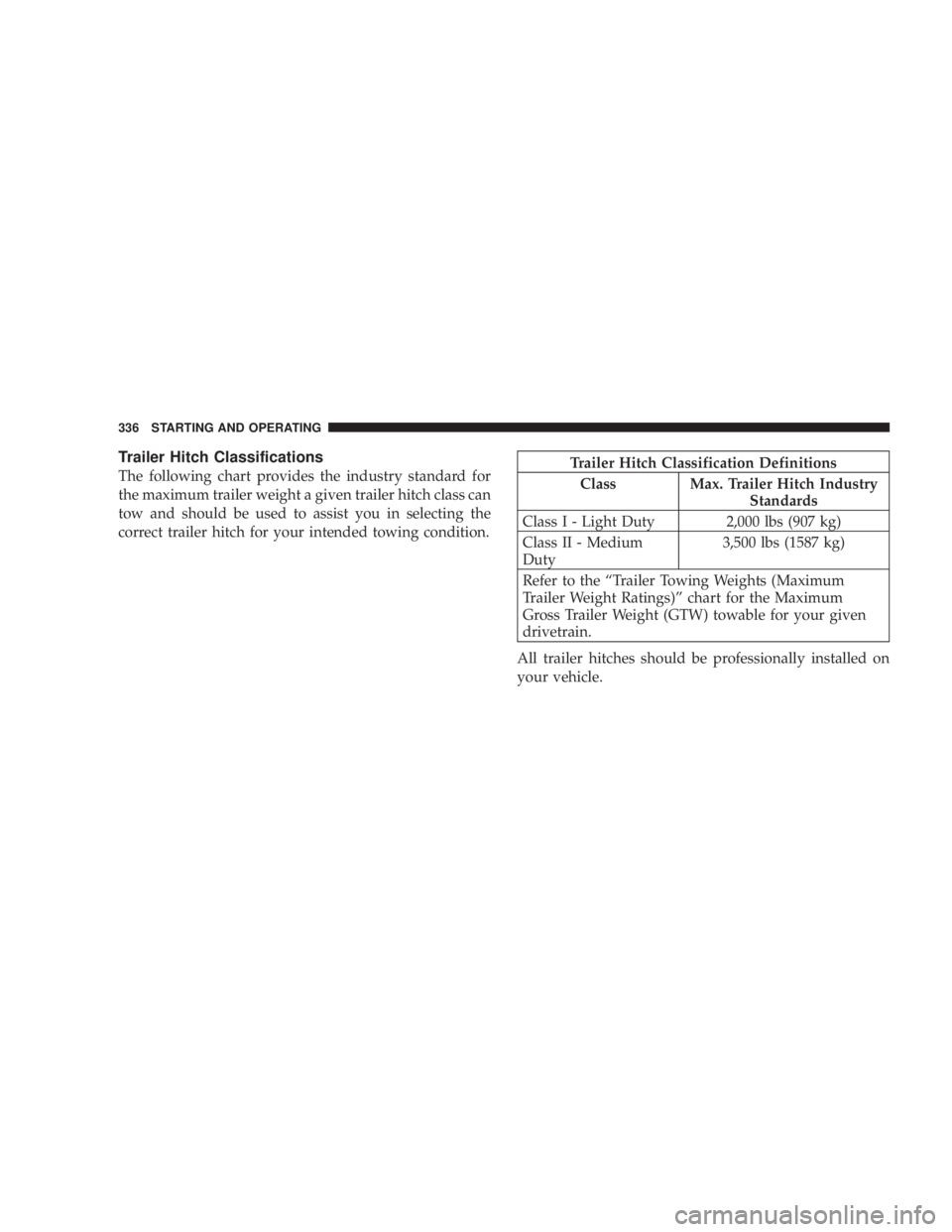
Trailer Hitch Classifications
The following chart provides the industry standard for
the maximum trailer weight a given trailer hitch class can
tow and should be used to assist you in selecting the
correct trailer hitch for your intended towing condition. Trailer Hitch Classification Definitions
Class Max. Trailer Hitch Industry
Standards
Class I - Light Duty 2,000 lbs (907 kg)
Class II - Medium
Duty 3,500 lbs (1587 kg)
Refer to the ªTrailer Towing Weights (Maximum
Trailer Weight Ratings)º chart for the Maximum
Gross Trailer Weight (GTW) towable for your given
drivetrain.
All trailer hitches should be professionally installed on
your vehicle.336 STARTING AND OPERATING
Page 344 of 467

² Trailer brakes are recommended for trailers over 1,000
lbs (450 kg) and required for trailers in excess of 2,000
lbs (907 kg).
CAUTION!If the trailer weighs more than 1,000 lbs (450 kg)
loaded, it should have its own brakes with adequate
braking capacity. Failure to do this could lead to
accelerated brake lining wear, higher brake pedal
effort, and longer stopping distances. WARNING!Do not connect trailer brakes to your vehicle's hy-
draulic brake lines. It can overload your brake sys-
tem and cause it to fail. You might not have brakes
when you need them and could have an accident.
Towing any trailer will increase your stopping dis-
tance. When towing, you should allow for additional
space between your vehicle and the vehicle in front
of you. Failure to do so could result in an accident.
Towing Requirements Ð Trailer Lights and Wiring
Whenever you pull a trailer, regardless of the trailer size,
stoplights and turn signals on the trailer are required for
motoring safety.
Use a factory approved trailer harness and connector.342 STARTING AND OPERATING
Page 345 of 467
NOTE: Do not cut or splice wiring into the vehicles
wiring harness.
The electrical connections are all complete to the vehicle,
but you must mate the harness to a trailer connector.
Towing Tips
Before setting out on a trip, practice turning, stopping,
and backing the trailer in an area located away from
heavy traffic.
Make sure all trailer and vehicle lights are working
properly Ð including hazard flashers.4-Pin Connector 7-Pin Connector STARTING AND OPERATING 343
5
Page 346 of 467

Automatic Transaxle
The DRIVE range can be selected when towing. How-
ever, if frequent shifting occurs while in this range, third
gear for a four-speed automatic and the fifth gear for a
six-speed AutoStick t should be selected.
NOTE: Using third or fifth instead of DRIVE while
operating the vehicle under heavy operating conditions,
will improve performance and extend transaxle life by
reducing excessive shifting and heat build-up. This ac-
tion will also provide better engine braking.
If you REGULARLY TOW a trailer for more than 45
minutes of continuous operation, then change the auto-
matic transaxle fluid and filter according to the interval
specified for ªpolice, taxi, fleet, or frequent trailer tow-
ingº in the ªMaintenance Scheduleº in this manual.
NOTE: Check the four-speed automatic transaxle fluid
level before towing. AutoStick t sixÐspeed transmission is sealed and the fluid level cannot be checked. See your
authorized dealership service center for assistance.
Electronic Speed Control Ð (If Equipped)
² Don't use in hilly terrain or with heavy loads.
² When using the speed control, if you experience speed
drops greater than 10 mph (16 km/h), disengage until
you can get back to cruising speed.
² Use speed control in flat terrain and with light loads to
maximize fuel efficiency.
Cooling System
To reduce potential for engine and transaxle overheating,
take the following actions:
² City Driving
When stopped for short periods of time, put transaxle in
neutral and increase engine idle speed.344 STARTING AND OPERATING
Page 358 of 467
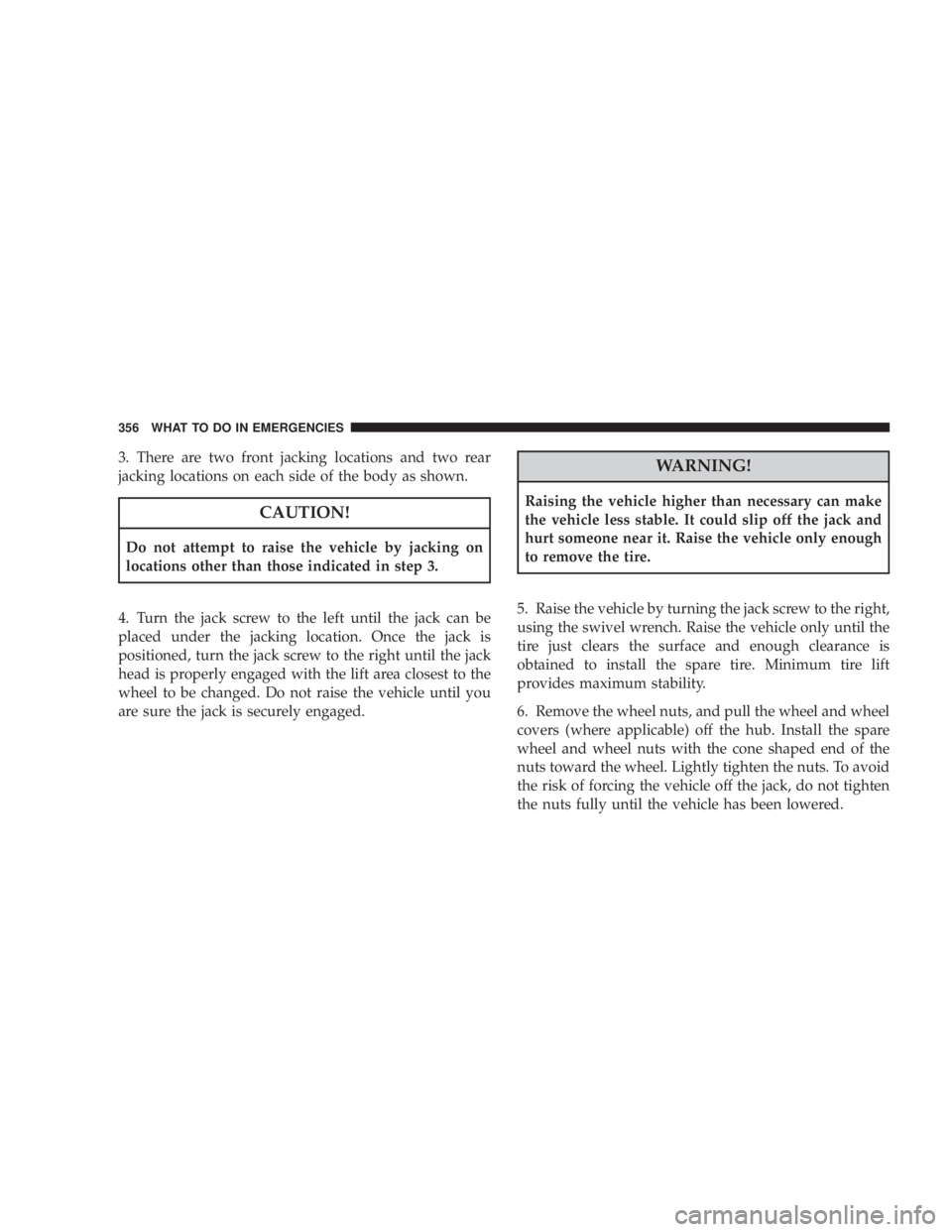
3. There are two front jacking locations and two rear
jacking locations on each side of the body as shown.
CAUTION!Do not attempt to raise the vehicle by jacking on
locations other than those indicated in step 3.
4. Turn the jack screw to the left until the jack can be
placed under the jacking location. Once the jack is
positioned, turn the jack screw to the right until the jack
head is properly engaged with the lift area closest to the
wheel to be changed. Do not raise the vehicle until you
are sure the jack is securely engaged. WARNING!Raising the vehicle higher than necessary can make
the vehicle less stable. It could slip off the jack and
hurt someone near it. Raise the vehicle only enough
to remove the tire.
5. Raise the vehicle by turning the jack screw to the right,
using the swivel wrench. Raise the vehicle only until the
tire just clears the surface and enough clearance is
obtained to install the spare tire. Minimum tire lift
provides maximum stability.
6. Remove the wheel nuts, and pull the wheel and wheel
covers (where applicable) off the hub. Install the spare
wheel and wheel nuts with the cone shaped end of the
nuts toward the wheel. Lightly tighten the nuts. To avoid
the risk of forcing the vehicle off the jack, do not tighten
the nuts fully until the vehicle has been lowered.356 WHAT TO DO IN EMERGENCIES
Page 360 of 467

11. Check the tire pressure as soon as possible. Correct
pressure as required.
JUMP-STARTING PROCEDURES DUE TO A LOW
BATTERY
Jump-starting remote battery terminals are located under
the hood.
The battery is stored between the left front headlight
assembly and the left front wheel splash shield. Access is
through the splash shield. WARNING! ² Take care to avoid the radiator cooling fan whenever the
hood is raised. It can start anytime the ignition switch is
on. You can be hurt by the fan.
² Do not attempt to push or tow your vehicle to get it
started. Vehicles equipped with an automatic transaxle
cannot be started this way. Unburned fuel could enter
the catalytic converter and once the engine has started,
ignite and damage the converter and vehicle. If the
vehicle has a discharged battery, booster cables may be
used to obtain a start from another vehicle. This type of
start can be dangerous if done improperly, so follow this
procedure carefully.
² Do not use a booster battery or any other booster source
with an output that exceeds 12 volts.
² During cold weather when temperatures are below
freezing point, electrolyte in a discharged battery may
freeze. Do not attempt jump-starting because the battery
could rupture or explode. The battery temperature must
be brought up above freezing point before attempting
jump-start.358 WHAT TO DO IN EMERGENCIES
Page 368 of 467
N A/C Air Filter Ð If Equipped ............383
N Power Steering .......................385
N Front Suspension .....................385
N Steering Linkage ......................386
N Body Lubrication .....................386
N Windshield Wiper Blades ................386
N Windshield Washers ...................387
N Exhaust System ......................387
N Cooling System .......................388
N Hoses And Vacuum/Vapor Harnesses .......394
N Fuel System .........................394
N Brake System ........................394
N Automatic Transaxle ...................397 N Front And Rear Wheel Bearings ...........400
N Appearance Care And Protection From
Corrosion ...........................400
N Cleaning Center Console Cupholders .......405
m Fuses Ð Totally Integrated Power Module
(TIPM) ..............................406
m Vehicle Storage ........................411
m Replacement Bulbs ......................411
m Bulb Replacement ......................412
N Headlight Bulb Replacement .............412
N Fog Lights ..........................415
N Taillights, Rear Turn Signals And Backup Lights Ð
Replacement .........................416
N License Plate Light Ð Rear ..............418366 MAINTAINING YOUR VEHICLE
Page 369 of 467
N Center High-Mounted Stop Light ..........418
m Fluids And Capacities ...................420 m Fluids, Lubricants, And Genuine Parts ........422
N Engine .............................422 MAINTAINING YOUR VEHICLE 367
7