Page 202 of 457

Oil Change Required
Your vehicle is equipped with an engine oil change
indicator system. The ªOil Change Requiredº message
will flash in the EVIC display for approximately 10
seconds after a single chime has sounded to indicate the
next scheduled oil change interval. The engine oil change
indicator system is duty cycle based, which means the
engine oil change interval may fluctuate dependent upon
your personal driving style.
Unless reset, this message will continue to display each
time you turn the ignition switch to the ON/RUN
position. To turn off the message temporarily, press and
release the Menu button. To reset the oil change indicator
system (after performing the scheduled maintenance)
perform the following procedure:
1. Turn the ignition switch to the ªONº position (Do not
start the engine).2. Fully depress the accelerator pedal slowly three times
within 10 seconds.
3. Turn the ignition switch to the ªLOCKº position.
NOTE:If the indicator message illuminates when you
start the vehicle, the oil change indicator system did not
reset. If necessary repeat this procedure.
NOTE:
²The oil change indicator system will not monitor the
time since the last oil change. Change the engine oil if
it has been 6 months since your last oil change even if
the oil change indicator message is NOT illuminated.
²Change the engine oil more often if you drive your
vehicle off-road for an extended period.
²Under no circumstances should oil change intervals
exceed 6,000 miles (10,000 km) or 6 months, whichever
comes first.
202 UNDERSTANDING YOUR INSTRUMENT PANEL
Page 293 of 457

Shallow Standing Water
Although your vehicle is capable of driving through
shallow standing water, consider the following before
doing so:CAUTION!
²Always check the depth of the standing water before
driving through it. Never drive through standing water that
is deeper than the bottom of the tire rims mounted on the
vehicle.
²Determine the condition of the road or the path that is
under water and if there are any obstacles in the way before
driving through the standing water.
²Do not exceed 5 mph (8 km/h) when driving through
standing water. This will minimize wave effects.
²Driving through standing water may cause damage to your
vehicle's drivetrain components. Always inspect your ve-
hicle's fluids (i.e. engine oil, transmission, axle, etc.) for
signs of contamination (i.e. fluid that is milky or foamy in
appearance) after driving through standing water. Do not
continue to operate the vehicle if any fluid appears con-
taminated, as this may result in further damage. Such
damage is not covered by the new vehicle limited warranty.
²Getting water inside your vehicle's engine can cause it to
lockup and stall out and cause serious internal damage to
the engine. Such damage is not covered by the new vehicle
limited warranty.
STARTING AND OPERATING 293
5
Page 310 of 457

WARNING!
Tires and spare tire should be replaced after six years,
regardless of the remaining tread. Failure to follow
this warning can result in sudden tire failure. You
could lose control and have an accident resulting in
serious injury or death.
Keep dismounted tires in a cool, dry place with as little
exposure to light as possible. Protect tires from contact
with oil, grease, and gasoline.
Replacement Tires
The tires on your new vehicle provide a balance of many
characteristics. They should be inspected regularly for
wear and correct cold tire inflation pressure. The manu-
facturer strongly recommends that you use tires equiva-
lent to the originals in size, quality and performance
when replacement is needed (refer to the paragraph on
ªTread Wear Indicatorsº). Refer to the ªTire and Loading
Informationº placard for the size designation of your tire.
The service description and load identification will be
found on the original equipment tire. Failure to use
equivalent replacement tires may adversely affect the
safety, handling, and ride of your vehicle. We recommend
that you contact your original equipment or an autho-
rized tire dealer with any questions you may have on tire
specifications or capability.
310 STARTING AND OPERATING
Page 339 of 457
3.8L & 4.0L Automatic with Engine Oil Cooler
Engine/TransmissionGCWR (Gross Com-
bined Wt. Rating)Frontal AreaMax. GTW (Gross
Trailer Wt.)Max. Tongue Wt.
3.8L & 4.0L Auto-
matic with Engine
Oil Cooler8,600 lbs (3 900 kg) 40 SQ. FT.Up to 2 persons &
Luggage 3,500 lbs
(1 600 kg)350 lbs (158 kg)
8,600 lbs (3 900 kg) 40 SQ. FT.3 to 4 persons &
Luggage 3,000 lbs
(1 360 kg)300 lbs (136 kg)
8,600 lbs (3 900 kg) 40 SQ. FT.5 to 6 persons &
Luggage 1,000 lbs
(454 kg)100 lbs (45 kg)
Refer to local laws for maximum trailer towing speeds.
NOTE:The trailer tongue weight must be considered as
part of the combined weight of occupants and cargo, and
should never exceed the weight referenced on the Tire
and Loading Information placard. Refer to the Tire±
Safety Information Section in this manual.
STARTING AND OPERATING 339
5
Page 340 of 457
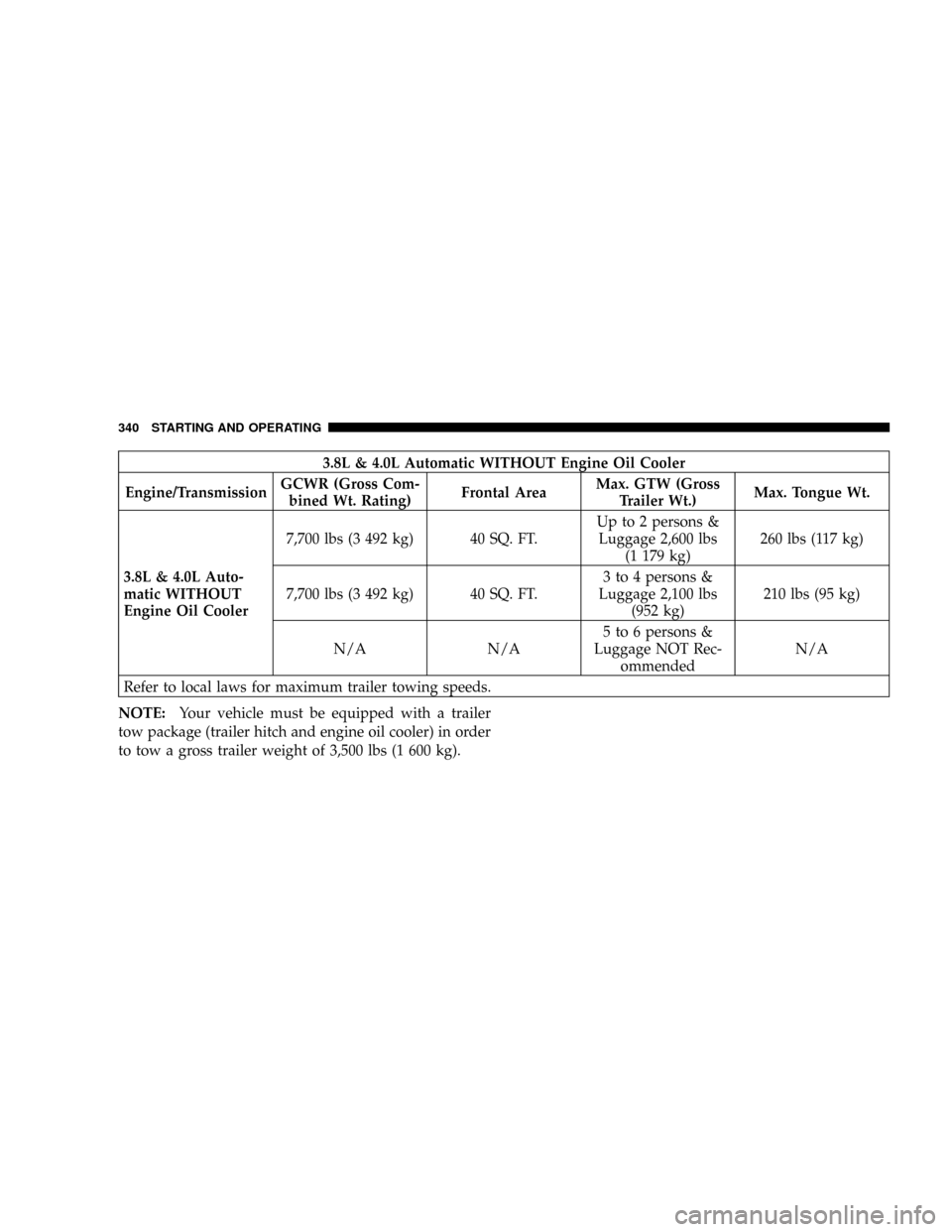
3.8L & 4.0L Automatic WITHOUT Engine Oil Cooler
Engine/TransmissionGCWR (Gross Com-
bined Wt. Rating)Frontal AreaMax. GTW (Gross
Trailer Wt.)Max. Tongue Wt.
3.8L & 4.0L Auto-
matic WITHOUT
Engine Oil Cooler7,700 lbs (3 492 kg) 40 SQ. FT.Up to 2 persons &
Luggage 2,600 lbs
(1 179 kg)260 lbs (117 kg)
7,700 lbs (3 492 kg) 40 SQ. FT.3 to 4 persons &
Luggage 2,100 lbs
(952 kg)210 lbs (95 kg)
N/A N/A5 to 6 persons &
Luggage NOT Rec-
ommendedN/A
Refer to local laws for maximum trailer towing speeds.
NOTE:Your vehicle must be equipped with a trailer
tow package (trailer hitch and engine oil cooler) in order
to tow a gross trailer weight of 3,500 lbs (1 600 kg).
340 STARTING AND OPERATING
Page 352 of 457
WARNING!
A hot engine cooling system is dangerous. You or
others could be badly burned by steam or boiling
coolant. You may want to call a service center if your
vehicle overheats. If you decide to look under the
hood yourself, see Section 7, Maintenance, of this
manual. Follow the warnings under the Cooling
System Pressure Cap paragraph.
JACKING AND TIRE CHANGING
Jack Location
Five Passenger Seating
The jack and jack-handle are stowed in the rear storage
bin located behind the second row bench seat. Pull up on
the storage bin cover to access the jack and jack tools.Remove the scissors jack and jack handle by rotating the
small wing nut to the left.
Jack Location
352 WHAT TO DO IN EMERGENCIES
Page 357 of 457
1. Remove the spare wheel, scissors jack and jack-handle
from stowage.
2. Carefully pry off the wheel center cap if equipped,
using the tip of the jack handle.
3. Loosen (but do not remove) the wheel lug nuts by
turning them to the left one turn while the wheel is still
on the ground.
NOTE:Do not oil wheel studs. For chrome wheels, do
not substitute with chrome plated wheel nuts.
4. There are two jack engagement locations on each side
of the body Ð refer to the following illustration.
5. These locations are on the sill flange on the underside
of the body. The jack is to be located, engaging the
flanges, 20 cm (8 inches) inward from the edge of the
wheel opening closest to the wheel to be changed. Place
the wrench on the jack screw and turn to the right until
the jack head is properly engaged in the described
Jack Engagement Locations
WHAT TO DO IN EMERGENCIES 357
6
Page 367 of 457
MAINTAINING YOUR VEHICLE
CONTENTS
m3.8L Engines..........................370
m4.0L Engines..........................371
mOnboard Diagnostic System Ð OBD II........372
NLoose Fuel Filler Cap Message............373
mEmissions Inspection And Maintenance
Programs............................373
mReplacement Parts......................375
mDealer Service.........................375
mMaintenance Procedures..................376NEngine Oil..........................376
NEngine Oil Filter......................379
NDrive Belt...........................379
NSpark Plugs.........................379
NEngine Air Cleaner Filter................380
NCatalytic Converter....................380
NMaintenance-Free Battery................382
NAir Conditioner Maintenance.............383
NPower Steering Ð Fluid Check............385
7