Page 289 of 457

The ABS light monitors the Anti-Lock Brake
System. The light will come on when the
ignition switch is turned to the ON position
and may stay on for as long as four seconds.
If the ABS light remains on or comes on while driving, it
indicates that the Anti-Lock portion of the brake system
is not functioning and that service is required. However,
the conventional brake system will continue to operate
normally if the BRAKE warning light is not on.
If the ABS light is on, the brake system should be serviced
as soon as possible to restore the benefits of Anti-Lock
brakes. If the ABS light does not come on when the
Ignition switch is turned to the ON position, have the
bulb repaired as soon as possible.
If both the Brake Warning Light and the ABS Light
remain on, the Anti-Lock brakes (ABS) and Electronic
Brake Force Distribution (EBD) systems are not function-
ing. Immediate repair to the ABS system is required.When the vehicle is driven over 7 mph (11 km/h), you
may also hear a slight clicking sound as well as some
related motor noises. These noises are the system per-
forming its self check cycle to ensure that the ABS system
is working properly. This self check occurs each time the
vehicle is started and accelerated past 7 mph (11 km/h).
ABS is activated during braking under certain road or
stopping conditions. ABS-inducing conditions can in-
clude ice, snow, gravel, bumps, railroad tracks, loose
debris, or panic stops.
You also may experience the following when the brake
system goes into Anti-lock:
²The ABS motor running (it may continue to run for a
short time after the stop),
²the clicking sound of solenoid valves,
²brake pedal pulsations,
STARTING AND OPERATING 289
5
Page 368 of 457

NFront & Rear Suspension Ball Joints........385
NSteering Shaft Seal....................385
NSteering Linkage......................386
NDrive Shaft Universal Joints..............386
NBody Lubrication.....................386
NWindshield Wiper Blades................387
NWindshield And Rear Window Washers.....387
NExhaust System......................388
NCooling System.......................389
NHoses And Vacuum/Vapor Harnesses.......394
NBrakes.............................394
NMaster Cylinder Ð Brake Fluid Level Check . . 396
NFuel System Hoses....................397NAutomatic Transmission................398
NAll Wheel Drive (AWD) Ð If Equipped.....400
NFront And Rear Wheel Bearings...........401
NAppearance Care And Protection From
Corrosion...........................401
NCleaning The Center Console Cup Holders . . . 406
mFuses (Integrated Power Module)...........407
mVehicle Storage........................410
mReplacement Light Bulbs.................411
mBulb Replacement......................412
NHeadlights..........................412
NHigh Intensity Discharge Headlights (HID) Ð
If Equipped.........................413
368 MAINTAINING YOUR VEHICLE
Page 374 of 457

Your vehicle has a simple ignition key actuated test,
which you can use prior to going to the test station. To
check if your vehicle's OBD system is ready, you must do
the following:
1. Insert your ignition key into the ignition switch.
2. Turn the ignition to the ON position, but do not crank
or start the engine.
3. If you crank or start the engine, you will have to start
this test over.
4. As soon as you turn your key to the ON position, you
will see your MIL symbol come on as part of a normal
bulb check.
5. Approximately 15 seconds later, one of two things will
happen:
a. The MIL will flash for about 10 seconds and then
return to being fully illuminated until you turn off theignition key or start the engine. This means that your
vehicle's OBD system isnot readyand you shouldnot
proceed to the I/M station.
b. The MIL will not flash at all and will remain fully
illuminated until you turn off the ignition key or start
the engine. This means that your vehicle's OBD system
isreadyand you can proceed to the I/M station.
If your OBD system isnot ready,you should see your
authorized dealer or repair facility. If your vehicle was
recently serviced or had a battery failure or replacement,
you may need to do nothing more than drive your
vehicle as you normally would in order for your OBD
system to update. A recheck with the above test routine
may then indicate that the system is now ready.
Regardless of whether your vehicle's OBD system is
ready or not ready, if the MIL symbol is illuminated
during normal vehicle operation, you should have your
374 MAINTAINING YOUR VEHICLE
Page 411 of 457
REPLACEMENT LIGHT BULBS
LIGHT BULBS Ð Interior Bulb Number
Center & Rear Reading Lights............... 578
Front Door Courtesy Light.................. 578
Liftgate Light(s).......................... 578
Overhead Console Reading Lights...........212±2
Visor Vanity Lights.....................V26377
NOTE:For lighted switches, see your dealer for replace-
ment instructions.
All of the interior bulbs are glass wedge base or glass
cartridge types. Aluminum base bulbs are not approved
and should not be used for replacement.LIGHT BULBS Ð Exterior Bulb Number
Back-up............................... 921
Rear Stop, Turn Signal....................3157
Rear Sidemarker.......................194NA
Fog Light.............................9145
Front Turn Signal....................3457NAK
Front Sidemarker......................194NA
Standard Headlight...................... H13
License................................ 168
MAINTAINING YOUR VEHICLE 411
7
Page 412 of 457
BULB REPLACEMENT
Headlights
1. Open hood, disconnect and isolate the battery nega-
tive cable.2. Remove the two screws securing the headlight mod-
ule to the vehicle and gently pull the headlight module
forward away from the vehicle, disengaging the assem-
bly from the lower attachment clip.
3. Disconnect the electrical connector.
4. Remove the rubber boot seal.
5. Rotate the bulb to the left and replace the bulb.
Reinstall the rubber boot seal and then the headlight
module.
CAUTION!
Do not touch the new bulb with your fingers. Oil
contamination will severely shorten bulb life. If the
bulb comes in contact with an oily surface, clean the
bulb with rubbing alcohol.
412 MAINTAINING YOUR VEHICLE
Page 413 of 457
High Intensity Discharge Headlights (HID) Ð If
Equipped
The headlights are a type of high voltage discharge tube.
High voltage can remain in the circuit even with the
headlight switch off and the key removed.Because of
this, you should not attempt to service a headlight bulb
yourself. If a headlight bulb fails, take your vehicle to
an authorized dealer for service.
WARNING!
A transient high tension occurs at the bulb sockets of
High Intensity Discharge (HID) headlights when the
headlight switch is turned ON. It may cause serious
electrical shock or electrocution if not serviced prop-
erly. See your authorized dealer for service.
NOTE:On vehicles equipped with High Intensity Dis-
charge Headlights (HID), when the headlights are turnedon there is a blue hue to the lights. This diminishes and
becomes more white after approximately 10 seconds, as
the system charges.
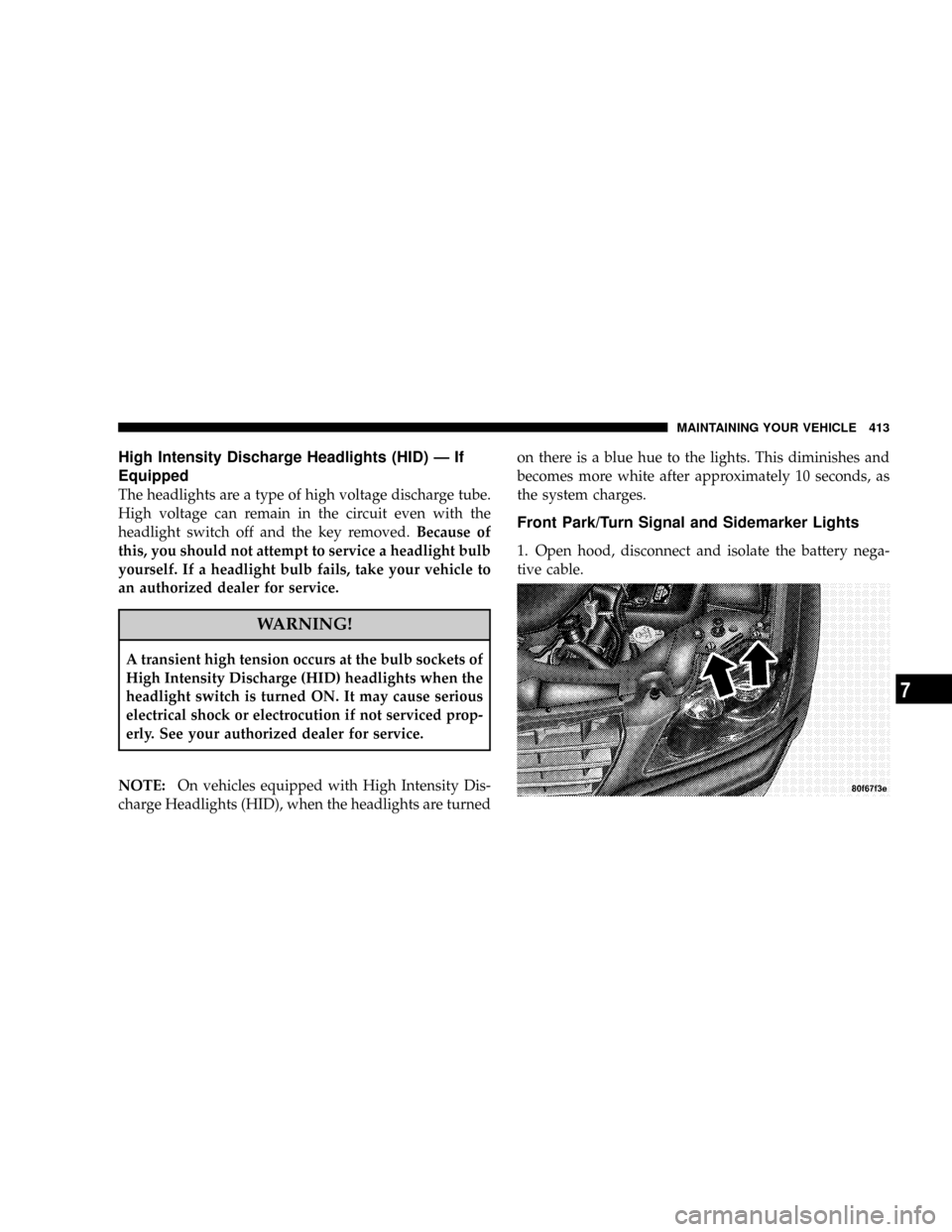
Front Park/Turn Signal and Sidemarker Lights
1. Open hood, disconnect and isolate the battery nega-
tive cable.
MAINTAINING YOUR VEHICLE 413
7
Page 414 of 457
2. Remove the two screws securing the headlight mod-
ule to the vehicle and pull the headlight module forward
away from the vehicle, disengaging the assembly from
the lower attachment clip.
3. Twist the bulb socket to remove from the headlight
module and pull the bulb from socket.
4. Replace the bulb, reinstall the socket and then reinstall
the headlight module.Front Fog Light
1. Reach under the front fascia and grasp the front fog
light bulb.
2. Twist the front fog light bulb to remove from the fog
light module.
3. Disconnect the electrical connector and replace the
bulb.
CAUTION!
Do not touch the new bulb with your fingers. Oil
contamination will severely shorten bulb life. If the
bulb comes in contact with an oily surface, clean the
bulb with rubbing alcohol.
414 MAINTAINING YOUR VEHICLE
Page 415 of 457
Rear Tail, Stop, Turn Signal, Side Marker and
Back-up Lights
1. Raise the liftgate.
2. Remove the two tail light assembly screws and rotate
the assembly outward to remove the ball stud form the
attaching grommet.3. Twist the socket assembly to remove it from the
housing.
4. Pull the bulb out of the socket.
5. Replace the bulb, reinstall the socket, and reattach the
tail light assembly.
License Light
1. Place a screwdriver in the slot next to the release tab
and push on the release tab to remove the lens.
2. Pull the bulb out of the socket. Replace the bulb and
push on the lens until it snaps into place.
MAINTAINING YOUR VEHICLE 415
7