Page 233 of 358
WHAT TO DO IN EMERGENCIES
CONTENTS
mHazard Warning Flasher..................232
mIf Your Engine Overheats.................232
mTIREFIT Tire Repair And Jacking............234
NTIREFIT............................234
NPreparations For Jacking................237
NJack Location And Instructions............239
mJump-Starting The Battery.................241mFreeing A Stuck Vehicle..................244
mTowing A Disabled Vehicle................245
NTowing Eyes.........................247
NTow-Away Alarm.....................248
mConvertible Top Emergency Operation........249
NRelieving Hydraulic Pressure.............250
NOpening a Locked Decklid...............256
6
Page 236 of 358
WARNING!
A hot cooling system is dangerous. You or others
could be badly burned by steam or boiling coolant. If
your temperature gauge pointer is in the red area,
turn OFF the engine immediately. You may want to
call an authorized dealer for service. If you decide to
look under the hood yourself, see Section 7 of this
manual. Follow the warnings under the Cooling
System Pressure Cap paragraph.
TIREFIT TIRE REPAIR AND JACKING
TIREFIT
Small punctures, particularly those in the tread, can be
sealed with TIREFIT. Foreign objects (e.g., screws or
nails) should not be removed from the tire. TIREFIT can
be used in outside temperatures down to approximately
-4ÉF (-20ÉC).1. TIREFIT sealant bottle
2. Air pump flap
3. Recess in air pump
4. Power plug and cable
5. Air pump hose with pressure gauge
6. Hose connection on sealant bottle
234 WHAT TO DO IN EMERGENCIES
Page 237 of 358

WARNING!
Cuts or punctures larger than approximately 0.16 in. (4 mm),
tire damage caused by driving with extremely low tire
pressure or on a flat tire, or a damaged wheel can pose a
hazard while driving. TIREFIT should not be used in such
circumstances. Do not drive the vehicle under such circum-
stances. Contact your nearest authorized dealer for assis-
tance.
Take care not to allow the contents of TIREFIT to come in
contact with hair, eyes or clothing. TIREFIT is harmful if
inhaled, swallowed or absorbed through the skin: It causes
skin, eye and respiratory irritation. Any contact with eyes
or skin should be flushed immediately with plenty of
water. If clothing comes in contact with TIREFIT, change
clothing as soon as possible.
In case of allergic reaction or rash, consult a physician
immediately. Keep TIREFIT out of reach of children. If
swallowed, rinse mouth immediately with plenty of water
and drink plenty of water. Do not induce vomiting! Consult
a physician immediately.
Keep away from open flame or heat source.
Sealing tire with TIREFIT
1. Set the parking brake and turn on the hazard warning
flashers.
2. Move the transmission selector lever to the PARK
position (manual transmission to FIRST or REVERSE
gear) and turn off the engine.
3. Remove the TIREFIT kit and electric air pump from
the area below the cargo compartment carpet.
4. Open flap (2) on the electric air pump.
5. Pull the power plug (4) and air hose (5) along with the
pressure gauge out of the air pump housing.
6. Screw the air hose (5) onto the hose connection on the
TIREFIT sealant bottle (1).
7. Holding the sealant bottle by the top, insert it down-
wards into the recess (3) on the air pump.
WHAT TO DO IN EMERGENCIES 235
6
Page 238 of 358

8. Unscrew the valve cap from the valve on the deflated
tire.
9. Screw the filler hose from the sealant bottle on the tire
valve.
10. Insert the power plug (4) into the power point on the
instrument panel.
11. Turn the ignition key to the ON/RUN position.
12. Press the switch on the air pump to 1. The air pump
should start to inflate the tire.
13. After five minutes, the tire should be inflated to at
least 26 psi (180 kPa) on the pressure gauge.
14. If the tire doesn't inflate to this level, press the air
pump switch to 0, disconnect the TIREFIT system from
the tire, and drive the vehicle back and forth approxi-
mately 30 feet (9 m) to distribute the sealant more evenly
within the tire.15. Attach the air pump hose directly to the tire, press the
switch to 1, and inflate the tire again.NOTE:If a tire
pressure of 26 psi (180 kPa) is not reached after five
minutes, the tire is too badly damaged. Do not attempt to
drive the vehicle further, and call for assistance.
16. If a tire pressure of 26 psi (180 kPa) is obtained, press
the air pump switch to 0, turn the ignition switch to the
OFF/LOCK position, and disconnect the TIREFIT sys-
tem.
17. Drive the vehicle for about 10 minutes to ensure
optimum distribution of the tire sealant within the tire.
18. Check the pressure in the tire. If the pressure is above
19 psi (130 kPa), inflate the tire to the pressure indicated
on the tire pressure label on the driver side latch pillar.
19. Have the tire inspected at the earliest opportunity at
an authorized dealer or tire service center.
236 WHAT TO DO IN EMERGENCIES
Page 239 of 358

NOTE:Do not exceed 50 mph (80 km/h) until the tire
has been inspected.
NOTE:If a pressure of at least 19 psi (130 kPa) cannot be
maintained in the tire, the tire is too badly damaged. Do
not attempt to drive the vehicle further, and call for
assistance.
NOTE:Do not operate the electric air pump for more
than eight minutes to avoid overheating. The air pump
may be used again once it has cooled down.
NOTE:Replace the TIREFIT sealant bottle once every
four years to assure optimum operation of the system.
NOTE:If TIREFIT is liquid, clean water and a damp
cloth will remove the material from the vehicle or tire and
wheel components. Once TIREFIT sealing material has
dried, it can easily be peeled off and properly discarded.Preparations for Jacking
WARNING!
Getting under a jacked-up vehicle is dangerous. The
vehicle could slip off the jack and fall on you. You
could be crushed. Never get any part of your body
under a vehicle that is on a jack. Never start or run
the engine while the vehicle is on a jack. If you need
to get under a raised vehicle, take it to a service
facility where it can be raised on a lift.
WARNING!
Do not attempt to repair a tire on the side of the
vehicle close to traffic. Pull far enough off the road to
avoid the danger of being hit when operating the
jack or repairing a tire.
WHAT TO DO IN EMERGENCIES 237
6
Page 243 of 358
parked on an incline. Raise the vehicle only until the tire
just clears the surface. Minimum tire lift provides maxi-
mum stability.
4. Replace the tire.
5. Lower the vehicle by cranking the handle counter-
clockwise, then remove the jack assembly.
NOTE:Before storing the jack, it should be fully col-
lapsed.
6. Ensure proper tire pressure.
WARNING!
Raising the vehicle higher than necessary can make
the vehicle less stable. It could slip off the jack and
hurt someone near it. Raise the vehicle only enough
to make the necessary repair.
WARNING!
A loose jack or tool thrown forward in a collision or
hard stop could endanger the occupants of the ve-
hicle. Always stow the jack parts and tools in the
places provided.
JUMP-STARTING THE BATTERY
WARNING!
Take care to avoid the radiator cooling fan whenever
the hood is raised. It can start any time the ignition
switch is ON. You can be hurt by the fan.
WHAT TO DO IN EMERGENCIES 241
6
Page 282 of 358

Cooling System
WARNING!
²When working near the radiator cooling fan, dis-
connect the fan motor lead or turn the ignition
switch to the OFF position. The fan is temperature
controlled and can start at any time the ignition
key is in the ON position.
²You or others can be badly burned by hot coolant
or steam from your radiator. If you see or hear
steam coming from under the hood, don't open the
hood until the radiator has had time to cool. Never
try to open a cooling system pressure cap when the
radiator is hot.
Coolant Checks
Check coolant protection every 12 months (before the
onset of freezing weather, where applicable). If the cool-
ant is dirty or rusty in appearance, the system should be
drained, flushed and refilled with fresh coolant.
Check the front of the radiator and condenser for an
accumulation of bugs, leaves, etc. Clean the radiator and
condenser by gently spraying water from a garden hose
at the back of the radiator core.
Check the recovery bottle tank tubing for condition and
tightness of connection at the bottle and radiator. Inspect
the entire system for leaks.
280 MAINTAINING YOUR VEHICLE
Page 301 of 358
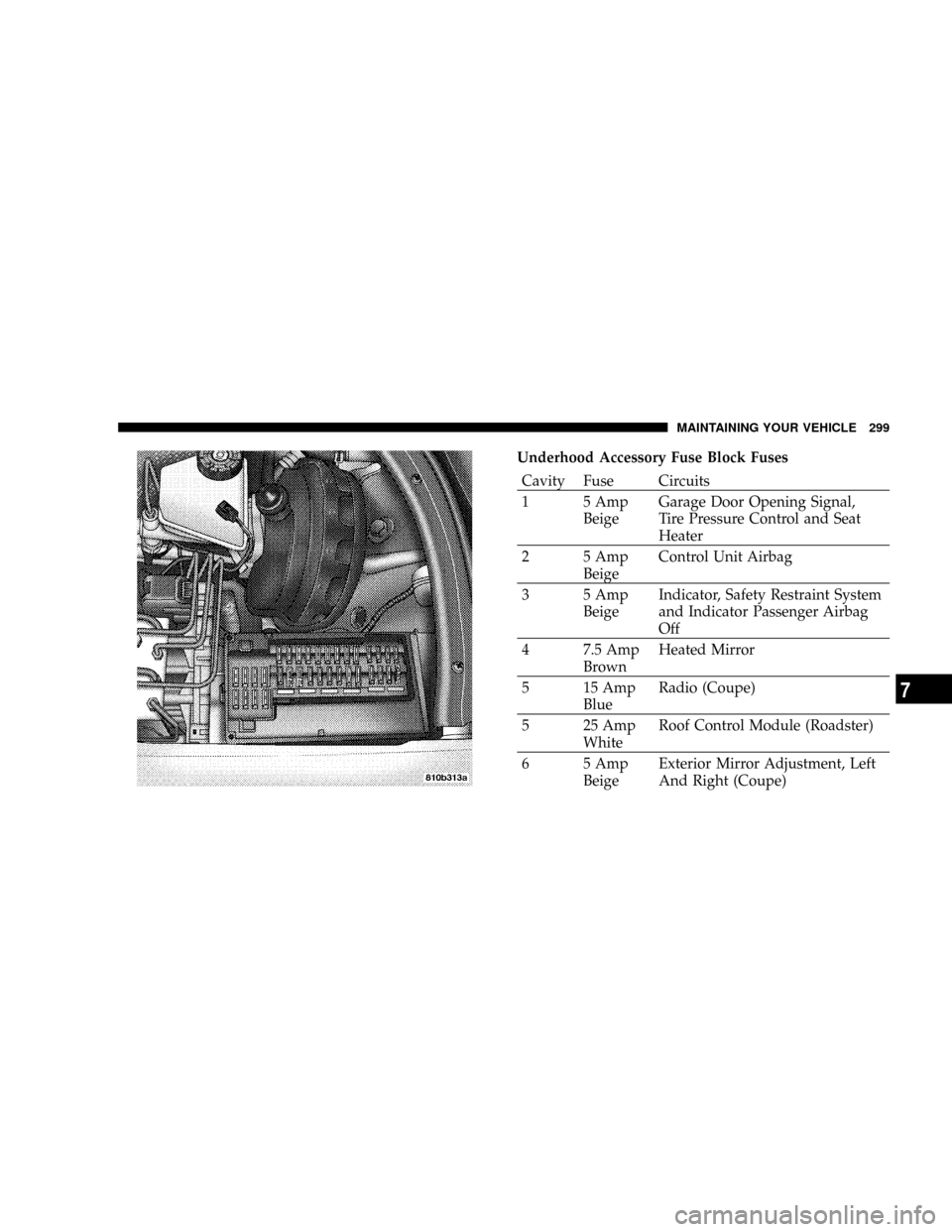
Underhood Accessory Fuse Block Fuses
Cavity Fuse Circuits
1 5 Amp
BeigeGarage Door Opening Signal,
Tire Pressure Control and Seat
Heater
2 5 Amp
BeigeControl Unit Airbag
3 5 Amp
BeigeIndicator, Safety Restraint System
and Indicator Passenger Airbag
Off
4 7.5 Amp
BrownHeated Mirror
5 15 Amp
BlueRadio (Coupe)
5 25 Amp
WhiteRoof Control Module (Roadster)
6 5 Amp
BeigeExterior Mirror Adjustment, Left
And Right (Coupe)
MAINTAINING YOUR VEHICLE 299
7