2008 CHEVROLET MALIBU ECU
[x] Cancel search: ECUPage 243 of 412
Dolly Towing
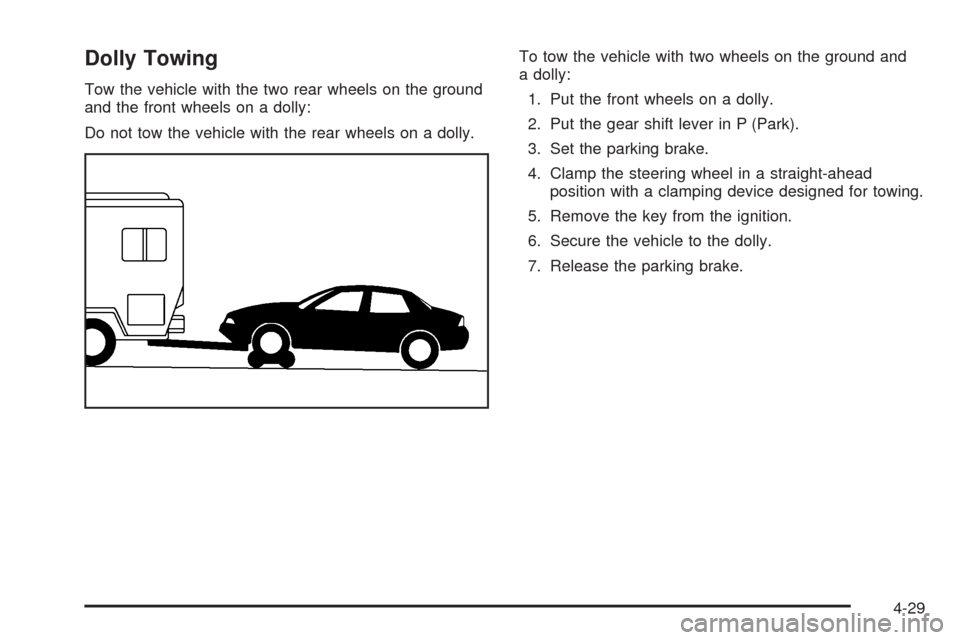
Tow the vehicle with the two rear wheels on the ground
and the front wheels on a dolly:
Do not tow the vehicle with the rear wheels on a dolly.To tow the vehicle with two wheels on the ground and
a dolly:
1. Put the front wheels on a dolly.
2. Put the gear shift lever in P (Park).
3. Set the parking brake.
4. Clamp the steering wheel in a straight-ahead
position with a clamping device designed for towing.
5. Remove the key from the ignition.
6. Secure the vehicle to the dolly.
7. Release the parking brake.
4-29
Page 248 of 412
Before you start, check the trailer hitch and platform
(and attachments), safety chains, electrical connector,
lamps, tires and mirror adjustment. If the trailer has
electric brakes, start your vehicle and trailer moving and
then apply the trailer brake controller by hand to be
sure the brakes are working. This lets you check your
electrical connection at the same time.
During your trip, check occasionally to be sure that the
load is secure, and that the lamps and any trailer
brakes are still working.
Following Distance
Stay at least twice as far behind the vehicle ahead as
you would when driving your vehicle without a trailer.
This can help you avoid situations that require
heavy braking and sudden turns.
Passing
You’ll need more passing distance up ahead when
you’re towing a trailer. And, because you’re a good deal
longer when towing a trailer, you’ll need to go much
farther beyond the passed vehicle before you can return
to your lane.
Backing Up
Hold the bottom of the steering wheel with one hand.
Then, to move the trailer to the left, just move that hand
to the left. To move the trailer to the right, move your
hand to the right. Always back up slowly and, if possible,
have someone guide you.
Making Turns
Notice:Making very sharp turns while trailering
could cause the trailer to come in contact with the
vehicle. Your vehicle could be damaged. Avoid
making very sharp turns while trailering.
When you’re turning with a trailer, make wider turns than
normal. Do this so your trailer won’t strike soft shoulders,
curbs, road signs, trees or other objects. Avoid jerky or
sudden maneuvers. Signal well in advance.
Turn Signals When Towing a Trailer
When you tow a trailer, your vehicle may need a
different turn signal asher and/or extra wiring. See your
retailer if you need information. The arrows on your
instrument panel will ash whenever you signal a turn or
lane change. Properly hooked up, the trailer lamps will
also ash, telling other drivers you’re about to turn,
change lanes or stop.
4-34
Page 250 of 412
When You Are Ready to Leave After
Parking on a Hill
1. Apply your regular brakes and hold the pedal down
while you:
start your engine
shift into a gear, and
release the parking brake.
2. Let up on the brake pedal.
3. Drive slowly until the trailer is clear of the chocks.
4. Stop and have someone pick up and store the
chocks.
Maintenance When Trailer Towing
Your vehicle will need service more often when you’re
pulling a trailer. SeeScheduled Maintenance on
page 6-4for more information. Things that are especiallyimportant in trailer operation are automatic transmission
uid (don’t overll), engine oil, axle lubricant, drive
belt, cooling system and brake system. Each of these is
covered in this manual, and the Index will help you
nd them quickly. If you’re trailering, it’s a good idea to
review this information before you start your trip.
Check periodically to see that all hitch nuts and bolts
are tight.
Engine Cooling When Trailer Towing
Your cooling system may temporarily overheat during
severe operating conditions. SeeEngine Overheating on
page 5-29.
Changing a Tire When Trailer Towing
If you get a at tire while towing a trailer, be sure
to secure the trailer and disconnect it from the vehicle
before changing the tire.
4-36
Page 279 of 412
{CAUTION:
You can be burned if you spill coolant on hot
engine parts. Coolant contains ethylene glycol,
and it will burn if the engine parts are hot
enough. Do not spill coolant on a hot engine.
When replacing the pressure cap, make sure it is
hand-tight and fully seated.
Pressure Cap
Notice:If the pressure cap is not tightly installed,
coolant loss and possible engine damage may
occur. Be sure the cap is properly and tightly
secured.
SeeEngine Compartment Overview on page 5-14for
more information on location.
Coolant Surge Tank Pressure Cap
Notice:If the pressure cap is not tightly installed,
coolant loss and possible engine damage may
occur. Be sure the cap is properly and tightly
secured.
The coolant surge tank pressure cap must be fully
installed on the coolant surge tank. SeeEngine
Compartment Overview on page 5-14for more
information on location.
Engine Overheating
You will nd an engine coolant temperature gage as
well as an engine coolant temperature warning light on
your vehicle’s instrument panel cluster. SeeEngine
Coolant Temperature Gage on page 3-40andEngine
Coolant Temperature Warning Light on page 3-40.
5-29
Page 326 of 412
Tire Chains
{CAUTION:
If your vehicle has P215/60R16, P225/50R17, or
P225/50R18 size tires, do not use tire chains.
There is not enough clearance.
Tire chains used on a vehicle without the
proper amount of clearance can cause damage
to the brakes, suspension, or other vehicle
parts. The area damaged by the tire chains
could cause you to lose control of your vehicle
and you or others may be injured in a crash.
Use another type of traction device only if its
manufacturer recommends it for use on your
vehicle and tire size combination and road
conditions. Follow that manufacturer’s
CAUTION: (Continued)
CAUTION: (Continued)
instructions. To help avoid damage to your
vehicle, drive slowly, readjust or remove the
device if it is contacting your vehicle, and do
not spin your vehicle’s wheels.
If you do nd traction devices that will t,
install them on the front tires.
Notice:If your vehicle has P205/65R15 size tires,
use tire chains only where legal and only when you
must. Use only SAE Class S-type chains that are the
proper size for your tires. Install them on the front
tires and tighten them as tightly as possible with the
ends securely fastened. Drive slowly and follow the
chain manufacturer’s instructions. If you can hear the
chains contacting your vehicle, stop and retighten
them. If the contact continues, slow down until it
stops. Driving too fast or spinning the wheels with
chains on will damage your vehicle.
5-76
Page 338 of 412
3. Place the jack over the bolt on the oor, making
sure in contacts the bolt and thread the jack
retainer nut until in contacts the jack.
4. With the valve stem up, place the tire on the
compartment oor with the rear of the tire beneath
the trim panel (tire may not lay completely at).
5. Line up the center hole of the wheel with the bolt.
6. With the yellow cap in place to prevent the
wheel from being scratched, screw the bolt
extension onto the bolt through the wheel nut hole.
7. Remove the yellow cap from the bolt extension.
8. Secure the tire and wheel with the larger wing nut.
The compact spare is for temporary use only. Replace
the compact spare tire with a full-size tire as soon
as you can.Compact Spare Tire on page 5-88.
See the storage instructions label to replace your
compact into your trunk properly.
Compact Spare Tire
Although the compact spare tire was fully inated
when the vehicle was new, it can lose air after a time.
Check the ination pressure regularly. It should be
60 psi (420 kPa).After installing the compact spare on the vehicle, stop
as soon as possible and make sure the spare tire is
correctly inated. The compact spare is made to perform
well at speeds up to 65 mph (105 km/h) for distances up
to 3,000 miles (5 000 km), so you can nish your trip
and have the full-size tire repaired or replaced at your
convenience. Of course, it is best to replace the spare
with a full-size tire as soon as possible. The spare tire
will last longer and be in good shape in case it is needed
again.
Notice:When the compact spare is installed,
do not take your vehicle through an automatic
car wash with guide rails. The compact spare can
get caught on the rails. That can damage the tire
and wheel, and maybe other parts of your vehicle.
Do not use the compact spare on other vehicles.
And do not mix the compact spare tire or wheel with
other wheels or tires. They will not t. Keep the
spare tire and its wheel together.
Notice:Tire chains will not t your compact spare.
Using them can damage your vehicle and can
damage the chains too. Do not use tire chains
on your compact spare.
5-88
Page 369 of 412
At Least Once a Month
Tire Ination Check
Inspect the vehicle’s tires and make sure they are
inated to the correct pressures. Do not forget to
check the spare tire. SeeInflation - Tire Pressure on
page 5-60. Check to make sure the spare tire is stored
securely. SeeChanging a Flat Tire on page 5-78.
Tire Wear Inspection
Tire rotation may be required for high mileage highway
drivers prior to the Engine Oil Life System service
notication. Check the tires for wear and, if necessary,
rotate the tires. SeeTire Inspection and Rotation on
page 5-67.
At Least Once a Year
Starter Switch Check
{CAUTION:
When you are doing this inspection, the
vehicle could move suddenly. If the vehicle
moves, you or others could be injured.
1. Before you start, be sure you have enough room
around the vehicle.
2. Firmly apply both the parking brake and the regular
brake. SeeParking Brake on page 2-34.
Do not use the accelerator pedal, and be ready to
turn off the engine immediately if it starts.
3. Try to start the engine in each gear. The vehicle
should start only in PARK (P) or NEUTRAL (N).
If the vehicle starts in any other position, contact
your dealer/retailer for service.
6-9
Page 386 of 412
Who is Covered?
Roadside Assistance coverage is for the vehicle
operator, regardless of ownership. In Canada, a person
driving this vehicle without the consent of the owner
is not eligible for coverage.
Services Provided
The following services are provided in the U.S. and
Canada up to 5 years/100,000 miles (160 000 km),
whichever occurs rst, and, in Canada only, up
to a maximum coverage of $100.
Fuel Delivery:Delivery of enough fuel for the
vehicle to get to the nearest service station
(approximately $5 in Canada). In Canada, service
to provide diesel may be restricted. For safety
reasons, propane and other alternative fuels will
not be provided through this service.
Lock-out Service:Lock-out service will be covered
at no charge if you are unable to gain entry into your
vehicle. A remote unlock may be available if you
have an active OnStar
®subscription. To ensure
security, the driver must present personal
identication before lock-out service is provided.
In Canada, the vehicle registration is also required.
Emergency Tow From a Public Roadway or
Highway:Tow to the nearest dealership for warranty
service or in the event of a vehicle-disabling crash.
Winch-out assistance is provided when the vehicle is
mired in sand, mud, or snow.
Flat Tire Change:Installation of a spare tire in good
condition, when equipped and properly inated, is
covered at no charge. The customer is responsible
for the repair or replacement of the tire if not covered
by a warrantable failure.
Jump Start:A battery jump start is covered at no
charge if the vehicle does not start.
Trip Routing Service (Canada only):Upon request,
Roadside Assistance will send you detailed,
computer personalized maps, highlighting your
choice of either the most direct route or the most
scenic route to your destination, anywhere in North
America, along with helpful travel information
pertaining to your trip.
Please allow three weeks before your planned
departure date. Trip routing requests will be limited to
six per calendar year.
7-8