2008 CHEVROLET MALIBU ECU
[x] Cancel search: ECUPage 51 of 412
Notice:Do not let the LATCH attachments rub
against the vehicle’s safety belts. This may damage
these parts. If necessary, move buckled safety
belts to avoid rubbing the LATCH attachments.
Do not fold the empty rear seat with a safety belt
buckled. This could damage the safety belt or
the seat. Unbuckle and return the safety belt to its
stowed position.
If you need to secure more than one child restraint in
the rear seat, seeWhere to Put the Restraint on
page 1-40. Depending on where you place the child
restraint, you may not be able to access certain safety
belt assemblies or LATCH anchors for additional
passengers or child restraints.
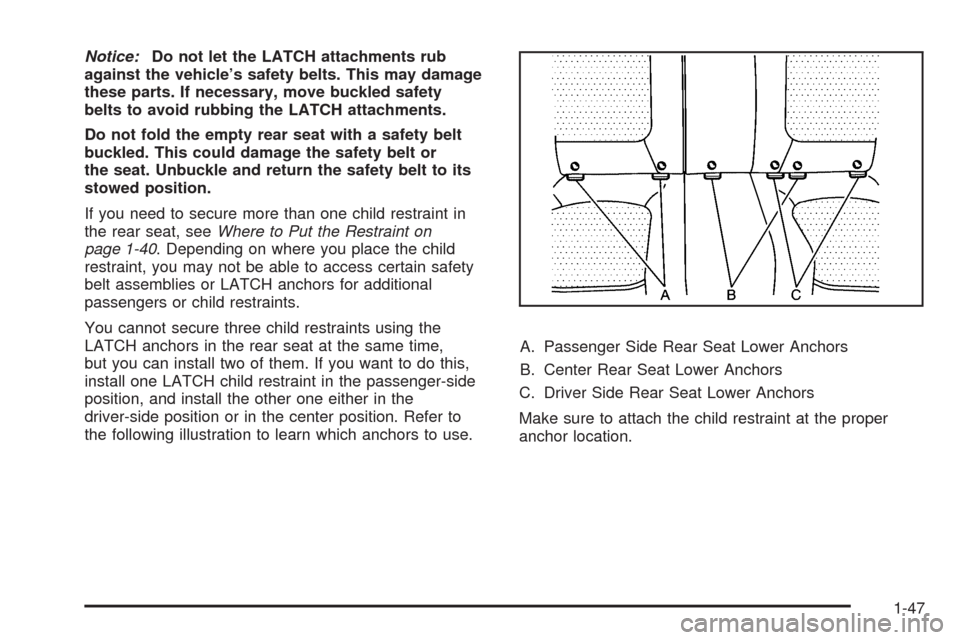
You cannot secure three child restraints using the
LATCH anchors in the rear seat at the same time,
but you can install two of them. If you want to do this,
install one LATCH child restraint in the passenger-side
position, and install the other one either in the
driver-side position or in the center position. Refer to
the following illustration to learn which anchors to use.A. Passenger Side Rear Seat Lower Anchors
B. Center Rear Seat Lower Anchors
C. Driver Side Rear Seat Lower Anchors
Make sure to attach the child restraint at the proper
anchor location.
1-47
Page 52 of 412
This system is designed to make installation of child
restraints easier. When using lower anchors, do not use
the vehicle’s safety belts. Instead use the vehicle’s
anchors and child restraint attachments to secure the
restraints. Some restraints also use another vehicle
anchor to secure a top tether.
1. Attach and tighten the lower attachments to the
lower anchors. If the child restraint does not have
lower attachments or the desired seating position
does not have lower anchors, secure the child
restraint with the top tether and the safety belts.
Refer to your child restraint manufacturer
instructions and the instructions in this manual.
1.1. Find the lower anchors for the desired
seating position.
1.2. Put the child restraint on the seat.
1.3. Attach and tighten the lower attachments on
the child restraint to the lower anchors.2. If the child restraint manufacturer recommends that
the top tether be attached, attach and tighten the
top tether to the top tether anchor, if equipped.
Refer to the child restraint instructions and
the following steps:
2.1. Find the top tether anchor.
Open the cover to expose the anchor.
2.2. If the position you are using has an
adjustable headrest or head restraint, raise it.
SeeHead Restraints on page 1-7.
2.3. Route, attach, and tighten the top tether
according to the child restraint instructions
and the following instructions:
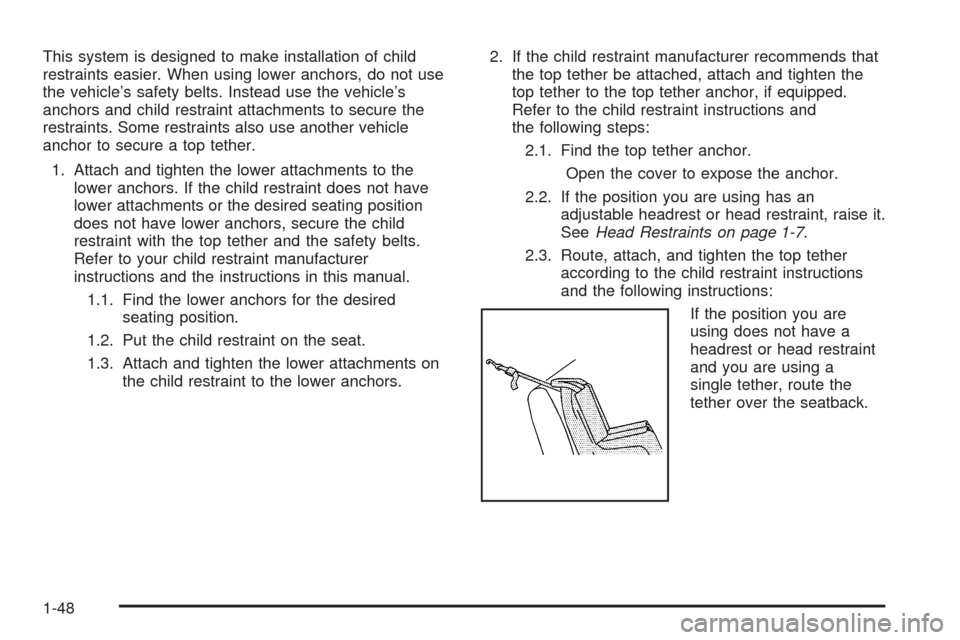
If the position you are
using does not have a
headrest or head restraint
and you are using a
single tether, route the
tether over the seatback.
1-48
Page 53 of 412
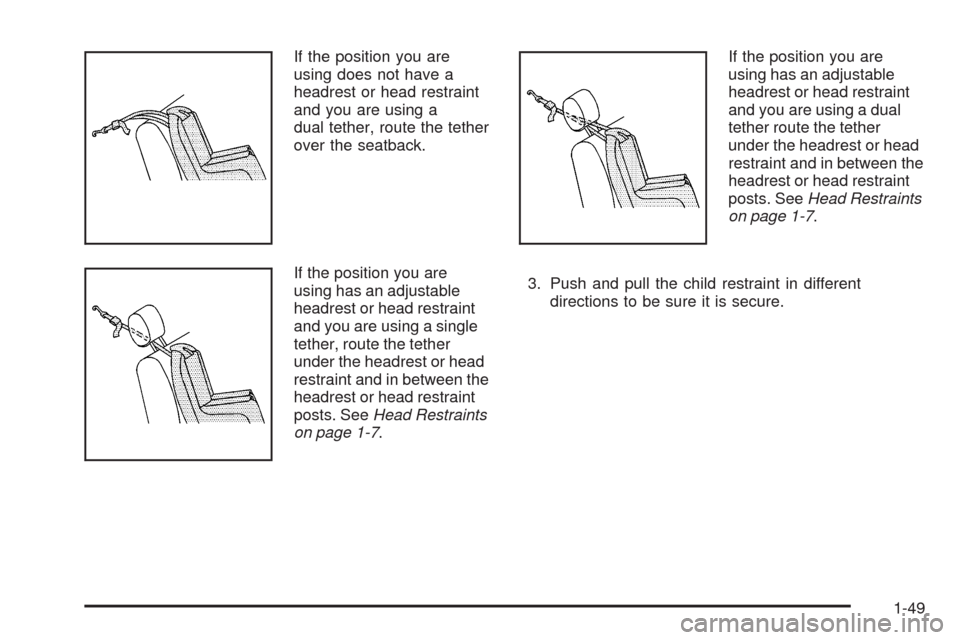
If the position you are
using does not have a
headrest or head restraint
and you are using a
dual tether, route the tether
over the seatback.
If the position you are
using has an adjustable
headrest or head restraint
and you are using a single
tether, route the tether
under the headrest or head
restraint and in between the
headrest or head restraint
posts. SeeHead Restraints
on page 1-7.If the position you are
using has an adjustable
headrest or head restraint
and you are using a dual
tether route the tether
under the headrest or head
restraint and in between the
headrest or head restraint
posts. SeeHead Restraints
on page 1-7.
3. Push and pull the child restraint in different
directions to be sure it is secure.
1-49
Page 54 of 412
Securing a Child Restraint in a Rear
Seat Position
When securing a child restraint in a rear seating
position, study the instructions that came with the child
restraint to make sure it is compatible with this vehicle.
If the child restraint has the LATCH system, see
Lower Anchors and Tethers for Children (LATCH) on
page 1-42for how and where to install the child restraint
using LATCH. If a child restraint is secured in the
vehicle using a safety belt and it uses a top tether,
seeLower Anchors and Tethers for Children (LATCH)
on page 1-42for top tether anchor locations.
Do not secure a child seat in a position without a top
tether anchor if a national or local law requires that
the top tether be anchored, or if the instructions
that come with the child restraint say that the top strap
must be anchored.
In Canada, the law requires that forward-facing child
restraints have a top tether, and that the tether be
attached.
If the child restraint does not have the LATCH system,
you will be using the safety belt to secure the child
restraint in this position. Be sure to follow the instructions
that came with the child restraint. Secure the child in the
child restraint when and as the instructions say.If more than one child restraint needs to be installed in
the rear seat, be sure to readWhere to Put the
Restraint on page 1-40.
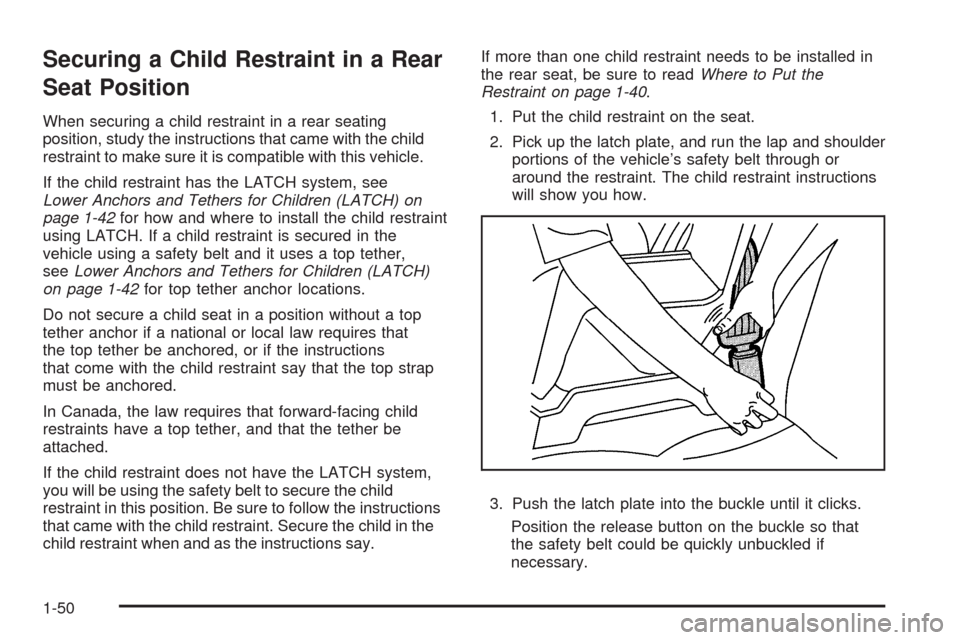
1. Put the child restraint on the seat.
2. Pick up the latch plate, and run the lap and shoulder
portions of the vehicle’s safety belt through or
around the restraint. The child restraint instructions
will show you how.
3. Push the latch plate into the buckle until it clicks.
Position the release button on the buckle so that
the safety belt could be quickly unbuckled if
necessary.
1-50
Page 56 of 412
6. If the child restraint has a top tether, follow the child
restraint manufacturer’s instructions regarding the
use of the top tether. SeeLower Anchors and
Tethers for Children (LATCH) on page 1-42for
more information.
7. Push and pull the child restraint in different
directions to be sure it is secure.
To remove the child restraint, unbuckle the vehicle
safety belt and let it return to the stowed position. If the
top tether is attached to a top tether anchor, disconnect it.
Securing a Child Restraint in the
Right Front Seat Position
Your vehicle has airbags. A rear seat is a safer place to
secure a forward-facing child restraint. SeeWhere to
Put the Restraint on page 1-40.
In addition, your vehicle has a passenger sensing
system which is designed to turn off the right front
passenger’s frontal airbag and seat-mounted side impact
airbag under certain conditions. SeePassenger
Sensing System on page 1-65andPassenger Airbag
Status Indicator on page 3-35for more information
on this, including important safety information.A label on your sun visor says, “Never put a rear-facing
child seat in the front.” This is because the risk to the
rear-facing child is so great, if the airbag deploys.
{CAUTION:
A child in a rear-facing child restraint can be
seriously injured or killed if the right front
passenger airbag inates. This is because the
back of the rear-facing child restraint would be
very close to the inating airbag. A child in a
forward-facing child restraint can be seriously
injured or killed if the right front passenger
airbag inates and the passenger seat is in a
forward position.
Even if the passenger sensing system has
turned off the right front passenger frontal
airbag, no system is fail-safe. No one can
guarantee that an airbag will not deploy under
some unusual circumstance, even though it is
turned off.
CAUTION: (Continued)
1-52
Page 57 of 412
CAUTION: (Continued)
Secure rear-facing child restraints in a rear
seat, even if the airbag is off. If you secure a
forward-facing child restraint in the right front
seat, always move the front passenger seat as
far back as it will go. It is better to secure the
child restraint in a rear seat.
SeePassenger Sensing System on page 1-65
for additional information.
If your child restraint has the LATCH system, see
Lower Anchors and Tethers for Children (LATCH) on
page 1-42for how to install your child restraint
using LATCH. If you secure a child restraint using a
safety belt and it uses a top tether, seeLower Anchors
and Tethers for Children (LATCH) on page 1-42for
top tether anchor locations.
Do not secure a child seat in a position without a top
tether anchor if a national or local law requires that
the top tether be anchored, or if the instructions
that come with the child restraint say that the top strap
must be anchored.In Canada, the law requires that forward-facing child
restraints have a top tether, and that the tether be
attached.
You will be using the lap-shoulder belt to secure the
child restraint in this position. Follow the instructions that
came with the child restraint.
1. Move the seat as far back as it will go before
securing the forward-facing child restraint.
When the passenger sensing system has turned
off the right front passenger’s frontal airbag
and seat-mounted side impact airbag, the off
indicator on the passenger airbag status indicator
should light and stay lit when you start the vehicle.
SeePassenger Airbag Status Indicator on
page 3-35.
2. Put the child restraint on the seat.
3. Pick up the latch plate, and run the lap and shoulder
portions of the vehicle’s safety belt through or
around the restraint. The child restraint instructions
will show you how.
1-53
Page 59 of 412
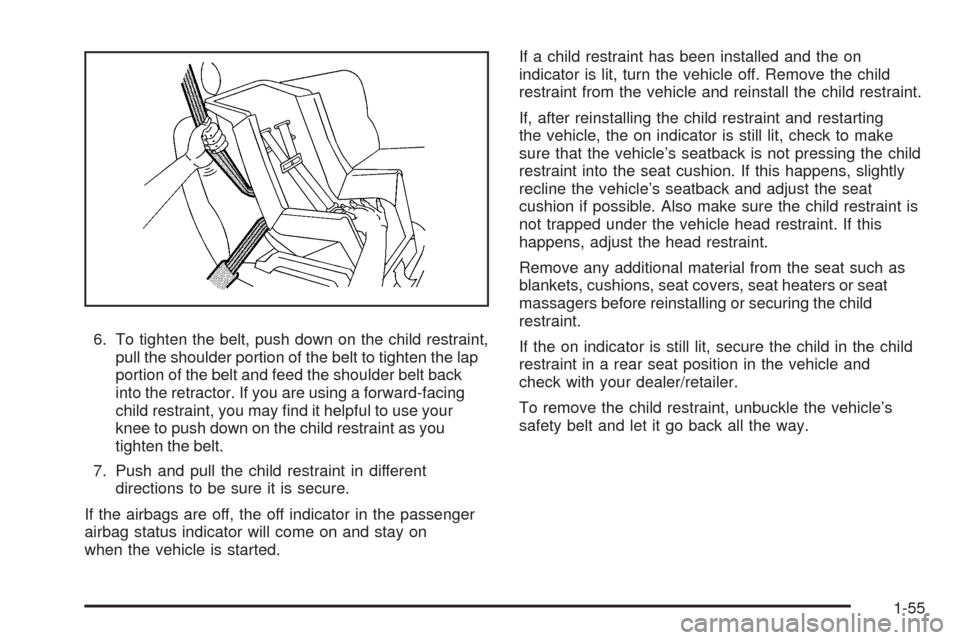
6. To tighten the belt, push down on the child restraint,
pull the shoulder portion of the belt to tighten the lap
portion of the belt and feed the shoulder belt back
into the retractor. If you are using a forward-facing
child restraint, you may nd it helpful to use your
knee to push down on the child restraint as you
tighten the belt.
7. Push and pull the child restraint in different
directions to be sure it is secure.
If the airbags are off, the off indicator in the passenger
airbag status indicator will come on and stay on
when the vehicle is started.If a child restraint has been installed and the on
indicator is lit, turn the vehicle off. Remove the child
restraint from the vehicle and reinstall the child restraint.
If, after reinstalling the child restraint and restarting
the vehicle, the on indicator is still lit, check to make
sure that the vehicle’s seatback is not pressing the child
restraint into the seat cushion. If this happens, slightly
recline the vehicle’s seatback and adjust the seat
cushion if possible. Also make sure the child restraint is
not trapped under the vehicle head restraint. If this
happens, adjust the head restraint.
Remove any additional material from the seat such as
blankets, cushions, seat covers, seat heaters or seat
massagers before reinstalling or securing the child
restraint.
If the on indicator is still lit, secure the child in the child
restraint in a rear seat position in the vehicle and
check with your dealer/retailer.
To remove the child restraint, unbuckle the vehicle’s
safety belt and let it go back all the way.
1-55
Page 62 of 412
{CAUTION:
Airbags plus lap-shoulder belts offer the best
protection for adults, but not for young
children and infants. Neither the vehicle’s
safety belt system nor its airbag system is
designed for them. Young children and infants
need the protection that a child restraint
system can provide. Always secure children
properly in your vehicle. To read how, see
Older Children on page 1-31orInfants and
Young Children on page 1-34.
There is an airbag
readiness light on the
instrument panel cluster,
which shows the airbag
symbol.
The system checks the airbag electrical system for
malfunctions. The light tells you if there is an electrical
problem. SeeAirbag Readiness Light on page 3-34
for more information.
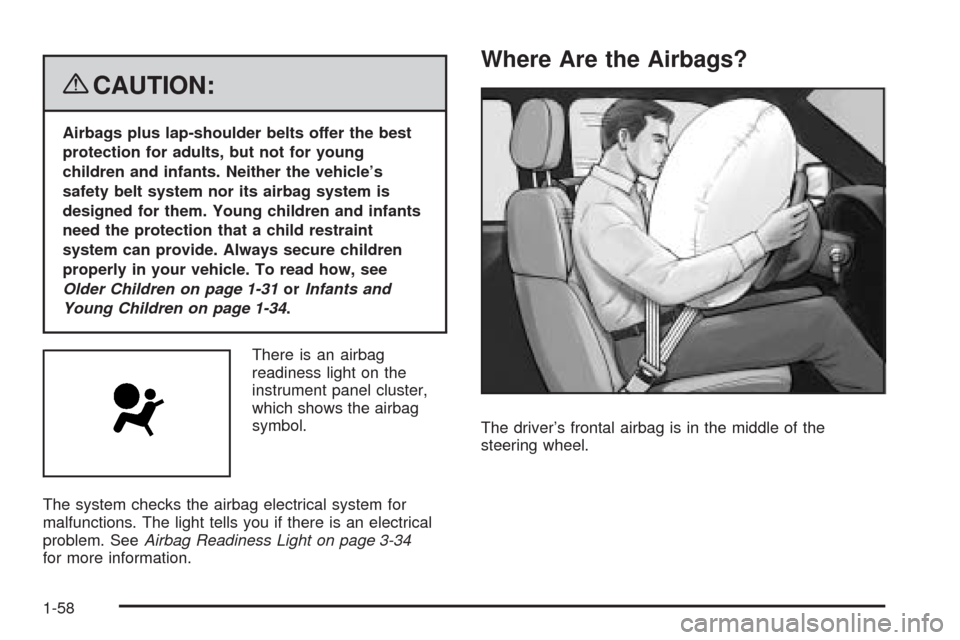
Where Are the Airbags?
The driver’s frontal airbag is in the middle of the
steering wheel.
1-58