2008 CHEVROLET CORVETTE power steering
[x] Cancel search: power steeringPage 213 of 432
Press the OPTION button until AUTO MEMORY
RECALL appears on the display, then press the RESET
button to scroll through the following modes:
YES
NO (default)
If you choose YES, the driver’s seat, the outside
rearview mirrors and the telescopic steering column, if
your vehicle has this feature, positions are recalled when
you turn the ignition on.
If you choose NO, this option will turn off.
When the mode you want is selected, press the
OPTION button to set your choice and advance to the
next personal option.
Auto Exit Recall:If your vehicle has the memory
package, you may have this option. This option allows
the driver’s seat and telescopic steering column, if
your vehicle has this feature, to automatically move to
the current driver’s exit position when one of the
following occurs:
The vehicle is turned off or in Retained Accessory
Power (RAP) or accessory mode and the driver’s
door is opened.
The vehicle is turned off or in RAP and the unlock
button on the keyless access transmitter is
pressed.In order for the Auto Exit Recall feature to work on an
automatic transmission vehicle, the vehicle must be
in PARK (P). On a manual transmission vehicle,
the parking brake must be set.
Press the OPTION button until AUTO EXIT RECALL
appears on the display, then press the RESET button to
scroll through the following modes:
YES
NO (default)
If you choose YES, when you turn the ignition off and
open the driver’s door or press the unlock button on the
keyless access transmitter, the seat and the telescopic
steering wheel, if your vehicle has this feature, will return
to their stored exit positions for an easy exit or an
easy entrance when returning to the vehicle.
The seat and steering wheel will only return to the
stored driving position if you press the appropriate
memory button or activate the auto memory recall
feature.
If you choose NO, this option will turn off.
When the mode you want is selected, press the
OPTION button to set your choice and advance to the
next personal option.
3-77
Page 220 of 432
Audio System(s)
Determine which radio your vehicle has and then read
the pages following to familiarize yourself with its
features.
{CAUTION:
This system provides you with far greater
access to audio stations and song listings.
Giving extended attention to entertainment
tasks while driving can cause a crash and you
or others can be injured or killed. Always keep
your eyes on the road and your mind on the
drive — avoid engaging in extended searching
while driving.
Keeping your mind on the drive is important for
safe driving. SeeDefensive Driving on page 4-2.
Here are some ways in which you can help avoid
distraction while driving.While your vehicle is parked:
Familiarize yourself with all of its controls.
Familiarize yourself with its operation.
Set up your audio system by presetting your
favorite radio stations, setting the tone, and
adjusting the speakers. Then, when driving
conditions permit, you can tune to your favorite
radio stations using the presets and steering wheel
controls if the vehicle has them.
Notice:Before adding any sound equipment to
your vehicle, such as an audio system, CD player,
CB radio, mobile telephone, or two-way radio, make
sure that it can be added by checking with your
dealer/retailer. Also, check federal rules covering
mobile radio and telephone units. If sound
equipment can be added, it is very important to do
it properly. Added sound equipment may interfere
with the operation of your vehicle’s engine, radio,
or other systems, and even damage them. Your
vehicle’s systems may interfere with the operation
of sound equipment that has been added.
Your vehicle has a feature called Retained Accessory
Power (RAP). With RAP, the audio system can be
played even after the ignition is turned off. SeeRetained
Accessory Power (RAP) on page 2-23for more
information.
3-84
Page 253 of 432
Steering
Power Steering
If you lose power steering assist because the engine
stops or the system is not functioning, you can steer but
it will take much more effort.
Magnetic Speed Variable Assist
Steering
Your vehicle has a steering system that continuously
adjusts the effort you feel when steering at all vehicle
speeds. It provides ease when parking, yet a rm, solid
feel at highway speeds.
Steering Tips
It is important to take curves at a reasonable speed.
A lot of the “driver lost control” accidents mentioned on
the news happen on curves. Here is why:
Experienced driver or beginner, each of us is subject to
the same laws of physics when driving on curves.
The traction of the tires against the road surface makes
it possible for the vehicle to change its path when
you turn the front wheels. If there is no traction, inertia
will keep the vehicle going in the same direction. If
you have ever tried to steer a vehicle on wet ice, you
will understand this.Traction in a curve depends on the condition of the tires
and the road surface, the angle at which the curve is
banked, and your speed. While in a curve, speed is the
one factor you can control.
Suppose you are steering through a sharp curve.
Then you suddenly accelerate. Both control
systems — steering and acceleration — have to do their
work where the tires meet the road. Adding the sudden
acceleration can demand too much of those places. You
can lose control. SeeTraction Control System (TCS) on
page 4-6.
What should you do if this ever happens? Ease up on
the accelerator pedal, steer the vehicle the way you
want it to go, and slow down.
Speed limit signs near curves warn that you should
adjust your speed. Of course, the posted speeds
are based on good weather and road conditions. Under
less favorable conditions you will want to go slower.
If you need to reduce speed when approaching a curve,
do it before you enter the curve, while the front wheels
are straight ahead.
Try to adjust the speed so you can drive through the
curve. Maintain a reasonable, steady speed. Wait
to accelerate until you are out of the curve, and then
accelerate gently into the straightaway.
Adding non-dealer/non-retailer accessories can affect
your vehicle’s performance. SeeAccessories and
Modifications on page 5-3.
4-11
Page 273 of 432
Service............................................................5-3
Accessories and Modications..........................5-3
California Proposition 65 Warning.....................5-4
California Perchlorate Materials Requirements.....5-4
Doing Your Own Service Work.........................5-4
Adding Equipment to the Outside of the
Vehicle......................................................5-5
Fuel................................................................5-5
Gasoline Octane............................................5-5
Gasoline Specications....................................5-6
California Fuel...............................................5-6
Additives.......................................................5-7
Fuels in Foreign Countries...............................5-8
Filling the Tank..............................................5-8
Filling a Portable Fuel Container.....................5-11
Checking Things Under the Hood....................5-12
Hood Release..............................................5-13
Engine Compartment Overview.......................5-14
Engine Oil...................................................5-17
Engine Oil Life System..................................5-23
Engine Air Cleaner/Filter................................5-25
Automatic Transmission Fluid.........................5-27
Manual Transmission Fluid.............................5-27
Hydraulic Clutch...........................................5-27
Engine Coolant.............................................5-28
Coolant Surge Tank Pressure Cap..................5-31Engine Overheating.......................................5-31
Overheated Engine Protection
Operating Mode........................................5-33
Cooling System............................................5-34
Power Steering Fluid.....................................5-39
Windshield Washer Fluid................................5-41
Brakes........................................................5-42
Battery........................................................5-45
Jump Starting...............................................5-46
Rear Axle.......................................................5-51
Headlamp Aiming...........................................5-51
Bulb Replacement..........................................5-52
High Intensity Discharge (HID) Lighting............5-52
Halogen Bulbs..............................................5-52
Headlamps, Front Turn Signal, and
Parking Lamps..........................................5-53
Taillamps, Turn Signal, and Stoplamps............5-54
Replacement Bulbs.......................................5-55
Windshield Replacement.................................5-55
Windshield Wiper Blade Replacement..............5-55
Tires..............................................................5-58
Winter Tires.................................................5-59
Tire Sidewall Labeling...................................5-60
Tire Terminology and Denitions.....................5-62
Run-Flat Tires..............................................5-64
Section 5 Service and Appearance Care
5-1
Page 287 of 432
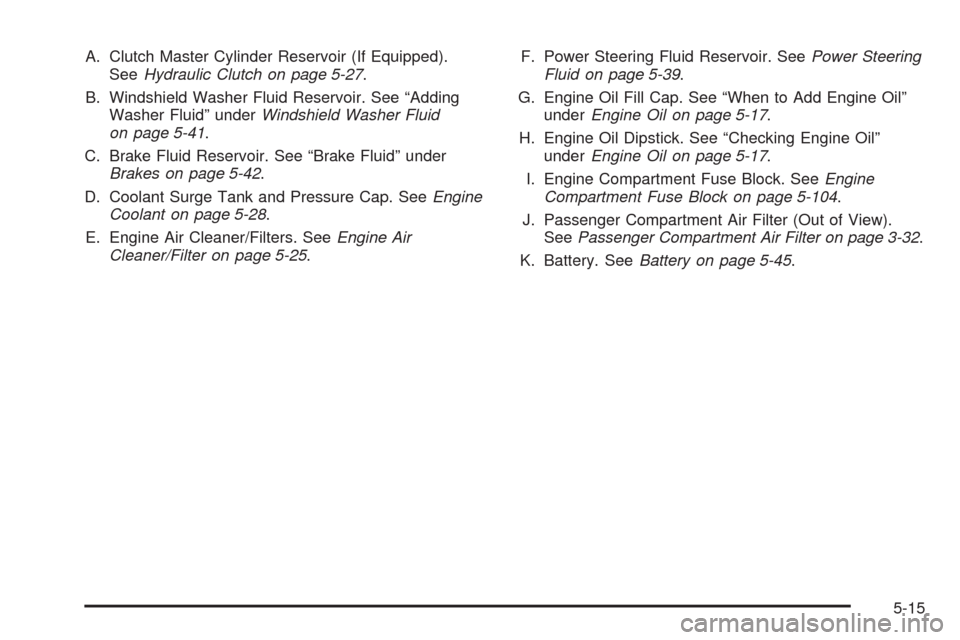
A. Clutch Master Cylinder Reservoir (If Equipped).
SeeHydraulic Clutch on page 5-27.
B. Windshield Washer Fluid Reservoir. See “Adding
Washer Fluid” underWindshield Washer Fluid
on page 5-41.
C. Brake Fluid Reservoir. See “Brake Fluid” under
Brakes on page 5-42.
D. Coolant Surge Tank and Pressure Cap. SeeEngine
Coolant on page 5-28.
E. Engine Air Cleaner/Filters. SeeEngine Air
Cleaner/Filter on page 5-25.F. Power Steering Fluid Reservoir. SeePower Steering
Fluid on page 5-39.
G. Engine Oil Fill Cap. See “When to Add Engine Oil”
underEngine Oil on page 5-17.
H. Engine Oil Dipstick. See “Checking Engine Oil”
underEngine Oil on page 5-17.
I. Engine Compartment Fuse Block. SeeEngine
Compartment Fuse Block on page 5-104.
J. Passenger Compartment Air Filter (Out of View).
SeePassenger Compartment Air Filter on page 3-32.
K. Battery. SeeBattery on page 5-45.
5-15
Page 289 of 432
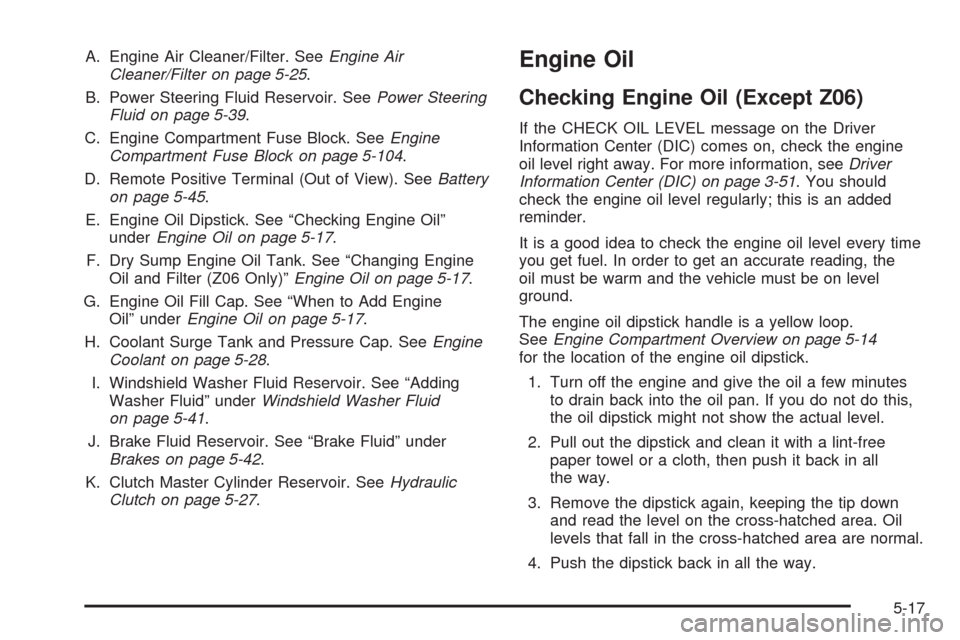
A. Engine Air Cleaner/Filter. SeeEngine Air
Cleaner/Filter on page 5-25.
B. Power Steering Fluid Reservoir. SeePower Steering
Fluid on page 5-39.
C. Engine Compartment Fuse Block. SeeEngine
Compartment Fuse Block on page 5-104.
D. Remote Positive Terminal (Out of View). SeeBattery
on page 5-45.
E. Engine Oil Dipstick. See “Checking Engine Oil”
underEngine Oil on page 5-17.
F. Dry Sump Engine Oil Tank. See “Changing Engine
Oil and Filter (Z06 Only)”Engine Oil on page 5-17.
G. Engine Oil Fill Cap. See “When to Add Engine
Oil” underEngine Oil on page 5-17.
H. Coolant Surge Tank and Pressure Cap. SeeEngine
Coolant on page 5-28.
I. Windshield Washer Fluid Reservoir. See “Adding
Washer Fluid” underWindshield Washer Fluid
on page 5-41.
J. Brake Fluid Reservoir. See “Brake Fluid” under
Brakes on page 5-42.
K. Clutch Master Cylinder Reservoir. SeeHydraulic
Clutch on page 5-27.Engine Oil
Checking Engine Oil (Except Z06)
If the CHECK OIL LEVEL message on the Driver
Information Center (DIC) comes on, check the engine
oil level right away. For more information, seeDriver
Information Center (DIC) on page 3-51. You should
check the engine oil level regularly; this is an added
reminder.
It is a good idea to check the engine oil level every time
you get fuel. In order to get an accurate reading, the
oil must be warm and the vehicle must be on level
ground.
The engine oil dipstick handle is a yellow loop.
SeeEngine Compartment Overview on page 5-14
for the location of the engine oil dipstick.
1. Turn off the engine and give the oil a few minutes
to drain back into the oil pan. If you do not do this,
the oil dipstick might not show the actual level.
2. Pull out the dipstick and clean it with a lint-free
paper towel or a cloth, then push it back in all
the way.
3. Remove the dipstick again, keeping the tip down
and read the level on the cross-hatched area. Oil
levels that fall in the cross-hatched area are normal.
4. Push the dipstick back in all the way.
5-17
Page 311 of 432
5. Then replace the pressure cap. Be sure the
pressure cap is hand-tight and fully seated.
Check the level in the surge tank when the system
has cooled down. If the coolant is not at the proper
level, repeat Steps 1 through 4, then reinstall the
pressure cap. If the coolant is not at the proper level
when the system cools down again, see your
dealer/retailer.Power Steering Fluid
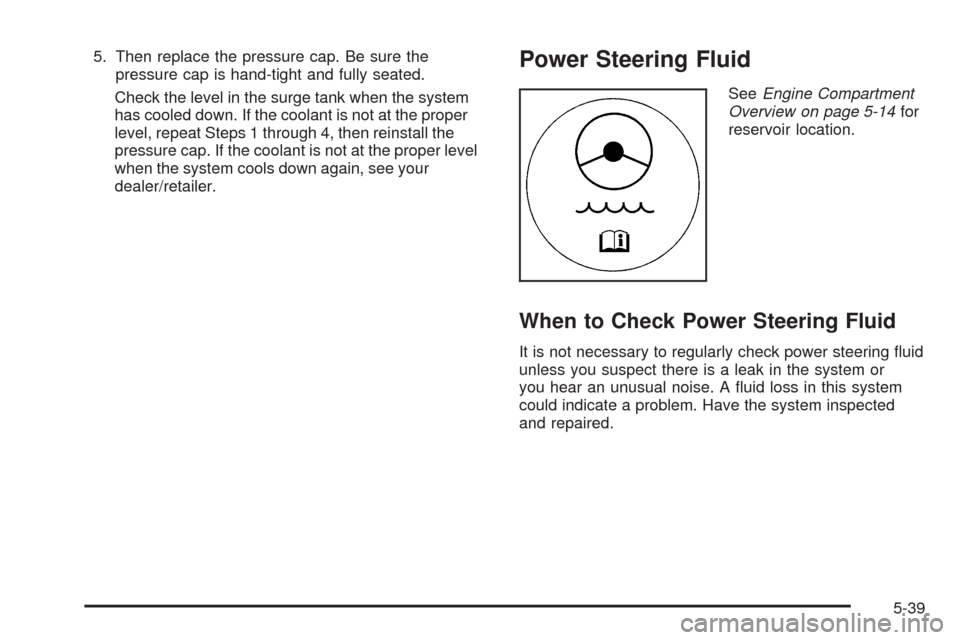
SeeEngine Compartment
Overview on page 5-14for
reservoir location.
When to Check Power Steering Fluid
It is not necessary to regularly check power steering uid
unless you suspect there is a leak in the system or
you hear an unusual noise. A uid loss in this system
could indicate a problem. Have the system inspected
and repaired.
5-39
Page 312 of 432
How to Check Power Steering Fluid
To check the power steering uid, do the following:
1. Turn the ignition off and let the engine compartment
cool down.
2. Wipe the cap and the top of the reservoir clean.
3. Unscrew the cap and wipe the dipstick with a
clean rag.
4. Replace the cap and completely tighten it.
5. Remove the cap again and look at the uid level on
the dipstick. There are markings on both sides of
the dipstick.
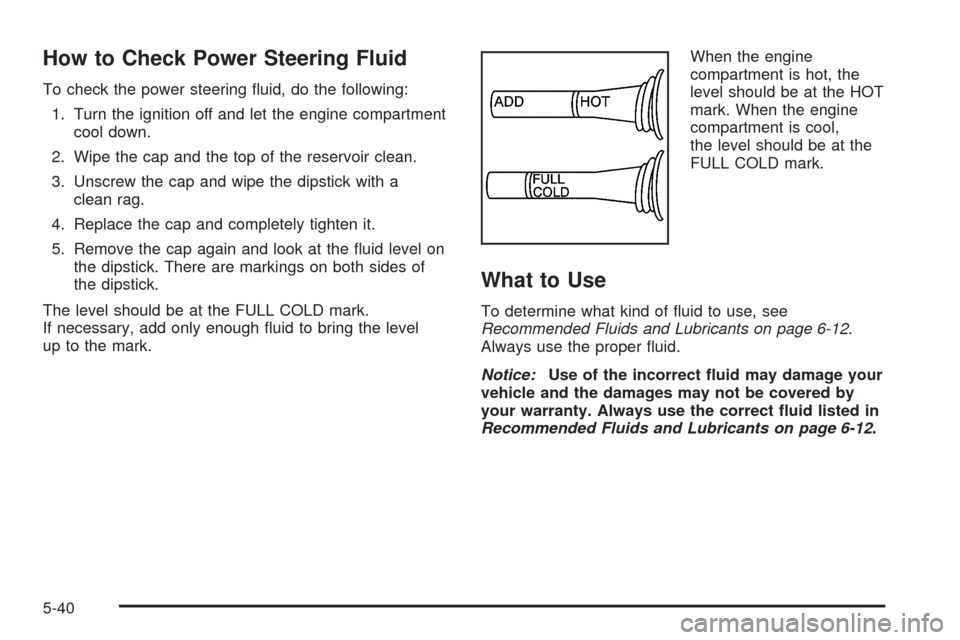
The level should be at the FULL COLD mark.
If necessary, add only enough uid to bring the level
up to the mark.When the engine
compartment is hot, the
level should be at the HOT
mark. When the engine
compartment is cool,
the level should be at the
FULL COLD mark.
What to Use
To determine what kind of uid to use, see
Recommended Fluids and Lubricants on page 6-12.
Always use the proper uid.
Notice:Use of the incorrect uid may damage your
vehicle and the damages may not be covered by
your warranty. Always use the correct uid listed in
Recommended Fluids and Lubricants on page 6-12.
5-40