2008 AUDI TT ROADSTER battery
[x] Cancel search: batteryPage 108 of 316
• ..__O_ n_ t_h _ e_ r_ o_ a_ d ____________________________________________________ _
Ignition lock and ignition switch
Ignition lock
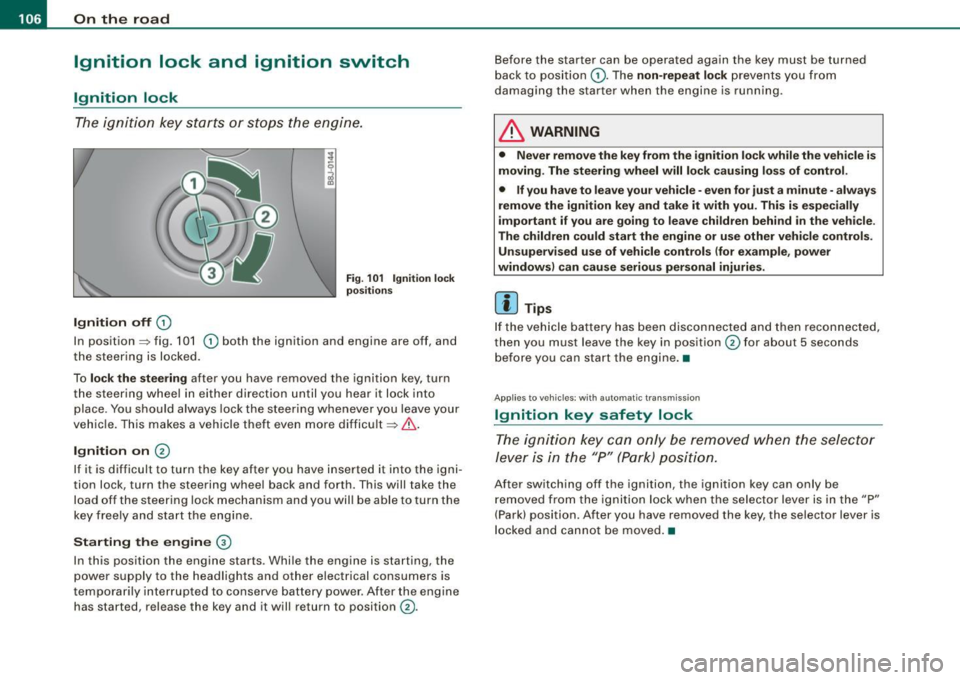
The igniti on key starts or s tops the eng ine.
Ignition off G)
Fi g. 1 01 Ign it io n lock
po sition s
In posit ion => fig. 101 G) both the ignition and engine are off, and
t he steering is locked.
To
lo ck the steering after you have removed the ignition key, turn
the steering whee l in either direction until you hear it lock into
place . You should always lock the steering whenever you leave your
vehic le. This makes a vehicle theft even more difficult =>& .
Ignition on 0
If it is difficult to turn the key after you have inserted it into the igni
tion lock, turn the steering wheel back and forth. This will take the
load off the steering lock mechanism and you wil l be able to turn the
key freely and start the engine.
Starting the engine ®
In this position the engine starts . Whi le the engine is starting, the
power supply to the headlights and other electrical consumers is
temporari ly interrupted to conserve battery power . After the engine
has started, release the key and it will return to position
G) .
Before the starter can be operated again the key must be turned
back to posi tion
G) . The non -repeat lock prevents you from
damaging the starter when the engine is running.
& WARNING
• Never remove the key from the ignition lo ck while the veh icle is
moving. The steering wheel will lo ck causing lo ss of control .
• If you have to leave your vehicle -even for just a minute -always
remove the ign ition key and take it with you . This i s especially
i mportant if you are going to l eave children behind in the vehi cle .
The children could start the eng ine or u se other vehi cle control s.
Unsupe rv ised use of vehicle controls (for e xample , power
window s) can cau se serious per sonal injurie s.
[ i ] Tips
If the veh icle ba ttery has been disconnected a nd then reconnected,
then you must leave the key in position
G) for about 5 seconds
bef ore you can start the engine .•
Appl ies to vehicles: with automat ic trans miss io n
Ignition key safety lock
The ig nition ke y can only be rem oved when the selec tor
le ver i s in the "P" (Par k) p osition.
After switching off the ignition, the ignition key can only be
r emoved from the igni tio n lock w hen the se lector leve r is in the "P"
(Park) position . After you have removed the key, the selector lever is
l ocked and cannot be moved. •
Page 122 of 316
• ..__T_ ra_ n_s_ m_ i_ s _s_ i_ o _n ___________________________________________________ _
Applies t o vehi cles: with S tr oni c®
Emergency release for selector lever
If the vehicle's power supply fails, the selector lever can
be released in an emergency.
Fig. 113 Selector
lever:: Remove selector
lever sleeve
Fig. 114 Selector lever:
emergency release
from the Park position
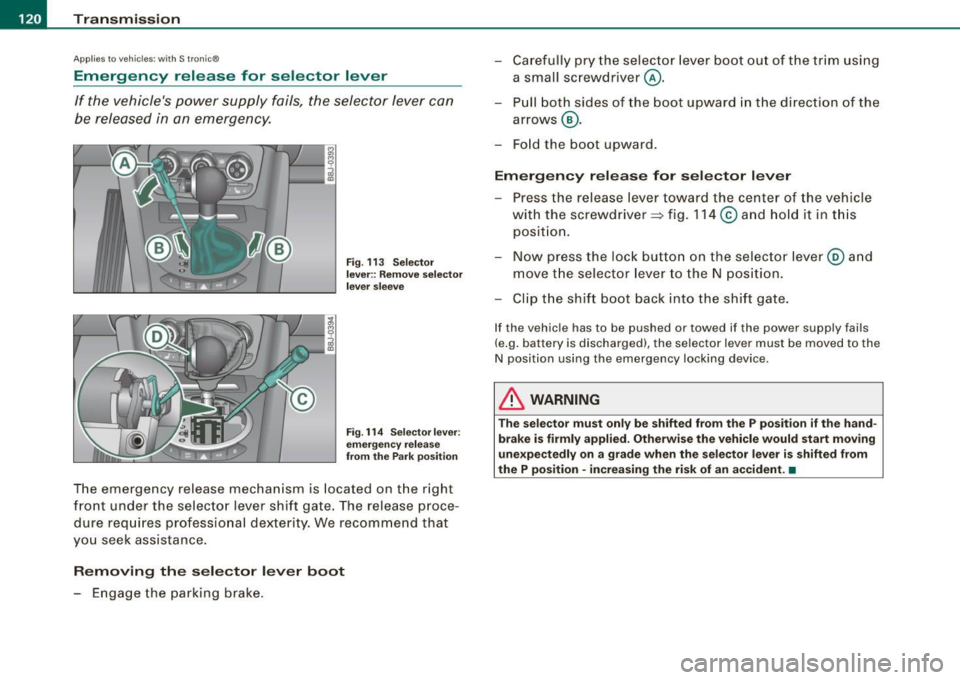
The emergency release mechanism is located on the right
front under the selector lever shift gate. The release proce
dure requires professional dexterity. We recommend that
you seek assistance.
Removing the selector lever boot
- Engage the parking brake. -
Carefully pry the selector lever boot out of the trim using
a small screwdriver @.
- Pull both sides of the boot upward in the direct ion of the
arrows @.
- Fold the boot upward.
Emergency release for selector lever
- Press the release lever toward the center of the vehicle
with the screwdriver ~ fig. 114
© and hold it in this
position.
- Now press the lock button on the selector lever@ and
move the selector lever to the N position.
- Clip the shift boot back into the shift gate.
If the vehicle has to be pushed or towed if the power supply fails
(e.g. battery is discharged), the selector lever must be moved to the
N position using the emergency locking device .
& WARNING
The selector must only be shifted from the P position if the hand
brake is firmly applied. Otherwise the vehicle would start moving
unexpectedly on a grade when the selector lever is shifted from
the P position · increasing the risk of an accident. •
Page 222 of 316

-~_C_ h_e _c _ k_ i_n ...:::g::;...._ a_n_ d_ f_ i_ll _in -'g:::;.._ ___________________________________________ _
Closing the engine hood
- Pull the hood down until the pressure from the struts is
reduced.
- Let the hood
drop down and latch in place. Do not try to
push it shut;
it may fail to engage~& .
& WARNING
A hood that is not completely latched could fly up and block your
view while driving.
• When you close the engine hood, check it to make sure the
safety catch has properly engaged. The hood should be flush with
the surrounding vehicle body parts.
• If you notice while driving that the hood is not secured prop
erly, stop at once and close it. •
Working in the engine compartment
Be especially careful whenever you work in the engine
compartment!
Whenever you must perform any work in the engine compartment,
for example checking and filling the different fluids, there is a risk of injury, burns and accidents. To prevent personal injury always
observe the following WARNINGS. The engine compartment of any
vehicle is a hazardous area!
=> &
& WARNING
To help avoid injury, before you check anything under the hood :
• Switch off the engine.
• Remove the ignition key.
• Apply the parking brake.
& WARNING (continued)
• Move selector lever of automatic transmission to "P" {Park);
put manual transmission in Neutral.
• Always let the engine cool down. Hot components will burn
skin on contact.
• To reduce the risk of being burned, never open the hood if you
see or hear steam or coolant escaping from the engine compart
ment. Wait until no steam or coolant can be seen or heard before
carefully opening the hood .
• Keep children away from the engine compartment.
• Never spill fluids on hot engine components. They can cause a
fire.
• Never touch the radiator fan. The auxiliary electric fan is
temperature controlled and can switch on suddenly.
• Never open the coolant reservoir cap when the engine is still
warm. The coolant system is pressurized and hot coolant could
spray out.
• Protect your face, hands and arm from steam or hot engine
coolant by placing a thick rag over the cap when you open the
coolant reservoir.
• If work on the fuel system or the electrical system is necessary:
- Always disconnect the battery .
- Never smoke or work near heaters or open flames. Fluids in
the engine compartment could start a fire.
- Keep an approved fire extinguisher immediately available.
• To avoid electrical shock and personal injury while the engine
is running or being started, never touch :
- Ignition cables
- Other components of the high voltage electronic ignition
system.
• If you must perform a check or repair with the engine running: .,_
Page 223 of 316

_____________________________________________ C_h_ e;::..:. c:..:..k :..:..in ;..:..= g:.....:.; a:..:..n :....:d :..:....:. f.:.:il .:.:li :..:..n :.::g:!-_ ___,J-
& WA RNING !continued )
-First, fully apply the parking br ake , move selector lev er of
automatic tran smi ssion to "P " (P a rk ); put manu al tran smi ssio n
in Neutral.
- Alw ays use extreme c aution to p revent clothing, j ewelry , or
long hair from getting caught in the radi ator fan , V -belts or
other moving pa rt s, or from c onta cting hot parts. Tie b ack hair
before starting , and wear no cloth ing th at will hang or droop
into the engine.
• Minimize exposure to emi ssion and ch emical hazards
:=> & .
& WARNING
California Propo sition 65 Warning :
• Engine exha ust , some of its constituent s, and certa in vehi cle
c omponents contain or emit chemical s known to the State of Cali
fornia to cause cancer and birth defe cts and reprodu ctive harm . In
addition , certain fluid s cont ained in vehicle s and certain produ cts
of compone nt wear contain or emit chemi cals known to the State
of Cal ifornia to cause cancer and birth defe cts or oth er repr oduc
tive ha rm.
• Battery post s, terminals and related ac cess ori es conta in lead
and le ad compou nds , c hemic als kno wn to th e St ate of California
to c ause cancer and reproductive harm s. Wa sh hand s after
ha ndling.
0 Note
When adding fluids , always make sure that they are poured into the
proper container o r filler opening, otherwise ser ious damage to
vehicle systems will occur .
ffi For the sake of the environment
To detect leaks in time, inspect the vehic le floor pan from under
neath regularly. If you see spots from oil or other vehicle fluids, have
your vehicle inspected by an authorized Aud i dealer .•
Engine compartment
Ap plies to vehic le s: wit h 1.8 I1 80-h p engi ne
2.01 200 -hp engine
These ar e the most im por tant i tems tha t yo u can check.
Fig . 149 En gine c omp art men t: 2.01 200 -hp engine
0 Coolan t expansion tank (J_ ) ..... .... ........ ..• ..
0 Engine oil filler cap(~) ... ... .. .. .... .... ... ... .
© Engine oil dipstick (orange) ........ ....... ..... . .
© Brake fluid reservoir ( ) . .... .. ... .. ...... ... ... .
Vehic le care I I
228
225
224
230 .,.
irechnical data
Page 233 of 316

Checkin g and fillin g ---------------~-!':WIii
•
& WARN ING (co ntinued)
- Use only br ake flu id th at m eet s SAE spec ificati on J 1703 and
c onf orms to F ed eral Motor Vehi cle St and ard 11 6. Always ch ec k
w ith your a uthori zed A ud i de aler to m ake sure you are u sin g
the corre ct brake fluid . Th e co rrect typ e of br ake fluid i s also
indic ate d on the br ake fluid res ervo ir .
- The br ake fluid mu st be ne w. Heavy u se of the br ake s c an
c au se a vapor lo ck if the brake fluid i s left in the s yste m too
long. Thi s ca n seriou sly affe ct the eff iciency of the brake s as
w ell as your safety . This could resu lt in an a ccident .
0 Note
Brake fluid wi ll damage the paint of your vehicle.
t he special too ls required and the necessary expertise, we recom
mend that you have the brake f luid changed by your authorized Audi
dea ler .•
Battery
General information
Your vehicle is equipped with a specia l battery, an AGM battery. This
battery is located in the luggage compartment and must be
replaced with an origina l equipment battery. Under normal oper
ating conditions, the battery is
maintenan ce-free .
Have the battery checked when you take your vehicle in for service.
You a re we ll advised to replace a battery that is olde r th an 5 years .
Disc onn ectin g th e batt ery t erm inal s
Some vehic le functions (power window regulators, for e xample) are
lost if the battery terminals are disconnected. These functions have
to be relearned after the batte ry term inals are connected again. To
prevent this, the battery should only be disconnected from the
vehicle electrical system when abso lutely necessary for repairs.
V ehi cle s not dri ven for long period s
If you are going to le t your vehicle stand for a long t ime a nd not
drive it, you should remember there are electrica l components
which are still functioning and they will draw energy from the
battery and drain it, for examp le, the engine immob ilizer. To prevent
this, you can either charge the battery occasionally to keep it in
good working condition or you can d isconnect the negative cab le
on the battery.
W inter op era ti on
During the winter months, battery capacity tends to decrease as
temperatures drop. This is because more power is a lso consumed
while starting, and the headlights, rear window defogger, etc., are
used more often .
Avoid unnecessary power consumption, particularly in city traffic or
when trave ling on ly shor t distances . Let your au thorized Audi dea ler
check the capacity of the vehicle battery before winter sets in
=>
page 235 . A well charged battery will not on ly prevent start ing
p rob lems when the weather is cold , but wi ll a lso last longer .
Replacing battery
The new battery must h ave the same capacity, voltage (12 volts},
amperage, construction and p lug sea ling, as the origina l battery.
Specifications are l isted on the battery hous ing. Batteries specially
developed by Audi fulfill the ma intenance, output, and safety
requirements.
When installing the battery, make sure the ignition and all electrical consumers are switched off=>
0. .,_
Vehicle care I t •
Page 234 of 316

-Ch
ecking and filling ---=-----=----------------
We recommend that you use maintenance -free or cyc le- resis
tant /leak -pr oof
batteries according to the standards TL 825 06 (from
December 1997) and VW 7 50 73 (from Augus t 2001 ).
Replacing the battery should be carried by a qualified workshop.
P lease follow the instructions on the battery cover.
0 Note
• All work on the battery requires technical knowledge. Please
contact an Audi dealership or another authorized facility for ques
tions about the battery- danger of acid bu rns and explosion hazard!
• The battery must not be opened! Do not try to change the
battery's liquid level, otherwise detonat ing gas wil l escape from the
battery - explosion ha zard!
• The AGM battery in the luggage compartment cannot leak,
because the electrolyte for this battery is absorbed into a special
g lass mat . This leak-proof battery must not be rep lace with a
conventiona l battery .
• Make sure the ventilation hose on the side of the battery is
connected, otherwise fumes or battery acid can leak out.
• Battery holde r and terminals always have to be secured correctly .
• Before al l wo rk on the battery follow the
warning s below :::> & in
" Working on the battery" on page
232.
~ For the sake of the environment
Because of the problem of proper d isposal of a battery, we recom
mend your authorized Audi dea ler change the battery fo r you.
Batteries contain sulfur ic acid and lead and must always be
disposed of properly in compliance with all environmental regula
t ions . Di sposing of vehicle batteries i mproper ly is very dangerous to
the environment. Make sure that the removed battery cannot over
ba lance, otherwise sulfur ic acid migh t escape!
[ i ] Tips
If your ve hic le is left standing for several weeks at extremely low
temperatures, the vehicle battery should be removed and stored
where it will no t free ze. This will preven t it from being damaged and
having to be replaced. •
Working on the battery
Be especially care ful w hen wor king o n or nea r the
battery!
Fig . 156 Luggag e
co mp artment : AGM
batte ry
The batte ry is loca ted in the lu g ga ge compartmen t.
- Sw ing up t he luggage compartmen t floo r.
Remove the cover p late b y tu rning the t humbw heel.
The positive (+) battery term ina l is protected by a pla stic cover . This
cover must be removed to access the positive( +) terminal when
connecting jumper cab les to start the engine.
Always heed the
safety w arnings , when working on the vehicle
battery or the vehicle electrical system to prevent injury.
Page 235 of 316
__________________________________________ C_ h _ e_c _k _in _ g =- a_ n __ df _i_ lli _n ___ g __ __
•
The following WARNINGS are very important when
working on the battery:
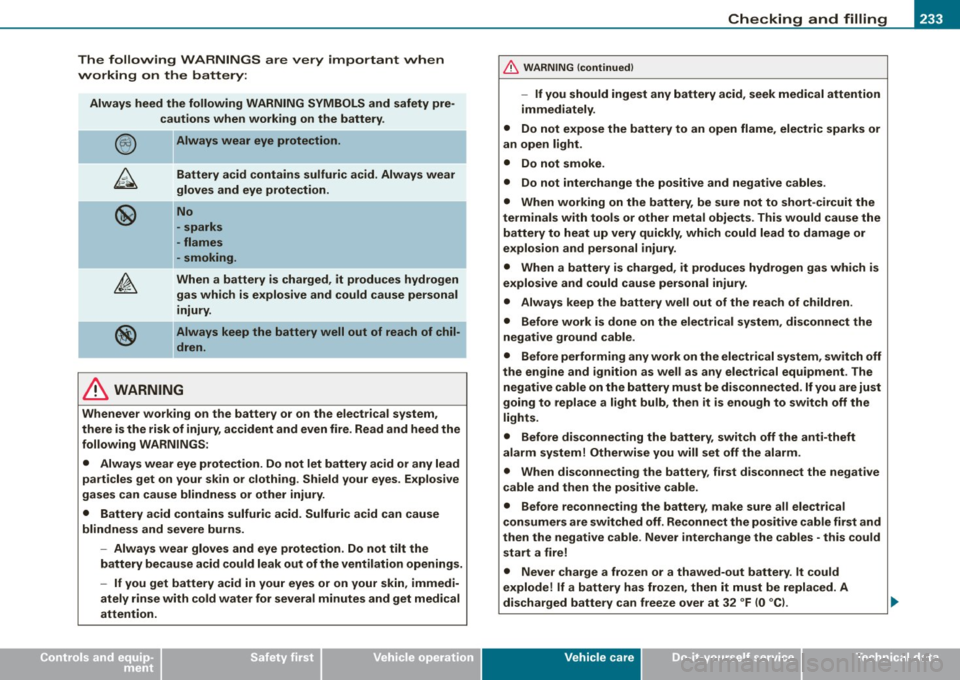
Always heed the following WARNING SYMBOLS and safety pre
cautions when working on the battery .
Always wear eye protection.
Battery acid contains sulfuric acid. Always wear
gloves and eye protection.
No
- sparks
- flames
- smoking.
When a battery is charged, it produces hydrogen
gas which is explosive and could cause personal
injury.
Always keep the battery well out of reach of chil
dren.
& WARNING
Whenever working on the battery or on the electrical system,
there is the risk of injury, accident and even fire. Read and heed the
following WARNINGS:
• Always wear eye protection. Do not let battery acid or any lead
particles get on your skin or clothing. Shield your eyes. Explosive
gases can cause blindness or other injury.
• Battery acid contains sulfuric acid. Sulfuric acid can cause
blindness and severe burns.
- Always wear gloves and eye protection. Do not tilt the
battery because acid could leak out of the ventilation openings.
- If you get battery acid in your eyes or on your skin, immedi
ately rinse with cold water for several minutes and get medical
attention.
& WARNING (continued)
-If you should ingest any battery acid, seek medical attention
immediately.
• Do not expose the battery to an open flame, electric sparks or
an open light.
• Do not smoke.
• Do not interchange the positive and negative cables .
• When working on the battery, be sure not to short -circuit the
terminals with tools or other metal objects. This would cause the battery to heat up very quickly, which could lead to damage or
explosion and personal injury.
• When a battery is charged, it produces hydrogen gas which is
explosive and could cause personal injury.
• Always keep the battery well out of the reach of children.
• Before work is done on the electrical system, disconnect the
negative ground cable.
• Before performing any work on the electrical system, switch off
the engine and ignition as well as any electrical equipment. The
negative cable on the battery must be disconnected.
If you are just
going to replace a light bulb, then it is enough to switch off the
lights.
• Before disconnecting the battery, switch off the anti-theft
alarm system! Otherwise you will set off the alarm.
• When disconnecting the battery, first disconnect the negative
cable and then the positive cable.
• Before reconnecting the battery, make sure all electrical
consumers are switched off. Reconnect the positive cable first and
then the negative cable . Never interchange the cables - this could
start a fire!
• Never charge a frozen or a thawed-out battery. It could
explode! If a battery has frozen, then it must be replaced. A
discharged battery can freeze over at 32 °F (0 °CI. .,,_
Vehicle care
I t •
Page 236 of 316

___ C_h_ e_ c_k _in --== g'-- a_n _d_ f_il _li _n ..:::g:::..- ___________________________________________ _
& WARNING (continued)
• Make sure the vent hose is always attached to the opening on
the side of the battery.
• Never use batteries which are damaged. Danger of explosion!
Always replace a damaged battery .
& WARNING
California Proposition 65 Warning :
• Battery posts, terminals and related accessories contain lead
and lead compounds, chemicals known to the State of California
to cause cancer and reproductive problems. Wash hands after
handling .
0 Note
• Do not disconnect the vehicle battery when the ignition is
switched on or when the engine is running, otherwise, you will
damage electronic components in the electrical system.
• When working on the engine, protect the battery housing from
ultraviolet (UV) rays by not parking the vehic le in direct sunlight.
• If your vehicle is going to stand for a long period of time without
being driven , protect the battery from "freezing", otherwise it will
be damaged and will then have to be replaced. •
Checking the battery acid level on magic eye
batteries*
The battery acid level in the battery can be checked
through the clear inspection window.
I
Fig. 157 Luggage
compartment : Battery
with magic eye.
On top of the battery, there is a round "window". This
window (magic eye) changes color as the battery charge
and acid level change.
- Read and heed all WARNINGS=>
& in "Working on the
battery" on
page 232
- Read the acid level from the window on the battery
=> fig. 157.
Air bubbles in the window can cause an inaccurate reading. Care
fully tap on the side of the window.
• If the window is
green, the battery acid level is correct.
• If the window has
no color or is bright yellow, the battery acid
level is too low. Have the battery tested by your authorized Audi
dealer or a qualified workshop.
• If the window is
black , then the battery is insufficiently charged.
Recharge the battery as soon as possible =>
page 235. ...