2008 AUDI TT ROADSTER clock
[x] Cancel search: clockPage 69 of 316
& WARNING
• When raising the folding top, take care not to reach into the
linkage that operates the folding top or any of its other moving
parts. Otherwise, your hands may be trapped in the mechanism -
risk of injury!
• When pushing the top down onto the frame for the windshield,
ensure that neither you nor the person helping you become caught
in the mechanism -risk of injury!
0 Note
To avoid damage when opening the folding top, make sure both
covers are completely open and the connecting rods are clipped
in. a
Appl ies to vehicles: with power folding top
Step 4: Locking the top
The locking system for the folding top latches is located
on the inside of the folding top.
Contro ls and eq uip
ment
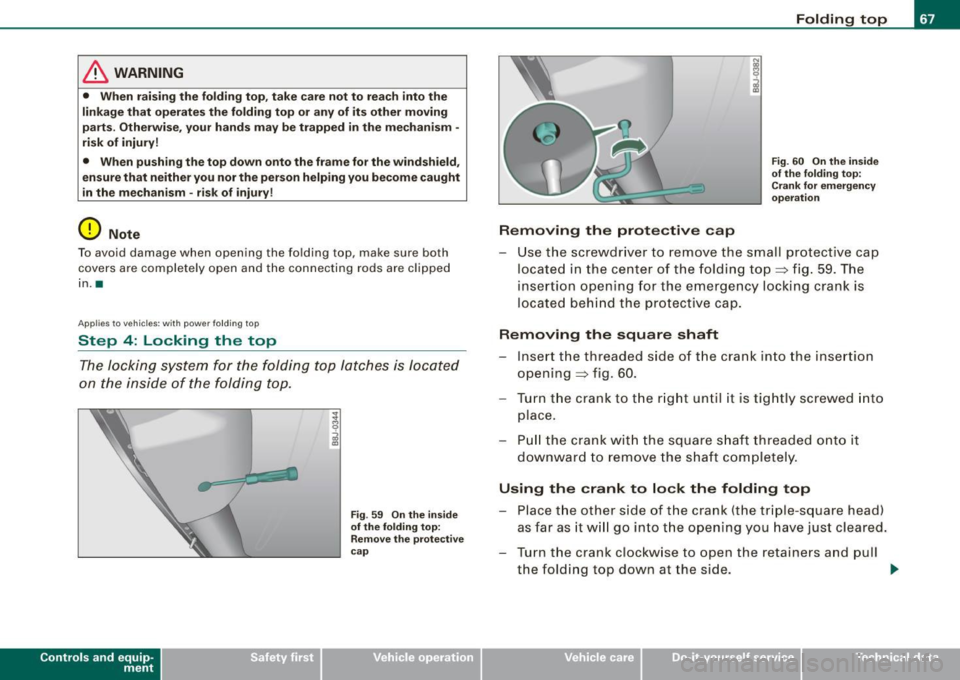
Fig . 59 On the inside
of the folding top:
Remove the protective
cap
Removing the protective cap
Folding top
Fig . 60 On the inside
of the folding top:
Crank for emergency
operation
- Use the screwdriver to remove the small protective cap
located in the center of the foldin g top=> fig. 59. The
insertion opening for the emergency locking crank is
located behind the protective cap.
Removing the square shaft
-Inse rt the threaded side of the crank into the insertion
opening => fig. 60.
- Turn the crank to the right until it is tightly screwed into
place.
- Pull the crank with the square shaft threaded onto it
downward to remove the shaft completely.
Using the crank to lock the folding top
-Place the other side of the crank (the triple-square head)
as far as it will go into the opening you have just cleared.
- Turn the crank clockwise to open the retainers and pull the folding top down at the side. ..,_
Vehicle care I I irechnical data
Page 70 of 316
Folding top
-Turn the crank counter-clockwise until the top is fully
locked in place and the indicator light on the instrument
cluster goes out.
- Pull the crank out.
- Unscrew the square shaft from the crank.
- Insert the square shaft into the opening until you hear it
click into place.
- Use the protective cap to close off the insertion opening.
The folding top is now completely closed. Have the malfunction
repaired as soon as possible.
[ i) Tips
Turn the emergency operation screw in the luggage compartment
to the right to close the folding top hydraulic system.•
Page 107 of 316

___________________________________________________ O _n_ t_h :.... e:.....:. r_:o :.... a:.:. d ..:.:.___,J"'
On the road
Steering
Adjusting the steering wheel column
The steering wheel position can be continuously adjusted
in height and distance.
First, adjust the driver's seat correctly.
Fig. 100 Lever under
the steering column
-Push the lever~ fig. 100 -Arrow-~ /.1 .
- Move the steering wheel to the desired position.
Pu sh the lever against the steering column until it locks.
T here must be at least 10 inches (25 cm) between your chest and the
center of the steering wheel. If you cannot sit more than 10 inches
(25 cm) from the steering wheel, see if adaptive equipment is avail
able to help you reach the pedals and increase the distance from the
steering wheel.
For detailed information on how to ad just the driver's seat, see
=> page 89.
Contro ls and eq uip
ment
& WARNING
Improper use of steering wheel adjustment and improper seating
position can cause serious personal injury.
• Adjust the steering wheel column only when the vehicle is not
moving to prevent loss of vehicle control.
• Adjust the driver's seat or steering wheel so that there is a
minimum of 10 inches (25 cm) between your chest and the
steering wheel
=> page 130, fig. 118 . If you cannot maintain this
minimum distance , the airbag system cannot protect you prop
erly .
• If physical limitations prevent you from sitting 10 inches (25
cm) or more from the steering wheel, check with your authorized
Audi dealer to see if adaptive equipment is available.
• If the steering wheel is aligned with your face, the supple
mental driver's airbag cannot provide as much protection in an
accident. Always make sure that the steering wheel is aligned with
your chest .
• Always hold the steering wheel with your hands at the 9 o'clock
and 3 o'clock positions to reduce the risk of personal injury if the
driver's airbag deploys .
• Never hold the steering wheel at the 12 o'clock position or with
your hands inside the steering wheel rim or on the steering wheel
hub . Holding the steering wheel the wrong way can cause serious
injuries to the hands , arms and head if the driver's airbag
deploys .•
Vehicle care
I I irechnical data
Page 133 of 316

Driving Safely -
----------------
& WARNING (continued)
• Always adjust the driver's seat and the steering wheel so that
there are at least 4 inches (10 cm) between the knees and the
lower part of the instrument panel.
• Always hold the steering wheel on the outside of the steering
wheel rim with your hands at the 9 o'clock and 3 o'clock positions
to help reduce the risk of personal injury if the driver's airbag inflates .
• Never hold the steering wheel at the 12 o'clock position or with
your hands at other positions inside the steering wheel rim or on
the steering wheel hub. Holding the steering wheel the wrong way
can cause serious injuries to the hands, arms and head if the
driver's airbag inflates
• Pointing the steering wheel toward your face decreases the
ability of the supplemental driver's airbag to protect you in a colli
sion .
• Always sit in an upright position and never lean against or
place any part of your body too close to the area where the airbags
are located.
• Before driving, always adjust the front seats and head
restraints properly and make sure that all passengers are properly
restrained .
• Never adjust the seats while the vehicle is moving. Your seat
may move unexpectedly and you could lose control of the vehicle.
• Never drive with the backrest reclined or tilted far back! The
farther the backrests are tilted back, the greater the risk of injury due to incorrect positioning of the safety belt and improper
seating position.
• Children must always ride in child seats=>
page 168. Special
precautions apply when installing a child seat on the front
passenger seat=>
page 146. •
Controls and equip
ment Safety first Vehicle operation
Proper seating position for the front
passenger
The proper front passenger seating position is important
for safe, relaxed driving.
For your own safety and to reduce the ris k of injury in the
event of an accident, we recommend that you adjust the
seat for the front passenger to the following pos ition:
- Move the front passenger seat back as far as possible.
There must be a minimum of 10 inches (25 cm) between
the breastbone and the instrument panel =>
&.
- Adjust the angle of the seatback so that it is in an upright
position and your back comes in full contact with it
whenever the vehicle is moving.
- Adjust the head restraint so that the upper edge is as
even with the top of your head as possible but not lower
than eye level and so that it is as close to the back of your
head as possible =>
page 132.
-Keep both feet flat on the floor in front of the front
passenger seat.
- Fasten and wear safety belts correctly=>
page 141.
For detailed information on how to adjust the front passenger's
seat, see => page 87.
& WARNING
Front seat passengers who are unbelted, out of position or too
close to the airbag can be seriously injured or killed by the airbag
as it unfolds. To help reduce the risk of serious personal injury : .,
Vehicle care Do-it-yourself service Technical data
Page 218 of 316
Fuel supply and filling your fuel tank
The label on the inside of the fuel filler flap tells you the correct fuel
for your vehicle. For more information about fuel specifications, see
~ page 214.
Your vehicle fuel tank has an on -board refuelling vapor recovery
system. This feature helps to prevent fuel vapors from escaping
from the tank and polluting the environment while you refuel your
vehicle. In order to fill the tank properly while protecting the envi
ronmen t, please follow this refueling procedure carefully.
& WARNING
Under normal operating conditions, never carry additional fuel
containers in your car. Gas canisters and other containers used to
transport fuel can be dangerous. Such containers, full or empty,
may leak and could cause a fire in a collision. If you must transport
fuel to use for your lawn mower, snow blower, etc ., be very careful
and always observe local and state laws regarding the use, trans
portation and storage of such fuel containers . Make certain the
container meets industry standards (ANSI/ASTM F852 -861.
0 Note
Never drive your vehicle until the fuel tank is completely dry. The
irregular supply of fuel can cause misfiring . Gasoline could enter
into the exhaust system and damage the catalytic converter. •
Refuelling
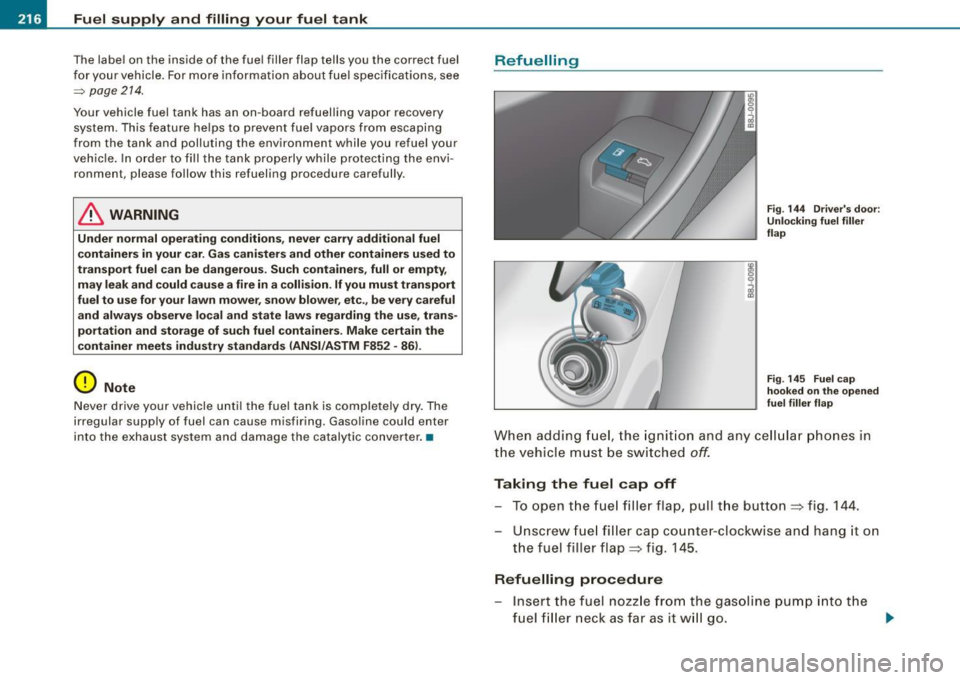
Fig. 144 Driver's door:
Unlocking fuel filler
flap
Fig . 145 Fuel cap
hooked on the opened
fuel filler flap
When adding fuel, the ignition and any cellular phones in
the vehicle must be switched
off.
Taking the fuel cap off
To open the fuel filler flap, pull the button ~ fig. 144.
Unscrew fuel filler cap counter-clockwise and hang it on
the fuel filler flap~ fig. 145 .
Refuelling procedure
Insert the fuel nozzle from the gasoline pump into the
fuel filler neck as far as
it will go. .,_
Page 219 of 316

_____________________________________ F_ u_ e_l _s _u-= pc...:... p_ly =--- a_ n_ d_ f_ i_ ll _in -=: gc.. y -=--- o-u_ r_ fu_ e_l _t _a _n_ k __ fflllll
•
- Select a medium refuelling rate so that the nozzle
switches off automatically when the tank is full.
Putting the fuel cap back on
- After filling your tank, twist the fuel filler cap clockwise
until you hear a definite click.
- Close the fuel filler flap.
To avoid fuel spilling or evaporating from the fuel tank always close
fuel filler cap properly and completely. An improperly closed fuel
filler cap may also cause a message in the driver information system =>
page 24 or cause the MIL lamp=> page 26 to come on.
& WARNING
Improper refueling or handling of fuel can cause fire, explosion
and severe burns .
• Fuel is highly flammable and can cause severe burns and other
injuries.
• Failure to shut the engine off while refueling and/or to insert
the pump nozzle fully into the fuel filler neck could cause fuel to
spray out of filler neck or to overflow. Fuel spray and overflowing
fuel can cause a fire.
• Never use a cellular telephone while refueling . The electromag
netic radiation can cause sparks that can ignite fuel vapors and
cause a fire .
• Never get back into your vehicle while refueling. If in excep
tional circumstances you must get back in your vehicle while refu
eling, make certain that you close the door and touch metal to
discharge static electricity before touching the filler nozzle again.
Static electricity can cause sparks that can ignite fuel vapors
released during refueling.
• Never smoke or have an open flame anywhere in or near your
vehicle when refueling or filling a portable fuel container.
& WARNING (continued)
• For your safety, we strongly recommend that you do not travel
with a portable fuel container in your vehicle. The container, full or empty may leak and could cause a fire, especially in a crash .
• If, under exceptional circumstances, you must transport a
portable fuel container, please observe the following: -Never fill a portable fuel container while it is anywhere in or
on the vehicle (for example, in the luggage compartment, or on
the trunk). Static electricity can build up while filling and can ignite fuel vapors causing a fire.
- Always place a portable fuel container on the ground before
filling.
- Always keep the filler nozzle completely inside the portable
container before and during filling.
- If filling a portable container made of metal, the filler nozzle
must always be in contact with the container. This will help
prevent static electricity from discharging and cause a fire.
- Never spill fuel inside the vehicle or luggage compartment.
Fuel vapors are highly flammable.
- Always observe local and state/provincial laws regarding the
use, storage and transportation of fuel containers
- Make certain the fuel container meets industry standards
(ANSI / ASTM F852-86l.
(D Note
If any fuel has spilled onto the car, it should be removed immedi
ately to prevent damage to the paint.
<£> For the sake of the environment
As soon as the correctly operated nozzle switches off automatically
for the first time, the tank is full. Do not try to add more fuel because
fuel may spill out. In addition, the expansion space in the fuel tank ..,_
Vehicle care
I t •
Page 247 of 316
________________________________________________ T_ i _r_e _s_ a_n_ d_ w_ h_ e_e _ l_s __ _
•
pressure for a trip - even one that you would not consider to be
"long." See=>
page 246, "Tires and vehicle load limits" for more
important information .
Always use an accurate tire pressure gauge when checking and adjus ting inflation pressures . Check all of the tires and be sure not
to forget the spare tire . If the pressure in any tire is too high when
the tire is "cold," let air out of the tire slowly with the edge of the tire gaug e and keep checking the pressur e until you reach the pressure
that is correct for the load (passengers and luggage) and kind of driving you plan to do.
I f the pressure in any tire is too low, note the difference between the
pressure in the cold tire and the pressure you need and add the air
that you need to reach the correct pressure for the vehicle load
(passengers and luggage) for the tires on your vehicle as listed on
the on your vehicle and in this manual and the kind of driving you
plan to do.
Ne ver e xceed the m aximum inflat ion pre ssure l isted on the tire
sid ewall for any rea son .
Remember that the veh ic le manufacturer, not the tire manufacturer ,
determin es the correct tire pressure for the tires on your vehicle .
It is important to check the tire pressure when the tires are cold .
• Read the required tire pressure from the tire pressure label
located on driver 's side 8 -pillar.
• T urn the va lve stem cap counter -clockwise to remove it from the
tire valve .
• Place the air pressure gauge on the valve .
• The tire pressures should only be checked and adjusted when
the tires are cold. The s lightly raised pressures of warm tir es mus t
not be reduced.
• Adjust the tire pressure to the load you are carrying .
• Reinstall the va lve stem cap on the valve .
When should I ch eck the tir e pr essu re?
The correct tire pressure is especially important a t high speeds . The
pressure should therefore be checked a t least once a month and
a lways before sta rting a journey.
Wh en sho uld I adjust the tire p re ss ure s?
Adjust the tire pressure to the load yo u are carrying . After changing
a wheel
o r replacing wheels you have to adjust the tire pressures on
a ll whee ls . In addition, you must then initia lize the new tire pres
sures in the tire pressure monitoring system=>
page 41.
& WARNING
Incorre ct t ir e pre ssures and /or underinfl ati on ca n lead sudden tire
failure , los s of contro l, colli sion , seriou s per sonal injury or even
death .
• Whe n the w arnin g sy mbol appear s in the instrument
cl uster , sto p and in spe ct the tire s.
• Inco rre ct tire pre ssure and /or underin flati on can cau se
in creased tire wear and can affe ct the ha ndling of the vehicle and
s topping ability.
• Incorre ct t ire pre ssures and /or underinfl atio n c an a ls o le ad to
s udden tire f ailure , including a blowout and sudden deflation ,
ca usi ng loss o f vehi cle co ntrol.
• The driv er i s re sp o nsible for the correct tire p re ss ure s for all
tire s on the vehicle . T he appl icable pre ssure v alu es are lo ca ted o n
a stic ker on th e driver 's side B -pillar.
• Onl y w hen all tire s on th e veh icle a re fi lled to the corre ct pre s
s ure , the tire pre ssure monitor ing sy ste m can work correctly .
• The u se of incorre ct t ire pr essure val ues can lead to accidents
or other d am age. The refo re it is esse ntial th at the dri ver ob serve
the spe cified tire pr essur e value s fo r the t ire s and the correc t pr es
s ures for the function of the tire pr essure monitoring sy stem.
• Always inflate t ires to the r ecom mended and corre ct tir e pr es -
su re bef ore dri ving off.
~
Vehicle care I t •
Page 270 of 316

_L--_W:...:....: h..:. a .:.:....: t..:..d=o ....:...I ..:d .:..;o:......;. n..:.. o.::;..;. vv..:....:.. ? ______________________________________________ _
App lies to veh ic les : w it h cap-cove red whee l bo lts
Wheels vvith cap -covered wheel bolts
The caps must be removed first from the wheel bolts
before the bolts can be unscrewed .
Remo ving
Fig . 172 W hee l
c h an ge: remo vin g t he
wh eel b olt caps
- Push the plasti c clip provided with t he on board tool kit
down over the wheel bo lt cap until it engages.
- Pull on the properly engaged plas tic c lip to ex tract the
cap
=> fig. 172 .
Refi tt ing
- Place the caps over the wheel bolts and push them back
1n.
The caps are there to prot ect and keep th e wheel bolts cl ean .•
Loosening and tightening the wheel bolts
The wheel bolts must be loosened before raising the
vehicle .
Lo os enin g
Fig. 173 Wheel
c h an ge : loose nin g the
wheel bol ts
- Fit the wheel b olt wr ench over the wheel bolt and push it
down as far as it wi ll go .
- Close your grip around the
end of the wrench hand le for
maximum torque and turn the wheel bolts counter-c lock
wis e about
one single turn in the direct ion of arrow
=> f ig . 173 .
Tight ening
Fit the wheel b olt wr ench ove r the wheel bolt and pus h it
down as far as it wi ll go.
- Close your gri p around the
end of the wrench hand le for
ma ximum torque and turn eac h wheel bolt clockwi se
until it sits tight . _..