2008 AUDI TT ROADSTER warning
[x] Cancel search: warningPage 140 of 316
___ S_a_ f_ e_ t-= y_ b_e_ l_ t _s _______________________________________________ _
- Make sure that your passengers also b uckle up and prop
erly wea r th eir sa fety belts.
Protect children wit h a child restraint system appropriate
for the size and age.
The warning light i in the instrument cluster lights up when the
ignition is switched on as a reminder to fasten the safety belts. In
addition , you will hear a warning tone.
After the ignition is switched on, the warning light in the instrument cluster will a lways come on for about 6 seconds and if the driver has
not fastened the safety belt, a warning tone will also sound for
about 6 seconds . As soon as the driver has fastened the safety belt,
the warning tone will stop and the warning light will go out .
If the driver or front seat passenger have not buckled -up within
about 10 seconds after the warning tone has stopped and the
vehicle is moving faster than about 15 mph, the warning tone will
sound again for about 6 seconds and then stop for 24 seconds and
then repeat this reminder sequence for a maximum of 2 minutes. At
speeds be low 5 mph, the warning tone will not sound.
Fa sten your safe ty belt and m ake su re that your p assengers also
properl y put on th eir s afet y belts .
& WARNING
• Safety belt s are the single mo st effective mean s available to
reduce th e risk of ser ious injur y and death in a utomobile acci
dent s. For your prote ction and th at of your pas senger s, alwa ys
c orre ctl y we ar safety belt s when t he vehicle is moving .
• Failure t o pay att ention to th e warning light that co me on,
c ould lead to per sonal injury .•
Why safety belts?
Frontal co11isions and the law of physics
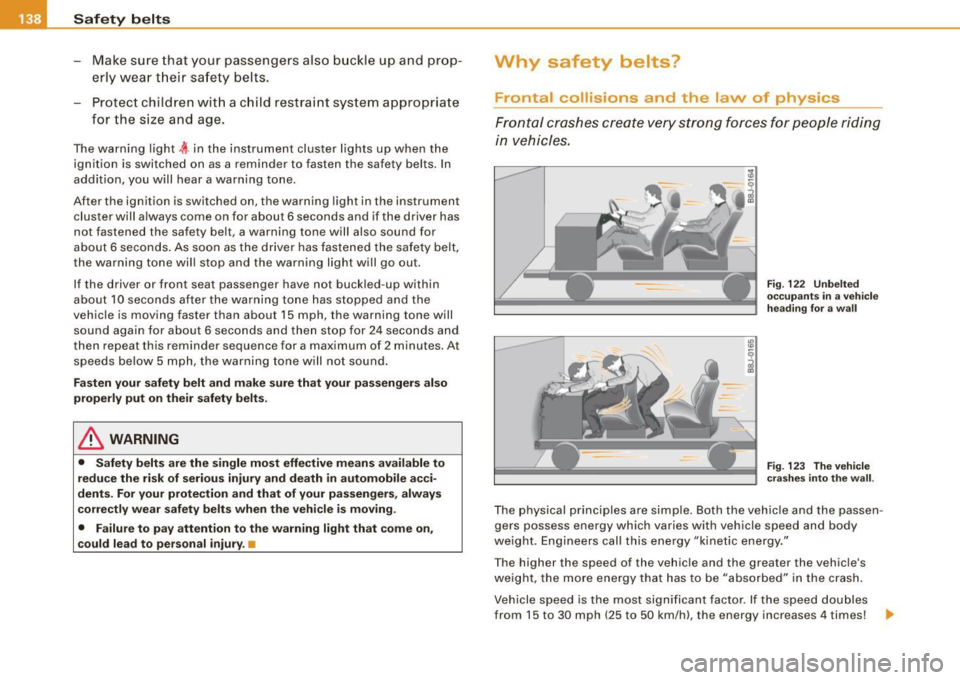
Front al crashes create very strong forces for pe ople riding
in vehicles.
F ig. 122 U nbel ted
o cc up ants i n a ve hicle
he ading for a wa ll
Fi g. 123 T he vehi cle
c ras hes in to t he wa ll.
The physical principles are simple. Both the vehicle and the passen
gers possess energy which varies with vehicle speed and body
we ight . Engineers cal l this energy "kinetic energy ."
T he higher the speed of the vehicle and the greater the vehic le's
we ight, the more energy that has to be "absorbed" in the crash .
Vehicle speed is the most significan t factor. If the speed doubles
from 15 to 30 mph (25 to 50 km/h), the energy increases 4 times! .,
Page 142 of 316
• ....__S_ a_ fe_ t _y=-- b_ e_ lt_s ________________________________________________ _
Safety belts attach passengers to the car and give them the benefit
of being slowed down more gent ly o r "softly" through the "give" in
the safety belts, crush zones and other safety features engineered
into today's vehicles . By "absorbing" the kinetic ene rgy over
a
longer period of time, the safety belts make the forces on the body
more "tolerable" and less likely to cause injury.
Although these examp les are based on a frontal co llision, sa fety
belts can a lso substantially reduce the risk of injury in other kinds
of crashes . So, whether you're on a long trip or just go ing to the
corner store, always buckle up and make sure others do, too. Acci
dent statistics show that vehic le occupants properly wea ring safety
belts have a lower risk of being injured and a much better chance of
surviv ing an accident . Properly using safety belts also great ly
increases the abi lity of the supplementa l airbags to do their job in a
collision. For this reason, wearing a safety belt is legally required in
most countries includ ing much of the United States and Canada.
Although your Audi is equipped with airbags, you sti ll have to wear
t he safety be lts prov ided. Fron t ai rbags, for example, are act iva ted
only in some frontal coll isions. The front airbags are not activated in
a ll frontal co llisions, in side and rear c ollisions, in rol l overs or i n
cases where there is not enough dece leration through impact to the
fron t of the vehicle . The same goes for the ot her airbag sys te m s in
your Audi . So, a lways wear your safety belt and make sure every
body in your vehicle is prope rly restrained! •
Important safety instructions about safety
belts
Safety belts must always be properly positioned a cross
the s trongest bones o f your b ody.
- Always w ear saf ety belts as i llus trat ed and d escrib ed in
th is cha pter .
- M ake sure that your safety b elt s ar e always read y for use
and a re not d am ag ed.
& WARNING
Not wearing safety belts or wearing them improperly increases
the risk of serious personal injury and death . Safety belts can work
only when used co rrectly .
• Alway s fa sten your safety belt s corre ctly before driving off and
make sure all pa ssengers are properly restrained .
• For maximum protection , safety belts mu st always be posi
tioned correctly on the body .
• Never strap more than one person , including sm all children ,
into any single safety belt .
• Never pla ce a safety belt ove r a child sitting on your lap .
• Always keep feet in the footwell in front of the seat while the
v ehicle is being dri ven .
• Never let any person ride with feet on the instrument panel or
s ticking out the window or on the seat .
• Never remove a safety belt while the vehicle i s moving. Doing
so will incre ase your risk of being i njured o r killed.
• Never wear belt s twi sted .
• Never wear belts over rigid or breakable objects in or on your
clothing , such a s eye glasses , pens , key s, etc ., as the se may cau se
i njury .
• Never wear the shoulder part of the belt under your arm or
otherwise out of position .
• Several layer s of heavy clothing may interfere with correct po si
tioning of belts and reduce their effe ctiveness .
• Alway s keep belt bu ckles free of anyth ing th at may prevent the
buckle from latching securely.
• Never use comfort clips or devices that create slack in the
s houlder belt . H owever , special clips may be required for the
c orre ct use of some child re straint system s.
• Never allow safety belt s to become damaged by being caught
in door or seat ha rdware . .,_
Page 143 of 316

& WARNING !continue d)
• Torn or fr ayed safety b elt s can tear and damaged b elt hard
ware can bre ak in an ac cident. Inspect belt s regularly . If webb ing ,
bind ings , buckles , or retra ctors are d am aged , have belts repla ced
by an authori zed Audi dealer or qualified work shop.
• Safety belt s th at have been worn and lo aded in an accident
mu st be repl aced with the correc t replacement saf ety belt by an
autho riz ed Audi de aler o r qualified work shop . Repla cement may
be nece ssary even if d amage cannot b e clea rly seen. Anchorage s
that wer e loaded must also be inspe cted .
• Never rem ove, modif y, dis ass em ble , or tr y to r epa ir the safety
belts your self .
• Alway s keep the belt s cle an. Dirty belt s may not work properly
and can impair the fun ction of the inertia reel=>
page 212 , "Safety
belts ".•
Safety belts
Fastening safety belts
Seat first -everybody buckle up!
Safety first
Fig . 126 Belt bu ckle
a nd ton gue on th e
driv er's s eat
Safety b elts
To provid e ma ximum protec tion, sa fety belts m ust always
be pos itioned c orrect ly on the wear er's bod y.
- Adjust the front seat and head restraint properly
=> page 87, "General recommend atio ns".
- Hold the belt by the tongue and pull it evenly across the
c h es t and pelvis=> &.
- Inse rt the tongue into the correct buckle of your seat
unti l you hea r it latch securely => fig. 126 .
- Pull on t he b elt t o mak e sur e tha t it is se curely l atc hed in
t h e buckle .
Automatic safety belt retra cto rs
Every safety belt is equipped with an automatic be lt retractor on the
shoulder belt . This feature locks the belt when the belt is pulled out
f ast, during hard braking and in an accident. The be lt may a lso lock
when you drive up or down a steep hill or through a sharp curve.
During norma l d riving the belt lets you move free ly .
Safety be lt pretensioners
The safety belts are equipped with a be lt pretensioner that helps to
tighten the safety belt and remove slack when the pretensioner is
activated. T he funct io n of the pretensioner is mon itored by a
warning light =>
page 19, "Airbag system
t!! (USA models)/!,~ · (Canada models)".
Swit chable locking featur e
Every safety belt except the one on the driver seat is equipped with
a switchable locking feature that
must be used when the safety be lt
is used to attach a chi ld seat. Be sure to read the important info rma-
tion about this feature =>
page 177. ._
Vehicle care I I Technical data
Page 144 of 316
___ S_a_ f_ e_ t-= y_ b_e_ l_ t _s _______________________________________________ _
& WARNING
Improperly positioned safety belts can cause serious injury in an
accident =:> page
142, "Safety belt position".
• Safety belts offer optimum protection only when the seat back
is upright and belts are properly positioned on the body.
• Never attach the safety belt to the buckle for another seat.
Attaching the belt to the wrong buckle will reduce safety belt effectiveness and can cause serious personal injury.
• A passenger who is not properly restrained can be seriously
injured by the safety belt itself when it moves from the stronger
parts of the body into critical areas like the abdomen.
• Always lock the convertible locking retractor when you are
securing a child seat in the vehicle=:> page
179. •
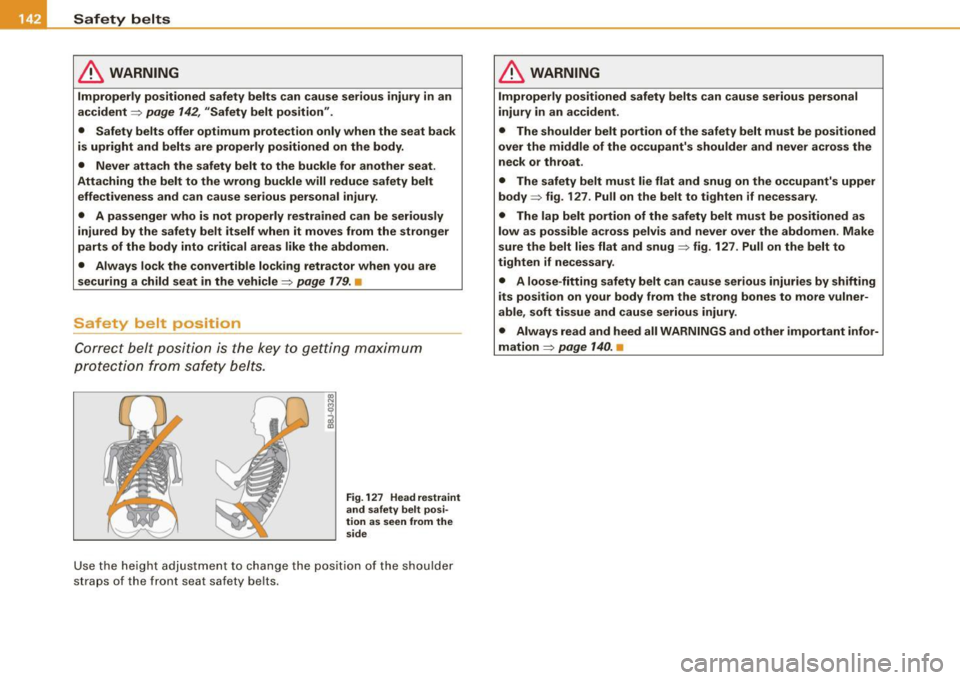
Safety belt position
Correct belt position is the key to getting maximum
protection from safety belts.
Fig. 127 Head restraint
and safety belt posi
tion as seen from the side
Use the height adjustment to change the position of the shoulder
straps of the front seat safety belts.
& WARNING
Improperly positioned safety belts can cause serious personal
injury in an accident.
• The shoulder belt portion of the safety belt must be positioned
over the middle of the occupant's shoulder and never across the
neck or throat .
• The safety belt must lie flat and snug on the occupant's upper
body
=> fig. 127 . Pull on the belt to tighten if necessary.
• The lap belt portion of the safety belt must be positioned as
low as possible across pelvis and never over the abdomen. Make
sure the belt lies flat and snug => fig. 127. Pull on the belt to
tighten if necessary.
• A loose -fitting safety belt can cause serious injuries by shifting
its position on your body from the strong bones to more vulner
able, soft tissue and cause serious injury.
• Always read and heed all WARNINGS and other important infor
mation => page
140. •
Page 145 of 316
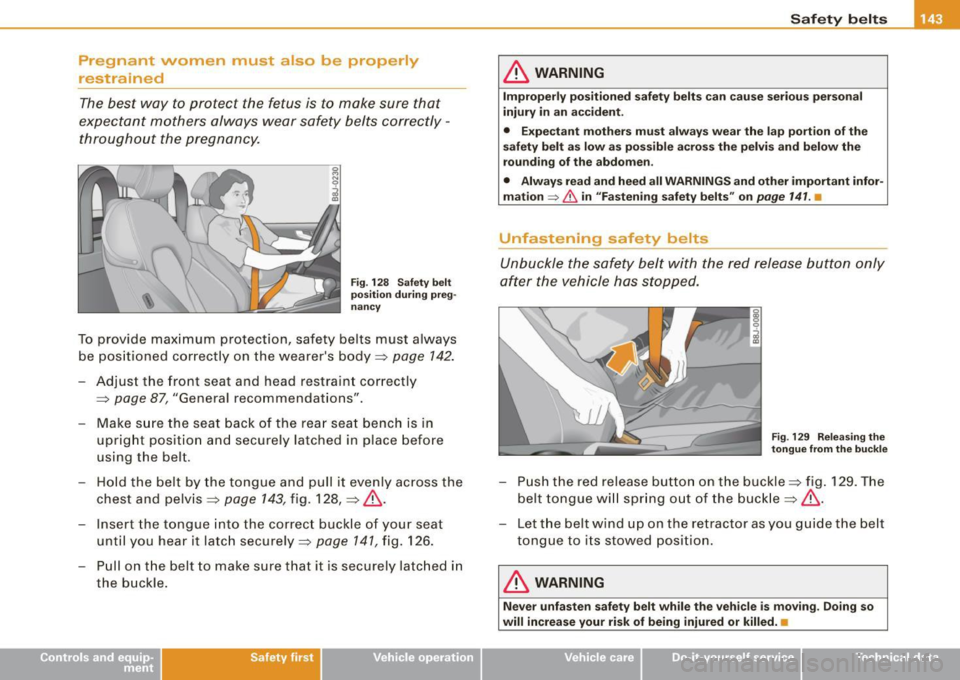
Pregnant women must also be properly
restrained The best way to protect the fetus is to make sure that
expectant mothers always wear safety belts correctly -
throughout the pregnancy.
Fig . 128 Safety belt
position during preg
nancy
To provide maximum protection, safety belts must always
be positioned correctly on the wearer's body=>
page 142.
-Adjust the front seat and head restraint correctly
=> page 87, "General recommendations".
- Make sure the seat back of the rear seat bench is in
upright position and securely latched in place before
using the belt.
- Hold the belt by the tongue and pull it evenly across the
chest and pelvis::::,
page 143, fig. 128, => &.
- Insert the tongue into the correct buckle of your seat
until you hear it latch securely =>
page 141, fig. 126.
- Pull on the belt to make sure that it is securely latched in
the buckle.
Safety first
Safety belts
& WARNING
Improperly positioned safety belts can cause serious personal
injury in an accident.
• Expectant mothers must always wear the lap portion of the
safety belt as low as possible across the pelvis and below the
rounding of the abdomen.
• Always read and heed all WARNINGS and other important infor
mation ~
& in "Fastening safety belts" on page 141. •
Unfastening safety belts
Unbuckle the safety belt with the red release button only
after the vehicle has stopped.
Fig . 129 Releasing the
tongue from the buckle
- Push the red release button on the buckle=> fig. 129. The
belt tongue will spring out of the buckle =>
&.
- Let the belt wind up on the retractor as you guide the belt
tongue to its stowed position.
& WARNING
Never unfasten safety belt while the vehicle is moving . Doing so
will increase your risk of being injured or killed .•
Vehicle care
I I irechnical data
Page 146 of 316

......... _s_ a_ fe_ ty=-- b_ e _ lt_s ________________________________________________ _
Improperly worn safety belts
Incorrectly positioned safety belts can cause severe inju
ries.
Wearing safety belts improperly can cause serious injury or
death. Safety belts can only work when they are correctly positioned on the body. Improper seating positions reduce
the effectiveness of safety belts and will even increase the
risk of injury and death by moving the safety belt to critical
areas of the body. Improper seating positions also increase
the risk of serious injury and death when an airbag deploys
and strikes an occupant who is not in the correct seating
position. A driver is responsible for the safety of all vehicle
occupants and especially for children. Therefore:
- Never permit anyone to assume an incorrect sitting posi
tion in the vehicle while traveling~&.
& WARNING
Improperly worn safety belts increase the risk of serious personal
injury and death whenever a vehicle is being used.
• Always make sure that all vehicle occupants are correctly
restrained and stay in a correct seating position whenever the
vehicle is being used.
• Always read and heed all WARNINGS and other important infor
mation =>
page 140. •
Safety belt tensioners
How safety belt pretensioners work
In front and side collisions above a particular severity,
safety belts in use are tensioned automatically.
The safety belts are equipped with safety belt pretensioners . The
system is activated by sensors in front and side collisions of great
severity . This tightens the belt and takes up belt slack=>&. in
"Service and disposal of safety belt pretensioner". Taking up the
slack helps to reduce forward occupant movement during a colli
sion.
[ i] Tips
The safety belt pretensioner can only be activated once.
• In minor frontal and side collisions, in rear-end collisions, in a
rollover and in accidents involving very little impact force, the safety
belt pretensioner are not activated.
• When the safety belt pretensioner is activated, a fine dust is
released. This is normal and is not caused by a fire in the vehicle.
• The relevant safety requirements must be observed when the
vehicle or components of the system are scrapped . A qualified deal
ership is familiar with these regulations and will be pleased to pass
on the information to you.
• Be sure to observe all safety, environmental and other regula
tions if the vehicle or individual parts of the system, particularly the
safety belt or airbag, are to be disposed. We recommend you have
your authorized Audi dealer perform this service for you. •
Page 147 of 316

_________________________________________________ S_ a_f _e _t .:..y _ b_ e_lt_ s __ llll
Service and disposal of safety belt
pretension er
The safety belt pretensioners are parts of the safety belts on your
Audi. Installing, remov ing, servic ing or repair ing of belt preten
sioners can damage the safety be lt system and prevent it from
working correctly in a coll ision.
T here are some important things you have to know to make sure
that the effectiveness of the system will not be impaired and that
discarded components do not cause injury or po llute the environ
ment .
& WARNING
Improper car e, servicing and repair proc edure s can incr ease the
ri sk of p ers onal injury and d eat h by pre venting a safety b elt
pret ensioner from activating whe n ne eded o r activating it un ex
p ec tedly :
• The belt preten sioner sy stem can be activated only once. If belt
p reten sion ers ha ve been activated , the syste m mu st be repl aced.
• Never repair , adju st, or chan ge any parts o f the safet y belt
s y stem .
• Safety belt sy stem s includin g safety belt preten sion ers cannot
be r epaired . Spe cial pro cedure s are requ ired for r emoval , in sta lla
tion and di spo sal of t his sys tem .
• For an y wor k on the safet y be lt sy stem , we strongl y rec om
mend that you see your authori zed Audi de aler or qua lifi ed techni
cian w ho has an Aud i appro ved rep air m anu al, t ra ining a nd spe cial
equipment n ece ssa ry.
W For the sake of the environm ent
Undeployed airbag modu les and pretensioners might be c lassified
as Perchlorate Material -special handling may apply, see
www .dtsc .ca .gov/hazardouswaste/perchlorate. When the vehicle or
Controls and equip ment Safety first Vehicle operation parts of the restraint system including airbag modules safety belts
with pretensioners are scrapped, a ll applicable laws and regu la
tions must be observed. Your authorized Audi dealer is familiar with
these requirements and we recommend that you have your dea ler
perform this service for you. •
Vehicle care Do-it-yourself service Technical data
Page 149 of 316

________________________________________________ A_ i_ r _b _a_, g:::.,_ s..., y'- s_ t_ e_ m ___ !II
repair costs or even the lack of vehicle damage is not necessari ly an
indication of whether an airbag should inflate or not.
It is not possible to define a range of vehicle speeds that will cover
every possible kind and ang le of impact that wil l always trigger the
airbags, since the circumstances wil l vary considerab ly between
one collision and another. Important factors include, for example,
the nature (hard or so ft) of the object which the car hits, the angle
of impact, vehicle speed, etc. The front airbags wi ll also not inflate
in side or rear co llisions, or in roll -overs .
Al way s rem ember : Airbags wi ll deploy only once, and on ly in certain
kinds of coll isions . Your safety belts are always there to offer protec
tion in those situat ions in wh ich airbags are not supposed to deploy,
or when they have already deployed; for example, when your vehic le
strikes or is struck by another a fter the first coll ision.
T his is just one of the reasons why an airbag is a supplementary
restraint and is not a substitute for a sa fety be lt. The airbag system
works most effectively when used with the safety be lts. Therefore ,
a lways prope rly wea r your safety belt s =>
page 137 .
& WARNING
Sitting too clo se to the steering wheel or in strument panel will
de crease the effect ivene ss of the airbags and will incr ease the risk
of personal injury in a collision.
• Never sit closer than 10 in ches (25 cm) to the steering wheel or
in strument panel.
• If you c annot sit more than 10 in ches (25 cm ) from the steering
wheel , inve stiga te whether adaptive equipment may be available
to held you reach the pedal s and in crease your se ating dist ance
from the steering wheel.
• If you are unrestra ined , leaning forward , sittin g side ways or out
of position in any way , your risk of injury i s much higher .
• You will also receive serious injur ies and could even be killed if
you are up again st the airba g or too clo se to it when it infl ates -
ev en with an Advanced Airbag .
Controls and equip ment Safety first
Vehicle operation
& WAR N IN G ( continued )
• To reduce the ri sk of injury when an airbag inflate s, alw ays
wear safety belt s prope rly~ page 141 , "S afet y belt s".
• If children are not properly re strained , they may be severely
injured or killed whe n an airbag inflates .
• Never let children ride unrestrained or improperly restrained in
the vehi cle . Adju st the front seats properly .
• Alway s sit a s far a s po ssible from the steering wheel or the
instrument panel~ page 1 30, "Proper occup ant se ati ng po si
tions ".
• Alwa ys sit upright with yo ur b ack again st the ba ckrest of your
s eat.
• Never place your feet on the instrument p anel or on the seat .
Alway s keep both feet on the floor in front of the seat to help
prevent serious injurie s to the leg s and hips if the airbag infl ate s.
& WARNING
Airbags that have deployed in a crash must be repla ced.
• U se on ly original equipment airbags app roved by Audi and
installed by a trained technici an who has the n eces sary tool s and
diagno sti c equipment to properly repl ace an y airb ag i n your
vehicle and assure sy stem effectivenes s in a crash .
• Ne ver permit salvaged or re cy cled airb ag s to be in stalled in
your vehicle . •
Child restraints on the front seat -some
important things to know
- Be sure to read the important info rmation a nd head the
WARNINGS for important details about c hildren and
Advanced Airbags~ page
168 . .-,
Vehicle care Do-it-yourself service Technical data