Page 54 of 79
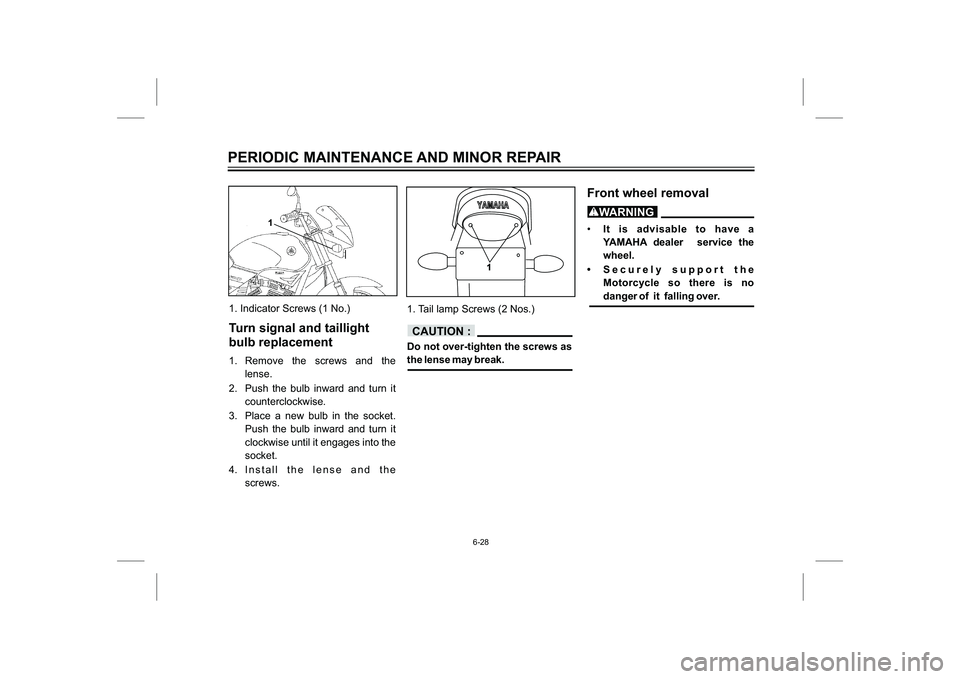
1. Indicator Screws (1 No.)Turn signal and taillight
bulb replacement1. Remove the screws and the
lense.
2. Push the bulb inward and turn it
counterclockwise.
3. Place a new bulb in the socket.
Push the bulb inward and turn it
clockwise until it engages into the
socket.
4. Install the lense and the
screws.1. Tail lamp Screws (2 Nos.)
Do not over-tighten the screws as
the lense may break.
Front wheel removalIt is advisable to have a
YAMAHA dealer service the
wheel.
Securely support the
Motorcycle so there is no
danger of it falling over.
PERIODIC MAINTENANCE AND MINOR REPAIR
6-28
WARNING
CAUTION :
Page 58 of 79

Rear wheel installation1. Install the rear wheel and the
axle.
2. Install the axle nut.
3. Insert the brake rod into the
brake cam lever and install the
brake free play adjusting nut.
4. Install the tension bar onto the
brake shoe plate and tighten the
tension bar nut to the specified
tightening torque.
5. Take the Motorcycle off the
centerstand.
6. Tighten the axle nut to the
specified tightening torque.
Then install a new cotter pin.
Specified torque:
Tension bar nut:
14 ft-lb (1.9 m kg)
Axle nut:
65 ft-lb (9.05 m kg)Always use a new cotter pin.
Check the operation of the brake
light after adjusting the rear brake. 7. Adjust the rear brake pedal free
play. (See page 6-17.)
TroubleshootingAlthough YAMAHA Motorcycles
receive a rigid inspection before
shipment from the factory, trouble
may occur during operation. Any
problem in the fuel, compression, or
ignition systems can cause poor
starting and loss of power. The
troubleshooting chart describes a
quick, easy procedure for making
checks. If your Motorcycle requires
any repair, bring it to a YAMAHA
dealer. The skilled technicians at a
YAMAHA dealership have the tools,
experience, and know-how to
properly service your Motorcycle.
Use only genuine YAMAHA parts
on your Motorcycle. Imitation
parts may look like YAMAHA
parts, but they are often inferior.
Consequently, they have a shorter
service life and can lead to
expensive repair bills.
PERIODIC MAINTENANCE AND MINOR REPAIR
6-32
WARNINGWARNING
Page 61 of 79

8. Clean the seat with a vinyl
upholstery cleaner to keep the
cover pliable and glossy.
9. Automotive-type wax may be
applied to all painted and chrome-
plated surfaces. Avoid
combination cleaner waxes. Many
contain abrasive which may mar
the paint or protective finish. When
finished, start the engine and let it
idle for several minutes.
B. STORAGELong term storage (60 days or more)
of your Motorcycle will require some
preventive procedures to guard
against deterioration. After thor-
oughly cleaning the Motorcycle,
prepare for storage as follows:
1. Drain the fuel tank, fuel lines, and
carburetor float bowl.
2. Remove the empty fuel tank, pour
a cup of SAE 10W30 or 20W40
motor oil in the tank, shake the
tank to coat the inner surfaces
thoroughly and drain off the
excess oil. Reinstall the tank.
3. Remove the spark plug, pour
about one tablespoon of SAE
10W30 or 20W40 motor oil in the
spark plug hole and reinstall the
spark plug. Kick the engine over
several times (with the ignition off)
to coat the cylinder wall with oil.
4. Remove the drive chain.
Thoroughly clean the chain withsolvent and lubricate it. Reinstall
the chain or store it in a plastic bag
(tied to frame for safe-keeping).
5. Lubricate all control cables.
6. Block up the frame to raise both
wheels off the ground.
7. Tie a plastic bag over the
exhaust pipe outlet to prevent
moisture from entering.
8. If storing in a humid or salt-air
atmosphere, coat all exposed
metal surfaces with a light film of
oil. Do not apply oil to any rubber
parts or the seat cover.
9. Remove the battery and charge it.
Store it in a dry place and
recharge it once a month. Do not
store the battery in an excessively
warm or cold place (less than 0ºC
or more than Ambient).
Make any necessary repairs before
storing the Motorcycle.
CLEANING AND STORAGE
7-2
NOTE :
Page 64 of 79
SPECIFICATIONS
8-3
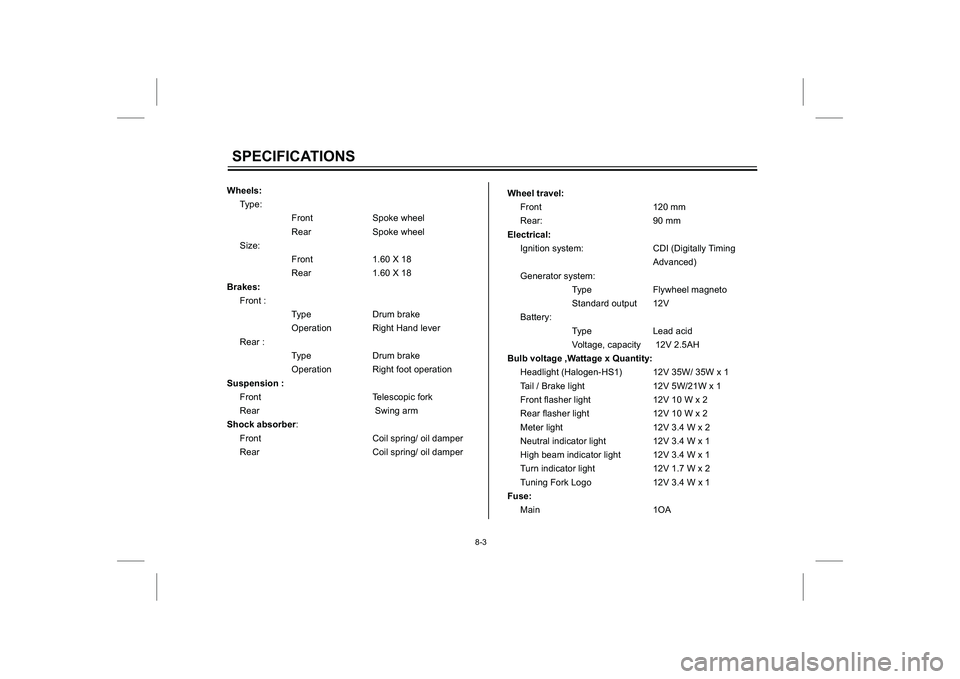
Wheels:
Brakes:
Suspension :
Shock absorberType:
Size:
Front :
Type Drum brake
Operation Right Hand lever
Front Telescopic fork
Rear
:
Front Coil spring/ oil damper
RearFront Spoke wheel
Rear Spoke wheel
Front 1.60 X 18
Rear 1.60 X 18
Rear :
Type Drum brake
Operation Right foot operation
Swing arm
Coil spring/ oil damperWheel travel:
Electrical:
Bulb voltage ,Wattage x Quantity:
Fuse:Front 120 mm
Rear: 90 mm
Ignition system: CDI (Digitally Timing
Generator system:
Type
Standard output 12V
Battery:
Type
Voltage, capacity
Headlight
Tail / Brake light
Front flasher light
Rear flasher light
Meter light
Neutral indicator light
High beam indicator light
Turn indicator light
Tuning Fork Logo 12V 3.4Wx1
MainAdvanced)
Flywheel magneto
Lead acid
12V 2.5AH
(Halogen-HS1) 12V 35W/ 35W x 1
12V 5W/21W x 1
12V10Wx2
12V10Wx2
12V3.4Wx2
12V3.4Wx1
12V3.4Wx1
12V1.7Wx2
1OA
Page 69 of 79
PRE-DELIVERY INSPECTION REPORT10-4
C. ELECTRICAL
a. Ignition Switch Operation
b. Left Hand Switch Operation & Pass Beam
• Horn
• Indicator• Head Light
c. All Bulbs - Functioningd. Battery
• Electrolyte Level
• Specific Gravity• Routing of Breather Pipe• Fuse• Routing of Positive Wire (Red) Below Breather Pipe
D. ROAD TEST
a. Starting
b. Gear Shifting Operationc. Clutch Operationd. Application of Brakes (Front and Rear)e. Speedo/ Odo Meter Operationf. Fuel gauge OperationEXPLAINED BYSIGNATURE: _____________ NAME:
CUSTOMER’S SIGN
MAIN SELLING DLR’S STAMP, SIGNATURE
service2.pmd11/3/2006, 8:50 PM 4
Page:
< prev 1-8 9-16 17-24