2007 SUBARU IMPREZA air condition
[x] Cancel search: air conditionPage 343 of 364
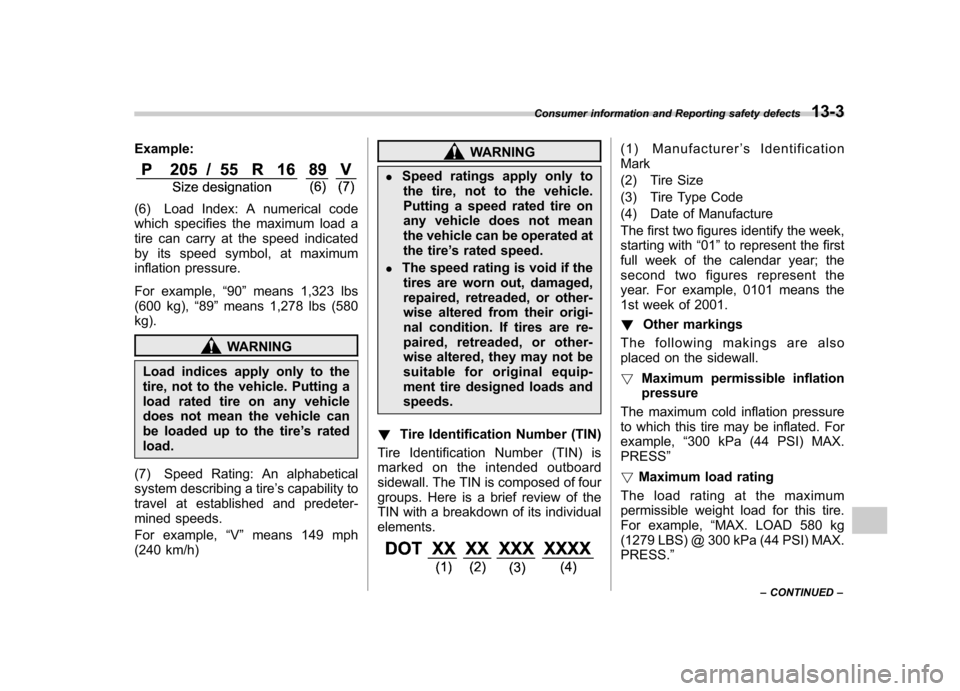
Example:
(6) Load Index: A numerical code
which specifies the maximum load a
tire can carry at the speed indicated
by its speed symbol, at maximum
inflation pressure.
For example,“90 ”means 1,323 lbs
(600 kg), “89 ”means 1,278 lbs (580
kg).
WARNING
Load indices apply only to the
tire, not to the vehicle. Putting a
load rated tire on any vehicle
does not mean the vehicle can
be loaded up to the tire ’s rated
load.
(7) Speed Rating: An alphabetical
system describing a tire ’s capability to
travel at established and predeter-
mined speeds.
For example, “V ” means 149 mph
(240 km/h)
WARNING
. Speed ratings apply only to
the tire, not to the vehicle.
Putting a speed rated tire on
any vehicle does not mean
the vehicle can be operated at
the tire ’s rated speed.
. The speed rating is void if the
tires are worn out, damaged,
repaired, retreaded, or other-
wise altered from their origi-
nal condition. If tires are re-
paired, retreaded, or other-
wise altered, they may not be
suitable for original equip-
ment tire designed loads and speeds.
! Tire Identification Number (TIN)
Tire Identification Number (TIN) is
marked on the intended outboard
sidewall. The TIN is composed of four
groups. Here is a brief review of the
TIN with a breakdown of its individual
elements.(1) Manufacturer ’s Identification
Mark
(2) Tire Size
(3) Tire Type Code
(4) Date of Manufacture
The first two figures identify the week,
starting with “01 ”to represent the first
full week of the calendar year; the
second two figures represent the
year. For example, 0101 means the
1st week of 2001. ! Other markings
The following makings are also
placed on the sidewall. ! Maximum permissible inflation
pressure
The maximum cold inflation pressure
to which this tire may be inflated. For
example, “300 kPa (44 PSI) MAX.
PRESS ”
! Maximum load rating
Theloadratingatthemaximum
permissible weight load for this tire.
For example, “MAX. LOAD 580 kg
(1279 LBS) @ 300 kPa (44 PSI) MAX.
PRESS. ”
Consumer information and Reporting safety defects
13-3
– CONTINUED –
Page 347 of 364

an asymmetrical tire that has a
particular side that must always
face outward when mounting on a
vehicle.
. Accessory weight
The combined weight (in excess of
those standard items which may be
replaced) of floor mats, leather seats
and cross bars to the extent that these
items are available as factory-in-
stalled equipment (whether installed
or not). . Curb weight
The weight of a motor vehicle with
standard equipment including the
maximum capacity of fuel, oil, and
coolant and air conditioning. . Maximum loaded vehicle weight
The sum of curb weight, accessory
weight, vehicle capacity weight and
production options weight. . Normal occupant weight
150 lbs (68 kg) times the number of
occupants (3 occupants). . Occupant distribution
Distribution of occupants in a vehicle,
2 in front, 1 in rear seat. .
Production options weight
The combined weight of those in-
stalled regular production options
weighing over 5.1 lbs (2.3 kg) in
excess of those standards items
which they replace, not previously
considered in curb weight or acces-
sory weight. . Vehicle capacity weight
The total weight of cargo, luggage
and occupants that can be added to
the vehicle. . Vehicle maximum load on a tire
Load on an individual tire that is
determined by distributing to each
axle its share of the maximum loaded
vehicle weight and dividing by two. . Vehicle normal load on a tire
Load on an individual tire that is
determined by distributing to each
axle its share of the curb weight,
accessory weight, and normal occu-
pant weight and dividing by two. & Tire care –maintenance and
safety practices
. Check on a daily basis that the tires
are free from serious damage, nails,
and stones. At the same time, check the tires for abnormal wear. .
Inspect the tire tread regularly and
replace the tires before their tread
wear indicators become visible. When
a tire ’s tread wear indicator becomes
visible, the tire is worn beyond the
acceptable limit and must be replaced
immediately. With a tire in this condi-
tion, driving at even low speeds in wet
weather can cause the vehicle to
hydroplane. Possible resulting loss
of vehicle control can lead to an
accident. . To maximize the life of each tire
and ensure that the tires wear uni-
formly, it is best to rotate the tires
every 7,500 miles (12,500 km). Rotat-
ing the tires involves switching the
front and rear tires on the right-hand
side of the vehicle and similarly
switching the front and rear tires on
the left-hand side of the vehicle.
(Each tire must be kept on its original
side of the vehicle.) Replace any
damaged or unevenly worn tires at
the time of rotation. After tire rotation,
adjust the tire pressures and make
sure the wheel nuts are correctly
tightened. A tightening torque specifi-
Consumer information and Reporting safety defects
13-7
– CONTINUED –
Page 355 of 364

14-2Index
A
ABS (Anti-lock Brake System) ..................................... 7-21
Warning light ................................................. 3-17, 7-22
Accessories ....................................................... 5-2, 11-44
Accessory power outlet ................................................. 6-6
Active head restraint ..................................................... 1-4
Air cleaner element ................................................... 11-15
Air conditioner ............................................................. 4-7
Air filtration system ..................................................... 4-12
Air flow selection .......................................................... 4-2
Alarm system ............................................................ 2-13
All-Wheel Drive warning light (AT vehicles) .................... 3-19
Aluminum wheels ...................................................... 11-35
Antenna system ........................................................... 5-2
Anti-lock Brake System (ABS) ..................................... 7-21
Arming the system ..................................................... 2-14
Armrest ....................................................................... 1-7
Ashtray ....................................................................... 6-8
AT OIL TEMPerature warning light ............................... 3-17
Audio set .................................................................... 5-3
Auto-dimming mirror/compass ...................................... 3-32
Automatic climate control system ................................... 4-8
Automatic transmission ............................................... 7-15
Capacities ............................................................. 12-4
Fluid .................................................................... 11-20
Selector lever ........................................................ 7-16
Temperature warning light (AT OIL TEMP) ................. 3-17
Automatic/Emergency Locking Retractor (A/ELR) ... ........ 1-11BBattery
.................................................................... 11-41
Jump starting .......................................................... 9-8
Replacement (Remote keyless entry system) .............. 2-7
Brake Booster ............................................................... 11-27
Fluid ................................................................... 11-25
Pad and lining ...................................................... 11-29
Parking ....................................................... 7-24, 11-30
Pedal .................................................................. 11-27
System .................................................................. 7-21
Brake pedal Free play ............................................................. 11-27
Reserve distance .................................................. 11-28
Brake system ............................................................. 7-21
Warning light .......................................................... 3-18
Braking ..................................................................... 7-20
Tips ...................................................................... 7-20
Breaking-in of new brake pads and linings ................... 11-29
Bulb Chart .................................................................... 12-9
Replacing ............................................................ 11-45
C Capacities ................................................................. 12-4
Cargo area Bars ...................................................................... 6-12
Cover .................................................................... 6-10
Light ...................................................................... 6-2
Tie-down hooks ...................................................... 6-11
Catalytic converter ....................................................... 8-3