Page 763 of 1449
ENGINE ELECTRICAL -Ignition System16-31
STANDARD WAVEFORM
Observation Conditions
FunctionSecondary
Pattern heightHigh (or Low)
Pattern selectorRaster
Engine revolutionsCurb idle speed
kV
Secondary
ignition
voltage
waveformIgnition voltage
(point D)
Dwell
section
Point CSpark line (point A)
Wave damping
reduction section
(point B)
Time
Observation Condition (The only change from above condition is the pattern selector.)
Pattern selectorDisplay
Secondary
ignition
voltage
waveformkV
No. 4 cylinder
No. 2 cylinder
ignition noiseNo. 1 cylinderNo. 3 cylinder
ignition noise
Neutral section 0
2Time
Page 772 of 1449
ENGINE AND EMISSION CONTROL -Engine Control System17-2
ENGINE CONTROL SYSTEM
GENERAL INFORMATION
A cable-type accelerator mechanism and a
suspended-type pedal have been adopted.
SERVICE SPECIFICATIONS
ItemsStandard value
Accelerator cable play mm1-2
Engineidlespeedr/min850±50Engineidle speed±/min850±50
ON-VEHICLE SERVICE
ACCELERATOR CABLE CHECK AND
ADJUSTMENT
1. Turn A/C and lamps OFF.
Inspect and adjust at no load.
2. Warm engine until stabilized at idle.
3. Confirm idle speed is at prescribed value.
Standard value: 850±50 r/min
4. Stop engine (ignition switch OFF).
5. Confirm there are no sharp bends in accelerator cable.
6. Check inner cable for correct slack.
Standard value: 1 - 2 mm
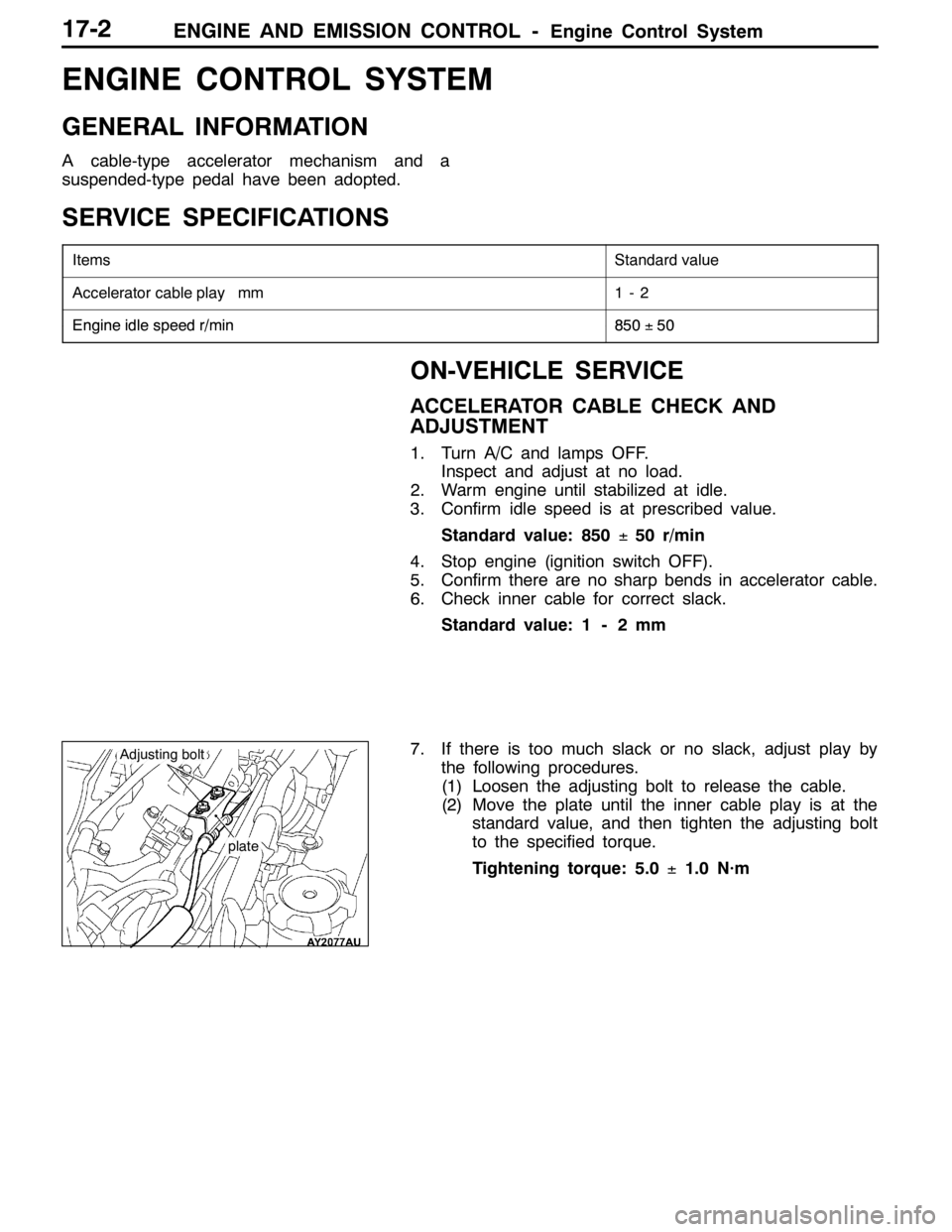
7. If there is too much slack or no slack, adjust play by
the following procedures.
(1) Loosen the adjusting bolt to release the cable.
(2) Move the plate until the inner cable play is at the
standard value, and then tighten the adjusting bolt
to the specified torque.
Tightening torque: 5.0±1.0 N·m
plate
Adjusting bolt
Page 779 of 1449
ENGINE AND EMISSION CONTROL -Emission Control System
PCV valve
17-9
COMPONENT LOCATION
POSITIVE CRANKCASE VENTILATION SYSTEM
CHECK
1. Remove the ventilation hose from the PCV valve.
2. Remove the PCV valve from the rocker cover.
3. Reinstall the PCV valve at the ventilation hose.
4. Start the engine and run at idle.
5. Place a finger at the opening of the PCV valve and check
that vacuum of the intake manifold is felt.
NOTE
At this moment, the plunger in the PCV valve moves
back and forth.
6. If vacuum is not felt, clean the PCV valve or replace
it.
PCV VALVE CHECK
1. Insert a thin rod into the PCV valve from the side shown
in the illustration (rocker cover installation side), and move
the rod back and forth to check that the plunger moves.
2. If the plunger does not move, there is a clogging in the
PCV valve. In this case, clean or replace the PCV valve.
PCV valve
PCV valve
Page 780 of 1449
ENGINE AND EMISSION CONTROL -Emission Control System
Vacuum tank
Alternator
Purge control solenoid valve
17-10
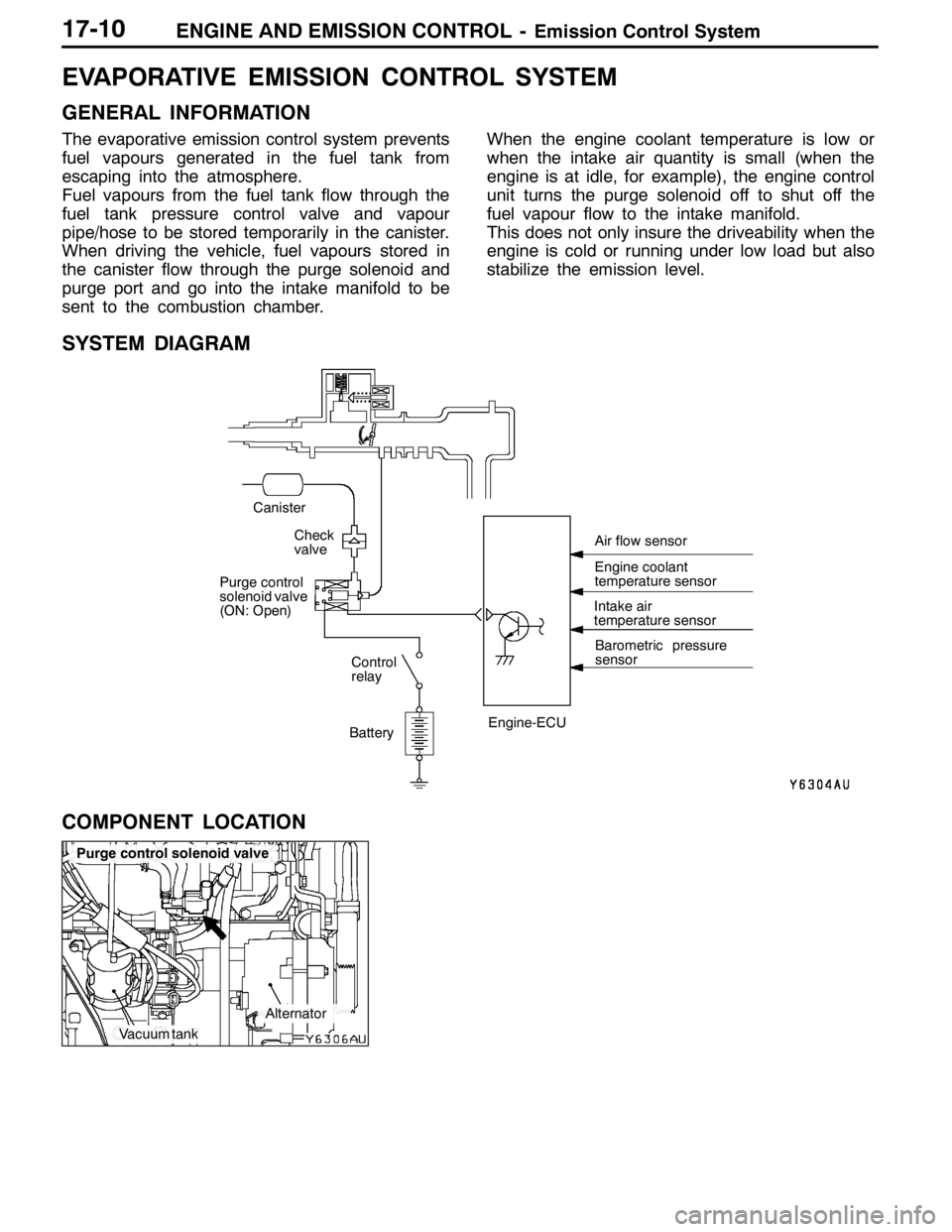
EVAPORATIVE EMISSION CONTROL SYSTEM
GENERAL INFORMATION
The evaporative emission control system prevents
fuel vapours generated in the fuel tank from
escaping into the atmosphere.
Fuel vapours from the fuel tank flow through the
fuel tank pressure control valve and vapour
pipe/hose to be stored temporarily in the canister.
When driving the vehicle, fuel vapours stored in
the canister flow through the purge solenoid and
purge port and go into the intake manifold to be
sent to the combustion chamber.When the engine coolant temperature is low or
when the intake air quantity is small (when the
engine is at idle, for example), the engine control
unit turns the purge solenoid off to shut off the
fuel vapour flow to the intake manifold.
This does not only insure the driveability when the
engine is cold or running under low load but also
stabilize the emission level.
SYSTEM DIAGRAM
BatteryIntake air
temperature sensor
Barometric pressure
sensor
Check
valve
Canister
Control
relay
Purge control
solenoid valve
(ON: Open)
Engine-ECUEngine coolant
temperature sensor Air flow sensor
COMPONENT LOCATION
Page 781 of 1449

ENGINE AND EMISSION CONTROL -Emission Control System17-11
PURGE CONTROL SYSTEM CHECK
1. Disconnect the vacuum hose (red stripe) from throttle
body and connect it to a hand vacuum pump.
2. Plug the nipple from which the vacuum hose was removed.
3. When the engine is cold or hot, apply a vacuum of 53
kPa, and check the condition of the vacuum.
When engine is cold
(Engine coolant temperature: 40_C or less)
Engine conditionNormal condition
At idleVacuum is maintained
3,000 r/min
When engine is hot
(Engine coolant temperature: 80_C or higher)
Engine conditionNormal condition
At idleVacuum is maintained
3,000 r/min (within 3
minutes after engine starts)Vacuum will leak.
PURGE PORT VACUUM CHECK
1. Disconnect the vacuum hose (red stripe) from the throttle
body purge vacuum nipple and connect a hand vacuum
pump to the nipple.
2. Confirm that the vacuum is approximately constant
regardless of the engine rotation speed.
NOTE
If vacuum changes, it is possible that the throttle body
purge port maybe clogged and require cleaning.
Red stripe
Plug
Throttle body
Red stripe
Throttle body
Vac-
uum
Engine speed (r/min)
Page 783 of 1449

ENGINE AND EMISSION CONTROL -Emission Control System17-13
EXHAUST GAS RECIRCULATION (EGR) SYSTEM
GENERAL INFORMATION
The exhaust gas recirculation (EGR) system lowers
the nitrogen oxide (NOx) emission level. When the
air/fuel mixture combustion temperature is high,
a large quantity of nitrogen oxides (NOx) is
generated in the combustion chamber. Therefore,
this system recirculates part of emission gas fromthe exhaust port of the cylinder head to the
combustion chamber through the intake manifold
to decrease the air/fuel mixture combustion
temperature, resulting in reduction of NOx.
The EGR flow rate is controlled by the EGR valve
so as not to decrease the driveability.
OPERATION
The EGR valve is being closed and does not
recirculate exhaust gases under one of the following
conditions. Otherwise, the EGR valve is opened
and recirculates exhaust gases.DThe engine coolant temperature is low.
DThe engine is at idle.
DThe throttle valve is widely opened.
SYSTEM DIAGRAM
ON Throttle body
EGR control
solenoid valve
Engine
control
relay
Battery EGR valve
Crank angle sensor
Throttle position sensor Engine-ECU
Engine coolant
temperature sensor Air flow sensor
Page 844 of 1449

MANUAL TRANSMISSION - Troubleshooting 22A-36
Item
no.Normal conditions Check condition Check item
19Pressure sensor power
supplyIgnition switch: ONApprox.5 V
20Valve power supplyIgnition switch: ONSystem voltage
21Steering wheel sensor
voltage Ignition switch: ONSteering wheel: Turn1 - 2 V and 2.5 - 4.5 V
are displayed alter-
nately.
22Steering wheel sensor
voltage Ignition switch: ONSteering wheel: Turn1 - 2 V and 2.5 - 4.5 V
are displayed alter-
nately.
23Steering wheel sensor
ltSTN
Ignition switch: ONSteering wheel: Neutral1-2Vg
voltage
g
Steering wheel: Turn2.5 - 4.5 V
51Idle switchIgnition switch: ONAccelerator pedal: Full
closedON
Accelerator pedal: PressOFF
52Steering wheel sensor
STN
Ignition switch: ONsteering wheel: NeutralONg
g
Steering wheel: Turn from
the neutral positionOFF
53Steering wheel sensor
Ignition switch: ONSteering wheel: Turn slowlyON and OFF are dis-
played alternaltely.
54Steering wheel sensor
Ignition switch: ONSteering wheel: Turn slowlyON and OFF are dis-
played alternately
55Steering wheel sensor
learning Perform actual drivingSteering wheel sensor neu-
tral position learning exe-
cutedON
Steering wheel sensor neu-
tral position learning unex-
ecutedOFF
56Stop lamp switchIgnition switch: ONBrake pedal: DepressONppg
Engine: StoppedBrake pedal: ReleaseOFF
57Motor monitorElectric pump motor is currently operatingON
Electric pump motor is currently not operatingOFF
58Oil pressure stateElectric pump motor is currently operatingLOWp
Electric pump motor is currently not operatingHIGH
59Directional valve
Ri ht
AYC clutch right side is currently operatingON
AYC clutch right side is currently not operatingOFF
60Directional valve
Lft
AYC clutch left side is currently operatingON
AYC clutch left side is currently not operatingOFF
61ABS monitorABS is currently operatingON
ABS is currently not operatingOFF
62Parking brake switchIgnition switch: ONParking brake lever: PullONgg
Engine:StoppedParking brake lever: Re-
leaseOFF
63ACD mode switchIgnition switch: ONACD mode switch: PressONg
Engine:StoppedACD mode switch: ReleaseOFF
Page 847 of 1449

MANUAL TRANSMISSION - Troubleshooting 22A-39
Termi-
nal no.Normal state Check condition Check item
24*2Longitudinal G sensor
earth, lateral G sensor
earthAny time1 V or less
26ECU earthAny time1 V or less
31ECU backup power
supplyAny timeSystem voltage
32Pressure sensorIgnition switch: ON0.5 - 1.5 V
33Steering wheel sensor
Ignition switch: ONSteering wheel: Turn slowly1-2V↔2.5 -
4.5 V flushing
34Steering wheel sensor
Ignition switch: ONSteering wheel: Turn slowly1-2V↔2.5 -
4.5 V flushing
35Diagnosis data input/
output--
36Idle switchIgnition switch: ONAccelerator pedal: Full closed1 V or lessg
Accelerator pedal: Depress4.5 - 5.0 V
37Parking brake switchIgnition switch: ONParking brake lever: Pull1 V or lessgg
Parking brake lever: ReleaseSystem voltage
38Stop lamp switchIgnition switch: ONBrake pedal: DepressSystem voltageppg
Brake pedal: Release1 V or less
39TPSIgnition switch: ONAccelerator pedal: Full closed0.5 - 0.7 Vg
Accelerator pedal: Full throttle4.5 - 5.5 V
40ACD mode indicator
lamp Ignition switch: ONACD mode indicator lamp position:
TARMAC0V
p
ACD mode indicator lamp position:
Except for aboveApprox. 10.5 V
42ECU earthAny time1 V or less
43Pressure sensor earthAny time1 V or less
44Steering wheel sensor
STN
Ignition switch: ONSteering wheel: Neutral1-2Vg
g
Steering wheel: Turn from the
neutral position2.5 - 4.5 V
46Diagnosis control--
47ACD mode switchIgnition switch: ONSwitch: PressSystem voltageg
Switch: Release0V
49*1ABS monitorWith ABS not activeSystem voltage
With ABS active1.5 V or less
50*2EarthAny time1 V or less
51ACD mode indicator
lamp Ignition switch: ONACD mode indicator lamp position:
SNOW0V
p
ACD mode indicator lamp position:
Except for aboveApprox. 10.5 V
52ACD mode indicator
lamp Ignition switch: ONACD mode indicator lamp position:
GRAVEL0V
p
ACD mode indicator lamp position:
Except for aboveApprox. 10.5 V