Page 235 of 440
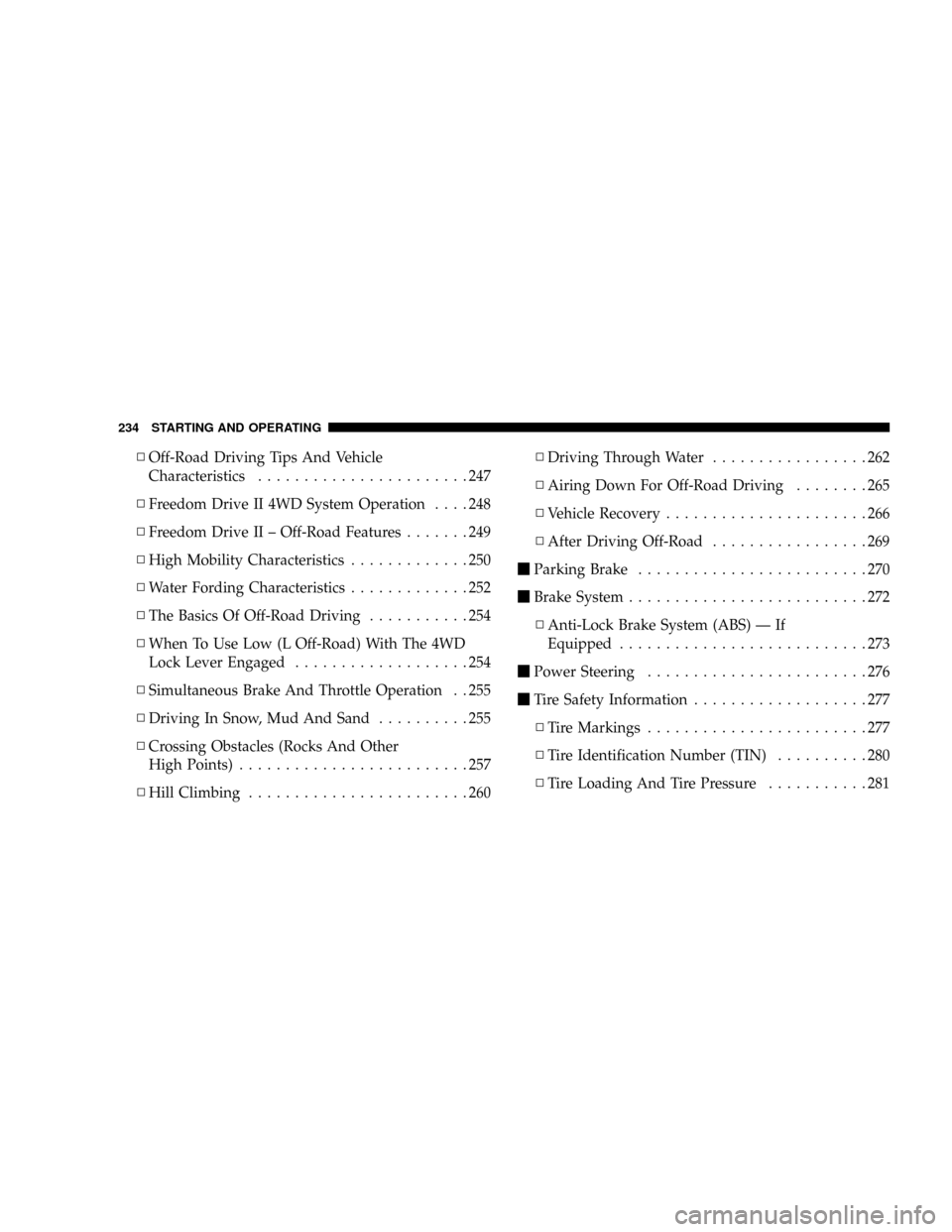
NOff-Road Driving Tips And Vehicle
Characteristics.......................247
NFreedom Drive II 4WD System Operation....248
NFreedom Drive II ± Off-Road Features.......249
NHigh Mobility Characteristics.............250
NWater Fording Characteristics.............252
NThe Basics Of Off-Road Driving...........254
NWhen To Use Low (L Off-Road) With The 4WD
Lock Lever Engaged...................254
NSimultaneous Brake And Throttle Operation . . 255
NDriving In Snow, Mud And Sand..........255
NCrossing Obstacles (Rocks And Other
High Points).........................257
NHill Climbing........................260NDriving Through Water.................262
NAiring Down For Off-Road Driving........265
NVehicle Recovery......................266
NAfter Driving Off-Road.................269
mParking Brake.........................270
mBrake System..........................272
NAnti-Lock Brake System (ABS) Ð If
Equipped...........................273
mPower Steering........................276
mTire Safety Information...................277
NTire Markings........................277
NTire Identification Number (TIN)..........280
NTire Loading And Tire Pressure...........281
234 STARTING AND OPERATING
Page 239 of 440
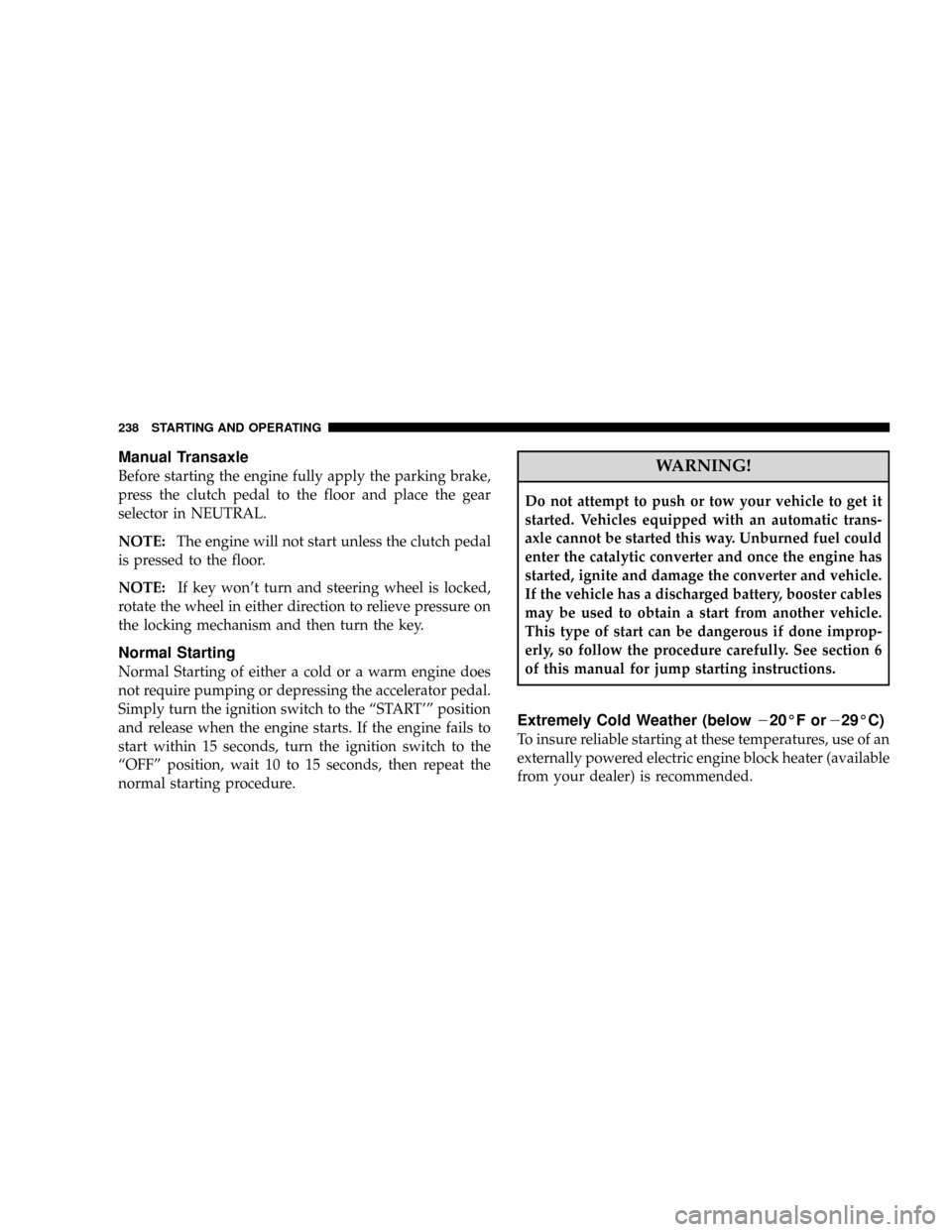
Manual Transaxle
Before starting the engine fully apply the parking brake,
press the clutch pedal to the floor and place the gear
selector in NEUTRAL.
NOTE:The engine will not start unless the clutch pedal
is pressed to the floor.
NOTE:If key won't turn and steering wheel is locked,
rotate the wheel in either direction to relieve pressure on
the locking mechanism and then turn the key.
Normal Starting
Normal Starting of either a cold or a warm engine does
not require pumping or depressing the accelerator pedal.
Simply turn the ignition switch to the ªSTART'º position
and release when the engine starts. If the engine fails to
start within 15 seconds, turn the ignition switch to the
ªOFFº position, wait 10 to 15 seconds, then repeat the
normal starting procedure.
WARNING!
Do not attempt to push or tow your vehicle to get it
started. Vehicles equipped with an automatic trans-
axle cannot be started this way. Unburned fuel could
enter the catalytic converter and once the engine has
started, ignite and damage the converter and vehicle.
If the vehicle has a discharged battery, booster cables
may be used to obtain a start from another vehicle.
This type of start can be dangerous if done improp-
erly, so follow the procedure carefully. See section 6
of this manual for jump starting instructions.
Extremely Cold Weather (below220ÉF or229ÉC)
To insure reliable starting at these temperatures, use of an
externally powered electric engine block heater (available
from your dealer) is recommended.
238 STARTING AND OPERATING
Page 242 of 440
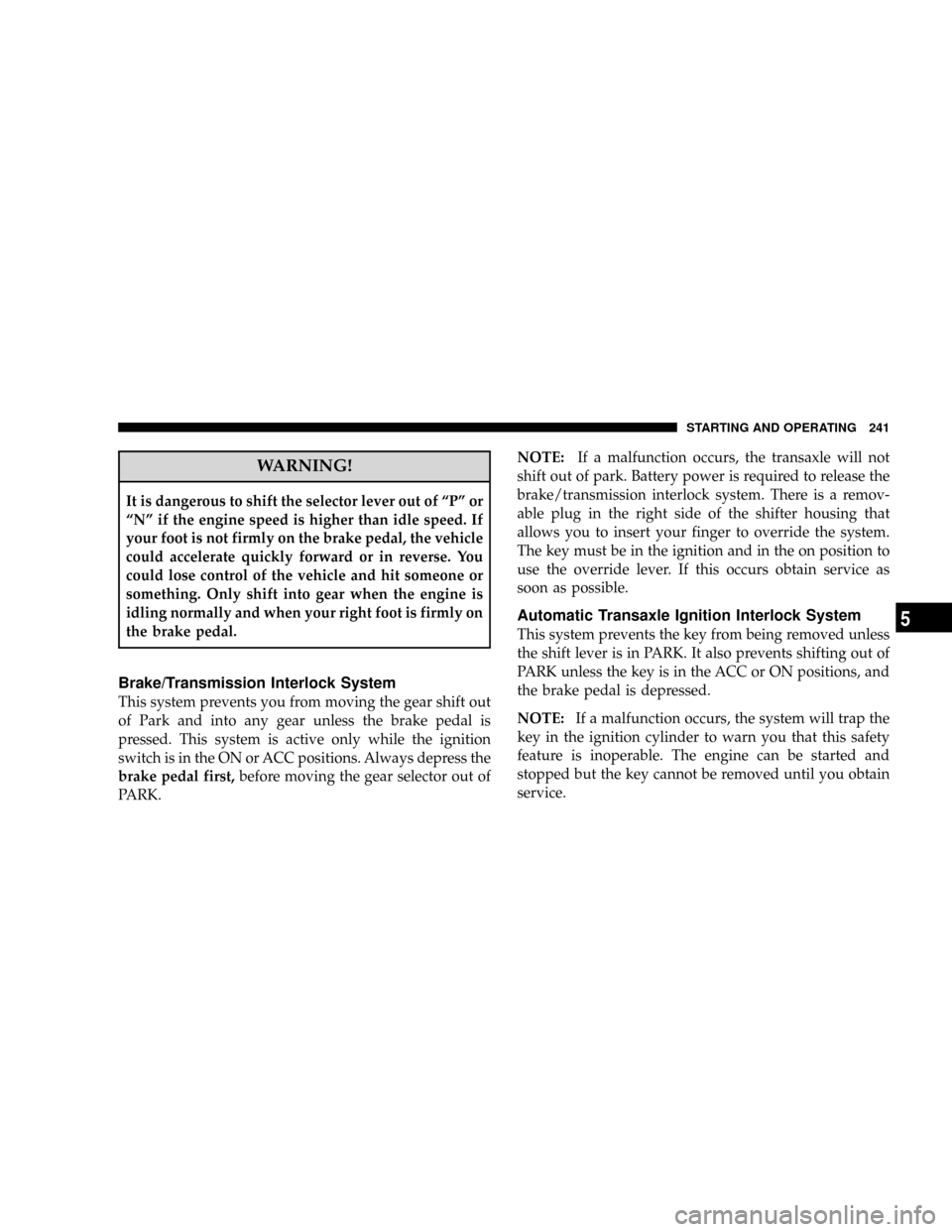
WARNING!
It is dangerous to shift the selector lever out of ªPº or
ªNº if the engine speed is higher than idle speed. If
your foot is not firmly on the brake pedal, the vehicle
could accelerate quickly forward or in reverse. You
could lose control of the vehicle and hit someone or
something. Only shift into gear when the engine is
idling normally and when your right foot is firmly on
the brake pedal.
Brake/Transmission Interlock System
This system prevents you from moving the gear shift out
of Park and into any gear unless the brake pedal is
pressed. This system is active only while the ignition
switch is in the ON or ACC positions. Always depress the
brake pedal first,before moving the gear selector out of
PARK.NOTE:If a malfunction occurs, the transaxle will not
shift out of park. Battery power is required to release the
brake/transmission interlock system. There is a remov-
able plug in the right side of the shifter housing that
allows you to insert your finger to override the system.
The key must be in the ignition and in the on position to
use the override lever. If this occurs obtain service as
soon as possible.
Automatic Transaxle Ignition Interlock System
This system prevents the key from being removed unless
the shift lever is in PARK. It also prevents shifting out of
PARK unless the key is in the ACC or ON positions, and
the brake pedal is depressed.
NOTE:If a malfunction occurs, the system will trap the
key in the ignition cylinder to warn you that this safety
feature is inoperable. The engine can be started and
stopped but the key cannot be removed until you obtain
service.
STARTING AND OPERATING 241
5
Page 243 of 440
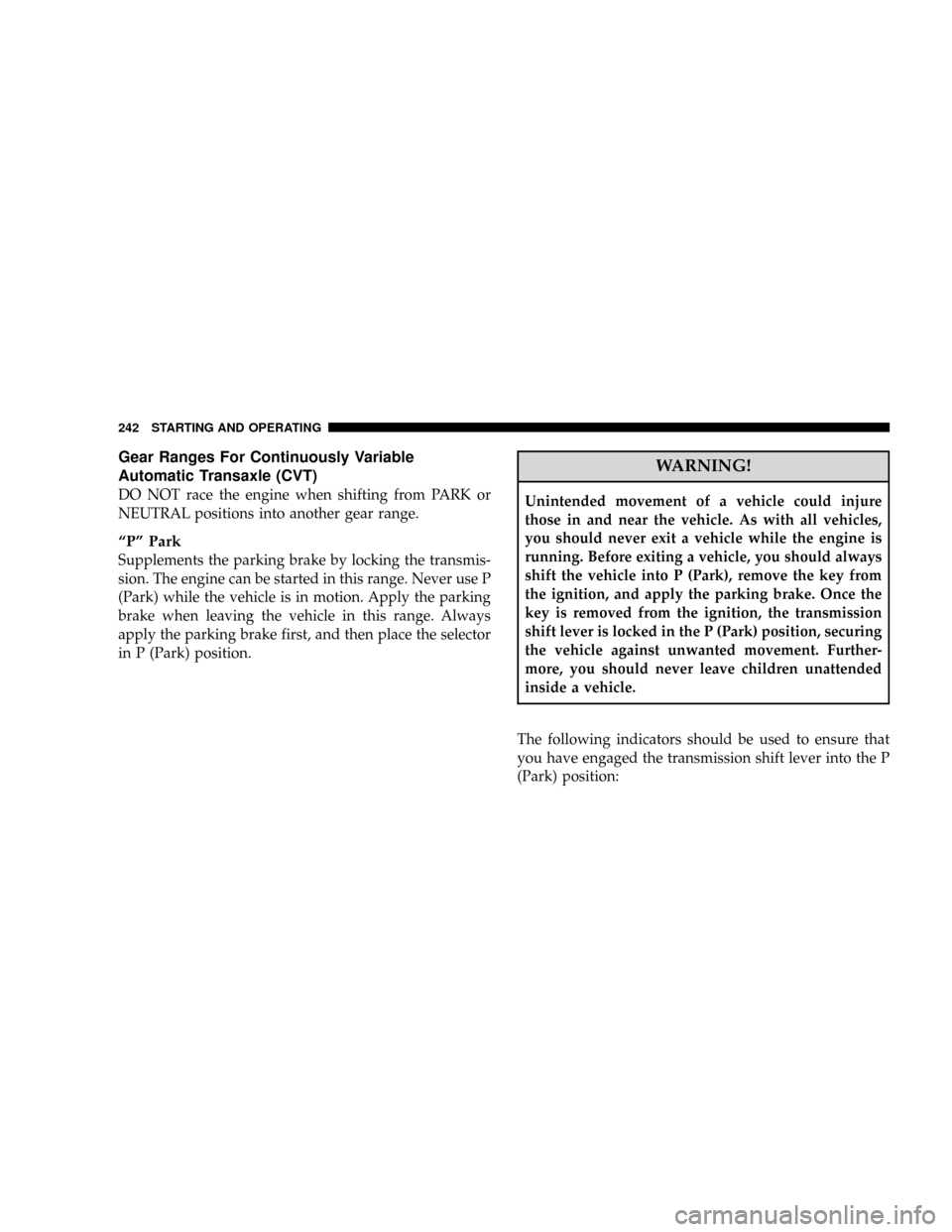
Gear Ranges For Continuously Variable
Automatic Transaxle (CVT)
DO NOT race the engine when shifting from PARK or
NEUTRAL positions into another gear range.
ªPº Park
Supplements the parking brake by locking the transmis-
sion. The engine can be started in this range. Never use P
(Park) while the vehicle is in motion. Apply the parking
brake when leaving the vehicle in this range. Always
apply the parking brake first, and then place the selector
in P (Park) position.
WARNING!
Unintended movement of a vehicle could injure
those in and near the vehicle. As with all vehicles,
you should never exit a vehicle while the engine is
running. Before exiting a vehicle, you should always
shift the vehicle into P (Park), remove the key from
the ignition, and apply the parking brake. Once the
key is removed from the ignition, the transmission
shift lever is locked in the P (Park) position, securing
the vehicle against unwanted movement. Further-
more, you should never leave children unattended
inside a vehicle.
The following indicators should be used to ensure that
you have engaged the transmission shift lever into the P
(Park) position:
242 STARTING AND OPERATING
Page 244 of 440
²When shifting into P (Park), firmly move the lever all
the way forward until it stops.
²Look at the shift indicator window on the console to
ensure it is in the P (Park) position.
²You must depress the brake pedal to move the shift
lever out of the P (Park) position.
CAUTION!
Before moving the shift lever out of P (Park), you
must turn the ignition from LOCK to ON so the
steering wheel and shift lever are released. Other-
wise, damage to the steering column or shifter could
result. You must also depress the brake pedal.
ªRº Reverse
Shift into this range only after the vehicle has come to a
complete stop.
ªNº Neutral
Engine may be started in this range.
ªDº
This should be used for most driving and provides the
best ratio for optimum driveability, fuel economy, and
performance.
ªLº Low
This range should be used for maximum engine braking
when descending steep grades. In this range, the trans-
axle will ratio up only to prevent transaxle damage or
engine over speed while ratioing down will occur as
early as possible
STARTING AND OPERATING 243
5
Page 248 of 440
traction surfaces, activate the 4WD Lock switch by pull-
ing up once and releasing. This locks the center coupling
allowing more torque to be sent to the rear wheels. The
amber94WD9light will come on in the cluster. This can be
done on the fly, at any vehicle speed. To deactivate,
simply pull on the switch one more time. The cluster light
will then go out.
NOTE:Refer to ºESP (Electronic Stability Program) in
the ªElectronic Brake Control Systemº section of this
manual for additional information.
PATRIOT FREEDOM DRIVE II ± SAFE OFF-ROAD
DRIVING
Off-Road Driving Tips and Vehicle Characteristics
The Patriot with the Freedom Drive II Off-Road package
has excellent on and off-road capabilities. These off-road
capabilities will allow you to explore those wilderness
trails where few travel, providing a source of exciting andsatisfying recreation. Before you venture out you should
contact your local governmental agency to determine
what are the designated off-road vehicle (ORV) trails or
recreation areas. You should always tread lightly and
only use established roads, trails or ORV recreational
areas. The National Forest Service, Bureau of Land Man-
agement or local Department of Natural Resources are a
wealth of information and usually have maps with
marked trails.
NOTE: For optimum off-road performance, premium
fuel is recommended. However, your vehicle is
equipped with an active spark knock system and can
adjust the engine calibration for varying range of fuel
octane levels.The Patriot's Freedom Drive II Off-Road Package
The Jeep Patriot with the Freedom Drive II has excellent
capability on and off-road.
STARTING AND OPERATING 247
5
Page 249 of 440
The package includes:
²2.4L DOHC 16-Valve I4 (172 bhp @ 6000 rpm, 165 lb-ft
@ 4400 rpm)
²Second generation continuously variable transaxle
(CVT2L) with 19:1 crawl ratio
²Tow Hooks: 2 front and 1 rear
²Front engine and transaxle skid plate
²Fuel tank skid plate
²Air filtration system
²Unique springs for a 1 inch of increased ride height
²Fog lamps
²Seat height adjust
²Three-mode Electronic Stability Program (ESP)
²Hill-descent control
²Unique off-road engine calibration for optimum off-
road performance with premium fuel
²Off-road Brake Traction Control
²Unique off-road Anti-lock brake calibration
²Heavy duty cooling package (Eng/larger CVT oil
cooler, High capacity cooling fans)
²Heavy duty alternator
²Improved body sealing and high located drivetrain
component vents
²Reinforced rear lateral links
Freedom Drive II 4WD System Operation
Under normal driving conditions, the vehicle operates in
the active four wheel drive mode. Pulling up on the 4WD
lock lever activates the 4WD system and lights the amber
4WD cluster light. This commands a higher torque to the
rear wheels, for improved traction capability on slippery
248 STARTING AND OPERATING
Page 250 of 440
roads. The active four wheel drive mode has the same
functionality with the Freedom Drive I system. Shifting
the transaxle gear select lever into Low Off-Road mode
with the 4WD lock lever active, lights the amber off-road
and 4WD cluster lights. This off-road mode gives the
combined benefits of a 19:1 crawl ratio, hill descent
braking, optimum off-road performance with premium
fuel, and off-road brake traction control for improved
traction capability off-road. In low, the transaxle (CVT2L)
initially maintains the 19:1 crawl ratio before changing
ratio. This low ratio is ideal for crawling over obstacles.
Freedom Drive II ± Off-Road Features
The following are key off-road features which are active
when the system has the 4WD lock lever engaged and is
in the Low Off-Road mode.
²Hill descent Braking± Hill descent braking uses the
vehicle braking system to provide a controlled descent
down varying grades. This feature is only active whenthe system has the 4WD lock lever engaged and is in
the Low Off-Road mode or reverse. Hill descent
braking can be turned off by turning off ESP. The hill
decent control speed varies between 4-6 mph (6 -10
km/h) forward, 3 mph (5 km/h) reverse.
²Off-Road Brake Traction Control± When conditions
warrant, the vehicle braking system transfers torque
from side to side. It does not control throttle input
unlike normal traction control which is active in
normal drive mode.
²19.1 Crawl Ratio± When the system has the 4WD lock
lever engaged and is in the Low Off-Road mode, the
CVT2L initially maintains the 19:1 crawl ratio before
changing ratio. This low ratio is ideal for crawling over
obstacles.
²4WD Lock Mode± Four wheel drive lock mode
commands a higher torque to the rear wheels, for
STARTING AND OPERATING 249
5