Page 12 of 440
NSeat Belt Extender......................48
NSeat Belts And Pregnant Women............49
NDriver And Front Passenger Supplemental
Restraint System (SRS) - Airbag............49
NEvent Data Recorder (EDR)...............58
NChild Restraint........................60
mEngine Break-In Recommendations...........69mSafety Tips............................69
NExhaust Gas..........................69
NSafety Checks You Should Make Inside The
Vehicle..............................70
NPeriodic Safety Checks You Should Make Outside
The Vehicle..........................71
THINGS TO KNOW BEFORE STARTING YOUR VEHICLE 11
2
Page 37 of 440
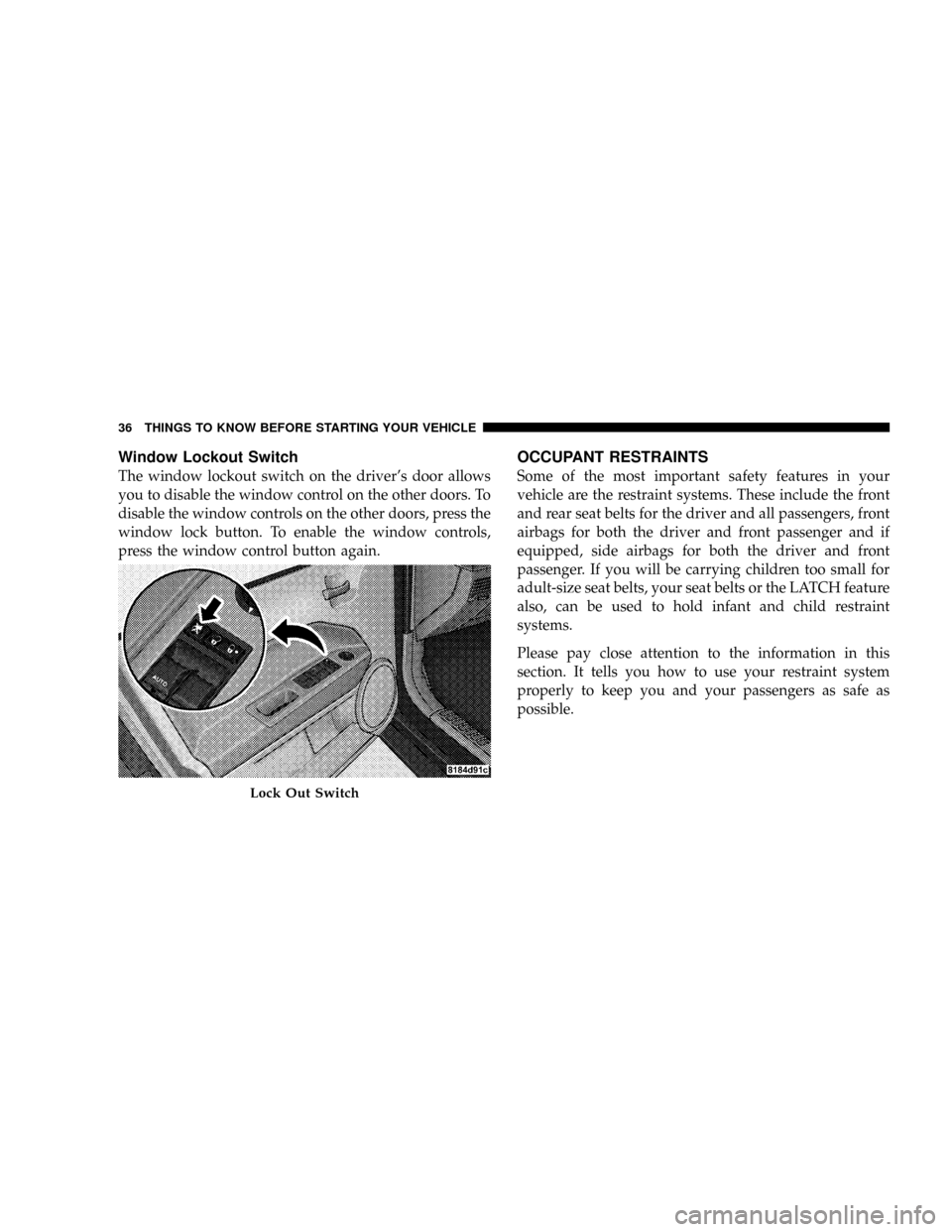
Window Lockout Switch
The window lockout switch on the driver's door allows
you to disable the window control on the other doors. To
disable the window controls on the other doors, press the
window lock button. To enable the window controls,
press the window control button again.
OCCUPANT RESTRAINTS
Some of the most important safety features in your
vehicle are the restraint systems. These include the front
and rear seat belts for the driver and all passengers, front
airbags for both the driver and front passenger and if
equipped, side airbags for both the driver and front
passenger. If you will be carrying children too small for
adult-size seat belts, your seat belts or the LATCH feature
also, can be used to hold infant and child restraint
systems.
Please pay close attention to the information in this
section. It tells you how to use your restraint system
properly to keep you and your passengers as safe as
possible.
Lock Out Switch
36 THINGS TO KNOW BEFORE STARTING YOUR VEHICLE
Page 47 of 440
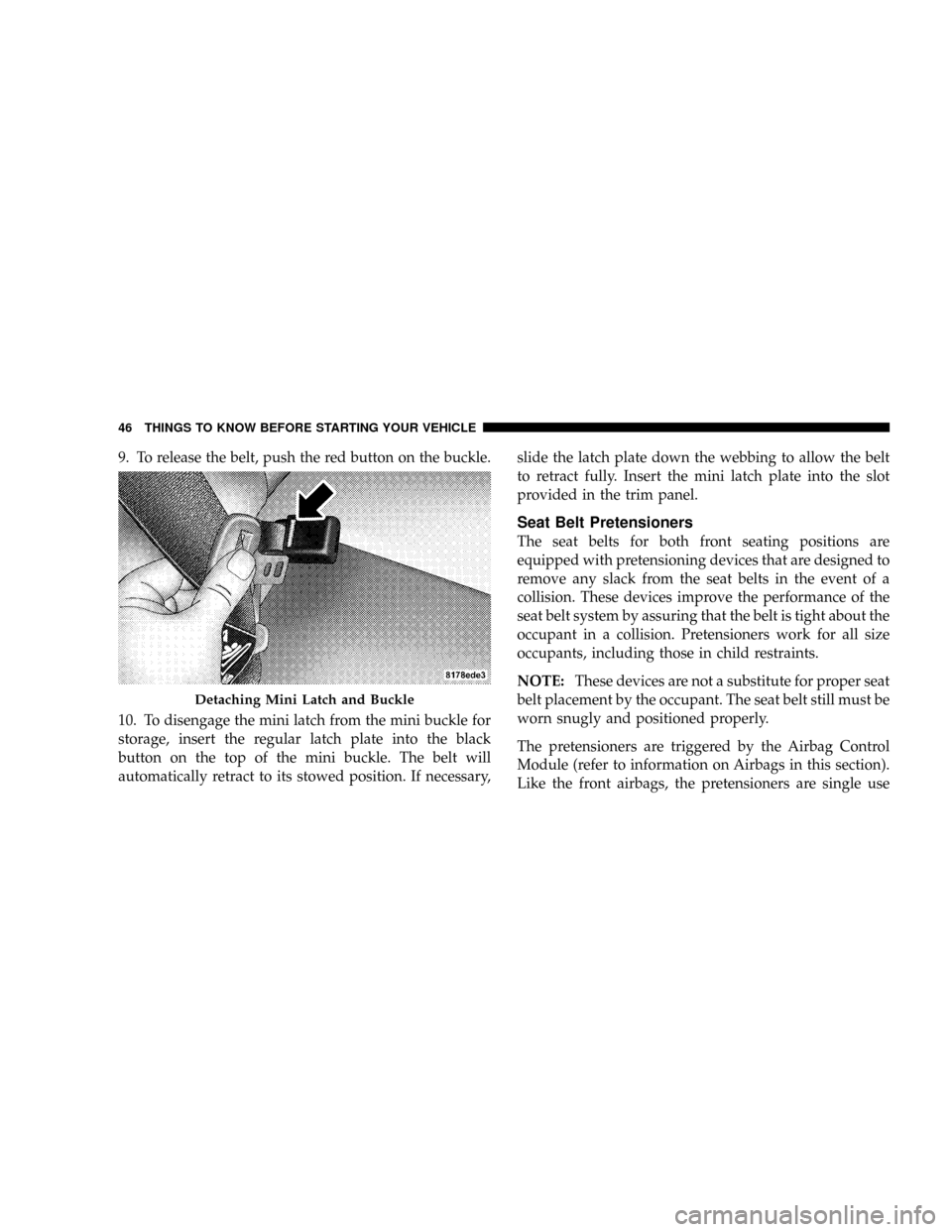
9. To release the belt, push the red button on the buckle.
10. To disengage the mini latch from the mini buckle for
storage, insert the regular latch plate into the black
button on the top of the mini buckle. The belt will
automatically retract to its stowed position. If necessary,slide the latch plate down the webbing to allow the belt
to retract fully. Insert the mini latch plate into the slot
provided in the trim panel.
Seat Belt Pretensioners
The seat belts for both front seating positions are
equipped with pretensioning devices that are designed to
remove any slack from the seat belts in the event of a
collision. These devices improve the performance of the
seat belt system by assuring that the belt is tight about the
occupant in a collision. Pretensioners work for all size
occupants, including those in child restraints.
NOTE:These devices are not a substitute for proper seat
belt placement by the occupant. The seat belt still must be
worn snugly and positioned properly.
The pretensioners are triggered by the Airbag Control
Module (refer to information on Airbags in this section).
Like the front airbags, the pretensioners are single use
Detaching Mini Latch and Buckle
46 THINGS TO KNOW BEFORE STARTING YOUR VEHICLE
Page 48 of 440
items. After a collision that is severe enough to deploy
the airbags and pretensioners, both must be replaced.
Enhanced Driver Seat Belt Reminder System
(BeltAlert)
If the driver's seat belt has not been buckled within 60
seconds of starting the vehicle and if the vehicle speed is
greater than 5 mph (8 km/h), the Enhanced Warning
System (BeltAlert) will alert the driver to buckle their seat
belt. The driver should also instruct all other occupants to
buckle their seat belts. Once the warning is triggered, the
Enhanced Warning System (BeltAlert) will continue to
chime and flash the Seat Belt Warning Light for 96
seconds or until the driver's seat belt is buckled. The
Enhanced Warning System (BeltAlert) will be reactivated
if the driver's seat belt is unbuckled for more than 10
seconds and the vehicle speed is greater than 5 mph (8
km/h).The Enhanced Warning System (BeltAlert) can be en-
abled or disabled by your authorized dealer or by
following these steps:
NOTE:The following steps must occur within the first
60 seconds of the ignition switch being turned to the ON
or START position. DaimlerChrysler does not recom-
mend deactivating the Enhanced Warning System
(BeltAlert).
1. Turn the ignition switch to the LOCK position and
buckle the driver's seat belt.
2. Turn the ignition switch to the ON position and wait
for the Seat Belt Warning Light to turn off.
3. Within 60 seconds of turning the ignition switch to the
ON position, unbuckle and then re-buckle the driver's
seat belt at least three times within 10 seconds, ending
with the seat belt buckled.
THINGS TO KNOW BEFORE STARTING YOUR VEHICLE 47
2
Page 50 of 440
Seat Belts And Pregnant Women
We recommend that pregnant women use the seat belts
throughout their pregnancy. Keeping the mother safe is
the best way to keep the baby safe.
Pregnant women should wear the lap part of the belt
across the thighs and as snug across the hips as possible.
Keep the belt low so that it does not come across the
abdomen. That way the strong bones of the hips will take
the force if there is a collision.
Driver and Front Passenger Supplemental
Restraint System (SRS) - Airbag
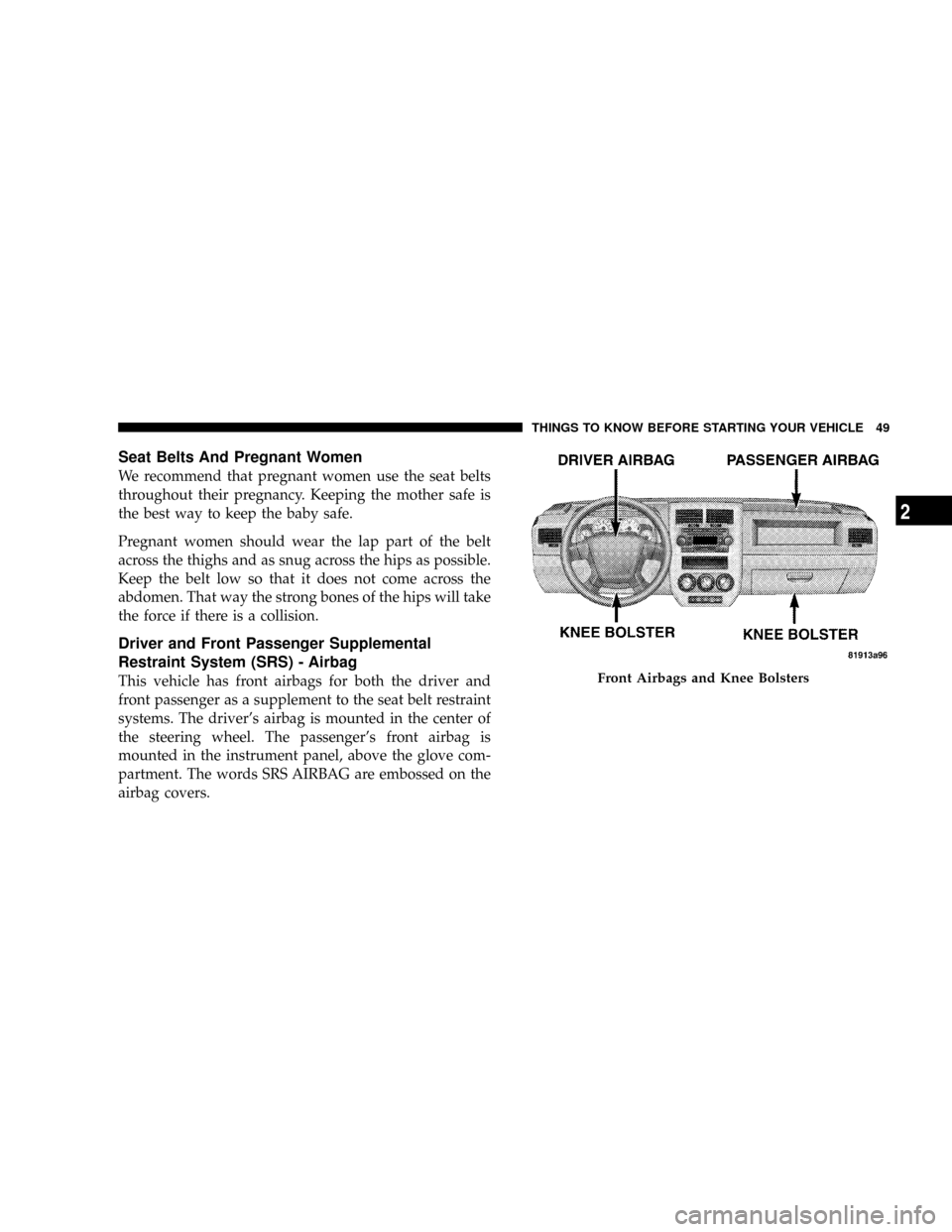
This vehicle has front airbags for both the driver and
front passenger as a supplement to the seat belt restraint
systems. The driver's airbag is mounted in the center of
the steering wheel. The passenger's front airbag is
mounted in the instrument panel, above the glove com-
partment. The words SRS AIRBAG are embossed on the
airbag covers.Front Airbags and Knee Bolsters
THINGS TO KNOW BEFORE STARTING YOUR VEHICLE 49
2
Page 51 of 440
NOTE:The front airbags are certified to the Federal
regulations that allow less forceful deployment.
The front airbags have a multistage inflator design. This
may allow the airbag to have different rates of inflation
that are based on collision severity.
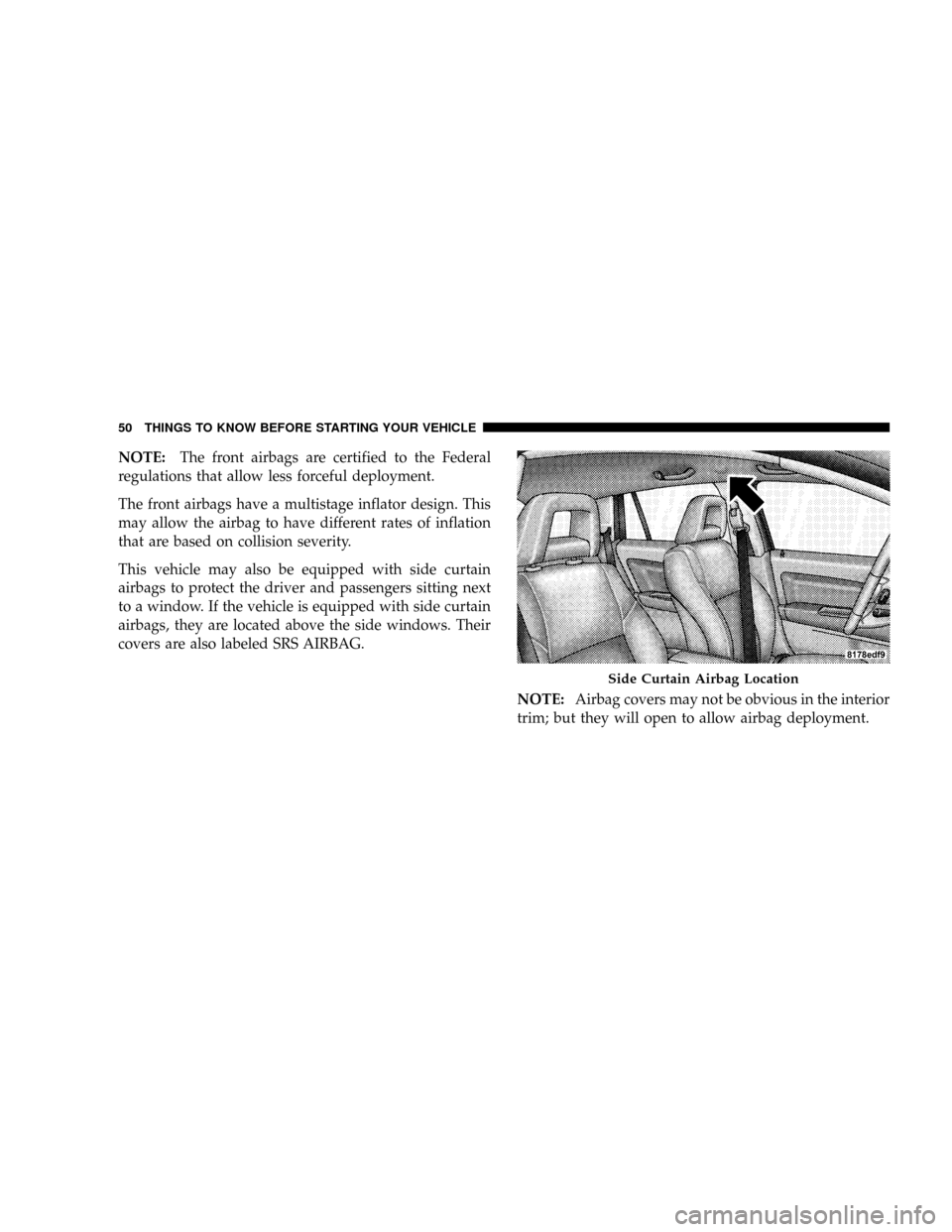
This vehicle may also be equipped with side curtain
airbags to protect the driver and passengers sitting next
to a window. If the vehicle is equipped with side curtain
airbags, they are located above the side windows. Their
covers are also labeled SRS AIRBAG.
NOTE:Airbag covers may not be obvious in the interior
trim; but they will open to allow airbag deployment.
Side Curtain Airbag Location
50 THINGS TO KNOW BEFORE STARTING YOUR VEHICLE
Page 52 of 440
WARNING!
²Do not put anything on or around the front airbag covers or
attempt to manually open them. You may damage the airbags
and you could be injured because the airbags are no longer
functional. These protective covers for the airbag cushions
are designed to open only when the airbags are inflating.
²If your vehicle is equipped with side curtain airbags, do not
stack luggage or other cargo up high enough to block the
location of the side curtain airbag. The area where the side
curtain airbag is located should remain free from any ob-
structions.
²If your vehicle is equipped with side curtain airbags, do not
have any accessory items installed which will alter the roof,
including adding a sunroof to your vehicle. Do not add roof
racks that require permanent attachments (bolts or screws)
for installation on the vehicle roof. Do not drill into the roof
of the vehicle for any reason.
²Do not drill, cut or tamper with the knee bolster in any way.
²Do not mount any accessories to the knee bolster such as
alarm lights, stereos, citizens band radios etc.
NOTE:Do not use a clothing bar mounted to the coat
hooks in this vehicle. A clothing bar will impede the
proper performance of the curtain airbags.
Along with the seat belts, front airbags work with the
instrument panel knee bolsters to provide improved
protection for the driver and front passenger. Side Cur-
tain Airbags also work with seat belts to improve occu-
pant protection.
The seat belts are designed to protect you in many types
of collisions. The front airbags deploy in moderate to
severe frontal collisions.
If your vehicle is so equipped, the Side Curtain Airbag on
the crash side of the vehicle is triggered in moderate to
severe side collisions. However, even in collisions where
the airbags deploy, you need the seat belts to keep you in
the correct position for the airbags to protect you prop-
erly.
THINGS TO KNOW BEFORE STARTING YOUR VEHICLE 51
2
Page 53 of 440
Here are some simple steps you can take to minimize
the risk of harm from a deploying airbag.
1. Children 12 years old and under should ride buckled
up in the rear seat.
2. Infants in rear-facing child restraints shouldNEVER
ride in the front seat of a vehicle with a passenger front
airbag. An airbag deployment could cause severe injury
or death to infants in that position.
3. Children that are not big enough to wear the vehicle
seat belt properly (refer to information on Child Restraint
in this section) should be secured in the rear seat in child
restraints or belt-positioning booster seats.
4. Older children who do not use child restraints or
belt-positioning booster seats should ride properly buck-
led up in the rear seat. Never allow children to slide the
shoulder belt behind them or under their arm.5. If a child from 1 to 12 years old must ride in the front
passenger seat because the vehicle is crowded, move the
seat as far back as possible, and use the proper child
restraint (refer to information on Child Restraint in this
section).
6. You should read the instructions provided with your
child restraint to make sure that you are using it properly.
7. All occupants should use their seat belts properly.
8. The driver and front passenger seats should be moved
back as far as practical to allow the airbags time to inflate.
9. If your vehicle has side curtain airbags do not lean
against the door, airbags will inflate forcefully into the
space between you and the door.
10. If the airbag system in this vehicle needs to be
modified to accommodate a disabled person, contact the
Customer Center. Phone numbers are provided in the9If
You Need Customer Assistance9section in this manual.
52 THINGS TO KNOW BEFORE STARTING YOUR VEHICLE