Page 283 of 440
3) the tire size designed for your vehicle
4) the cold tire inflation pressures for the front, rear,
and spare tires.
Loading
The vehicle maximum load on the tire must not exceed
the load carrying capacity of the tire on your vehicle. You
will not exceed the tire's load carrying capacity if you
adhere to the loading conditions, tire size, and cold tire
inflation pressures specified on the ªTire and Loading
Informationº placard and in the ªVehicle Loadingº sec-
tion of this manual.
NOTE:Under a maximum loaded vehicle condition,
gross axle weight ratings (GAWR's) for the front and rear
axles must not be exceeded. For further information on
GAWR's, vehicle loading, and trailer towing, refer to the
ªVehicle Loadingº section of this manual.To determine the maximum loading conditions of your
vehicle, locate the statement ªThe combined weight of
occupants and cargo should never exceed XXX kg or XXX
lbs.º on the Tire and Loading Information placard. The
combined weight of occupants, cargo/luggage and
trailer tongue weight (if applicable) should never exceed
the weight referenced here.
Steps for Determining Correct Load Limit
1. Locate the statement ªThe combined weight of occu-
pants and cargo should never exceed XXX poundsº on
your vehicle's placard.
2. Determine the combined weight of the driver and
passengers that will be riding in your vehicle.
3. Subtract the combined weight of the driver and pas-
sengers from XXX kilograms or XXX pounds.
282 STARTING AND OPERATING
Page 284 of 440
4. The resulting figure equals the available amount of
cargo and luggage load capacity. For example, if ªXXXº
amount equals 1400 lbs. and there will be five 150 lb.
passengers in your vehicle, the amount of available cargo
and luggage load capacity is 650 lbs. (since 5 x 150 = 750,
and 1400 ± 750 = 650 lbs.)
5. Determine the combined weight of luggage and cargo
being loaded on the vehicle. That weight may not safely
exceed the available cargo and luggage load capacity
calculated in Step 4.
6. If your vehicle will be towing a trailer, load from your
trailer will be transferred to your vehicle. Consult thismanual to determine how this reduces the available
cargo and luggage load capacity of your vehicle.
NOTE:The following table shows examples on how to
calculate total load, cargo/luggage, and towing capaci-
ties of your vehicle with varying seating configurations
and number and size of occupants. This table is for
illustration purposes only and may not be accurate for
the seating and load carry capacity of your vehicle.
NOTE:For the following example, the combined weight
of occupants and cargo should never exceed 865 lbs.
(392 kg).
STARTING AND OPERATING 283
5
Page 310 of 440
problem continues, the message will appear the next time
the vehicle is started. Refer to ªOnboard Diagnostic
System Ð OBDIIº in Section 7 of this manual for more
information.
VEHICLE LOADING
Vehicle Loading Capacities
Front Seat Occupants....................... 2
Rear Seat Occupants....................... 3
Luggage....................... 175lbs. (80 kg)
Vehicle Rated Capacity............ 925lbs. (420 kg)
Gross Vehicle Weight Rating (GVWR)
The GVWR is the total allowable weight of your vehicle.
This includes the weigh of your vehicle, the driver,
passengers, cargo and trailer tongue weight. The total
load must be limited so that you do not exceed the
GVWR.
TRAILER TOWING
In this section you will find safety tips and information
on limits to the type of towing you can reasonably do
with your vehicle. Before towing a trailer carefully re-
view this information to tow your load as efficiently and
safely as possible.
To maintain warranty coverage, follow the requirements
and recommendations in this manual concerning ve-
hicles used for trailer towing.
Common Towing Definitions
The following trailer towing related definitions will assist
you in understanding the following information:
Gross Vehicle Weight Rating (GVWR)
The GVWR is the total allowable weight of your vehicle.
This includes driver, passengers, cargo and tongue
weight. The total load must be limited so that you do not
exceed the GVWR.
STARTING AND OPERATING 309
5
Page 319 of 440
þWhen replacing tires refer to the Tires±General Infor-
mation section of this manual on Replacement Tires for
proper tire replacement procedures. Replacing tires
with a higher load carrying capacity will not increase
the vehicle's GVWR and GAWR limits.
Towing Requirements Ð Trailer Brakes
þ
Donotinterconnect the hydraulic brake system or
vacuum system of your vehicle with that of the trailer.
This could cause inadequate braking and possible
personal injury.
þAn electronically actuated trailer brake controller is
required when towing a trailer with electronically
actuated brakes. When towing a trailer equipped with
a hydraulic surge actuated brake system, an electronic
brake controller is not required.
þTrailer brakes are recommended for trailers over 1,000
lbs (454 kg) and required for trailers in excess of 2,000
lbs (907 kg).
CAUTION!
If the trailer weighs more than 1,000 lbs (454 kg)
loaded, it should have its own brakes and they
should be of adequate capacity. Failure to do this
could lead to accelerated brake lining wear, higher
brake pedal effort, and longer stopping distances.
318 STARTING AND OPERATING
Page 437 of 440
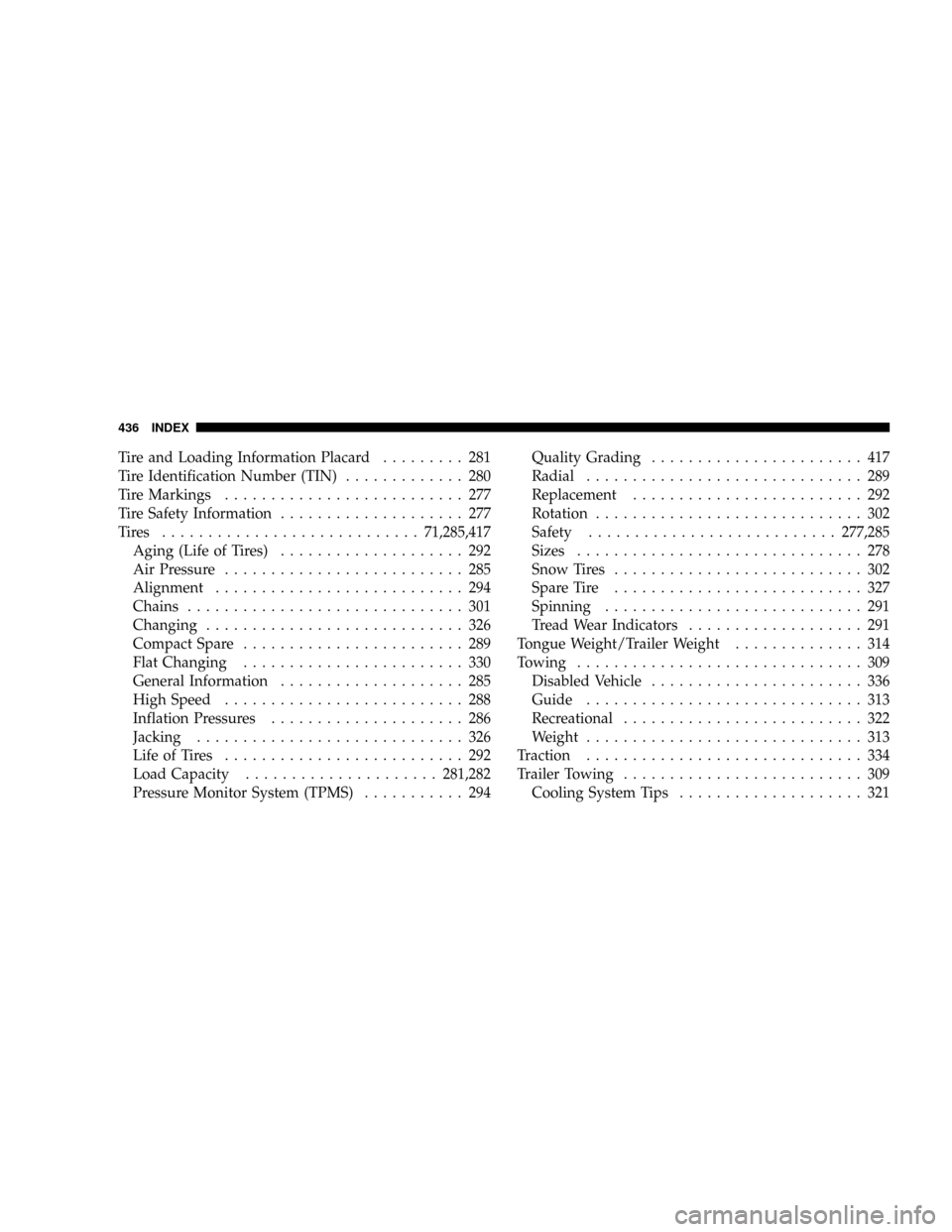
Tire and Loading Information Placard......... 281
Tire Identification Number (TIN)............. 280
Tire Markings.......................... 277
Tire Safety Information.................... 277
Tires ............................71,285,417
Aging (Life of Tires).................... 292
Air Pressure.......................... 285
Alignment........................... 294
Chains.............................. 301
Changing............................ 326
Compact Spare........................ 289
Flat Changing........................ 330
General Information.................... 285
High Speed.......................... 288
Inflation Pressures..................... 286
Jacking............................. 326
Life of Tires.......................... 292
Load Capacity.....................281,282
Pressure Monitor System (TPMS)........... 294Quality Grading....................... 417
Radial.............................. 289
Replacement......................... 292
Rotation............................. 302
Safety...........................277,285
Sizes............................... 278
Snow Tires........................... 302
Spare Tire........................... 327
Spinning............................ 291
Tread Wear Indicators................... 291
Tongue Weight/Trailer Weight.............. 314
Towing............................... 309
Disabled Vehicle....................... 336
Guide.............................. 313
Recreational.......................... 322
Weight.............................. 313
Traction.............................. 334
Trailer Towing.......................... 309
Cooling System Tips.................... 321
436 INDEX