Page 337 of 440
CAUTION!
Racing the engine or spinning the wheels too fast
may lead to transaxle overheating and failure. It can
also damage the tires. Do not spin the wheels above
30 mph (48 km/h). Do not spin the wheels continu-
ously for more than 30 seconds.
TOWING A DISABLED VEHICLE
With Ignition Key
Automatic And Manual Transaxle
Front-wheel-drive vehicles must have the front wheels
elevated; Four-wheel-drive vehicles must be hauled on a
flatbed truck.
All Transaxles
CAUTION!
If the vehicle being towed requires steering, the
ignition switch must be in the ACCESSORY posi-
tion, not in the LOCK position.
Do not attempt to use sling type equipment when
towing. When securing vehicle to flat bed truck, do
not attach to front or rear suspension components.
Damage to your vehicle may result from improper
towing.
If it is necessary to use the accessories while being towed
(wipers, defrosters, etc.), the key must be in the ON
position, not the ACCESSORY position. Make certain the
transaxle remains in NEUTRAL.
336 WHAT TO DO IN EMERGENCIES
Page 338 of 440
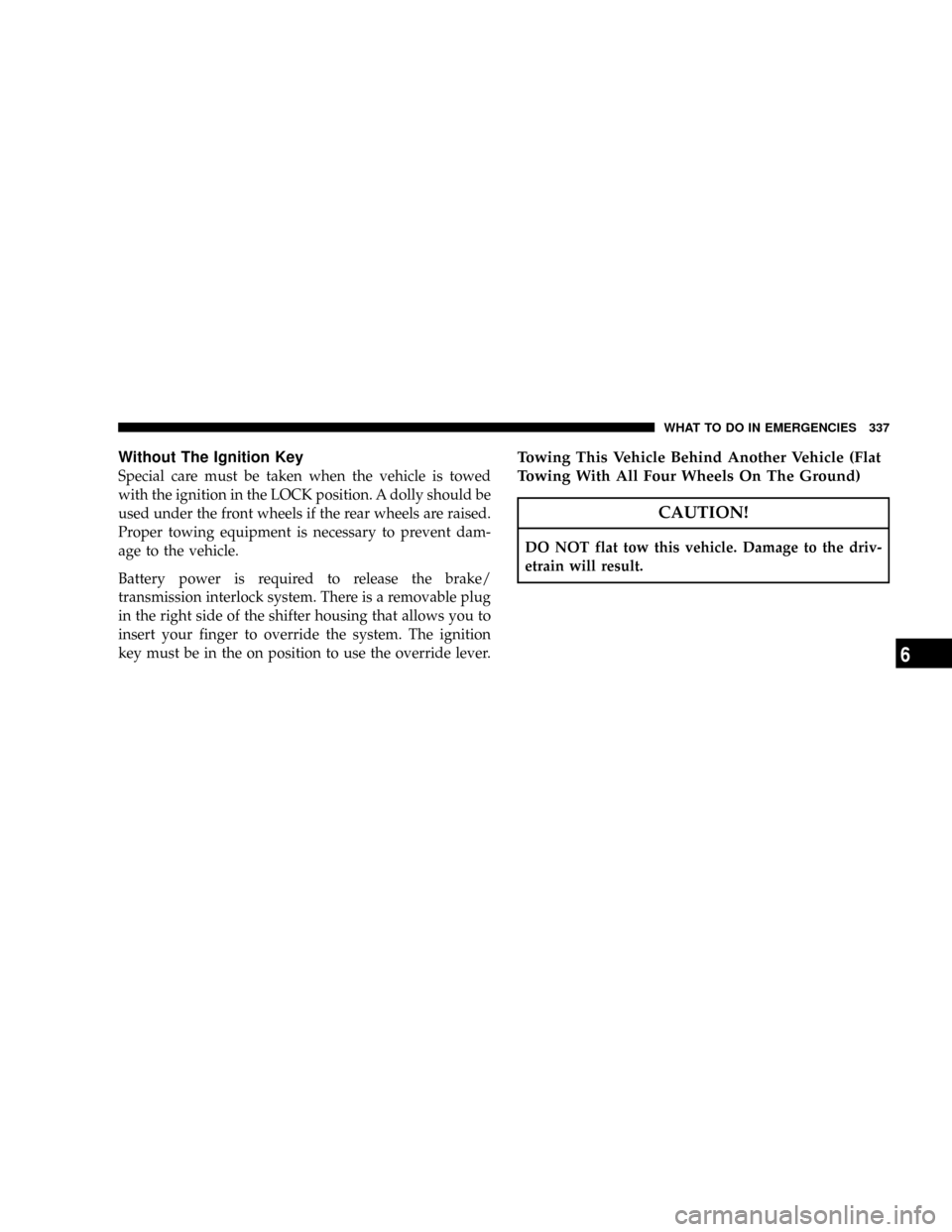
Without The Ignition Key
Special care must be taken when the vehicle is towed
with the ignition in the LOCK position. A dolly should be
used under the front wheels if the rear wheels are raised.
Proper towing equipment is necessary to prevent dam-
age to the vehicle.
Battery power is required to release the brake/
transmission interlock system. There is a removable plug
in the right side of the shifter housing that allows you to
insert your finger to override the system. The ignition
key must be in the on position to use the override lever.
Towing This Vehicle Behind Another Vehicle (Flat
Towing With All Four Wheels On The Ground)
CAUTION!
DO NOT flat tow this vehicle. Damage to the driv-
etrain will result.
WHAT TO DO IN EMERGENCIES 337
6
Page 359 of 440
Body Lubrication
Locks and all body pivot points, including such items as
seat tracks, doors, liftgate and hood hinges, should be
lubricated periodically to assure quiet, easy operation
and to protect against rust and wear. Prior to the appli-
cation of any lubricant, the parts concerned should be
wiped clean to remove dust and grit; after lubricating
excess oil and grease should be removed. Particular
attention should also be given to hood latching compo-
nents to insure proper function. When performing other
underhood services, the hood latch, release mechanism
and safety catch should be cleaned and lubricated.
The external lock cylinders should be lubricated twice a
year, preferably in the fall and spring. Apply a small
amount of a high quality lubricant such as MopartLock
Cylinder Lubricant directly into the lock cylinder.
Windshield Wiper Blades
Clean the rubber edges of the wiper blades and the
windshield periodically with a sponge or soft cloth and a
mild nonabrasive cleaner or use the washer solvent. This
will remove accumulations of salt, waxes or road film
and help reduce streaking and smearing.
Operation of the wipers on dry glass for long periods
may cause deterioration of the wiper blades. Always use
washer fluid when using the wipers to remove salt or dirt
from a dry windshield. Avoid using the wiper blades to
remove frost or ice from the windshield. make sure that
they are not frozen to the glass before turning them on to
avoid damaging the blade. Keep the blade rubber out of
contact with petroleum products such as engine oil,
gasoline, etc.
Windshield Wiper Blade Replacement
1. Lift the wiper arm away from the glass.
358 MAINTAINING YOUR VEHICLE
Page 360 of 440
2. Push the release tab and slide the wiper blade assem-
bly down along the arm. Gently place the wiper arm on
the windshield.
3. Install the new blade assembly onto the wiper arm tip
until it locks in place.
Windshield Washer Reservoir
The washer fluid reservoir is located in the rear of the
engine compartment on the right side and should be
checked for fluid level at regular intervals. Fill the
reservoir with windshield washer solvent (not radiator
antifreeze).
Exhaust System
The best protection against carbon monoxide entry into
the vehicle body is a properly maintained engine exhaust
system.
If you notice a change in the sound of the exhaust system,
or if exhaust fumes can be detected inside the vehicle, orwhen the underside or rear of the vehicle is damaged;
have a competent technician inspect the complete ex-
haust system and adjacent body areas for broken, dam-
aged, deteriorated, or mispositioned parts. Open seams
or loose connections could permit exhaust fumes to seep
into the passenger compartment. In addition, inspect the
exhaust system each time the vehicle is raised for an oil
change or lubrication. Replace as required.
WARNING!
Exhaust gases can injure or kill. They contain carbon
monoxide (CO) which is colorless and odorless.
Breathing it can make you unconscious and can
eventually poison you. To avoid breathing CO, refer
to Exhaust Gas in the Safety Tips section of this
manual.
MAINTAINING YOUR VEHICLE 359
7
Page 378 of 440
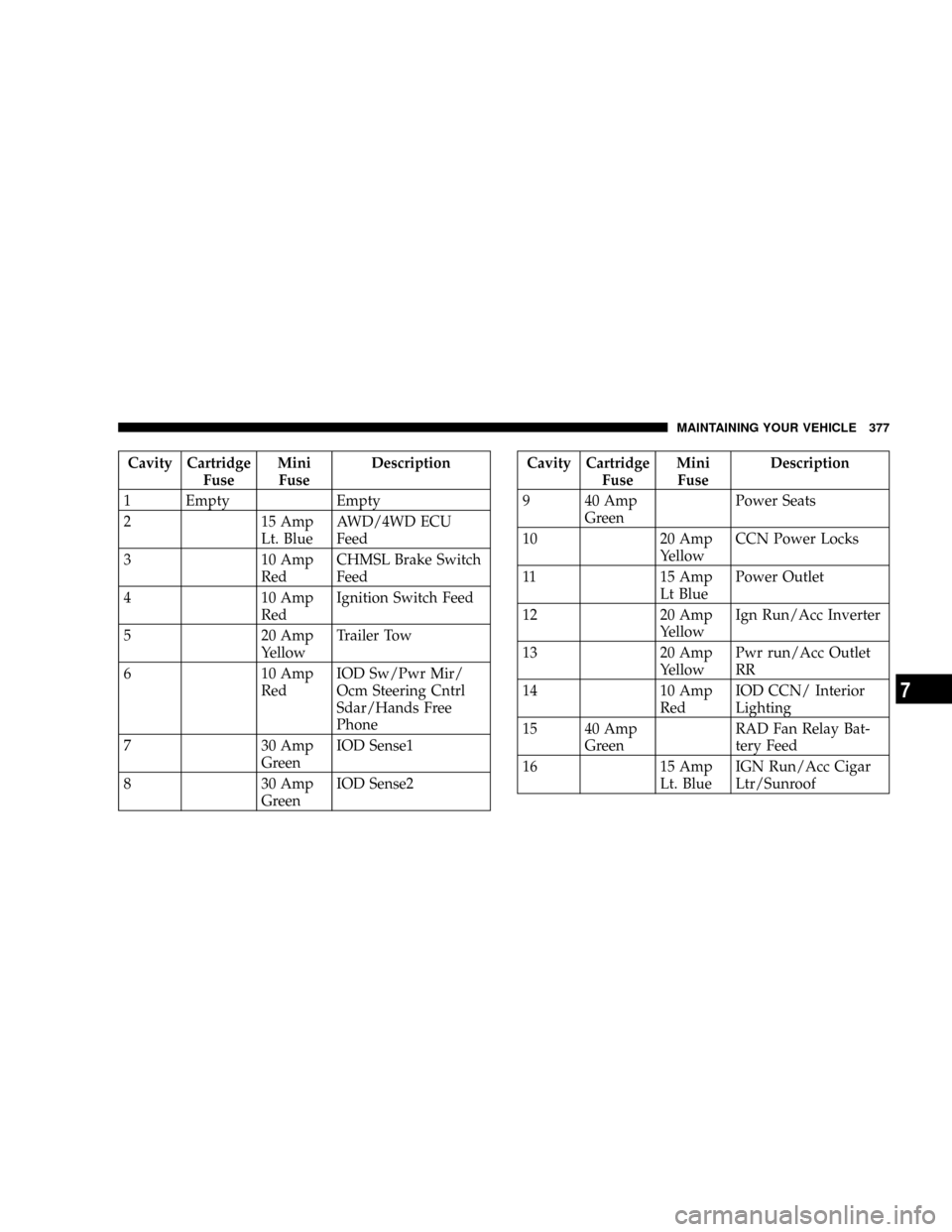
Cavity Cartridge
FuseMini
FuseDescription
1 Empty Empty
2 15 Amp
Lt. BlueAWD/4WD ECU
Feed
3 10 Amp
RedCHMSL Brake Switch
Feed
4 10 Amp
RedIgnition Switch Feed
5 20 Amp
YellowTrailer Tow
6 10 Amp
RedIOD Sw/Pwr Mir/
Ocm Steering Cntrl
Sdar/Hands Free
Phone
7 30 Amp
GreenIOD Sense1
8 30 Amp
GreenIOD Sense2Cavity Cartridge
FuseMini
FuseDescription
9 40 Amp
GreenPower Seats
10 20 Amp
YellowCCN Power Locks
11 15 Amp
Lt BluePower Outlet
12 20 Amp
YellowIgn Run/Acc Inverter
13 20 Amp
YellowPwr run/Acc Outlet
RR
14 10 Amp
RedIOD CCN/ Interior
Lighting
15 40 Amp
GreenRAD Fan Relay Bat-
tery Feed
16 15 Amp
Lt. BlueIGN Run/Acc Cigar
Ltr/Sunroof
MAINTAINING YOUR VEHICLE 377
7
Page 382 of 440
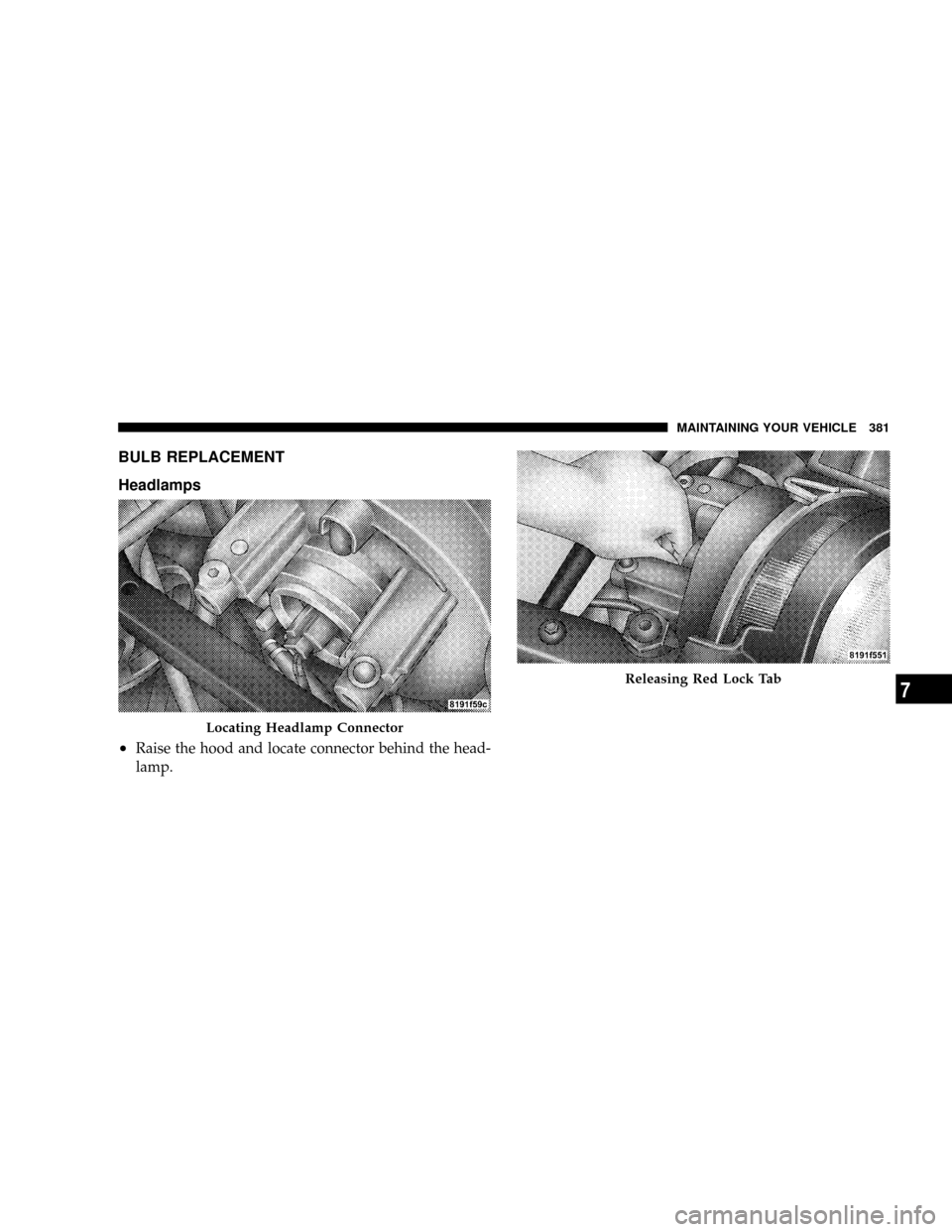
BULB REPLACEMENT
Headlamps
²
Raise the hood and locate connector behind the head-
lamp.
Locating Headlamp Connector
Releasing Red Lock Tab
MAINTAINING YOUR VEHICLE 381
7
Page 383 of 440
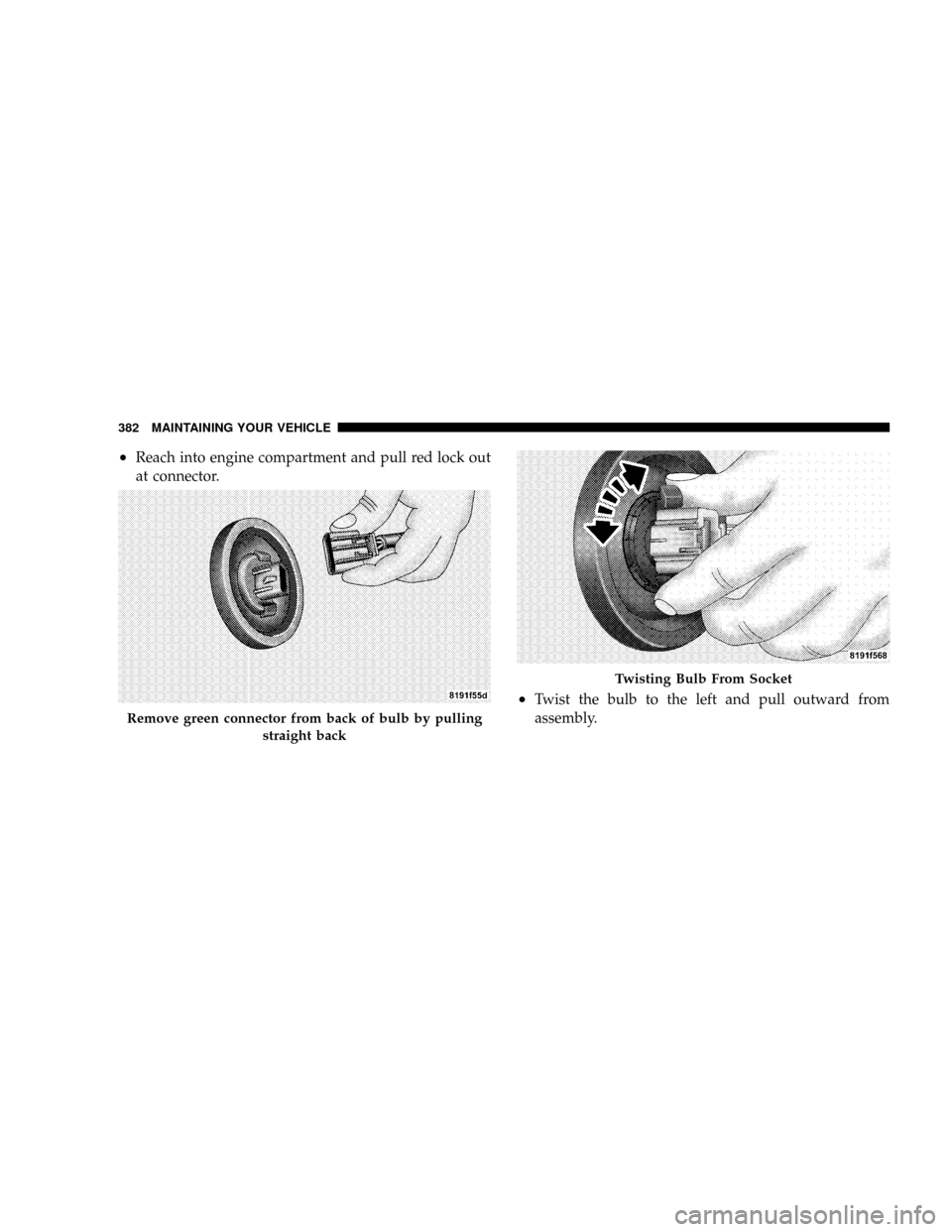
²Reach into engine compartment and pull red lock out
at connector.
²Twist the bulb to the left and pull outward from
assembly.
Remove green connector from back of bulb by pulling
straight back
Twisting Bulb From Socket
382 MAINTAINING YOUR VEHICLE
Page 387 of 440
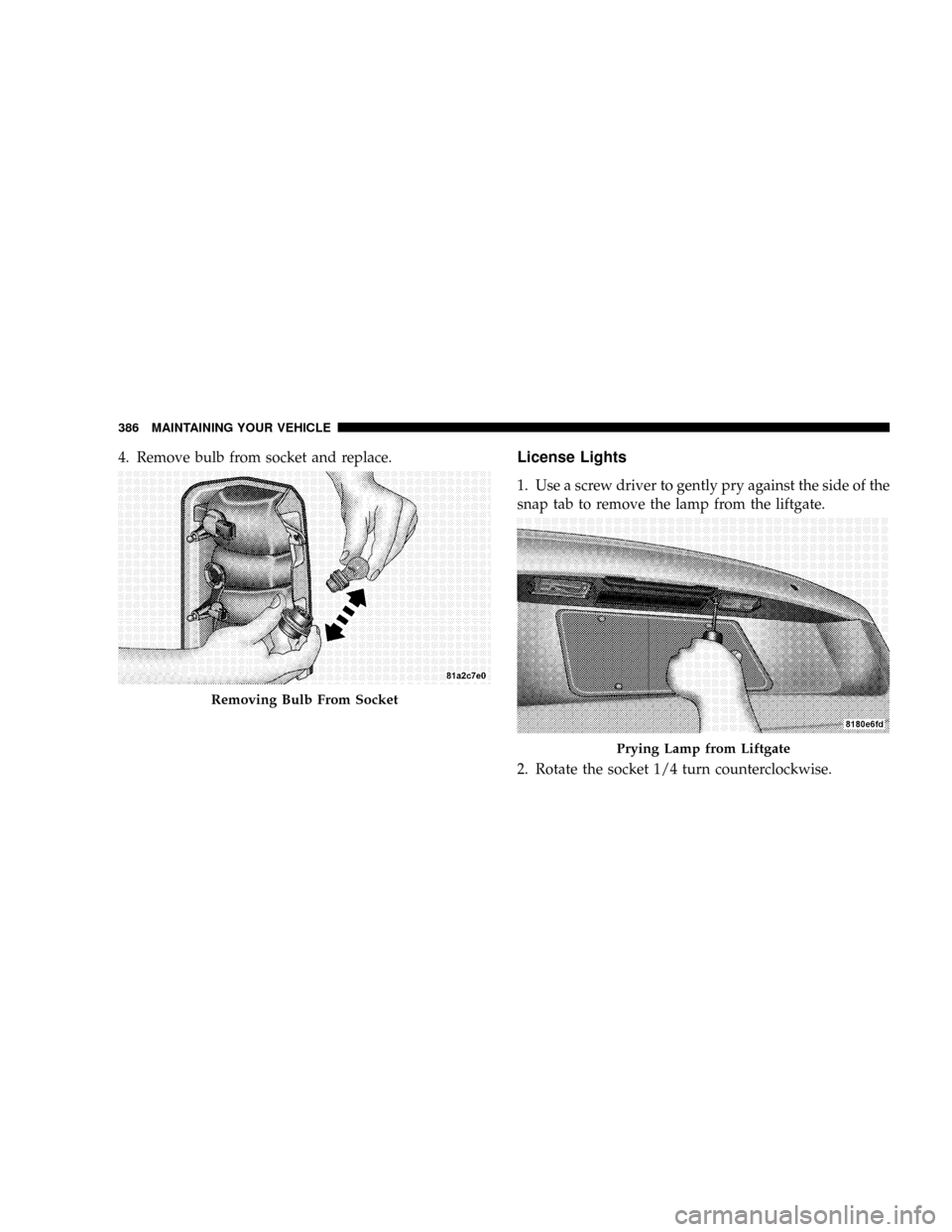
4. Remove bulb from socket and replace.License Lights
1. Use a screw driver to gently pry against the side of the
snap tab to remove the lamp from the liftgate.
2. Rotate the socket 1/4 turn counterclockwise.
Removing Bulb From Socket
Prying Lamp from Liftgate
386 MAINTAINING YOUR VEHICLE