Page 247 of 440
CAUTION!
If you skip more than one gear while downshifting
or downshift at too high a vehicle speed, you could
damage the engine, transmission, or clutch.
To maintain a safe speed and prolong brake life, shift
down to 2nd or 1st when descending a steep grade.
When turning a corner, or driving up a steep grade,
downshift early so that the engine will not be overbur-
dened.
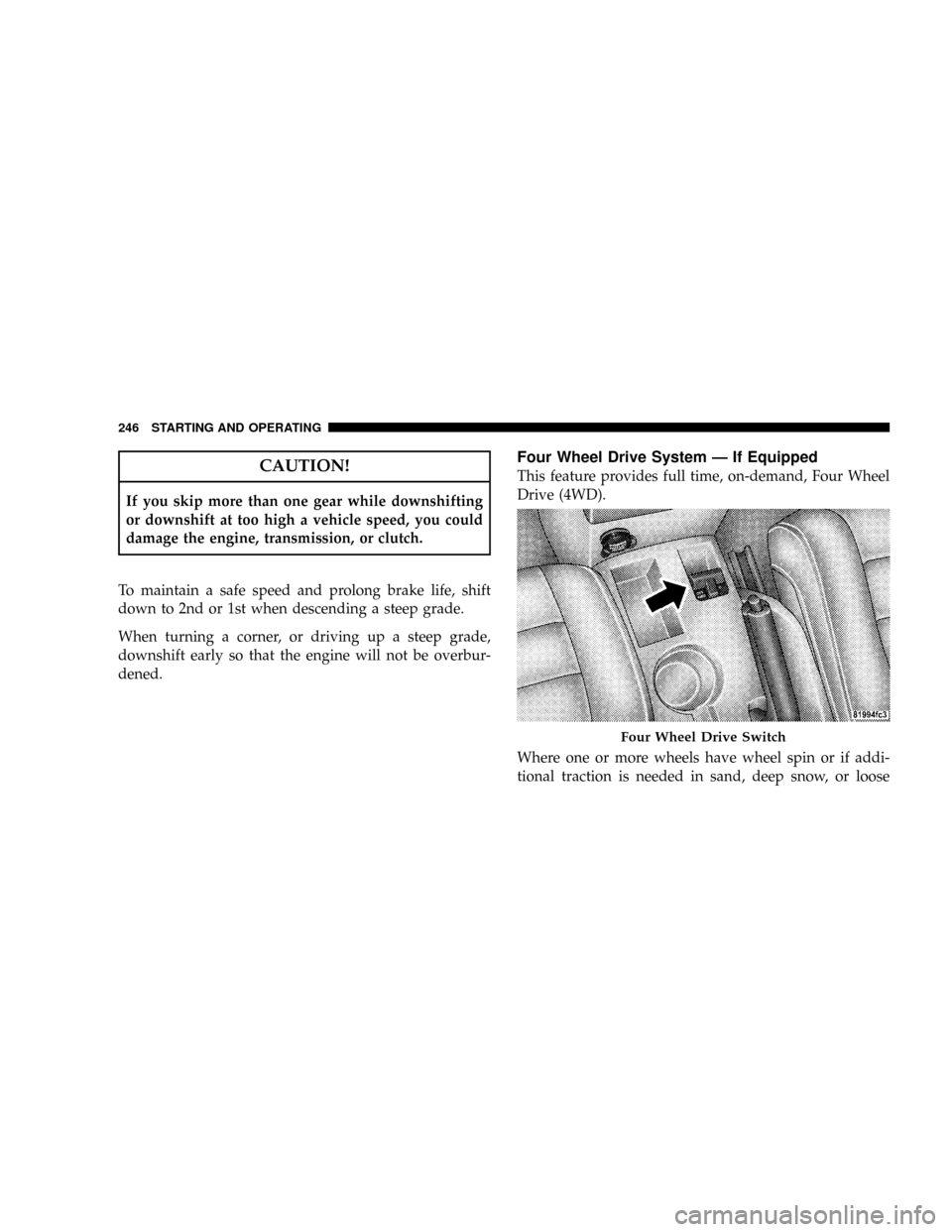
Four Wheel Drive System Ð If Equipped
This feature provides full time, on-demand, Four Wheel
Drive (4WD).
Where one or more wheels have wheel spin or if addi-
tional traction is needed in sand, deep snow, or loose
Four Wheel Drive Switch
246 STARTING AND OPERATING
Page 248 of 440
traction surfaces, activate the 4WD Lock switch by pull-
ing up once and releasing. This locks the center coupling
allowing more torque to be sent to the rear wheels. The
amber94WD9light will come on in the cluster. This can be
done on the fly, at any vehicle speed. To deactivate,
simply pull on the switch one more time. The cluster light
will then go out.
NOTE:Refer to ºESP (Electronic Stability Program) in
the ªElectronic Brake Control Systemº section of this
manual for additional information.
PATRIOT FREEDOM DRIVE II ± SAFE OFF-ROAD
DRIVING
Off-Road Driving Tips and Vehicle Characteristics
The Patriot with the Freedom Drive II Off-Road package
has excellent on and off-road capabilities. These off-road
capabilities will allow you to explore those wilderness
trails where few travel, providing a source of exciting andsatisfying recreation. Before you venture out you should
contact your local governmental agency to determine
what are the designated off-road vehicle (ORV) trails or
recreation areas. You should always tread lightly and
only use established roads, trails or ORV recreational
areas. The National Forest Service, Bureau of Land Man-
agement or local Department of Natural Resources are a
wealth of information and usually have maps with
marked trails.
NOTE: For optimum off-road performance, premium
fuel is recommended. However, your vehicle is
equipped with an active spark knock system and can
adjust the engine calibration for varying range of fuel
octane levels.The Patriot's Freedom Drive II Off-Road Package
The Jeep Patriot with the Freedom Drive II has excellent
capability on and off-road.
STARTING AND OPERATING 247
5
Page 249 of 440
The package includes:
²2.4L DOHC 16-Valve I4 (172 bhp @ 6000 rpm, 165 lb-ft
@ 4400 rpm)
²Second generation continuously variable transaxle
(CVT2L) with 19:1 crawl ratio
²Tow Hooks: 2 front and 1 rear
²Front engine and transaxle skid plate
²Fuel tank skid plate
²Air filtration system
²Unique springs for a 1 inch of increased ride height
²Fog lamps
²Seat height adjust
²Three-mode Electronic Stability Program (ESP)
²Hill-descent control
²Unique off-road engine calibration for optimum off-
road performance with premium fuel
²Off-road Brake Traction Control
²Unique off-road Anti-lock brake calibration
²Heavy duty cooling package (Eng/larger CVT oil
cooler, High capacity cooling fans)
²Heavy duty alternator
²Improved body sealing and high located drivetrain
component vents
²Reinforced rear lateral links
Freedom Drive II 4WD System Operation
Under normal driving conditions, the vehicle operates in
the active four wheel drive mode. Pulling up on the 4WD
lock lever activates the 4WD system and lights the amber
4WD cluster light. This commands a higher torque to the
rear wheels, for improved traction capability on slippery
248 STARTING AND OPERATING
Page 251 of 440
improved traction capability off-road. It also, turns on
other system features in conjunction with L Off-Road
mode.
²Unique Engine Calibration± When the system has
the 4WD lock lever engaged and is in the Low
Off-Road mode or reverse, the engine calibration
changes to run higher spark advance with premium
fuel for optimum off-road performance. Your vehicle is
equipped with an active spark knock system and can
adjust the engine calibration for varying range of fuel
octane levels.
High Mobility Characteristics
The Patriot with the Freedom Drive II Off-Road package
has high off-road mobility characteristics with an ap-
proach angle A= 29 degrees, a break-over angle B= 23
degrees, a running ground clearance C= 9 ins. (23 cm), a
departure angle D= 33 degrees, and a turning circle of
35.6 ft. (11 m).
250 STARTING AND OPERATING
Page 256 of 440
additional traction and activates the numerous off-road
features to improve handling and control on slippery or
difficult terrain. Due to the sustained lower gearing, low
(L Off-Road) with 4WD Lock engaged will allow the
engine to operate in a higher power range. This will
allow you to cross over obstacles and descend hills, with
improved control and less effort.
Simultaneous Brake And Throttle Operation
Many off-road driving conditions require the simulta-
neous use of the brake and throttle (two footed driving).
When climbing rocks, logs, or other stepped objects,
using light brake pressure with light throttle will keep the
vehicle from jerking or lurching. This technique is also
used when you need to stop and restart a vehicle on a
steep incline.
Driving in Snow, Mud and Sand
There is a drastic reduction in traction when driving in
snow, mud or sand. The vehicle will be less responsive to
steering, acceleration and braking inputs. Therefore you
should accelerate slowly, leave greater stopping distances
and avoid abrupt vehicle maneuvers. You want to keep a
slow constant steady pace. The key is to maintain the
vehicle's momentum.
²Snow± In heavy snow or for additional control and
traction at slower speeds, activate the 4WD Lock and
shift the transmission to a low (L Off-Road) if neces-
sary. Don't shift to a lower gear than necessary to
maintain headway. Over-revving the engine can spin
the wheels and traction will be lost. If you start to slow
to a stop, try turning your steering wheel no more than
a 1/4; turn quickly back and forth, while still applying
throttle. This will allow the tires to get a fresh9bite9
and help maintain your momentum.
STARTING AND OPERATING 255
5
Page 257 of 440
CAUTION!
On icy or slippery roads, do not downshift at high
engine rpm's or vehicle speeds because engine brak-
ing may cause skidding and loss of control.
²Mud± Deep mud creates a great deal of suction
around the tires and is very difficult to get through.
You should use low (L Off-Road) with the 4WD Lock
engaged and maintain your momentum. If you start to
slow to a stop, try turning your steering wheel no
more than a 1/4; turn quickly back and forth for
additional traction. Mud holes pose an increased
threat of vehicle damage and getting stuck. They are
normally full of debris from previous vehicles getting
stuck. As a good practice before entering any mudhole, get out and determine how deep it is, if there are
any hidden obstacles and if the vehicle can be safely
recovered if stuck.
²Sand± Soft sand is very difficult to travel through
with full tire pressure. When crossing soft sandy spots
in a trail maintain your vehicle's momentum and do
not stop. The key to driving in soft sand is to use the
appropriate tire pressure, accelerating slowly, avoid-
ing abrupt maneuvers and maintaining the vehicle's
momentum. If you are going to be driving on large soft
sandy areas or dunes, reduce your tire pressure to a
minimum of 15 psi (103 kPa) to allow for a greater tire
surface area. You should use low (L Off-Road) with the
4WD Lock engaged and ESP turned off. Reduced tire
pressure will drastically improve your traction and
handling, while driving on the soft sand, but you must
return the tires to normal air pressure before driving
256 STARTING AND OPERATING
Page 262 of 440
a 1/4; turn quickly back and forth. This will provide a
fresh9bite9into the surface and will usually provide
enough traction to complete the climb. If you do not
make it to the top, place the vehicle in reverse and
back straight down the grade using engine resistance
along with the vehicle brakes.
WARNING!
Never attempt to climb a hill at an angle or turn
around on a steep grade. Driving across an incline
increases the risk of a roll over, which may result in
severe injury.
²Driving Down Hill± Before driving down a steep hill
you need to determine if it is too steep for a safe
descent. What is the surface traction? Is the grade too
steep to maintain a slow controlled descent? Are there
obstacles? Is it a straight descent? Is there plenty ofdistance at the base of the hill to regain control if the
vehicle descends to fast? If you feel confident in your
ability to proceed then make sure you are in low (L
Off-Road) with the 4WD Lock engaged and proceed
with caution. Allow engine and hill descent braking to
control the descent and apply your brakes if necessary,
but do not allow the tires to lock.
WARNING!
Do not descend a steep grade in neutral. Use vehicle
brakes in conjunction with engine braking. Descend-
ing a grade too fast could cause you to lose control
and be seriously injured.
²Driving Across An Incline± If at all possible avoid
driving across an incline. If it is necessary, know your
vehicle's abilities. Driving across an incline places
more weight on the down hill wheels, which increases
STARTING AND OPERATING 261
5
Page 263 of 440
the possibilities of a down hill slide or roll over. Make
sure the surface has good traction with firm and stable
soils. If possible transverse the incline at an angle
heading slightly up or down.
WARNING!
Driving across an incline increases the risk of a roll
over, which may result in severe injury.
²If You Stall Or Begin To Lose Headway± If you stall
or begin to lose headway while climbing a steep hill,
allow your vehicle to come to a stop and immediately
apply the brake. Restart the engine and shift to R
(Reverse). Back slowly down the hill allowing engine
and hill descent braking to control the descent and
apply your brakes if necessary, but do not allow the
tires to lock
WARNING!
If the engine stalls or you lose headway or cannot
make it to the top of a steep hill or grade, never
attempt to turn around. To do so may result in
tipping and rolling the vehicle, which may result in
severe injury. Always back carefully straight down a
hill in R (Reverse) gear. Never back down a hill in N
(Neutral) using only the vehicle brakes. Never drive
diagonally across a hill, always drive straight up or
down
Driving Through Water
Extreme care should be taken crossing any type of water.
Water crossings should be avoided if possible and only
be attempted when necessary, in a safe responsible
manner. You should only drive through areas which are
designated and approved. You should tread lightly and
262 STARTING AND OPERATING