Page 178 of 440
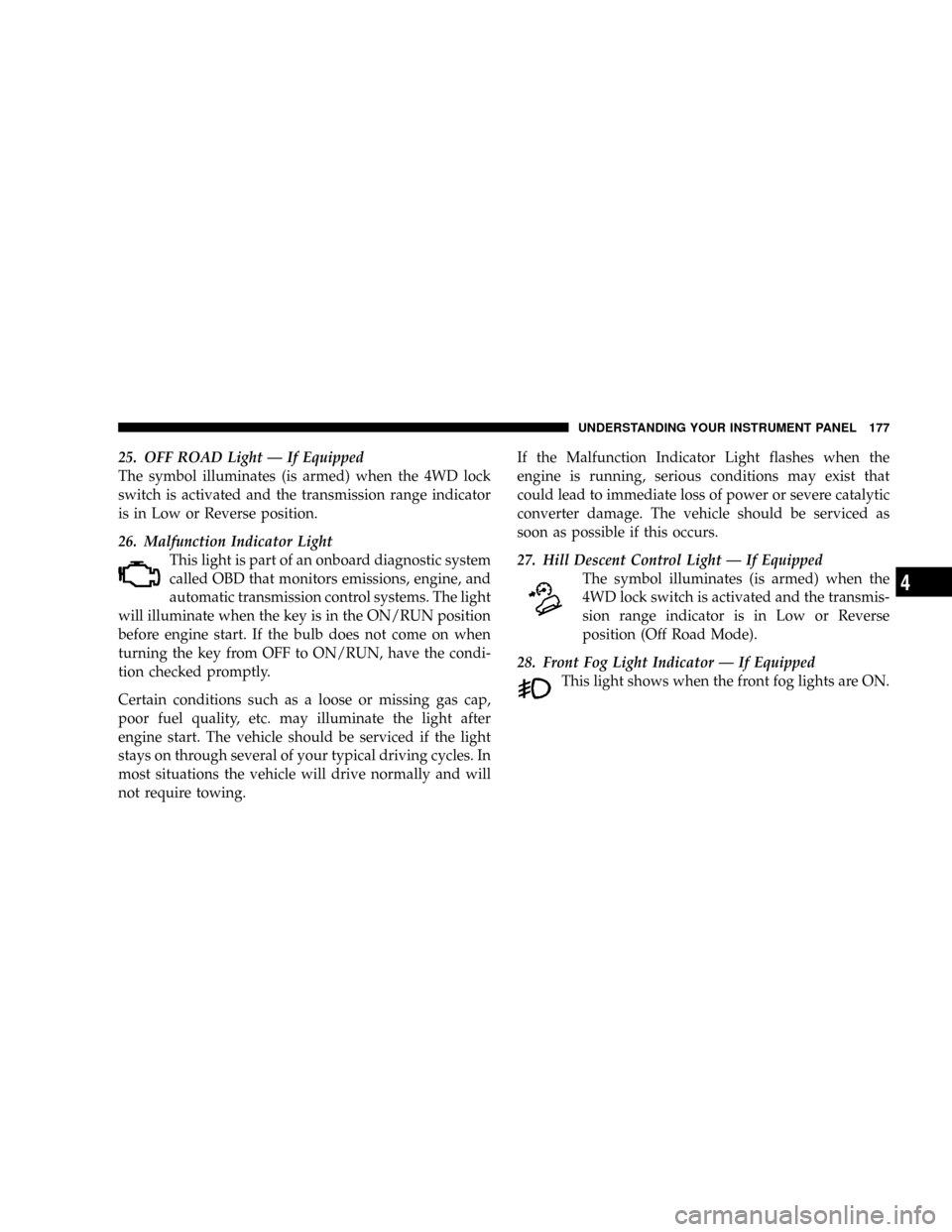
25. OFF ROAD Light Ð If Equipped
The symbol illuminates (is armed) when the 4WD lock
switch is activated and the transmission range indicator
is in Low or Reverse position.
26. Malfunction Indicator Light
This light is part of an onboard diagnostic system
called OBD that monitors emissions, engine, and
automatic transmission control systems. The light
will illuminate when the key is in the ON/RUN position
before engine start. If the bulb does not come on when
turning the key from OFF to ON/RUN, have the condi-
tion checked promptly.
Certain conditions such as a loose or missing gas cap,
poor fuel quality, etc. may illuminate the light after
engine start. The vehicle should be serviced if the light
stays on through several of your typical driving cycles. In
most situations the vehicle will drive normally and will
not require towing.If the Malfunction Indicator Light flashes when the
engine is running, serious conditions may exist that
could lead to immediate loss of power or severe catalytic
converter damage. The vehicle should be serviced as
soon as possible if this occurs.
27. Hill Descent Control Light Ð If Equipped
The symbol illuminates (is armed) when the
4WD lock switch is activated and the transmis-
sion range indicator is in Low or Reverse
position (Off Road Mode).
28. Front Fog Light Indicator Ð If Equipped
This light shows when the front fog lights are ON.
UNDERSTANDING YOUR INSTRUMENT PANEL 177
4
Page 179 of 440
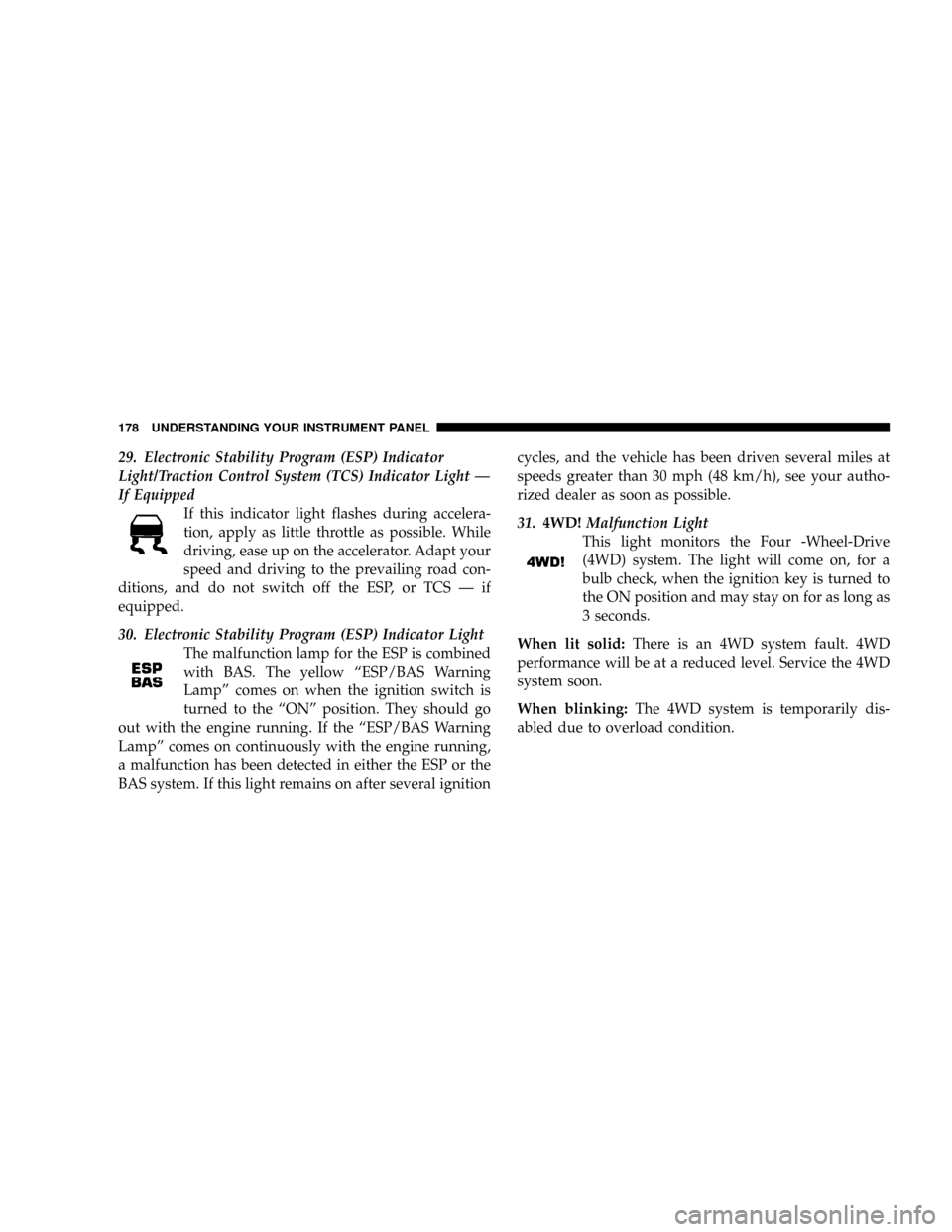
29. Electronic Stability Program (ESP) Indicator
Light/Traction Control System (TCS) Indicator Light Ð
If Equipped
If this indicator light flashes during accelera-
tion, apply as little throttle as possible. While
driving, ease up on the accelerator. Adapt your
speed and driving to the prevailing road con-
ditions, and do not switch off the ESP, or TCS Ð if
equipped.
30. Electronic Stability Program (ESP) Indicator Light
The malfunction lamp for the ESP is combined
with BAS. The yellow ªESP/BAS Warning
Lampº comes on when the ignition switch is
turned to the ªONº position. They should go
out with the engine running. If the ªESP/BAS Warning
Lampº comes on continuously with the engine running,
a malfunction has been detected in either the ESP or the
BAS system. If this light remains on after several ignitioncycles, and the vehicle has been driven several miles at
speeds greater than 30 mph (48 km/h), see your autho-
rized dealer as soon as possible.
31.4WD!Malfunction Light
This light monitors the Four -Wheel-Drive
(4WD) system. The light will come on, for a
bulb check, when the ignition key is turned to
the ON position and may stay on for as long as
3 seconds.
When lit solid:There is an 4WD system fault. 4WD
performance will be at a reduced level. Service the 4WD
system soon.
When blinking:The 4WD system is temporarily dis-
abled due to overload condition.
178 UNDERSTANDING YOUR INSTRUMENT PANEL
Page 181 of 440
The Electronic Vehicle Information Center (EVIC) fea-
tures a driver-interactive display. It is located in the lower
left part of the cluster below the fuel and engine tem-
perature gauge. The EVIC consists of the following:
²System Status
²Vehicle information warning message displays
²Personal Settings (customer programmable features)
²Compass heading
²Outside temperature display
²Trip computer functions
²UConnectŸ hands-free communication system dis-
plays Ð If Equipped
²Audio mode display
²Tire Pressure Monitor (TPM)When the appropriate conditions exist, the Electronic
Vehicle Information Center (EVIC) displays the following
messages.
²Turn Signal On (with a continuous warning chime)
²Left Front Turn Signal Lamp Out (with a single chime)
²Left Rear Turn Signal Lamp Out (with a single chime)
²Right Front Turn Signal Lamp Out (with a single
chime)
²Right Rear Turn Signal Lamp Out (with a single
chime)
²RKE Battery Low (with a single chime)
²Personal Settings Not Available ± Vehicle Not in Park
(automatic transmissions) or vehicle is in motion
(manual transmissions).
180 UNDERSTANDING YOUR INSTRUMENT PANEL
Page 189 of 440
To set the variance:with the ignition in the ON position,
with a short button press (less than one second) press and
release the EVIC button several times until you have
displayed the Personal Settings (Customer Program-
mable Features) menu. Once in the Personal Settings
(Customer Programmable Features) menu, press and
release (less than one second) the EVIC button several
times until ªCompass Varianceº is highlighted. The
ªCompass Varianceº message and the current variance
zone number will be displayed. To change the zone, press
and hold (longer than two seconds) the EVIC button to
increment the variance one step. Repeat as necessary,
with individual long (for at least 1 second) EVIC button
presses for each increment, until the desired variance is
achieved. To exit the Variance Programming, press the
EVIC button with a short (less than one second) button
press.NOTE:The factory default Zone is 8. During program-
ming, the Zone value will wrap around from Zone 15 to
Zone 1.
Compass Calibration
The Compass will automatically calibrate if the Cal
indicator is flashing, by driving around slowly (under 5
mph / 8 km/h) in one or more complete circles in an area
free from large metallic objects or power lines, until the
Cal indicator turns off. If during normal use the compass
appears erratic, inaccurate or abnormal, you may wish to
manually calibrate the compass. Prior to calibrating the
compass make sure the proper zone is selected.
To manually calibrate the Compass:start the engine and
leave the transmission in the PARK position. Using a
short button press (less than one second), press and
release the EVIC button several times until the EVIC
displays the Personal Settings (Customer Programmable
Features) menu. Once in the Personal Settings (Customer
188 UNDERSTANDING YOUR INSTRUMENT PANEL
Page 228 of 440
NOTE:See ªCirculation Controlº later in this section,
for proper or extended use of this position.
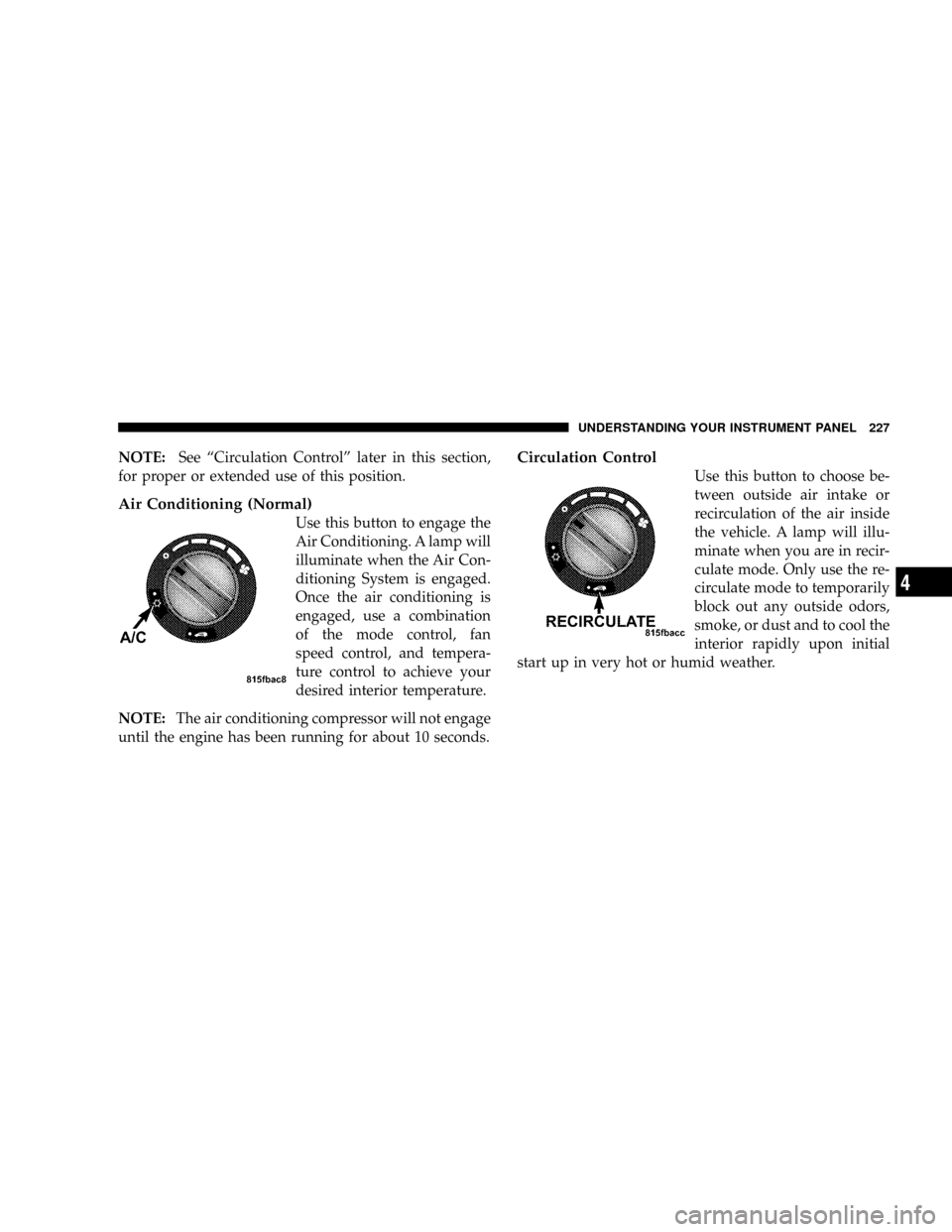
Air Conditioning (Normal)
Use this button to engage the
Air Conditioning. A lamp will
illuminate when the Air Con-
ditioning System is engaged.
Once the air conditioning is
engaged, use a combination
of the mode control, fan
speed control, and tempera-
ture control to achieve your
desired interior temperature.
NOTE:The air conditioning compressor will not engage
until the engine has been running for about 10 seconds.
Circulation Control
Use this button to choose be-
tween outside air intake or
recirculation of the air inside
the vehicle. A lamp will illu-
minate when you are in recir-
culate mode. Only use the re-
circulate mode to temporarily
block out any outside odors,
smoke, or dust and to cool the
interior rapidly upon initial
start up in very hot or humid weather.
UNDERSTANDING YOUR INSTRUMENT PANEL 227
4
Page 229 of 440
NOTE:Continuous use of the recirculate mode may
make the inside air stuffy and window fogging may
occur. Extended use of this mode is not recommended.
In cold or damp weather, the use of the Recirculate
position will cause windows to fog on the inside because
of moisture build up inside the vehicle. For maximum
defogging, select the Outside Air position.
NOTE:Recirculation Mode will not operate in floor, mix
or defrost modes.
Air Filtration System ± If Equipped
An air filter is included in the optional Security Group.
Filter media includes a particle filtration layer and acharcoal layer. The filter will reduce, but not eliminate,
diesel and agricultural smells. The filter acts only on air
coming from outside the vehicle; it does not filter air
inside the passenger compartment. See the maintenance
schedule for the filter change interval. The air filter
change interval coincides with engine oil and filter
change intervals. As with oil changes, the interval is
shorter for heavy duty service or dusty conditions. See
your authorized dealer for service.
228 UNDERSTANDING YOUR INSTRUMENT PANEL
Page 234 of 440
STARTING AND OPERATING
CONTENTS
mStarting Procedures.....................237
NAutomatic Transaxle...................237
NManual Transaxle.....................238
NNormal Starting......................238
NExtremely Cold Weather (Below220ÉF
Or229ÉC)..........................238
NIf Engine Fails To Start.................239
NAfter Starting........................239
mAutomatic Transaxle Ð If Equipped.........240NBrake/Transmission Interlock System.......241
N
Automatic Transaxle Ignition Interlock System. 241
NGear Ranges For Continuously Variable
Automatic Transaxle (CVT)..............242
mManual Transaxle Operation...............244
NRecommended Shift Speeds..............245
NDownshifting........................245
mFour Wheel Drive System Ð If Equipped......246
mPatriot Freedom Drive II ± Safe Off-Road
Driving..............................247
5
Page 236 of 440
mTires Ð General Information...............285
NTire Pressure.........................285
NTire Inflation Pressures.................286
NRadial-Ply Tires......................289
NCompact Spare Tire Ð If Equipped.........289
NLimited Use Spare Ð If Equipped.........290
NTire Spinning........................291
NTread Wear Indicators..................291
NLife Of Tire.........................292
NReplacement Tires.....................292
NAlignment And Balance.................294
mTire Pressure Monitoring System (TPMS) Ð If
Equipped............................294NBase Tire Pressure Monitoring System (TPMS)
Operation ± If Equipped................294
NPremium System ± If Equipped...........296
NGeneral Information...................301
mTire Chains...........................301
mSnow Tires...........................302
mTire Rotation Recommendations............302
mFuel Requirements......................303
NGasoline Engines.....................303
NReformulated Gasoline.................303
NGasoline/Oxygenate Blends..............304
NMMT In Gasoline.....................304
NMaterials Added To Fuel................305
STARTING AND OPERATING 235
5