Page 330 of 440
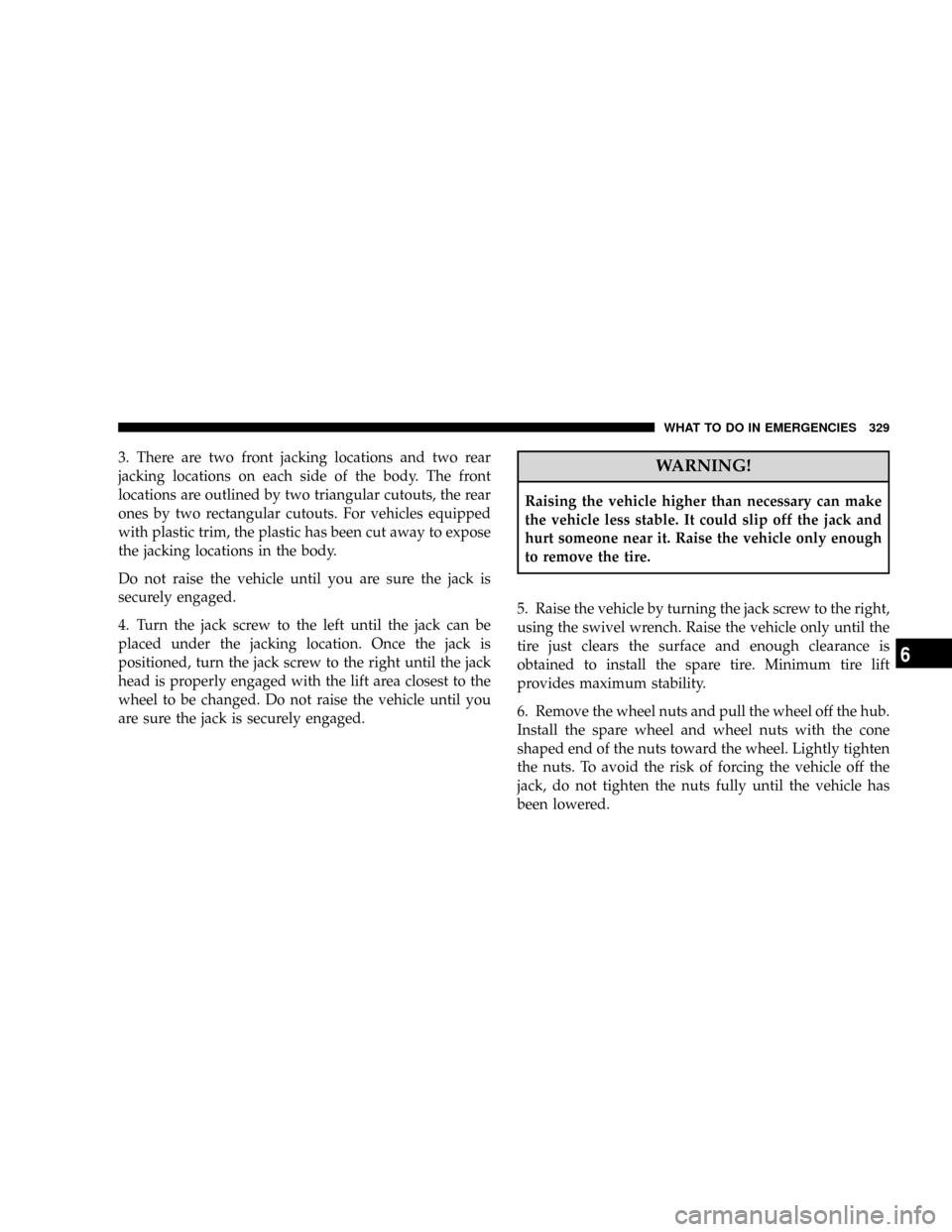
3. There are two front jacking locations and two rear
jacking locations on each side of the body. The front
locations are outlined by two triangular cutouts, the rear
ones by two rectangular cutouts. For vehicles equipped
with plastic trim, the plastic has been cut away to expose
the jacking locations in the body.
Do not raise the vehicle until you are sure the jack is
securely engaged.
4. Turn the jack screw to the left until the jack can be
placed under the jacking location. Once the jack is
positioned, turn the jack screw to the right until the jack
head is properly engaged with the lift area closest to the
wheel to be changed. Do not raise the vehicle until you
are sure the jack is securely engaged.WARNING!
Raising the vehicle higher than necessary can make
the vehicle less stable. It could slip off the jack and
hurt someone near it. Raise the vehicle only enough
to remove the tire.
5. Raise the vehicle by turning the jack screw to the right,
using the swivel wrench. Raise the vehicle only until the
tire just clears the surface and enough clearance is
obtained to install the spare tire. Minimum tire lift
provides maximum stability.
6. Remove the wheel nuts and pull the wheel off the hub.
Install the spare wheel and wheel nuts with the cone
shaped end of the nuts toward the wheel. Lightly tighten
the nuts. To avoid the risk of forcing the vehicle off the
jack, do not tighten the nuts fully until the vehicle has
been lowered.
WHAT TO DO IN EMERGENCIES 329
6
Page 331 of 440
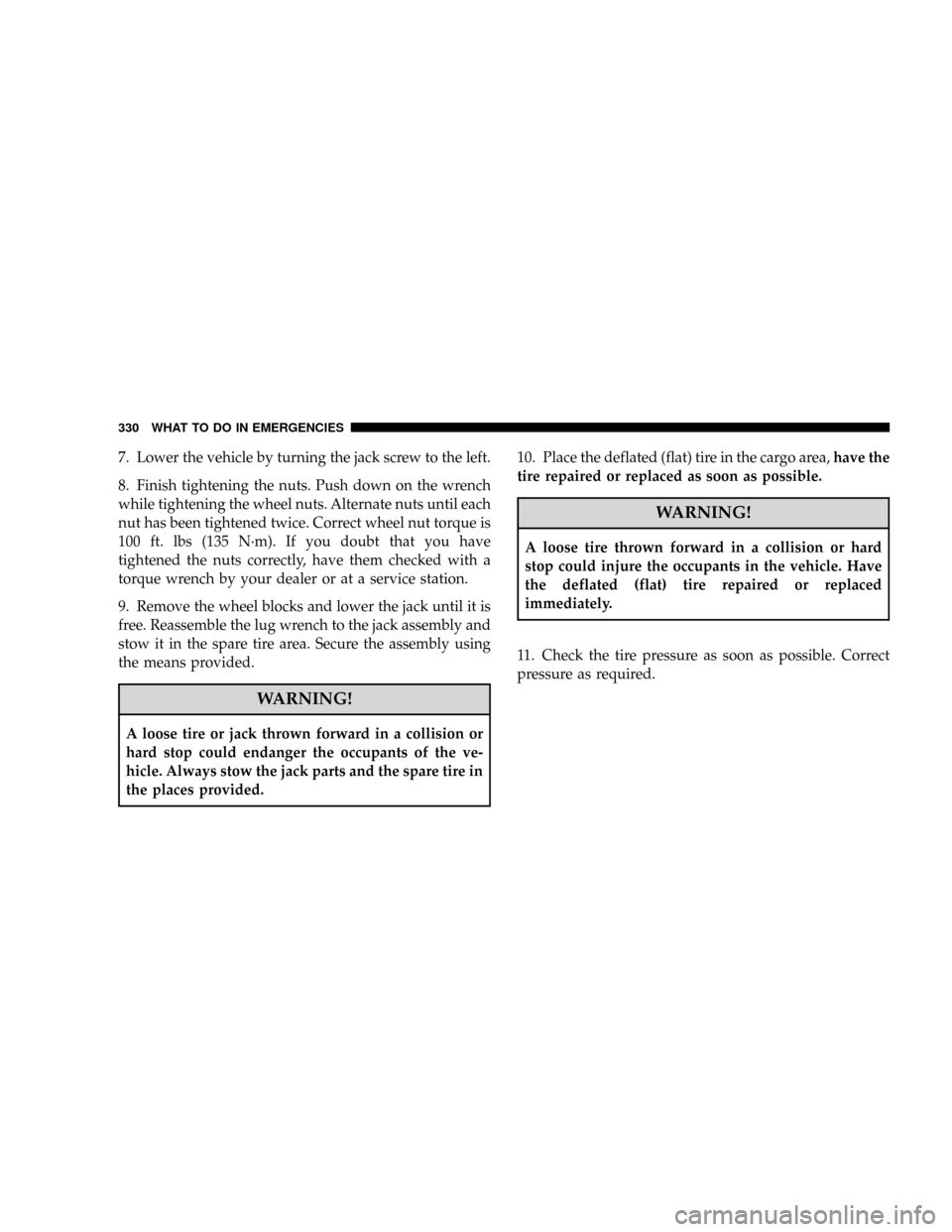
7. Lower the vehicle by turning the jack screw to the left.
8. Finish tightening the nuts. Push down on the wrench
while tightening the wheel nuts. Alternate nuts until each
nut has been tightened twice. Correct wheel nut torque is
100 ft. lbs (135 N´m). If you doubt that you have
tightened the nuts correctly, have them checked with a
torque wrench by your dealer or at a service station.
9. Remove the wheel blocks and lower the jack until it is
free. Reassemble the lug wrench to the jack assembly and
stow it in the spare tire area. Secure the assembly using
the means provided.
WARNING!
A loose tire or jack thrown forward in a collision or
hard stop could endanger the occupants of the ve-
hicle. Always stow the jack parts and the spare tire in
the places provided.10. Place the deflated (flat) tire in the cargo area,have the
tire repaired or replaced as soon as possible.
WARNING!
A loose tire thrown forward in a collision or hard
stop could injure the occupants in the vehicle. Have
the deflated (flat) tire repaired or replaced
immediately.
11. Check the tire pressure as soon as possible. Correct
pressure as required.
330 WHAT TO DO IN EMERGENCIES
Page 337 of 440
CAUTION!
Racing the engine or spinning the wheels too fast
may lead to transaxle overheating and failure. It can
also damage the tires. Do not spin the wheels above
30 mph (48 km/h). Do not spin the wheels continu-
ously for more than 30 seconds.
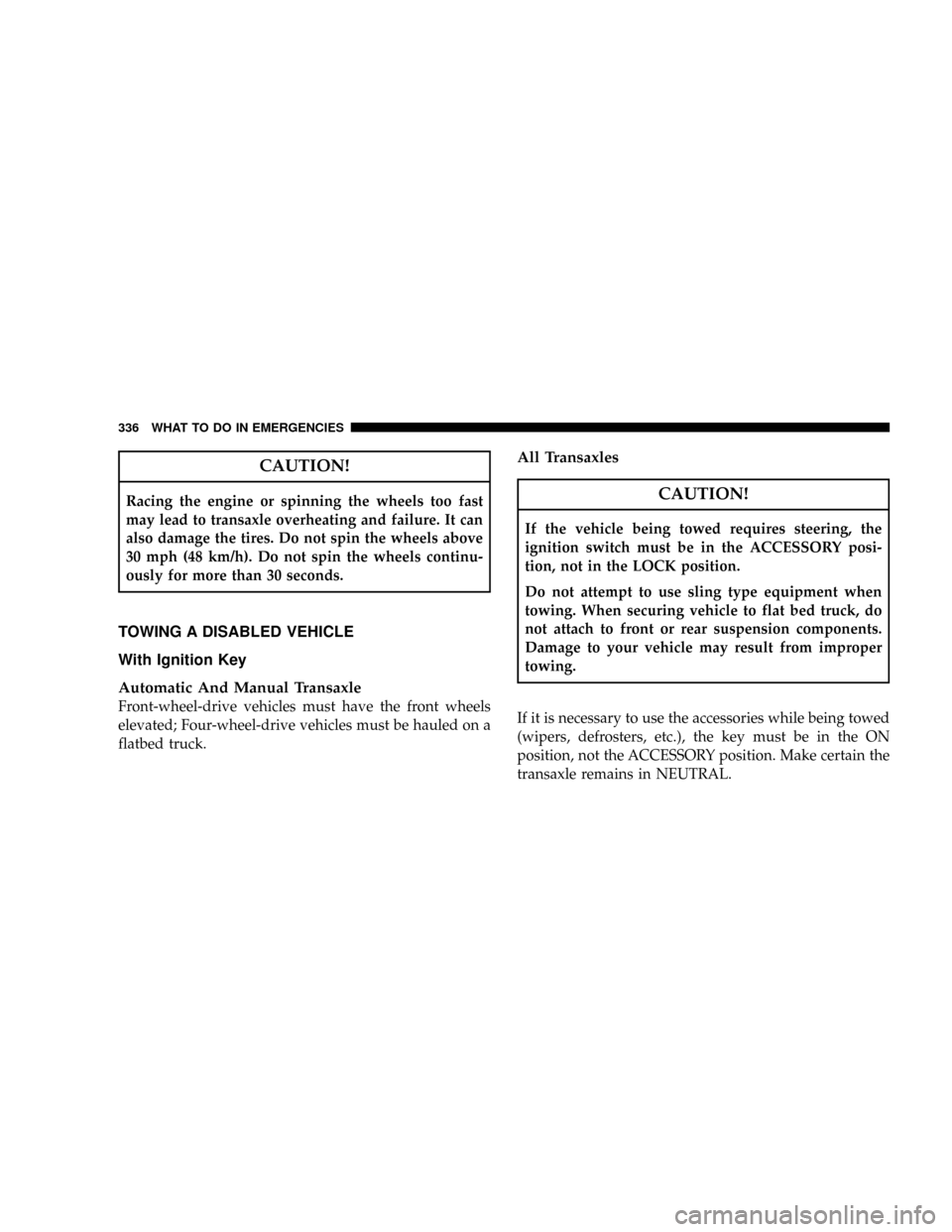
TOWING A DISABLED VEHICLE
With Ignition Key
Automatic And Manual Transaxle
Front-wheel-drive vehicles must have the front wheels
elevated; Four-wheel-drive vehicles must be hauled on a
flatbed truck.
All Transaxles
CAUTION!
If the vehicle being towed requires steering, the
ignition switch must be in the ACCESSORY posi-
tion, not in the LOCK position.
Do not attempt to use sling type equipment when
towing. When securing vehicle to flat bed truck, do
not attach to front or rear suspension components.
Damage to your vehicle may result from improper
towing.
If it is necessary to use the accessories while being towed
(wipers, defrosters, etc.), the key must be in the ON
position, not the ACCESSORY position. Make certain the
transaxle remains in NEUTRAL.
336 WHAT TO DO IN EMERGENCIES
Page 366 of 440
²Do not change the thermostat for summer or winter
operation. If replacement is ever necessary, install
ONLY the correct type thermostat. Other designs may
result in unsatisfactory coolant performance, poor gas
mileage, and increased emissions.
Hoses And Vacuum/Vapor Harnesses
Inspect surfaces of hoses and nylon tubing for evidence
of heat and mechanical damage. Hard or soft spots,
brittle rubber, cracking, tears, cuts, abrasions, and exces-
sive swelling indicate deterioration of the rubber
Pay particular attention to the hoses nearest to high heat
sources such as the exhaust manifold. Inspect hose rout-
ing to be sure hoses do not touch any heat source or
moving component that may cause heat damage or
mechanical wear.
Insure nylon tubing in these areas has not melted or
collapsedInspect all hose connections such as clamps and cou-
plings to make sure the are secure and no leaks are
present.
Components should be replaced immediately if there is
any evidence of degradation that could cause failure.Fuel System Connections
Electronic Fuel Injection high pressure fuel systems are
designed with tubes and special connects, connections
and clamps which have unique material characteristics to
provide adequate sealing and resist attack by deterio-
rated gasoline.
You are urged to use only the manufactures-specified
tubes, connections and clamps, or their equivalent in
material and specification, in any fuel system servicing.
MAINTAINING YOUR VEHICLE 365
7
Page 367 of 440
Brake System
In order to assure brake system performance, all brake
system components should be inspected periodically.
Suggested service intervals can be found in the Mainte-
nance Section.
WARNING!
Riding the brakes can lead to brake failure and
possibly an accident. Driving with your foot resting
or riding on the brake pedal can result in abnormally
high brake temperatures, excessive lining wear, and
possible brake damage. You wouldn't have your full
braking capacity in an emergency.
Brake And Power Steering System Hoses
When servicing the vehicle for scheduled maintenance,
inspect the surface of the hoses and nylon tubing for
evidence of heat and mechanical damage. Hard andbrittle rubber, cracking, tears, cuts, abrasions, and exces-
sive swelling suggest deterioration of the rubber. Particu-
lar attention should be made to examining those hose
surfaces nearest to high heat sources, such as the exhaust
manifold.
Inspect all hose clamps and couplings to make sure they
are secure and no leaks are present.
Insure nylon tubing in these areas has not melted or
collapsed.
NOTE:Often, fluids such as oil, power steering fluid,
and brake fluid are used during assembly plant opera-
tions to ease the assembly of hoses to couplings. There-
fore, oil wetness at the hose-coupling area is not neces-
sarily an indication of leakage. Actual dripping of hot
fluid when systems are under pressure (during vehicle
operation) should be noted before a hose is replaced
based on leakage.
366 MAINTAINING YOUR VEHICLE
Page 378 of 440
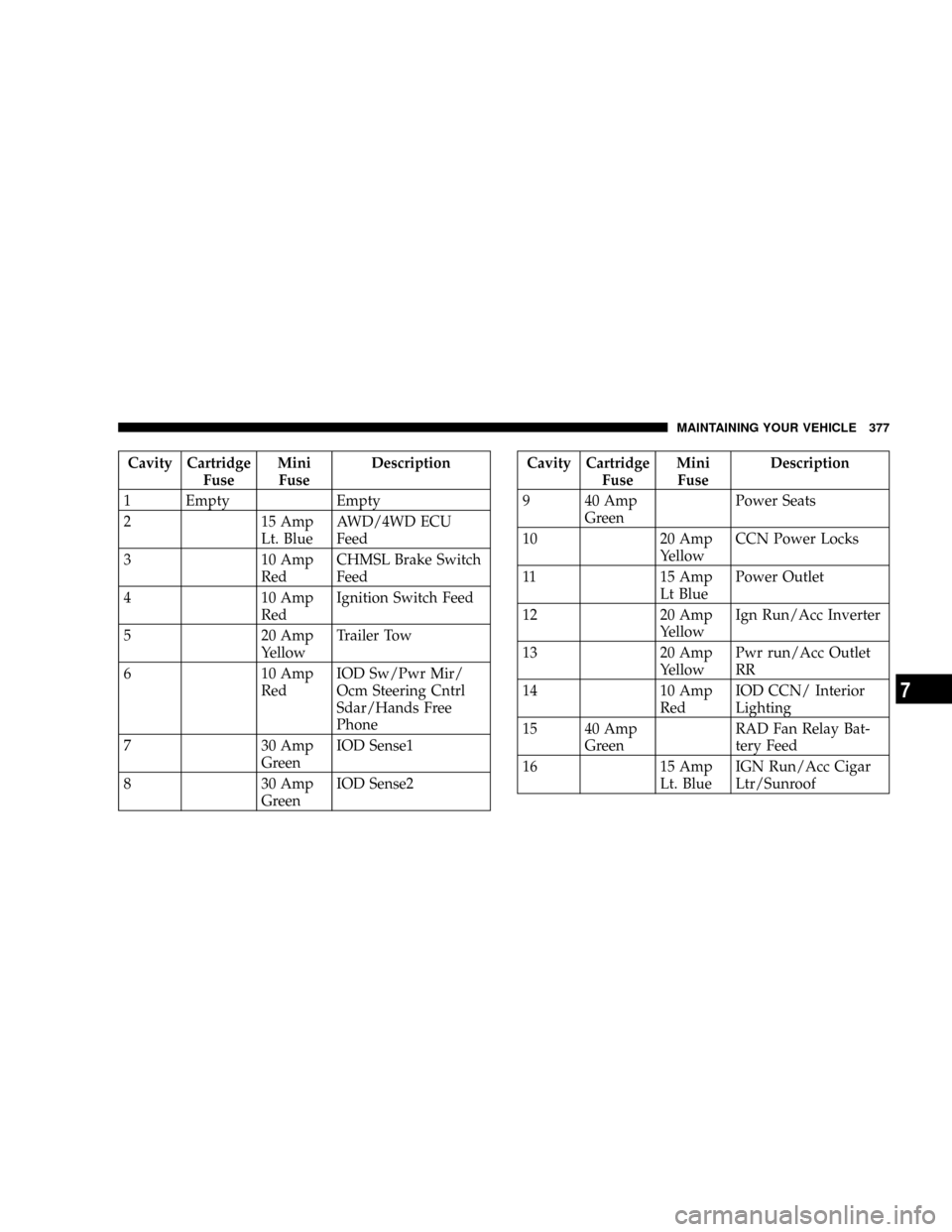
Cavity Cartridge
FuseMini
FuseDescription
1 Empty Empty
2 15 Amp
Lt. BlueAWD/4WD ECU
Feed
3 10 Amp
RedCHMSL Brake Switch
Feed
4 10 Amp
RedIgnition Switch Feed
5 20 Amp
YellowTrailer Tow
6 10 Amp
RedIOD Sw/Pwr Mir/
Ocm Steering Cntrl
Sdar/Hands Free
Phone
7 30 Amp
GreenIOD Sense1
8 30 Amp
GreenIOD Sense2Cavity Cartridge
FuseMini
FuseDescription
9 40 Amp
GreenPower Seats
10 20 Amp
YellowCCN Power Locks
11 15 Amp
Lt BluePower Outlet
12 20 Amp
YellowIgn Run/Acc Inverter
13 20 Amp
YellowPwr run/Acc Outlet
RR
14 10 Amp
RedIOD CCN/ Interior
Lighting
15 40 Amp
GreenRAD Fan Relay Bat-
tery Feed
16 15 Amp
Lt. BlueIGN Run/Acc Cigar
Ltr/Sunroof
MAINTAINING YOUR VEHICLE 377
7
Page 423 of 440
ABS (Anti-Lock Brake System).............. 273
Adding Engine Coolant (Antifreeze).......... 362
Adding Fuel........................... 307
Adding Washer Fluid..................126,159
Additives, Fuel......................... 305
Air Cleaner, Engine (Engine Air Cleaner Filter) . . . 353
Air Conditioner Maintenance............... 356
Air Conditioning Controls................. 223
Air Conditioning, Operating Tips............ 229
Air Conditioning Refrigerant.............356,357
Air Conditioning System................223,356
Air Pressure, Tires....................... 286
Airbag................................ 49
Airbag Deployment.....................54,56
Airbag Light.....................54,58,70,170
Airbag Maintenance....................... 57
Airbag, Side............................ 55
Airbag, Window (Side Curtain).............50,55
Alarm System (Security Alarm)............30,173Alignment and Balance................... 294
Alterations/Modifications, Vehicle............. 8
Antenna, Satellite Radio................... 220
Antifreeze (Engine Coolant)..............361,388
Capacities........................... 388
Disposal............................ 363
Anti-Lock Brake System (ABS)............136,273
Anti-Theft Security Alarm (Theft Alarm)........ 30
Appearance Care........................ 371
Automatic Door Locks...................20,21
Automatic Transaxle...........12,237,240,326,368
Fluid Level Check...................... 369
Interlock System.....................17,241
Overheating.......................... 326
Selection Of Lubricant................... 368
Shifting............................. 242
Special Additives...................... 369
Ball Joints............................. 357
422 INDEX
Page 431 of 440
Headlight Switch...................... 119
Headlights........................... 119
High Beam Indicator.................... 170
Instrument Cluster..................... 119
License............................. 386
Lights On Reminder.................... 120
Low Fuel............................ 170
Malfunction Indicator (Check Engine)........ 177
Map Reading......................... 118
Oil Pressure.......................... 170
Seat Belt Reminder..................... 171
Security Alarm (Theft Alarm).............. 31
Theft Alarm (Security Alarm).............. 173
Traction Control....................... 141
Turn Signal.................. 119,121,170,384
Voltage............................. 169
Warning (Instrument Cluster Description)..... 169
Loading Vehicle......................... 309
Tires ............................... 281Locks
Child Protection........................ 23
Door................................ 18
Power Door........................... 19
Steering Wheel......................... 17
Lubrication, Body....................... 358
Luggage Rack (Roof Rack)................. 160
Lumbar Support........................ 109
Maintenance Free Battery.................. 354
Maintenance, General..................... 347
Maintenance Procedures................... 347
Maintenance Schedule.................... 392
Schedule ªAº......................... 405
Schedule ªBº......................... 395
Malfunction Indicator Light (Check Engine) . . 177,344
Manual, Service......................... 416
Manual Transaxle..................238,244,369
Downshifting......................... 245
430 INDEX