Page 153 of 440
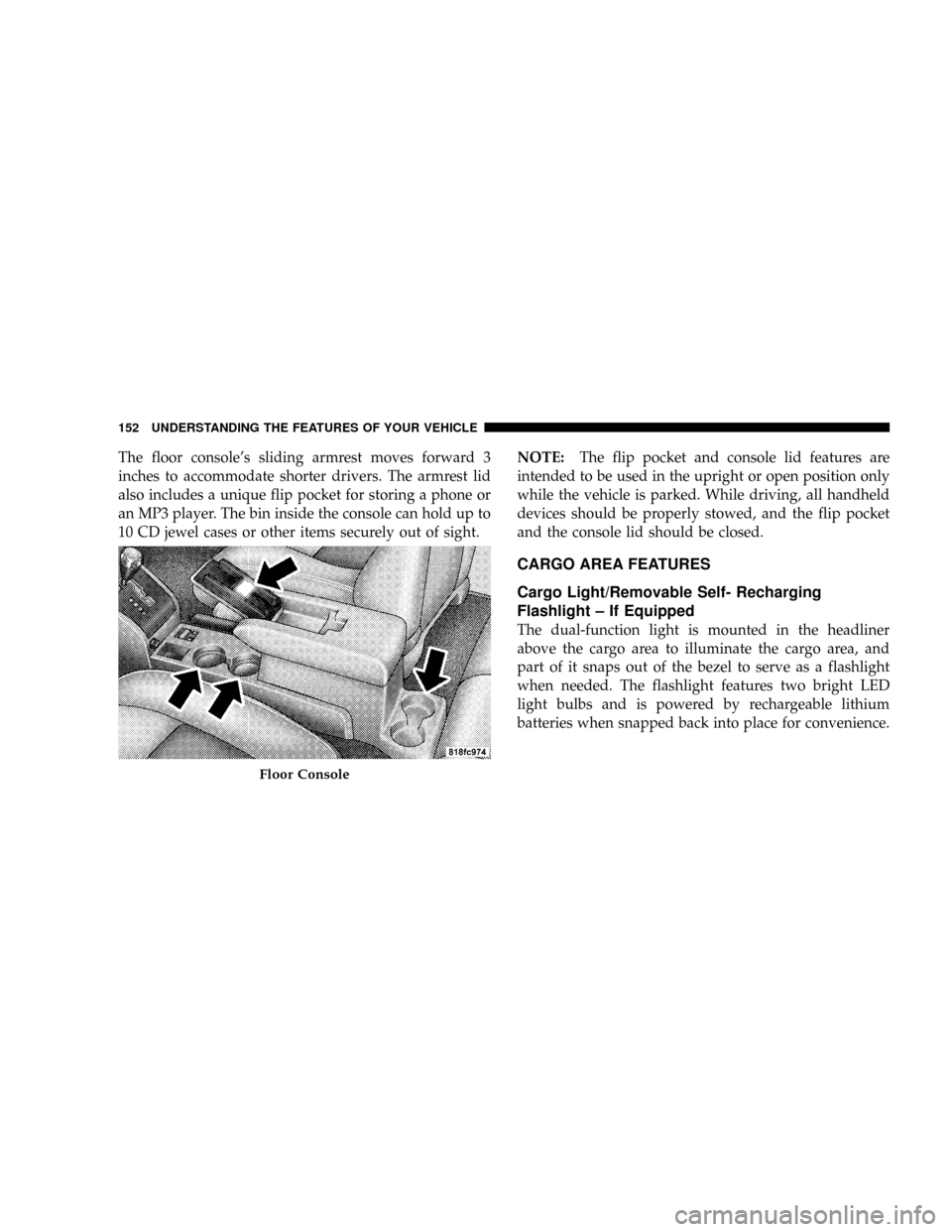
The floor console's sliding armrest moves forward 3
inches to accommodate shorter drivers. The armrest lid
also includes a unique flip pocket for storing a phone or
an MP3 player. The bin inside the console can hold up to
10 CD jewel cases or other items securely out of sight.NOTE:The flip pocket and console lid features are
intended to be used in the upright or open position only
while the vehicle is parked. While driving, all handheld
devices should be properly stowed, and the flip pocket
and the console lid should be closed.
CARGO AREA FEATURES
Cargo Light/Removable Self- Recharging
Flashlight ± If Equipped
The dual-function light is mounted in the headliner
above the cargo area to illuminate the cargo area, and
part of it snaps out of the bezel to serve as a flashlight
when needed. The flashlight features two bright LED
light bulbs and is powered by rechargeable lithium
batteries when snapped back into place for convenience.
Floor Console
152 UNDERSTANDING THE FEATURES OF YOUR VEHICLE
Page 157 of 440
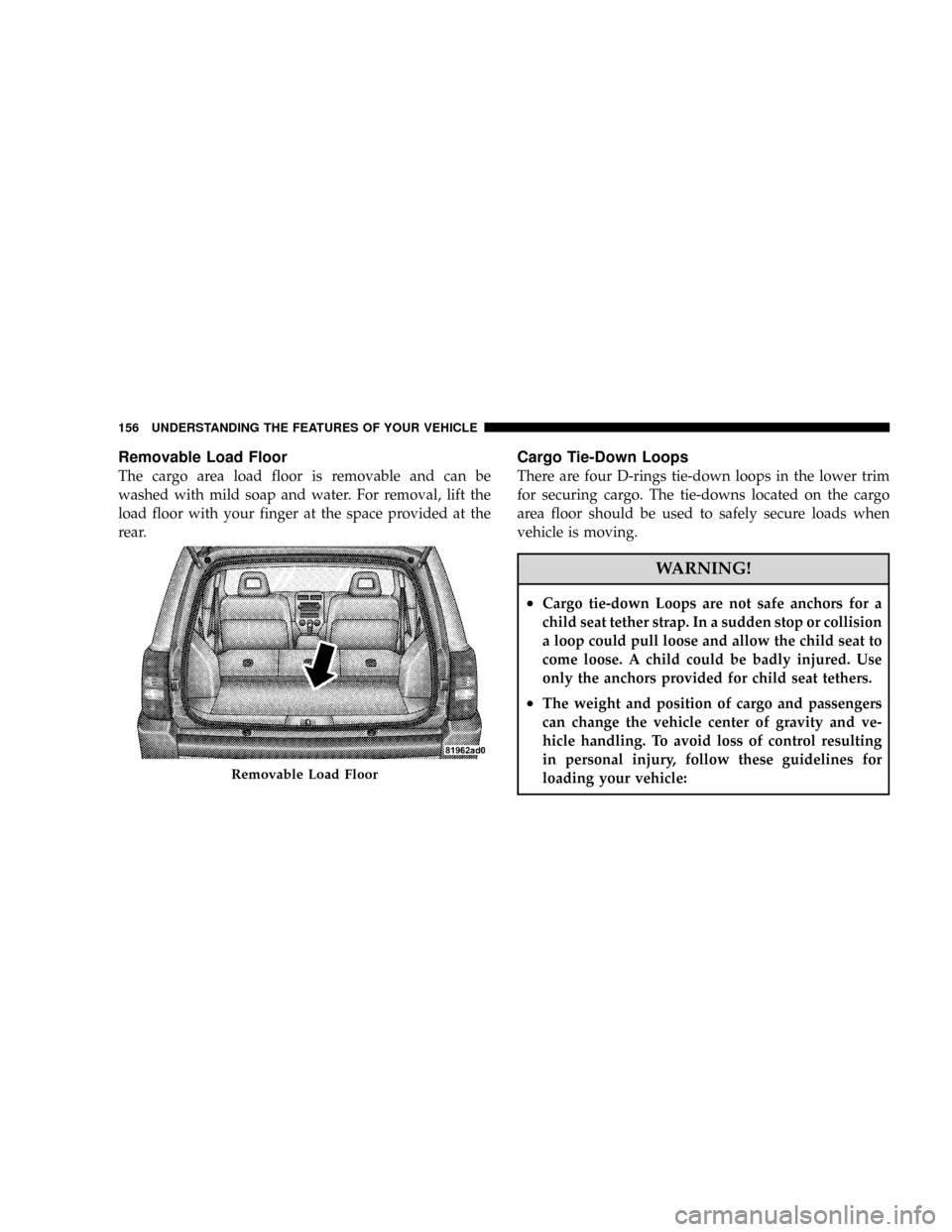
Removable Load Floor
The cargo area load floor is removable and can be
washed with mild soap and water. For removal, lift the
load floor with your finger at the space provided at the
rear.
Cargo Tie-Down Loops
There are four D-rings tie-down loops in the lower trim
for securing cargo. The tie-downs located on the cargo
area floor should be used to safely secure loads when
vehicle is moving.
WARNING!
²Cargo tie-down Loops are not safe anchors for a
child seat tether strap. In a sudden stop or collision
a loop could pull loose and allow the child seat to
come loose. A child could be badly injured. Use
only the anchors provided for child seat tethers.
²The weight and position of cargo and passengers
can change the vehicle center of gravity and ve-
hicle handling. To avoid loss of control resulting
in personal injury, follow these guidelines for
loading your vehicle:
Removable Load Floor
156 UNDERSTANDING THE FEATURES OF YOUR VEHICLE
Page 161 of 440
CAUTION!
Use care when washing the inside of the rear window
to prevent damage to heating elements. Use a soft
cloth and a mild washing solution, wiping parallel to
the heating elements. Also, keep all objects a safe
distance from the window to prevent damaging the
heating elements.
ROOF LUGGAGE RACK Ð IF EQUIPPED
External racks do not increase the total load carrying
capacity of the vehicle. Be sure that the total occupant
and luggage load inside the vehicle, plus the load on the
luggage rack, do not exceed the rated vehicle capacity.
This vehicle is not equipped with roof rack cross rails as
built, unless ordered as optional equipment. Cross rails
must be installed prior to carrying loads on the roof rack.
If not equipped, your authorized dealer can order andinstall Mopartcross rails built specifically for this roof
rack system or a number of after market rails that are
tailored to your lifestyle or activities.
NOTE:The optional cross rails have seven specific
locations identified by a feature on both the side rail and
the cross rail. Cross rails must be secured in one of the
seven detent locations on the side rail to prevent move-
ment with a sudden stop. For improved wind noise
performance when cross rails are not in use, place them
in detent positions #2 (second detent from the front of the
vehicle) and #7 (detent closest to the rear of the vehicle)
as indicated with a unique feature on the side rails.
160 UNDERSTANDING THE FEATURES OF YOUR VEHICLE
Page 162 of 440
CAUTION!
²To prevent damage to the roof of your vehicle, DO NOT
carry any loads on the roof rack without cross rails
installed. The load should be secured and placed on top of
the cross rails, not directly on the roof. If it is necessary to
place the load on the roof, place a blanket or some other
protection between the load and the roof surface.
²To avoid damage to the roof rack and vehicle, do not
exceed the rated load capacity of your cross rail system or
the roof rack system maximum load capacity of 150 lbs (68
kg). Always distribute heavy loads as evenly as possible
and secure the load appropriately.
²Long loads which extend over the windshield, such as
wood panels or surfboards, should be secured to both the
front and rear of the vehicle.
²Travel at reduced speeds and turn corners carefully when
carrying large or heavy loads on the roof rack. Wind forces,
due to natural causes or nearby truck traffic, can add
sudden upward loads. This is especially true on large flat
loads and may result in damage to the cargo or your
vehicle.
WARNING!
Cargo must be securely tied before driving your
vehicle. Improperly secured loads can fly off the
vehicle, particularly at high speeds, resulting in per-
sonal injury or property damage. Follow the roof rack
ªCautionsº when carrying cargo on your roof rack.
UNDERSTANDING THE FEATURES OF YOUR VEHICLE 161
3
Page 229 of 440
NOTE:Continuous use of the recirculate mode may
make the inside air stuffy and window fogging may
occur. Extended use of this mode is not recommended.
In cold or damp weather, the use of the Recirculate
position will cause windows to fog on the inside because
of moisture build up inside the vehicle. For maximum
defogging, select the Outside Air position.
NOTE:Recirculation Mode will not operate in floor, mix
or defrost modes.
Air Filtration System ± If Equipped
An air filter is included in the optional Security Group.
Filter media includes a particle filtration layer and acharcoal layer. The filter will reduce, but not eliminate,
diesel and agricultural smells. The filter acts only on air
coming from outside the vehicle; it does not filter air
inside the passenger compartment. See the maintenance
schedule for the filter change interval. The air filter
change interval coincides with engine oil and filter
change intervals. As with oil changes, the interval is
shorter for heavy duty service or dusty conditions. See
your authorized dealer for service.
228 UNDERSTANDING YOUR INSTRUMENT PANEL
Page 243 of 440
Gear Ranges For Continuously Variable
Automatic Transaxle (CVT)
DO NOT race the engine when shifting from PARK or
NEUTRAL positions into another gear range.
ªPº Park
Supplements the parking brake by locking the transmis-
sion. The engine can be started in this range. Never use P
(Park) while the vehicle is in motion. Apply the parking
brake when leaving the vehicle in this range. Always
apply the parking brake first, and then place the selector
in P (Park) position.
WARNING!
Unintended movement of a vehicle could injure
those in and near the vehicle. As with all vehicles,
you should never exit a vehicle while the engine is
running. Before exiting a vehicle, you should always
shift the vehicle into P (Park), remove the key from
the ignition, and apply the parking brake. Once the
key is removed from the ignition, the transmission
shift lever is locked in the P (Park) position, securing
the vehicle against unwanted movement. Further-
more, you should never leave children unattended
inside a vehicle.
The following indicators should be used to ensure that
you have engaged the transmission shift lever into the P
(Park) position:
242 STARTING AND OPERATING
Page 255 of 440
The Basics of Off-Road Driving
You will encounter many types of terrain driving off-
road. You should be familiar with the terrain and area
before proceeding. There are many types of surface
conditions: hard packed dirt, gravel, rocks, grass, sand,
mud, snow and ice. Every surface has a different effect on
your vehicle's steering, handling and traction. Control-
ling your vehicle is one of the keys to successful off-road
driving, so always keep a firm grip on the steering wheel
and maintain a good driving posture. Avoid sudden
accelerations, turns or braking. In most cases there are no
road signs, posted speed limits or signal lights. Therefore
you will need to use your own good judgment on what is
safe and what isn't. When on a trail you should always be
looking ahead for surface obstacles and changes in
terrain. The key is to plan your future driving route while
remembering what you are currently driving over.CAUTION!
Never park your vehicle over dry grass or other
combustible materials. The heat from your vehicle
exhaust system could cause a fire.
WARNING!
Always wear your seat belt and firmly tie down
cargo. Unsecured cargo can become projectiles in an
off-road situation.
When To Use Low (L Off-Road) with the 4WD
Lock Lever Engaged
When To Use Low (L Off-Road) with the 4WD Lock
Lever Engaged When driving off-road, shift into low (L
Off-Road) and activate the 4WD Lock. This will provide
254 STARTING AND OPERATING
Page 317 of 440
CAUTION!
²Avoid towing a trailer for the first 500 miles (805
km) of vehicle operation. Doing so may damage
your vehicle.
²During the first 500 miles (805 km) of trailer
towing, limit your speed to 50 mph (80 km/h).
Perform the maintenance listed in Section 8 of this
manual. When towing a trailer, never exceed the GAWR,
or GCWR, ratings.
WARNING!
Improper towing can lead to an injury accident.
Follow these guidelines to make your trailer towing
as safe as possible:
Make certain that the load is secured in the trailer
and will not shift during travel. When trailering
cargo that is not fully secured, dynamic load shifts
can occur that may be difficult for the driver to
control. You could lose control of your vehicle and
have an accident.
²When hauling cargo or towing a trailer, do not over-
load your vehicle or trailer. Overloading can cause a
loss of control, poor performance or damage to brakes,
axle, engine, transmission, steering, suspension, chas-
sis structure or tires.
316 STARTING AND OPERATING