2007 ISUZU KB P190 parking brake
[x] Cancel search: parking brakePage 456 of 6020

4B-12 REAR AXLE
9. Use offset box wrench to compress locking lugs
on the cable, then remove parking brake oute
r
cable from back plate.
311RS012
Legend
1. Offset Box W rench
10. Remove wheel cylinder.
11. Remove bearing holder fixing nuts.
12. Take out axle shaft assembly with back plate and
set it on a bench press as following illustration.
W hen axle shaft is extracted, since axle case oil
seal is damaged, replace the axle case oil seal.
13. Remove snap ring. Use snap ring pliers to
remove. Snap ring is prohibition of reuse.
14. Remove shim (If so equipped)
15. Grind the retainer surfaces using a grinder, then chisel them out with a chisel.
16. Position remover 5-8840-2831-0 on the bearing
holder with 4 nuts.
RTW 54BSH000801
BACK TO CHAPTER INDEX
TO MODEL INDEX
ISUZU KB P190 2007
Page 461 of 6020

REAR AXLE 4B-17
8. Certainly install new snap ring, use snap ring
pliers. W hen transform or damage, replace ne
w
one.
RTW 34BMH000101
Legend
1. Snap ring
2. Crevice
3. Retainer (with ABS)
Retainer (without ABS)
9. Insert a shim of sufficient thickness between
snap ring and end of retainer.
Standard 0 − 0.2 mm (0 − 0.008 in)
Crevice is measured using thickness gauge, and
when crevice exceeds 0.2 mm (0.008 in), it
adjusts so that is may become 0.2 mm (0.008 in)
or less using shim.
Shim Pats No. Thickness
1 9-41519110- ∗ 0.18 mm (0.0071 in)
2 8-97130387- ∗ 0.50 mm (0.0197 in)
Crevice No. of shim Total
mm (in)
1 2 mm (in)
1.0(0.0394) 2 1.00(0.0394)
0.9(0.0354) 2 1 0.86(0.0339)
0.8(0.0315) 1 1 0.68(0.0268)
0.7(0.0276) 1 1 0.68(0.0268)
0.6(0.0236) 1 0.50(0.0197)
0.5(0.0197) 1 0.50(0.0197)
0.4(0.0157) 2 0.36(0.0142)
0.3(0.0118) 1 0.18(0.0071)
0.2(0.0079) 1 0.18(0.0071)
10. Install axle shaft assembly in rear axle case
assembly.
a. Clean the mating surface of axle case and bearing holder.
b. Apply Three Bond 1215 (TB1215) o
r
equivalent on the surface of axle case
assembly.
Note:
When inserting an axle shaft, it inserts so that an
oil seal may not be damaged.
11. Install and tighten bearing holder fixing nut to the specified torque.
Torque : 84 N ⋅m (8.6 kgf ⋅m/62 lb ⋅ft)
12. Install wheel cylinder and tighten the bolt to the specified torque.
Torque : 9 N ⋅m (0.9 kgf ⋅m/78 lb ⋅in)
13. Install parking brake outer cable in back plate and inner cable in parking brake lever.
BACK TO CHAPTER INDEX
TO MODEL INDEX
ISUZU KB P190 2007
Page 462 of 6020

4B-18 REAR AXLE
14. Install shoe assembly with adjuster lever, shoe
assembly with parking brake lever and spring.
15. Install return spring.
16. Install shoe clamp spring and tension pin.
305R300001
Legend
1. Tension Pin
2. Shoe Clamp Spring
3. Return Spring
4. Shoe Assembly with Parking Brake Lever
5. Shoe Assembly with Adjuster Lever
6. Spring
7. Parking Brake Cable
8. Adjuster
9. Parking Brake Lever
10. Adjuster Spring
11. Adjuster Lever
12. W heel Cylinder
13. Back plate
BACK TO CHAPTER INDEX
TO MODEL INDEX
ISUZU KB P190 2007
Page 592 of 6020
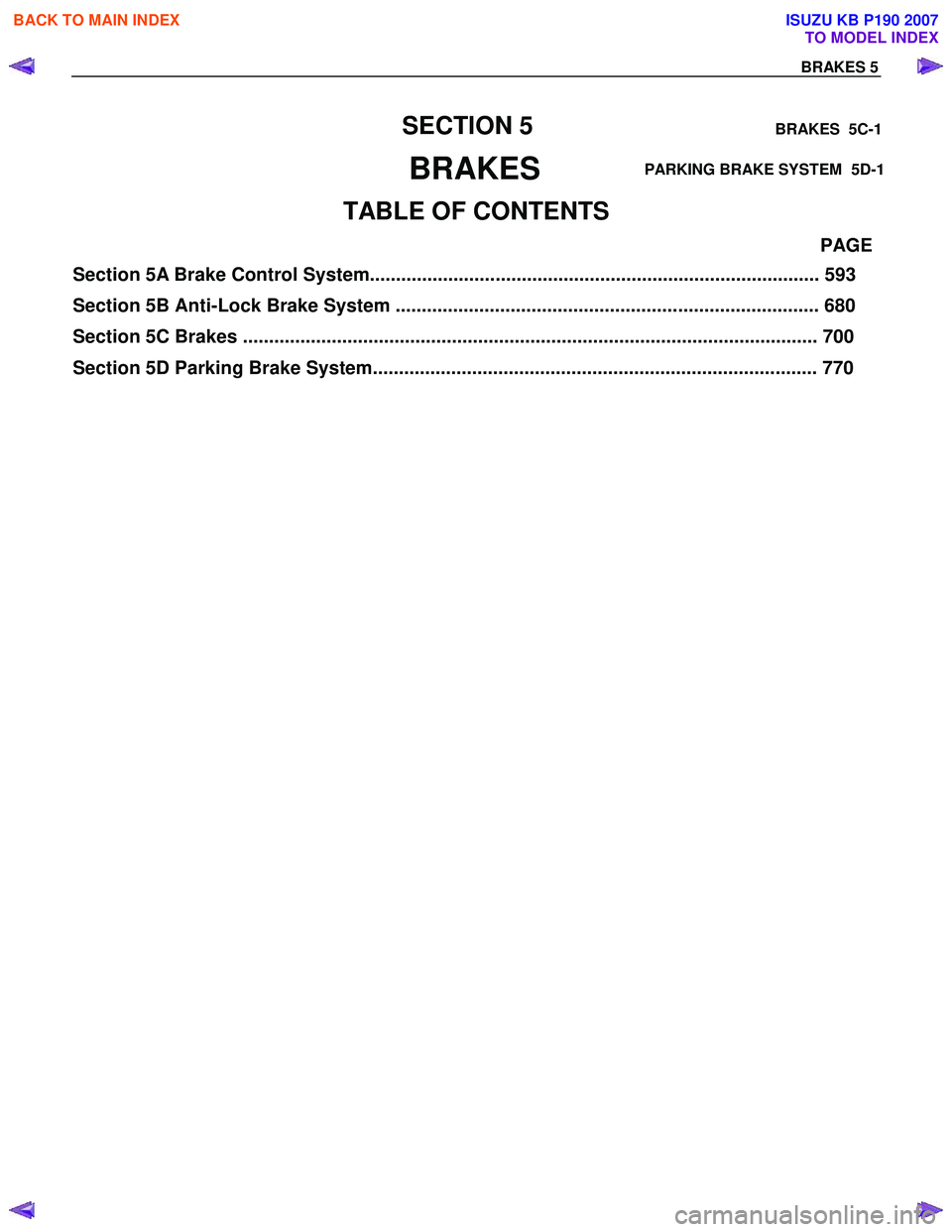
BRAKE S 5
SECTI ON 5
BRAKE S
TA BLE OF CONTENTS
Section 5A Brake Control System ................................................................. ..................... 593
Section 5B Anti-Lock Brake System ................................................................................. 680
PAGE
BRAKES 5C-1
Sec
tion 5C Brakes .............................................................................................................. 700
PARKING BRAKE SYSTEM 5D-1
Section 5D Parking Brake System ............................................................................. ........ 770
TO MODEL INDEX
BACK TO MAIN INDEX
ISUZU KB P190 2007
Page 616 of 6020

BRAKE CONTROL SYSTEM 5A-23
Electronic Brake-force Distribution (EBD) System
ABS has the EBD function. EBD is a function which
controls braking force distribution of a front wheel and a
rear wheel, and makes brake fluid pressure of a rear
wheel the optimal. If the rate of slip of a rear wheel
becomes greater compared to a front wheel, the brake
fluid pressure of a rear wheel will be controlled in order
to perform braking force distribution between the front
and rear wheels. EBD enables the braking power of a
rear wheel to always be utilized for the maximum
according to the load change concerning the back axis
according to the vehicle’s loading state (No luggage,
loading, etc.), deceleration, etc. Brake fluid pressure
control to a rear wheel is performed by the EBD function
which uses the ABS function without the mechanical
proportioning valve.
C05L300016
Brake Pedal Travel
Vehicles equipped with the Anti-lock Brake System may
be stopped by applying normal force to the brake pedal.
Although there is no need to push the pedal beyond the
point where it stops or holds the vehicle, by applying
more force the pedal will continue to travel toward the
floor.
This extra brake pedal travel is normal.
Acronyms and Abbreviations
Several acronyms and abbreviations are commonly
used throughout this section:
ABS
Anti-lock Brake System
CKT
Circuit
DLC
Data Link Connector
EBD
Electronic Brake-force Distribution
EHCU
Electronic Hydraulic Control Unit
FL
Front Left
FR
Front Right
GEN
Generator
H/U
Hydraulic Unit
MV
Millivolts
RR
Rear
RPS
Revolutions per Second
VDC
DC Volts
VAC
AC Volts
W/L
W arning Lamp
WSS
W heel Speed Sensor
General Diagnosis
General Information
ABS problems can be classified into two types, those
which can be detected by the ABS warning lamp and
those which can be detected as a vehicle abnormality
by the driver.
In either case, locate the fault in accordance with the
“BASIC DIAGNOSTIC FLOW CHART” and repair.
Please refer to Section 5C for the diagnosis of
mechanical troubles such as brake noise, brake judder
(brake pedal or vehicle vibration felt when braking),
uneven braking, and parking brake trouble.
ABS Service Precautions
Required Tools and Items:
• Box W rench
• Brake Fluid
• Special Tool
Some diagnosis procedures in this section require the
installation of a special tool.
5-8840-0366-0 High Impedance Multimeter
W hen circuit measurements are requested, use a circuit
tester with high impedance.
BACK TO CHAPTER INDEX
TO MODEL INDEX
ISUZU KB P190 2007
Page 618 of 6020

BRAKE CONTROL SYSTEM 5A-25
“ABS” Warning Lamp
W hen ABS and problems occur that actuate the “ABS”
warning lamp, the code corresponding to the problem is
stored in the EHCU. Only ordinary braking is available
when the ABS is deactivated. Even when the “ABS”
warning lamp is actuated, if the starter switch is set ON
after setting it OFF once, the EHCU checks up on the
entire system. If there is no abnormality, the EHCU
judges ABS to work correctly and the warning lamp is lit
normally, even though the problem code is stored.
NOTE: Illumination of the “ABS” warning lamp indicates
that anti-lock braking is no longer available. Power
assisted braking without anti-lock control is still
available.
Normal Operation
“ABS ” Warning Lamp
W hen the ignition is first moved from “OFF” to “RUN”,
the amber “ABS” warning lamp will turn “ON”. The
“ABS” warning lamp will turn “ON” during engine
starting and will usually stay “ON” for approximately
three seconds after the ignition switch is returned to the
“ON” position. The warning lamp should remain “OFF”
at all other times.
Brake (EBD) Warning Lamp
RTW 75ASH000101
Vehicles equipped with the EBD (Electronic Brake-force
Distribution) System have a “Brake” warning lamp on
the instrument panel.
If the ABS warning lamp and Brake warning lamp are
turned "ON", then EBD has failed. ( Parking brake
switch is "OFF")
In the following conditions, the EBD warning lamp is
"ON".
• Starter switch is "ON", engine "OFF". ( Parking brake switch is "OFF")
If engine is started, then EBD warning lamp is "OFF".
( Parking brake switch is "OFF")
BACK TO CHAPTER INDEX
TO MODEL INDEX
ISUZU KB P190 2007
Page 622 of 6020

BRAKE CONTROL SYSTEM 5A-29
8. According to indication of Tech 2 press the
"Confirm".
RTW 75ASH000901
9. According to indication of Tech 2 press the
"Confirm".
RTW 75ASH001001
10. According to indication of Tech 2 press the
"Confirm".
RTW 75ASH001101
Return Pump Relay Test
Test condition: Engine stops with the key turned to the
"ON" position. To be more specific, the test is
conducted with the brake pedal stepped on afte
r
stepping once and releasing.
Test Procedure: 1. Connect the Tech 2 with the vehicle, and selec
t
"Actuator Test" menus.
2. Select a " Return Pump Relay Test " menu from the "Actuator Test" menus.
The circuit is normal if the pump motor is operated in
accordance with Tech 2 instruction.
Front Left Hold Valve Test
Purpose: The purpose of this test is to detect brake pipe
and valve line harness wire for incorrect connections
and valve problem.
This test will help you confirm the result of your repai
r
service including the removal/ reinstallation of brake
pipe, valve line harness and valve.
Test conditions: The ignition key is in the "ON" position
with the four wheels lifted up. The brake pedal is
stepped on, released and stepped on again with the
parking brake released.
Test Procedure: 1. Connect Tech 2 with the vehicle, and selec
t
"Actuator Test" menus.
2. Select a "Front Left Hold Valve Test" menu from the "Actuator Test" menus.
3. Step on the brake pedal.
BACK TO CHAPTER INDEX
TO MODEL INDEX
ISUZU KB P190 2007
Page 623 of 6020

5A-30 BRAKE CONTROL SYSTEM
4. Release the brake pedal.
5. Make sure that the front left hold solenoid valve "ON" aimed at by Tech 2 and the wheel locked
position are the same.
If different, check brake pipe, valve line harness wiring
and hydraulic unit. Repair is needed if abnormality is
found.
Front Left Release Valve Test
Purpose: The purpose of this test is to detect brake pipe
and valve line harness wire for incorrect connections and
valve problem.
This test will help you confirm the result of your repai
r
service including the removal/ reinstallation of brake
pipe, valve line harness and valve.
Test conditions: The ignition key is in the "ON" position
with the four wheels lifted up. The brake pedal is stepped
on, released and stepped on again with the parking
brake released.
Test Procedure: 1. Connect Tech 2 with the vehicle, and select "Actuator Test" menus.
2. Select a "Front Left Release Valve Test" menu from the "Actuator Test" menus.
3. Step on the brake pedal.
4. Make sure that the front left release solenoid valve "ON" aimed at by Tech 2 and the wheel released
position are the same.
If different, check brake pipe, valve line harness wiring
and hydraulic unit. Repair is needed if abnormality is
found.
Front Right Hold Valve Test
Purpose: The purpose of this test is to detect brake pipe
and valve line harness wire for incorrect connections and
valve problem.
This test will help you confirm the result of your repai
r
service including the removal/ reinstallation of brake
pipe, valve line harness and valve.
Test conditions: The ignition key is in the "ON" position
with the four wheels lifted up. The brake pedal is stepped
on, released and stepped on again with the parking
brake released.
Test Procedure: 1. Connect Tech 2 with the vehicle, and select "Actuator Test" menus.
2. Select a "Front Right Hold Valve Test" menu from the "Actuator Test" menus.
3. Step on the brake pedal.
4. Release the brake pedal.
5. Make sure that the front right hold solenoid valve "ON" aimed at by Tech 2 and the wheel locked
position are the same.
If different, check brake pipe, valve line harness wiring
and hydraulic unit. Repair is needed if abnormality is
found.
Front Right Release Valve Test
Purpose: The purpose of this test is to detect brake pipe
and valve line harness wire for incorrect connections
and valve problem.
This test will help you confirm the result of your repai
r
service including the removal/ reinstallation of brake
pipe, valve line harness and valve.
Test conditions: The ignition key is in the "ON" position
with the four wheels lifted up. The brake pedal is
stepped on, released and stepped on again with the
parking brake released.
Test Procedure: 1. Connect Tech 2 with the vehicle, and selec
t
"Actuator Test" menus.
2. Select a "Front Right Release Valve Test" menu from the "Actuator Test" menus.
3. Step on the brake pedal.
4. Make sure that the front right release solenoid valve "ON" aimed at by Tech 2 and the wheel released
position are the same.
If different, check brake pipe, valve line harness wiring
and hydraulic unit. Repair is needed if abnormality is
found.
Rear Hold Valve Test
Purpose: The purpose of this test is to detect brake pipe
and valve line harness wire for incorrect connections
and valve problem.
This test will help you confirm the result of your repai
r
service including the removal/ reinstallation of brake
pipe, valve line harness and valve.
Test conditions: The ignition key is in the "ON" position
with the four wheels lifted up. The brake pedal is
stepped on, released and stepped on again with the
parking brake released.
Test Procedure: 1. Connect Tech 2 with the vehicle, and selec
t
"Actuator Test" menus.
BACK TO CHAPTER INDEX
TO MODEL INDEX
ISUZU KB P190 2007