2007 ISUZU KB P190 oil
[x] Cancel search: oilPage 4384 of 6020
7A2-100 TRANSMISSION CONTROL SYSTEM (JR405E)
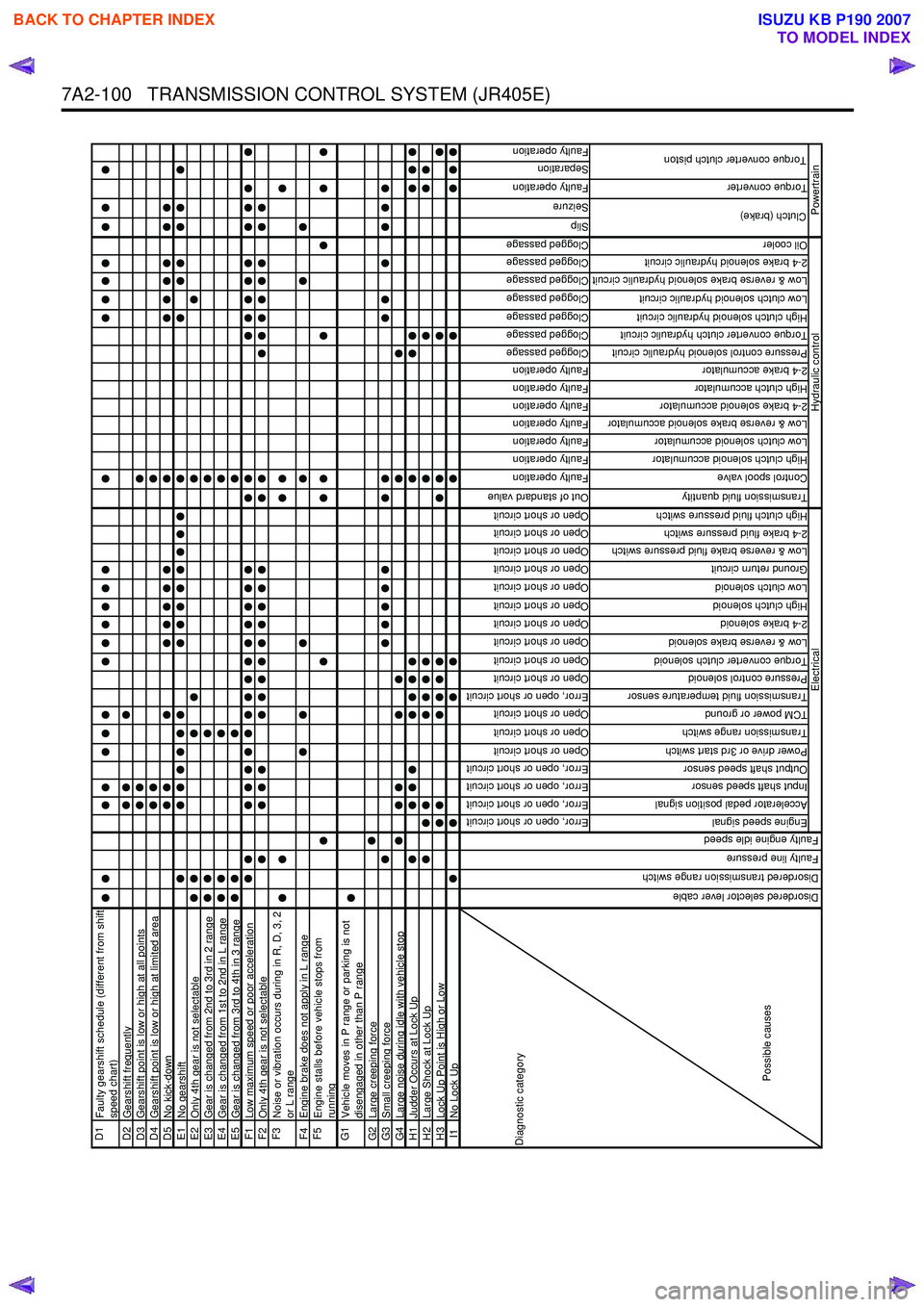
D1
Faulty gearshift schedule (different from shift
speed chart)
D2 Gearshift frequentlyD3Gearshift point is low or high at all pointsD4Gearshift point is low or high at limited areaD5No kick-downE1No gearshiftE2Only 4th gear is not selectableE3Gear is changed from 2nd to 3rd in 2 rangeE4Gear is changed from 1st to 2nd in L rangeE5Gear is changed from 3rd to 4th in 3 rangeF1Low maximum speed or poor accelerationF2Only 4th gear is not selectableF3
Noise or vibration occurs during in R, D, 3, 2
or L range
F4 Engine brake does not apply in L rangeF5
Engine stalls before vehicle stops from
running
G1
Vehicle moves in P range or parking is not
disengaged in other than P range
G2 Large creeping forceG3Small creeping forceG4Large noise during idle with vehicle stopH1Judder Occurs at Lock UpH2Large Shock at Lock UpH3Lock Up Point is High or LowI1No Lock Up
Error, open or short circuit
Error, open or short circuit
Error, open or short circuit
Error, open or short circuit
Open or short circuit
Open or short circuit
Open or short circuit
Error, open or short circuit
Open or short circuit
Open or short circuit
Open or short circuit
Open or short circuit
Open or short circuit
Open or short circuit
Open or short circuit
Open or short circuit
Open or short circuit
Open or short circuit
Out of standard value
Faulty operation
Faulty operation
Faulty operation
Faulty operation
Faulty operation
Faulty operation
Faulty operation
Clogged passage
Clogged passage
Clogged passage
Clogged passage
Clogged passage
Clogged passage
Clogged passage
Slip
Seizure
Faulty operation
Separation
Faulty operation
Engine speed signal
Accelerator pedal position signal
Input shaft speed sensor
Output shaft speed sensor
Power drive or 3rd start switch
Transmission range switch
TCM power or ground
Transmission fluid temperature sensor
Pressure control solenoid
Torque converter clutch solenoid
Low & reverse brake solenoid
2-4 brake solenoid
High clutch solenoid
Low clutch solenoid
Ground return circuit
Low & reverse brake fluid pressure switch
2-4 brake fluid pressure switch
High clutch fluid pressure switch
Transmission fluid quantity
Control spool valve
High clutch solenoid accumulator
Low clutch solenoid accumulator
Low & reverse brake solenoid accumulator
2-4 brake solenoid accumulator
High clutch accumulator
2-4 brake accumulator
Pressure control solenoid hydraulic circuit
Torque converter clutch hydraulic circuit
High clutch solenoid hydraulic circuit
Low clutch solenoid hydraulic circuit
Low & reverse brake solenoid hydraulic circuit
2-4 brake solenoid hydraulic circuit
Oil cooler
Torque converter
Diagnostic category
Possible causes
Electrical
Disordered selector lever cable
Disordered transmission range switch
Faulty line pressure
Faulty engine idle speed
Clutch (brake)
Torque converter clutch piston
Hydraulic control
Powertrain
BACK TO CHAPTER INDEX
TO MODEL INDEX
ISUZU KB P190 2007
Page 4385 of 6020
TRANSMISSION CONTROL SYSTEM (JR405E) 7A2-101
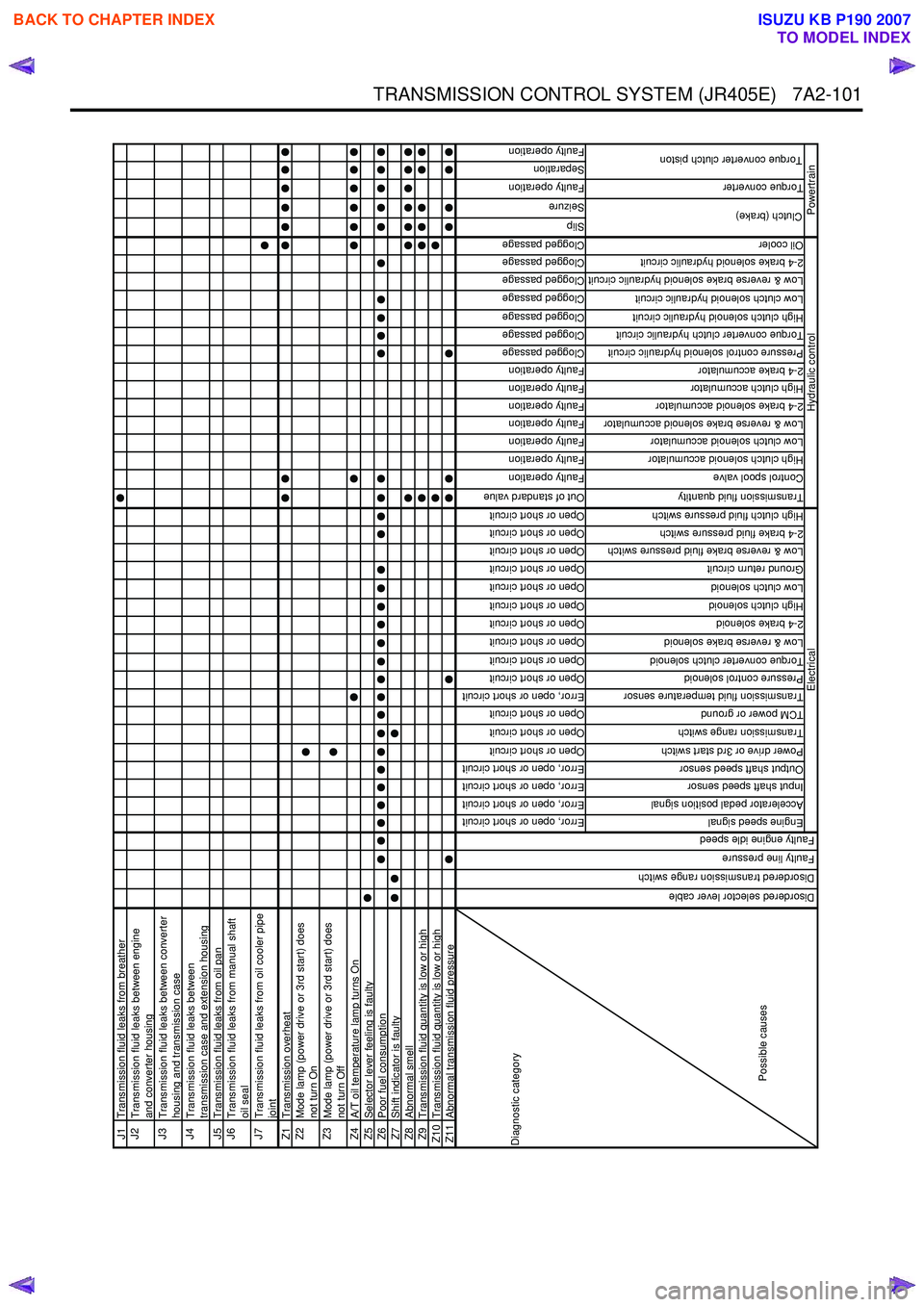
J1Transmission fluid leaks from breatherJ2
Transmission fluid leaks between engine
and converter housing
J3
Transmission fluid leaks between converter
housing and transmission case
J4
Transmission fluid leaks between
transmission case and extension housing
J5 Transmission fluid leaks from oil panJ6
Transmission fluid leaks from manual shaft
oil seal
J7
Transmission fluid leaks from oil cooler pipe
joint
Z1 Transmission overheatZ2
Mode lamp (power drive or 3rd start) does
not turn On
Z3
Mode lamp (power drive or 3rd start) does
not turn Off
Z4 A/T oil temperature lamp turns OnZ5Selector lever feeling is faultyZ6Poor fuel consumptionZ7Shift indicator is faultyZ8Abnormal smellZ9Transmission fluid quantity is low or highZ10 Transmission fluid quantity is low or highZ11Abnormal transmission fluid pressure
Error, open or short circuit
Error, open or short circuit
Error, open or short circuit
Error, open or short circuit
Open or short circuit
Open or short circuit
Open or short circuit
Error, open or short circuit
Open or short circuit
Open or short circuit
Open or short circuit
Open or short circuit
Open or short circuit
Open or short circuit
Open or short circuit
Open or short circuit
Open or short circuit
Open or short circuit
Out of standard value
Faulty operation
Faulty operation
Faulty operation
Faulty operation
Faulty operation
Faulty operation
Faulty operation
Clogged passage
Clogged passage
Clogged passage
Clogged passage
Clogged passage
Clogged passage
Clogged passage
Slip
Seizure
Faulty operation
Separation
Faulty operation
Engine speed signal
Accelerator pedal position signal
Input shaft speed sensor
Output shaft speed sensor
Power drive or 3rd start switch
Transmission range switch
TCM power or ground
Transmission fluid temperature sensor
Pressure control solenoid
Torque converter clutch solenoid
Low & reverse brake solenoid
2-4 brake solenoid
High clutch solenoid
Low clutch solenoid
Ground return circuit
Low & reverse brake fluid pressure switch
2-4 brake fluid pressure switch
High clutch fluid pressure switch
Transmission fluid quantity
Control spool valve
High clutch solenoid accumulator
Low clutch solenoid accumulator
Low & reverse brake solenoid accumulator
2-4 brake solenoid accumulator
High clutch accumulator
2-4 brake accumulator
Pressure control solenoid hydraulic circuit
Torque converter clutch hydraulic circuit
High clutch solenoid hydraulic circuit
Low clutch solenoid hydraulic circuit
Low & reverse brake solenoid hydraulic circuit
2-4 brake solenoid hydraulic circuit
Oil cooler
Torque converter
Clutch (brake)
Torque converter clutch piston
Hydraulic control
Powertrain
Diagnostic category
Possible causes
Electrical
Disordered selector lever cable
Disordered transmission range switch
Faulty line pressure
Faulty engine idle speed
BACK TO CHAPTER INDEX
TO MODEL INDEX
ISUZU KB P190 2007
Page 4390 of 6020
7A2-106 TRANSMISSION CONTROL SYSTEM (JR405E)
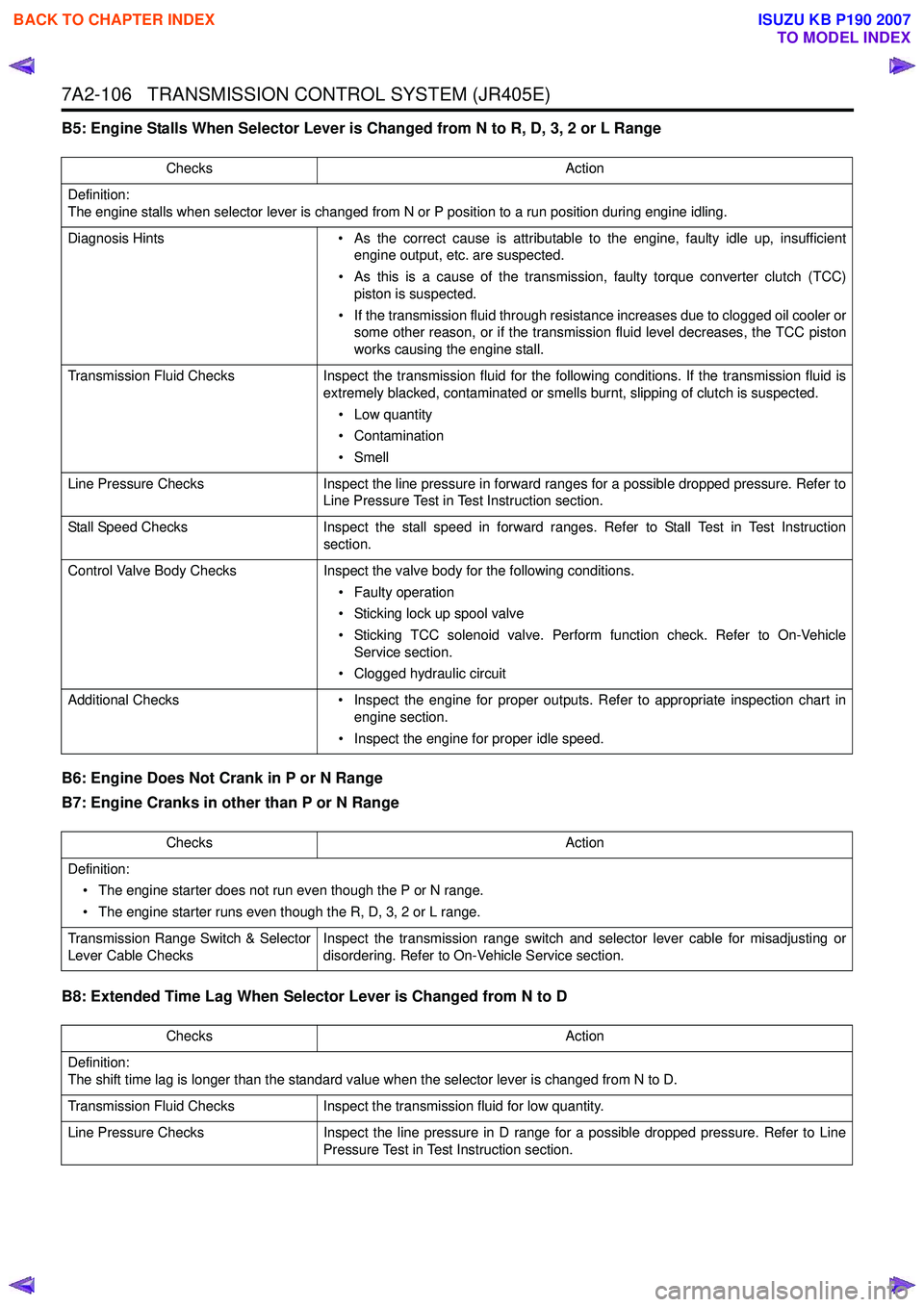
B5: Engine Stalls When Selector Lever is Changed from N to R, D, 3, 2 or L Range
B6: Engine Does Not Crank in P or N Range
B7: Engine Cranks in other than P or N Range
B8: Extended Time Lag When Selector Lever is Changed from N to D
Checks Action
Definition:
The engine stalls when selector lever is changed from N or P position to a run position during engine idling.
Diagnosis Hints • As the correct cause is attributable to the engine, faulty idle up, insufficient
engine output, etc. are suspected.
• As this is a cause of the transmission, faulty torque converter clutch (TCC) piston is suspected.
• If the transmission fluid through resistance increases due to clogged oil cooler or some other reason, or if the transmission fluid level decreases, the TCC piston
works causing the engine stall.
Transmission Fluid Checks Inspect the transmission fluid for the following conditions. If the transmission fluid is
extremely blacked, contaminated or smells burnt, slipping of clutch is suspected.
• Low quantity
• Contamination
• Smell
Line Pressure Checks Inspect the line pressure in forward ranges for a possible dropped pressure. Refer to
Line Pressure Test in Test Instruction section.
Stall Speed Checks Inspect the stall speed in forward ranges. Refer to Stall Test in Test Instruction
section.
Control Valve Body Checks Inspect the valve body for the following conditions.
• Faulty operation
• Sticking lock up spool valve
• Sticking TCC solenoid valve. Perform function check. Refer to On-Vehicle Service section.
• Clogged hydraulic circuit
Additional Checks • Inspect the engine for proper outputs. Refer to appropriate inspection chart in
engine section.
• Inspect the engine for proper idle speed.
Checks Action
Definition: • The engine starter does not run even though the P or N range.
• The engine starter runs even though the R, D, 3, 2 or L range.
Transmission Range Switch & Selector
Lever Cable Checks Inspect the transmission range switch and selector lever cable for misadjusting or
disordering. Refer to On-Vehicle Service section.
Checks Action
Definition:
The shift time lag is longer than the standard value when the selector lever is changed from N to D.
Transmission Fluid Checks Inspect the transmission fluid for low quantity.
Line Pressure Checks Inspect the line pressure in D range for a possible dropped pressure. Refer to Line
Pressure Test in Test Instruction section.
BACK TO CHAPTER INDEX
TO MODEL INDEX
ISUZU KB P190 2007
Page 4401 of 6020
TRANSMISSION CONTROL SYSTEM (JR405E) 7A2-117
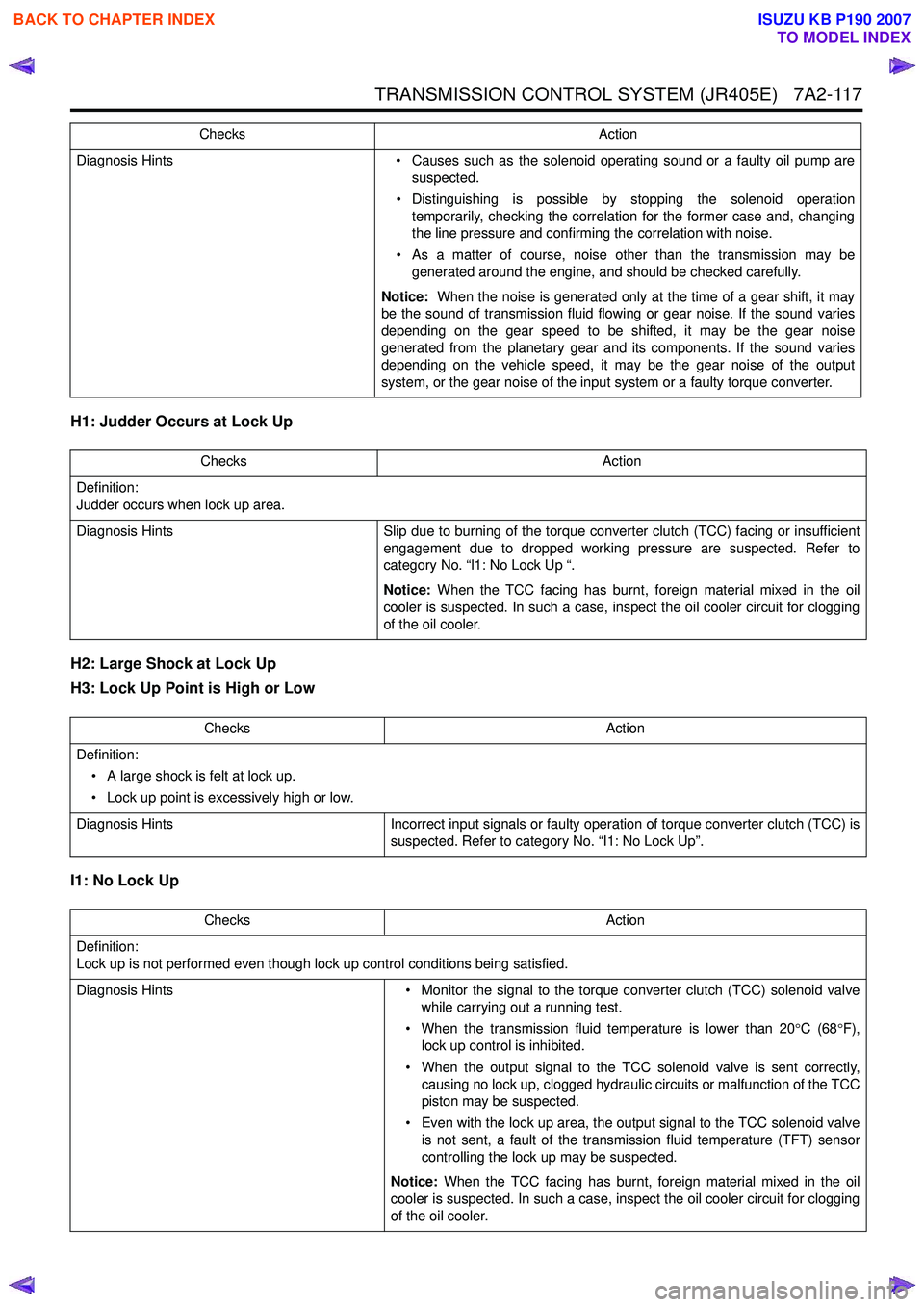
H1: Judder Occurs at Lock Up
H2: Large Shock at Lock Up
H3: Lock Up Point is High or Low
I1: No Lock Up
Diagnosis Hints • Causes such as the solenoid operating sound or a faulty oil pump are
suspected.
• Distinguishing is possible by stopping the solenoid operation temporarily, checking the correlation for the former case and, changing
the line pressure and confirming the correlation with noise.
• As a matter of course, noise other than the transmission may be generated around the engine, and should be checked carefully.
Notice: When the noise is generated only at the time of a gear shift, it may
be the sound of transmission fluid flowing or gear noise. If the sound varies
depending on the gear speed to be shifted, it may be the gear noise
generated from the planetary gear and its components. If the sound varies
depending on the vehicle speed, it may be the gear noise of the output
system, or the gear noise of the input system or a faulty torque converter.
Checks
Action
Checks Action
Definition:
Judder occurs when lock up area.
Diagnosis Hints Slip due to burning of the torque converter clutch (TCC) facing or insufficient
engagement due to dropped working pressure are suspected. Refer to
category No. “l1: No Lock Up “.
Notice: When the TCC facing has burnt, foreign material mixed in the oil
cooler is suspected. In such a case, inspect the oil cooler circuit for clogging
of the oil cooler.
Checks Action
Definition: • A large shock is felt at lock up.
• Lock up point is excessively high or low.
Diagnosis Hints Incorrect input signals or faulty operation of torque converter clutch (TCC) is
suspected. Refer to category No. “I1: No Lock Up”.
Checks Action
Definition:
Lock up is not performed even though lock up control conditions being satisfied.
Diagnosis Hints • Monitor the signal to the torque converter clutch (TCC) solenoid valve
while carrying out a running test.
• When the transmission fluid temperature is lower than 20 °C (68 °F),
lock up control is inhibited.
• When the output signal to the TCC solenoid valve is sent correctly, causing no lock up, clogged hydraulic circuits or malfunction of the TCC
piston may be suspected.
• Even with the lock up area, the output signal to the TCC solenoid valve is not sent, a fault of the transmission fluid temperature (TFT) sensor
controlling the lock up may be suspected.
Notice: When the TCC facing has burnt, foreign material mixed in the oil
cooler is suspected. In such a case, inspect the oil cooler circuit for clogging
of the oil cooler.
BACK TO CHAPTER INDEX
TO MODEL INDEX
ISUZU KB P190 2007
Page 4402 of 6020
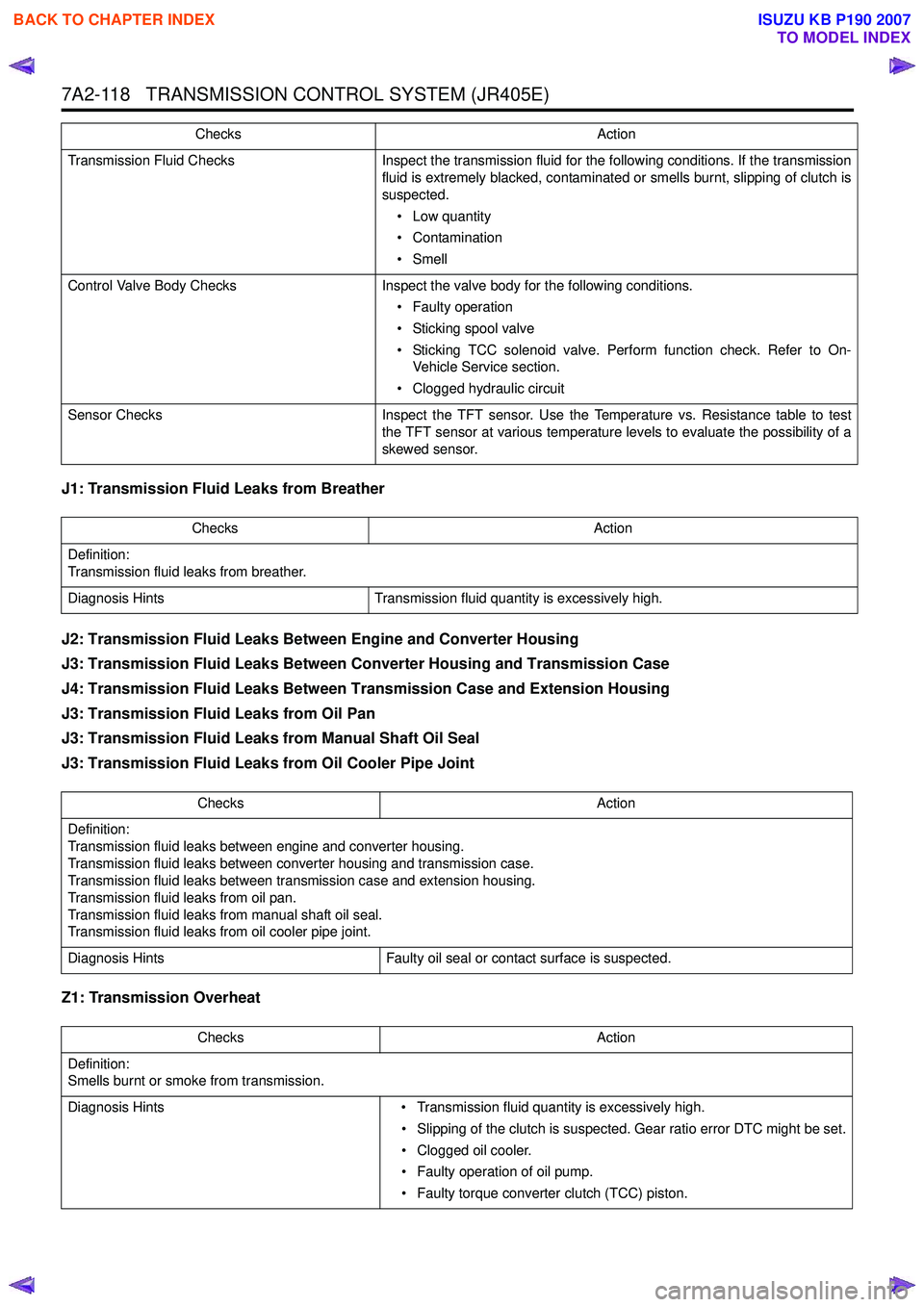
7A2-118 TRANSMISSION CONTROL SYSTEM (JR405E)
J1: Transmission Fluid Leaks from Breather
J2: Transmission Fluid Leaks Between Engine and Converter Housing
J3: Transmission Fluid Leaks Between Converter Housing and Transmission Case
J4: Transmission Fluid Leaks Between Transmission Case and Extension Housing
J3: Transmission Fluid Leaks from Oil Pan
J3: Transmission Fluid Leaks from Manual Shaft Oil Seal
J3: Transmission Fluid Leaks from Oil Cooler Pipe Joint
Z1: Transmission Overheat
Transmission Fluid Checks Inspect the transmission fluid for the following conditions. If the transmission
fluid is extremely blacked, contaminated or smells burnt, slipping of clutch is
suspected.
• Low quantity
• Contamination
• Smell
Control Valve Body Checks Inspect the valve body for the following conditions.
• Faulty operation
• Sticking spool valve
• Sticking TCC solenoid valve. Perform function check. Refer to On- Vehicle Service section.
• Clogged hydraulic circuit
Sensor Checks Inspect the TFT sensor. Use the Temperature vs. Resistance table to test
the TFT sensor at various temperature levels to evaluate the possibility of a
skewed sensor.
Checks
Action
Checks Action
Definition:
Transmission fluid leaks from breather.
Diagnosis Hints Transmission fluid quantity is excessively high.
Checks Action
Definition:
Transmission fluid leaks between engine and converter housing.
Transmission fluid leaks between converter housing and transmission case.
Transmission fluid leaks between transmission case and extension housing.
Transmission fluid leaks from oil pan.
Transmission fluid leaks from manual shaft oil seal.
Transmission fluid leaks from oil cooler pipe joint.
Diagnosis Hints Faulty oil seal or contact surface is suspected.
Checks Action
Definition:
Smells burnt or smoke from transmission.
Diagnosis Hints • Transmission fluid quantity is excessively high.
• Slipping of the clutch is suspected. Gear ratio error DTC might be set.
• Clogged oil cooler.
• Faulty operation of oil pump.
• Faulty torque converter clutch (TCC) piston.
BACK TO CHAPTER INDEX
TO MODEL INDEX
ISUZU KB P190 2007
Page 4403 of 6020
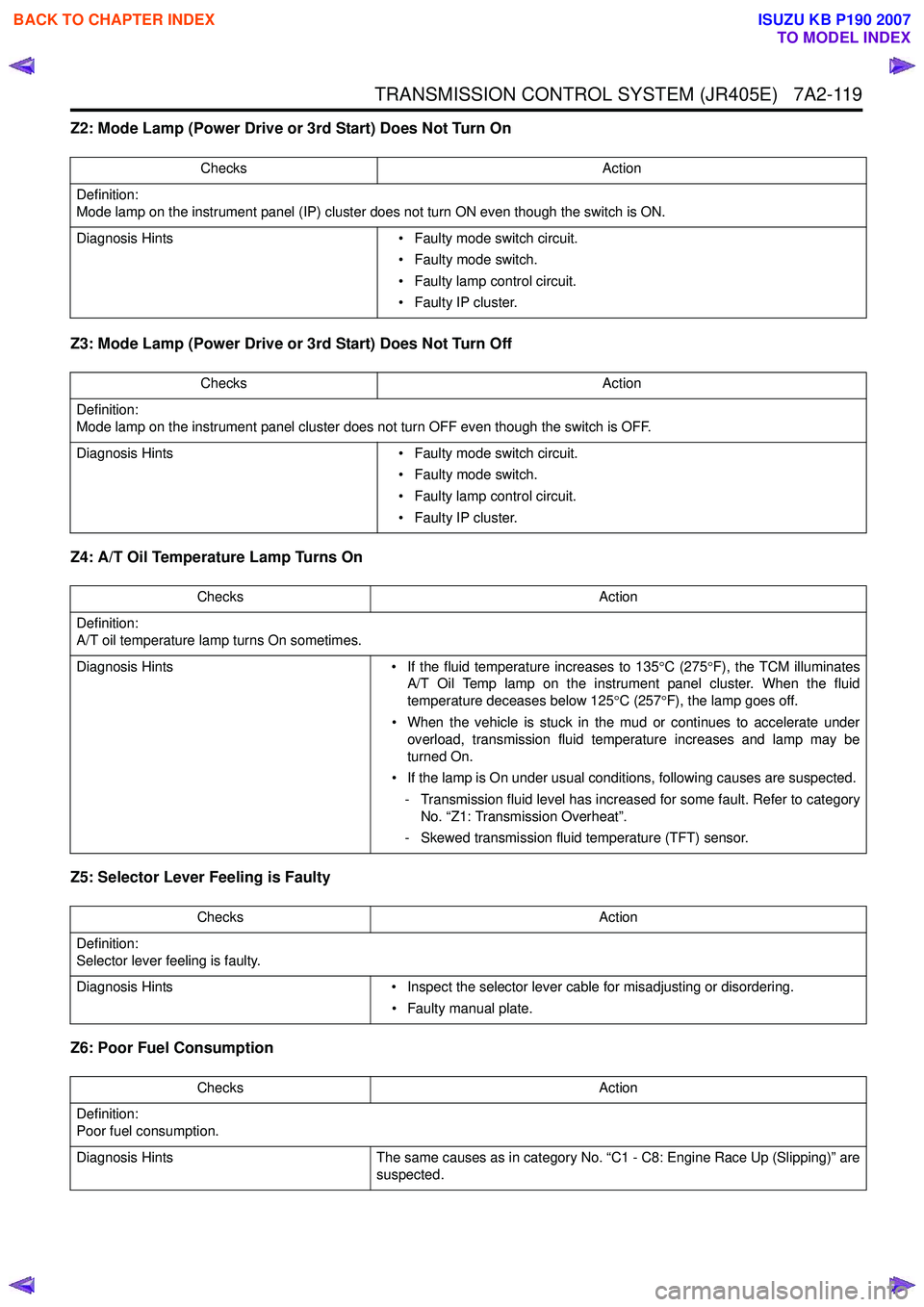
TRANSMISSION CONTROL SYSTEM (JR405E) 7A2-119
Z2: Mode Lamp (Power Drive or 3rd Start) Does Not Turn On
Z3: Mode Lamp (Power Drive or 3rd Start) Does Not Turn Off
Z4: A/T Oil Temperature Lamp Turns On
Z5: Selector Lever Feeling is Faulty
Z6: Poor Fuel Consumption
Checks Action
Definition:
Mode lamp on the instrument panel (IP) cluster does not turn ON even though the switch is ON.
Diagnosis Hints • Faulty mode switch circuit.
• Faulty mode switch.
• Faulty lamp control circuit.
• Faulty IP cluster.
Checks Action
Definition:
Mode lamp on the instrument panel cluster does not turn OFF even though the switch is OFF.
Diagnosis Hints • Faulty mode switch circuit.
• Faulty mode switch.
• Faulty lamp control circuit.
• Faulty IP cluster.
Checks Action
Definition:
A/T oil temperature lamp turns On sometimes.
Diagnosis Hints • If the fluid temperature increases to 135°C (275 °F), the TCM illuminates
A/T Oil Temp lamp on the instrument panel cluster. When the fluid
temperature deceases below 125 °C (257 °F), the lamp goes off.
• When the vehicle is stuck in the mud or continues to accelerate under overload, transmission fluid temperature increases and lamp may be
turned On.
• If the lamp is On under usual conditions, following causes are suspected. - Transmission fluid level has increased for some fault. Refer to category No. “Z1: Transmission Overheat”.
- Skewed transmission fluid temperature (TFT) sensor.
Checks Action
Definition:
Selector lever feeling is faulty.
Diagnosis Hints • Inspect the selector lever cable for misadjusting or disordering.
• Faulty manual plate.
Checks Action
Definition:
Poor fuel consumption.
Diagnosis Hints The same causes as in category No. “C1 - C8: Engine Race Up (Slipping)” are
suspected.
BACK TO CHAPTER INDEX
TO MODEL INDEX
ISUZU KB P190 2007
Page 4404 of 6020
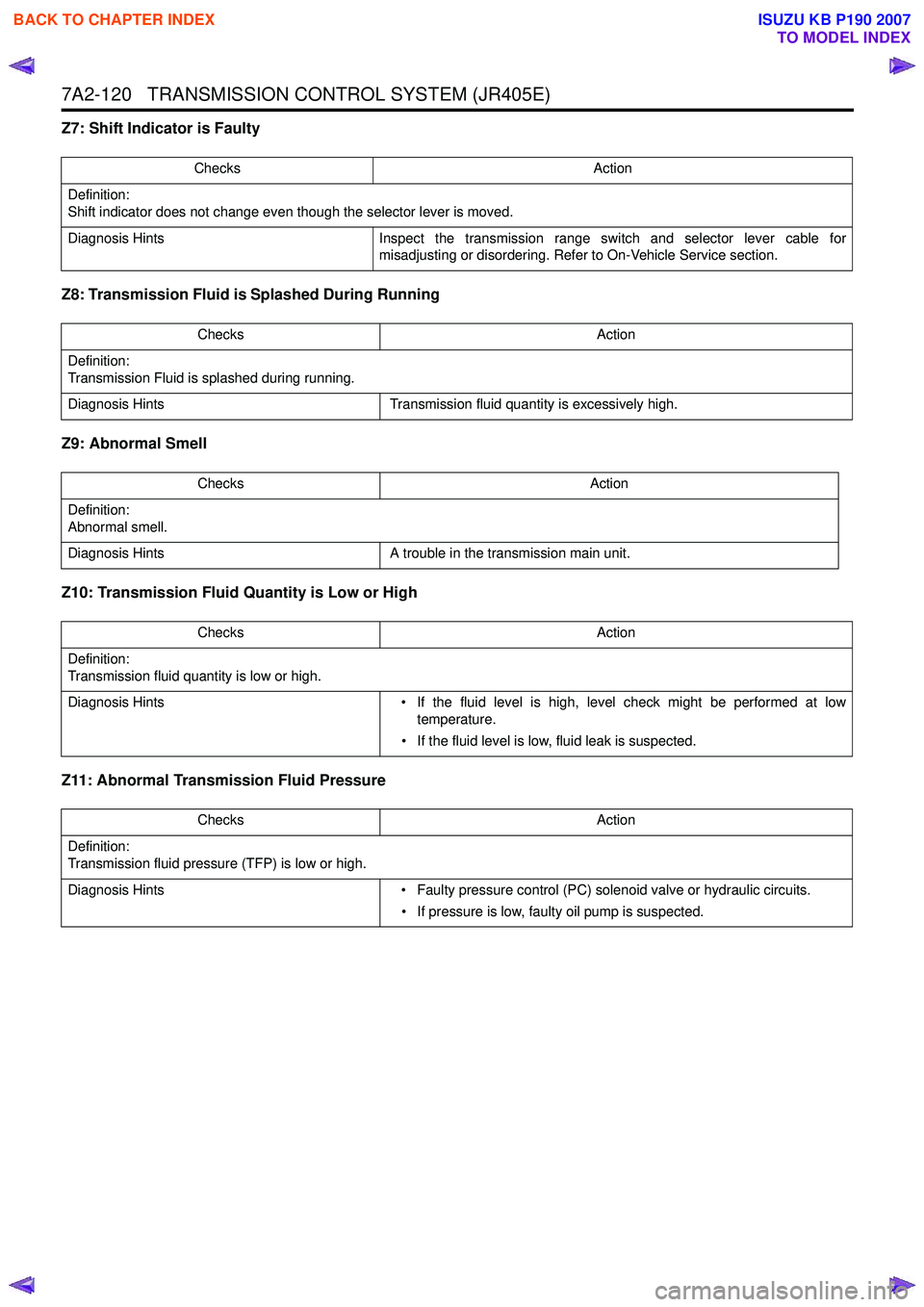
7A2-120 TRANSMISSION CONTROL SYSTEM (JR405E)
Z7: Shift Indicator is Faulty
Z8: Transmission Fluid is Splashed During Running
Z9: Abnormal Smell
Z10: Transmission Fluid Quantity is Low or High
Z11: Abnormal Transmission Fluid Pressure
Checks Action
Definition:
Shift indicator does not change even though the selector lever is moved.
Diagnosis Hints Inspect the transmission range switch and selector lever cable for
misadjusting or disordering. Refer to On-Vehicle Service section.
Checks Action
Definition:
Transmission Fluid is splashed during running.
Diagnosis Hints Transmission fluid quantity is excessively high.
Checks Action
Definition:
Abnormal smell.
Diagnosis Hints A trouble in the transmission main unit.
Checks Action
Definition:
Transmission fluid quantity is low or high.
Diagnosis Hints • If the fluid level is high, level check might be performed at low
temperature.
• If the fluid level is low, fluid leak is suspected.
Checks Action
Definition:
Transmission fluid pressure (TFP) is low or high.
Diagnosis Hints • Faulty pressure control (PC) solenoid valve or hydraulic circuits.
• If pressure is low, faulty oil pump is suspected.
BACK TO CHAPTER INDEX
TO MODEL INDEX
ISUZU KB P190 2007
Page 4405 of 6020
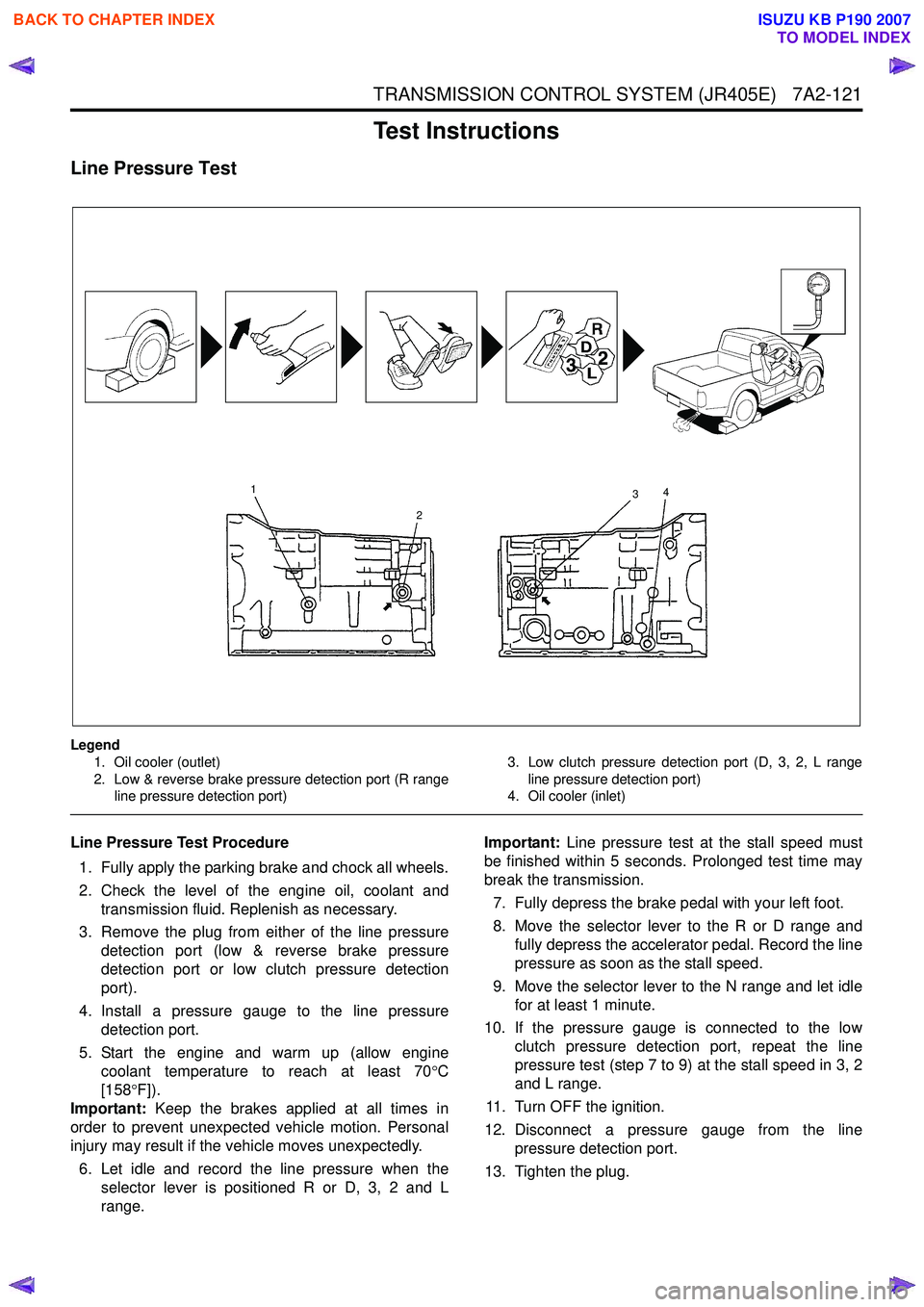
TRANSMISSION CONTROL SYSTEM (JR405E) 7A2-121
Test Instructions
Line Pressure Test
Legend1. Oil cooler (outlet)
2. Low & reverse brake pressure detection port (R range line pressure detection port) 3. Low clutch pressure detection port (D, 3, 2, L range
line pressure detection port)
4. Oil cooler (inlet)
Line Pressure Test Procedure
1. Fully apply the parking brake and chock all wheels.
2. Check the level of the engine oil, coolant and transmission fluid. Replenish as necessary.
3. Remove the plug from either of the line pressure detection port (low & reverse brake pressure
detection port or low clutch pressure detection
port).
4. Install a pressure gauge to the line pressure detection port.
5. Start the engine and warm up (allow engine coolant temperature to reach at least 70 °C
[158 °F]).
Important: Keep the brakes applied at all times in
order to prevent unexpected vehicle motion. Personal
injury may result if the vehicle moves unexpectedly.
6. Let idle and record the line pressure when the selector lever is positioned R or D, 3, 2 and L
range. Important:
Line pressure test at the stall speed must
be finished within 5 seconds. Prolonged test time may
break the transmission.
7. Fully depress the brake pedal with your left foot.
8. Move the selector lever to the R or D range and fully depress the accelerator pedal. Record the line
pressure as soon as the stall speed.
9. Move the selector lever to the N range and let idle for at least 1 minute.
10. If the pressure gauge is connected to the low clutch pressure detection port, repeat the line
pressure test (step 7 to 9) at the stall speed in 3, 2
and L range.
11. Turn OFF the ignition.
12. Disconnect a pressure gauge from the line pressure detection port.
13. Tighten the plug.
1
2 3
4
BACK TO CHAPTER INDEX
TO MODEL INDEX
ISUZU KB P190 2007