Page 182 of 331

Help assure your vehicle’s future
reliability and performance by paying
extra attention to how you drive
during the first 600 miles (1,000 km).
During this period:
Avoid full-throttle starts and rapid
accele ration.
Do not change the oil until the
scheduled maintenance time.
Avoidhardbrakingforthefirst
200
miles (300 km).
Do not tow a trailer.
You should also follow these
recommendations with an
overhauled or exch anged engine, or
when the brakes are replaced. Your
vehicle is designed to operate
on unleaded gasoline with a pump
octane number of 87 or higher. Use
of a lower octane gasoline can cause
a persi stent, heavy metallic rapping
noise that can lead to engine damage.
We recommended using a quality
gasoline containing detergent
additives that help prevent fuel
system and engine deposits.
In addition, in order to maintain good
performance, fuel economy, and
emissions control, we strongly
recommend, in areas where it is
available, the use of gasoline that
does NOT contain manganese-b ased
fuel additives such as MMT.
Use of gasoline with these additives
may adversely affect performance,
and cause the malfunction indicator
lamp on your instrument panel to
come on. If this happens, contact your
authorized dealer for service.
Some gasoline today is blended with
oxygenates such as ethanol or
MTBE. Your vehicle is designed to
operate on oxyg enated gasoline
containing up to 10 % eth anol by
volume and up to 15 % MTBE by
volume. Do not use gasoline
containing methanol.
If you notice any undesirable
operating symptoms, try another
service station or switch to another
brand of gasoline.
Premium f uel is recommended when
towing in certain conditions (see
page ).
For f urther important f uel-related
inf ormation, please ref er to your .
224
Break-in Period
Fuel Recommendation
Quick Start Guide
Break-in Period, Fuel Recommendation
178
Page 183 of 331
CONT INUED
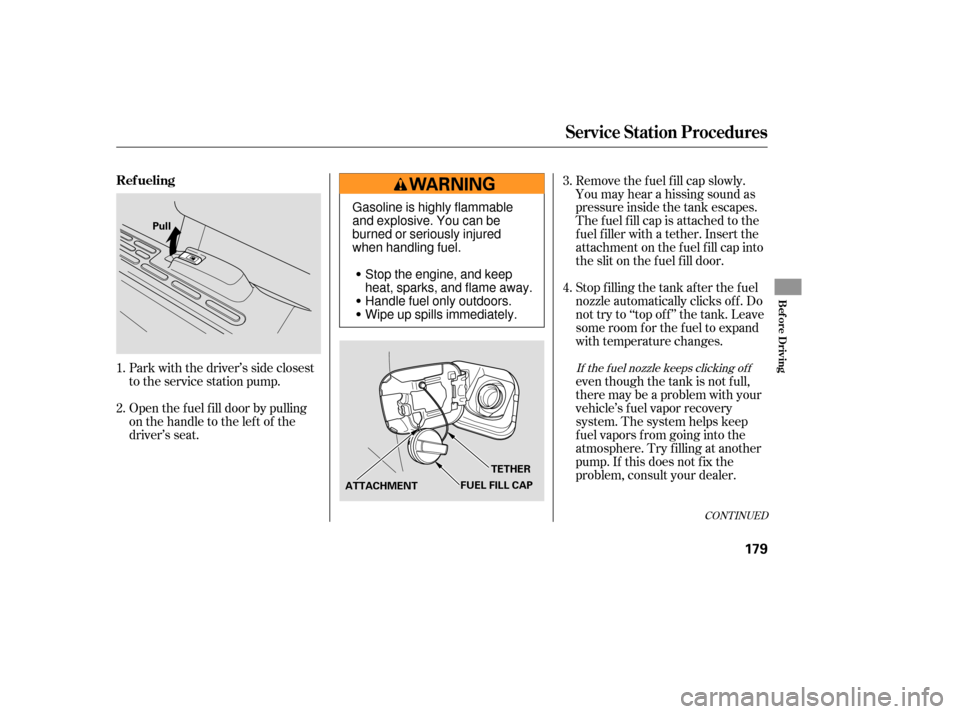
Open the f uel f ill door by pulling
onthehandletotheleftof the
driver’s seat. Park with the driver’s side closest
to the service station pump.Stop f illing the tank af ter the f uel
nozzle automatically clicks of f . Do
not try to ‘‘top of f ’’ the tank. Leave
some room f or the f uel to expand
with temperature changes. Remove the f uel f ill cap slowly.
You may hear a hissing sound as
pressure inside the tank escapes.
The fuel fill cap is attached to the
f uel f iller with a tether. Insert the
attachment on the fuel fill cap into
the slit on the f uel f ill door.
even though the tank is not f ull,
there may be a problem with your
vehicle’s fuel vapor recovery
system. The system helps keep
f uel vapors f rom going into the
atmosphere. Try f illing at another
pump. If this does not f ix the
problem, consult your dealer.
1.
2. 3.
4.
If the f uel nozzle keeps clicking of f
Ref ueling
Service Station Procedures
Bef ore Driving
179
Pull
FUEL FILL CAP
ATTACHMENT TETHER
Gasoline is highly flammable
and explosive. You can be
burned or seriously injured
when handling fuel.
Stop the engine, and keep
heat, sparks, and flame away.
Handle fuel only outdoors.
Wipe up spills immediately.
Page 186 of 331
Wait a few minutes after turning the
engine off before you check the oil.
Remove the dipstick (orange loop).
Wipe off the dipstick with a clean
cloth or paper towel.
Insert the dipstick all the way back
into its hole. Remove
the dipstick again, and
check the level. It should be
between the upper and lower
marks.
If it is near or below the lower mark,
see on page .Look
at the coolant level in the
radiator reserve tank. Make sure it is
between the MAX and MIN lines. If
it is below the MIN line, see
on page for
info rmation on adding the proper
coolan t.
Refer to
on page f or inf ormation
about checking other items on your
vehicle.
1.
2.
3. 4.
246 249
241
Service Station Procedures
A dding Engine Oil Engine Coolant Check
Oil Check
A dding
Engine Coolant
Owner’s Maintenance
Checks
182
DIPSTICK
UPPER MARK
LOWER MARK MAX
MIN
RESERVE TANK
Page 187 of 331
For example, an underinflated tire
causes more ‘‘rolling resistance,’’
which uses more fuel.
The build-up of snow or mud on
your vehicl e’s underside or on the
truck bed adds weight and rolling
resistan ce. Frequent cleaning
helps your fuel mileage and
reduces the chance of corrosion.
Drive moderately. Rapid
acceleration, abrupt cornering,
and hard braking use more fuel.
Always drive in the highest gear
possible. Try
to maintain a constant speed.
Everytimeyouslowdownand
speed up, your vehic le uses extra
fuel. Use cruise control when
appropriate.
Combine several short trips into
one.
The air conditioning puts an extra
load on the engine which makes it
usemorefuel.Usethefresh-air
ventilation when possible.
Always
maintain your vehicle
according to the maintenance
messages displayed on the
inf ormation display. See on page
.
241
Improving Fuel Economy
Owner’s
Maintenance Checks
Fuel Economy
Bef ore Driving
183
Page 197 of 331

This section gives you tips on
starting the engine under various
conditions, and how to operate the
automatic transmission. It also
includes important inf ormation on
parking your vehicle, the braking
system, the VTM-4 system, the VSA
system, the tire pressure monitoring
system, and f acts you need if you are
planning to tow a trailer.........................
Driving Guidelines .194
........................
Preparing to Drive .195
.......................
Starting the Engine .196
..............
Automatic Transmission .197
Variable Torque Management
.............
4WD (VTM-4) System .203
Tire Pressure Monitoring System ......................................
(TPMS) .204
...........................................
Parking .206
.............................
Braking System .207
...............
Anti-lock Brakes (ABS) .208
Vehicle Stability Assist (VSA)
........................................
System .210
.................
Towing Weight Limits .212
..........
Towing Weight Guidelines .214
...........................
Towing a Trailer .215
Of f -Highway Driving
..................................
Guidelines .227
Driving
Driving
193
Page 199 of 331

Youshoulddothefollowingchecks
and adjustmen ts before you drive
your vehicle.
Make sure all windows, mirrors,
and outside lights are clean and
unobstructed. Remove frost, snow,
or ice.
Check that the hood is fully closed.
Check that the tailgate is fully
closed when it is not used as an
exte nded pickup bed.
Vi sually check the tires. If a tire
looks low, use a gauge to check its
pressure.
Check that any items you may be
carrying are stored properly or
fastened down securely. Check
the adjustment of the
inside and outside mirrors (see
page ).
Check the steering wheel
ad justment (see page ).
Make sure the doors and In-Bed
Trunk are securely closed and
locked.
Fasten your seat belt. Check that
your passengers have fastened
their seat belts (see page ).
Wh en you start the engine, check
the gauges and indicato rs in the
instrument panel (see page ).
Check the seat adjustment (see
pages and ).
1.
2.
3.
4.
5.
6.
8. 7.
9.
10.
11. 14
110
79
59
98 100
Preparing to Drive
Driving
195
Page 200 of 331

Apply the parking brake.
In cold weather, turn off all
electrical accessories to reduce
the drain on the battery.
Make sure the shift lever is in
Park. Press on the brake pedal. Without
touching the accelerator
pedal, turn the ignition key to the
START (III) position. Do not hold
the key in the START (III)
position for more than 15 seconds
at a time. If the engine does not
start right away, pause for at least
10 seconds before trying again. If
the engine does not start within
15 seconds, or starts but stalls
right away, repeat step 4 with the
accelerator pedal pressed halfway
down. If the engine starts, release
pressu re on the accelerator pedal
so the engine does not race.
If the engine fails to start, press
the accelerator pedal all the way
down, and hold it there while
starting to clear flooding. If the
engine still does not start, return
to step 5.
5.
6.
1.
2.
3.
4.
Starting
theEngine
196
The immobilizer system protects your
vehicle f rom thef t. If an improperly-
coded key (or other device) is used, the
engine’s f uel system is disabled. For
more inf ormation, see page .
The engine is harder to start in cold
weather. Also, the thinner air f ound at
altitudes above 8,000 f eet (2,400
meters) adds to this problem.
81
Page 202 of 331

�µ�µThis position mechani-
cally locks the transmission. Use
Park whenever you are turning off or
starting the engine. To shift out of
Park, you must press on the brake
pedal and have your foot off the
accelerator pedal. Pull the shift lever
to wards you, then move it out of
Park.
If you have done all of the above and
still cannot move the lever out of
Park, see on
page .
You must also pull the shif t lever
towards you to shift into Park. To
avoid transmission damage, come to
a complete stop bef ore shif ting into
Park. The shif t lever must be in Park
for you to remove the key from the
ignition switch. Press the brake
pedal and pull the shif t lever towards
you to shif t f rom Park to reverse. To
shif t f rom reverse to neutral, come
to a complete stop, and then shif t.
Pull the shif t lever towards you
bef ore shif ting into reverse f rom
neutral.
202
To shift from: PtoR
RtoP
NtoR Dto2 2to1
1to2
2toD
DtoN
NtoD RtoN Do this:
Press the brake pedal, and
pull the shift lever towards
you.
Pull the shift lever towards
you.
Move the shift lever.
Automatic Transmission
Park (P)
Shif t L ock Release Reverse (R)
198

