Page 74 of 331
To switch the information display
between the odometer, trip meter
and outside temperature (if
equipped), and engine oil lif e and
maintenance service items, press the
SELECT button repeatedly.
This shows the total distance your
vehicle has been driven. It measures
miles in U.S. models and kilometers
in Canadian models.
It is illegal under U.S. f ederal law and
Canadian provincial regulations to
disconnect, reset, or alter the
odometer with the intent to change
the number of miles or kilometers
indicated. Odometer
Gauges
70
SPEEDOMETER
TACHOMETER TEMPERATURE GAUGE FUEL GAUGE
SELECT
BUTTON
TRIP METER RESET
BUTTON
OUTSIDE
TEMPERATURE
INDICATOR
U.S. model is shown. INFORMATION
DISPLAY
ODOMETER/
TIGHTEN FUEL
CAP MESSAGE
Page 75 of 331

This meter shows the number of
miles (U.S.) or kilometers (Canada)
driven since you last reset it.
There are two trip meters: TRIP A
and TRIP B. Switch between these
displays by pressing the SELECT
button repeatedly. Each trip meter
works independently, so you can
keep track of two dif f erent distances.To reset a trip meter, display it, and
then press and hold the RESET
button until the number resets to
‘‘0.0’’. Both trip meters will reset if
the vehicle’s battery goes dead or is
disconnected. And both continue to
track mileage, even when only one is
displayed. When you turn the ignition switch to
the ON (II) position, the meter you
last selected is displayed.
This shows how much f uel you have.
It may show slightly more or less
than the actual amount. The needle
returns to the bottom after you turn
of f the ignition.
Trip Meter Fuel Gauge
Gauges
Inst rument s and Cont rols
71
SELECT BUTTON
RESET BUTTON
Avoid driving with an extremely low
f uel level. Running out of f uel could
cause the engine to misf ire, damaging
the catalytic converter.
Page 76 of 331

�¶�¶�µ�µ
�µ�µ�µ
�µ�µ�µ
This
indicator displays the outside
temperature in Fah renheit (U.S.
models) or Cen tigrade (Canadian
models).
The temperature sensor is in the
front bumper. Therefore, the
temperature reading can be affected
by heat reflection from the road
surface, engine heat, and the
exhaust from surrounding traffic.
This can cause an incorrect
te mperature reading when your
speed is under 19 mph (30 km/h).
The sensor delays the indicator
update until it reaches the correct
outside temperature. This may take
several minutes.
If the outside temperature is
inco rrectly displayed, you can adjust
it up 5°F in U.S. models ( 3°C in
Canadian models) warmer or cooler. NOTE:
The temperature must be
stabilized before doing this
procedure.
To adjust the outside temperature
indicator, make sure the outside
temperature indicator is shown in
thedisplay,thenpressandholdthe
RESET button for 10 seconds (the
TRIP A or B is also reset). The
following sequence will appear for 1
secondeach:0,1,2,3,4,5, 5, 4,
3, 2, 1, 0 (U.S.) or 0, 1, 2, 3,
3, 2, 1, 0 (Canada).
When it reaches the desired value,
release the RESET button. You
should see the new outside
te mperature displayed.
In certain weather conditions,
temperature readings near freezing
(32°F, 0°C) could mean that ice is
forming on the road surface.
This
shows the temperature of the
engine’s coolant. During normal
operation, the pointer should rise to
about the middle of the gauge. In
severe driving conditions, the pointer
may rise to the upper zone. If it
reaches the red (hot) mark, pull
safely to the side of the road. For
instructions and precautions on
checking the engine’s cooling
system, see page . 286
If equipped
Temperature Gauge Outside Temperature Indicator
Gauges
72
Page 77 of 331

The information display in the
instrument panel shows you the
engine oil life and maintenance
service items when the ignition
switch is in the ON (II) position. This
information helps to keep you aware
of the periodic maintenance your
vehicle needs for continued trouble-
free driving. Refer to page for
more information.
If
your fuel fill cap is loose or
missing, a ‘‘TIGHTEN FUEL CAP’’
message appears on the information
display after you start the engine.
Turn the engine off, and confirm the
fuel cap is installed. If it is, loosen it,
then retighten it until it clicks at least
once. When you restart the engine,
the message appears again. The
message goes off after several days
of normal driving once you tighten
or replace the fuel cap. To scroll to
another message, press the select
button. If
the system still detects a leak in
your vehicle's evaporative emissions
system, the malfunction indicator
lamp (MIL) comes on. If the fuel cap
was not already tightened, turn the
engine off, and check or retighten the
fuel cap until it clicks at least once.
The MIL goes off after several days of
normal driving once the cap is
tightened or replaced. If the MIL does
not go off, have your vehicle inspected 235
Maintenance
Minder Display
Tighten Fuel Cap Message
Gauges
Instrument sand Cont ro ls
73
by a dealer. For more information, see
page 289.
Page 84 of 331
These keys contain electronic
circuits that are activated by the
immobilizer system. They will not
work to start the engine if the
circuits are damaged.
Protect the keys from direct
sunlight, high temperature, and
high humidity.
Donotdropthekeysorsetheavy
objects on them.
Keep the keys away from liquids.
If they get wet, dry them
immediately with a soft cloth.
The
master key fits all the locks on
your vehicle. The valet key works
only in the ignition and the driver’s
door lock. You can keep the glove
boxlockedwhenyouleaveyour
vehicle and the valet key at a parking
facility.
You can also keep the In-Bed Trunk
locked by using the main switch in
theglovebox(seepage ). Youshouldhavereceivedakey
number tag with your keys. You will
need this key number if you ever
have to get a lost key replaced. Use
only Honda-approved key blanks.
97
Keys
80
VALET KEY
(LIGHT GRAY)
MASTER KEY
WITH REMOTE
TRANSMITTER
KEY
NUMBER
TAG
Page 85 of 331

When you turn the ignition switch to
the ON (II) position, the immobilizer
system indicator should come on f or
a f ew seconds, then go of f . If the
indicator starts to blink, it means the
system does not recognize the
coding of the key. Turn the ignition
switch to the LOCK (0) position,
remove the key, reinsert it, and turn
the ignition switch to the ON (II)
position again.The system may not recognize your
key’s coding if another immobilizer
key or other metal object (i.e. key
f ob) is near the ignition switch when
you insert the key.
Do not attempt to alter this system
or add other devices to it. Electrical
problems could result that may make
your vehicle undrivable. If the system repeatedly does not
recognize the coding of your key,
contact your dealer.
The immobilizer system protects
your vehicle f rom thef t. If an
improperly-coded key (or other
device) is used, the engine’s f uel
system is disabled.
If you have lost your key and cannot
start the engine, contact your dealer.
As required by the FCC:This device complies with Part 15 of theFCC rules. Operation is subject to thef ollowing two conditions: (1) This devicemay not cause harmf ul interf erence, and(2) this device must accept anyinterf erence received, includinginterf erence that may cause undesiredoperation.
Changes or modif ications not expresslyapproved by the party responsible f orcompliance could void the user’sauthority to operate the equipment.
This device complies with IndustryCanada Standard RSS-210.Operation is subject to the f ollowing twoconditions: (1) this device may not causeinterf erence, and (2) this device mustaccept any interf erence that may causeundesired operation of the device.
Immobilizer System
Inst rument s and Cont rols
81
Page 86 of 331
�µ�µ
�µ �µ
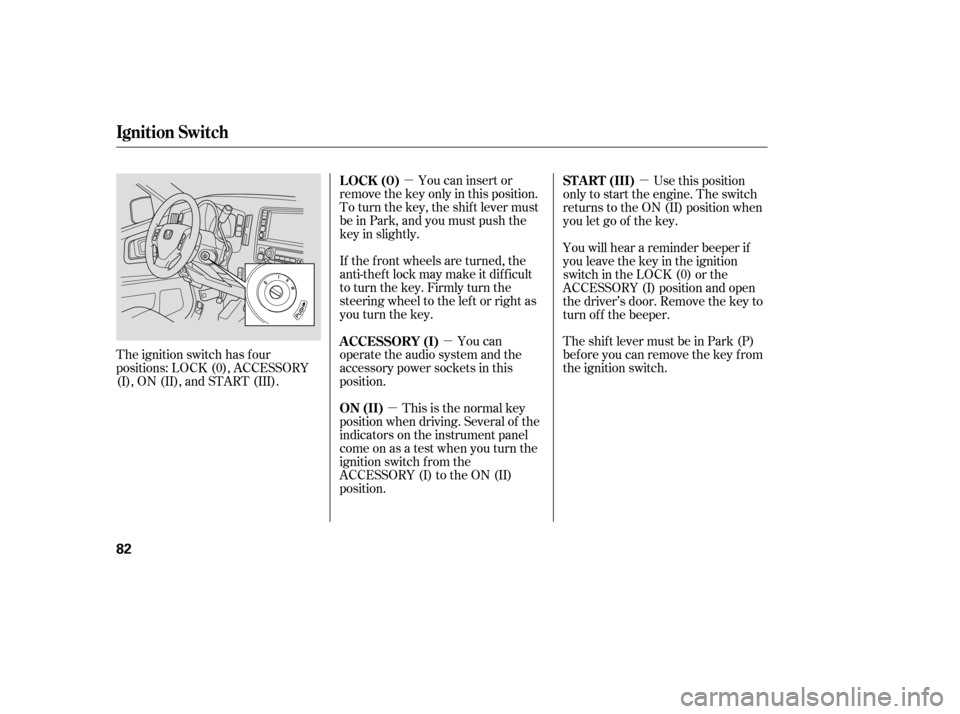
The ignition switch has f our
positions: LOCK (0), ACCESSORY
(I), ON (II), and START (III). You can insert or
remove the key only in this position.
To turn the key, the shift lever must
be in Park, and you must push the
key in slightly.
If the f ront wheels are turned, the
anti-theft lock may make it difficult
to turn the key. Firmly turn the
steering wheel to the lef t or right as
you turn the key.
You can
operate the audio system and the
accessory power sockets in this
position.
This is the normal key
position when driving. Several of the
indicators on the instrument panel
come on as a test when you turn the
ignition switch f rom the
ACCESSORY (I) to the ON (II)
position. Use this position
only to start the engine. The switch
returns to the ON (II) position when
you let go of the key.
You will hear a reminder beeper if
you leave the key in the ignition
switch in the LOCK (0) or the
ACCESSORY (I) position and open
the driver’s door. Remove the key to
turn of f the beeper.
TheshiftlevermustbeinPark(P)
bef ore you can remove the key f rom
the ignition switch.
LOCK (0)
A CCESSORY (I)
ON (II) ST A RT (III)
Ignition Switch
82
Page 88 of 331
Your vehicle has customizable
settings f or the doors to
automatically lock and unlock. Make
all settings bef ore you start driving.
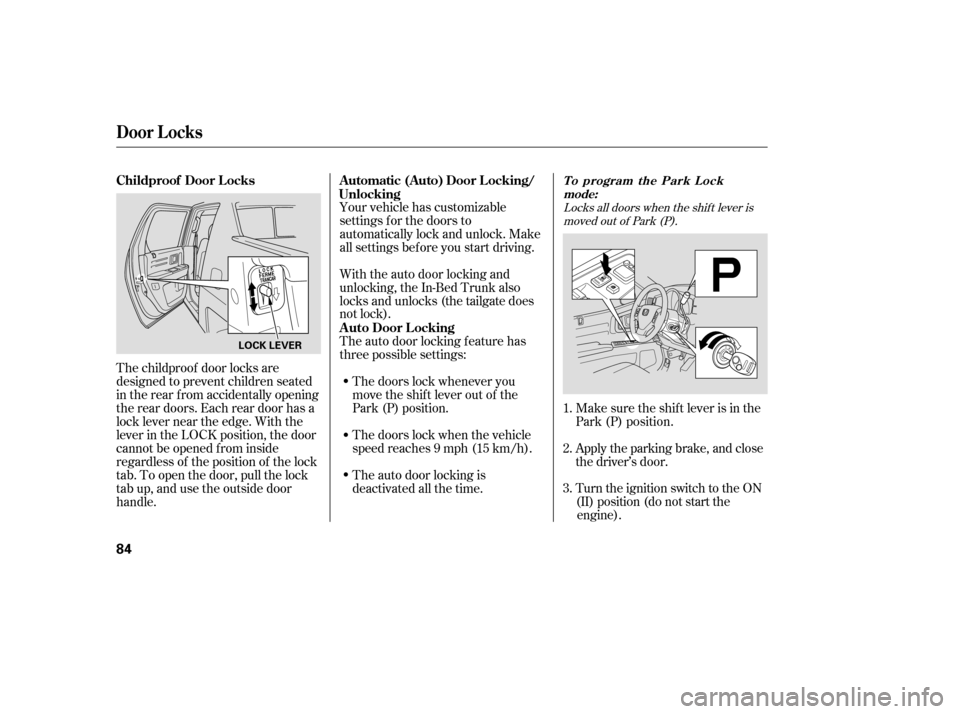
T he childproof door loc
k
s are
designed to prevent children seated
in the rear f rom accidentally opening
the rear doors. Each rear door has a
lock lever near the edge. With the
lever in the LOCK position, the door
cannot be opened f rom inside
regardless of the position of the lock
tab. To open the door, pull the lock
tab up, and use the outside door
handle. Make sure the shif t lever is in the
Park (P) position.
Apply the parking brake, and close
the driver’s door.
With the auto door locking and
unlocking, the In-Bed Trunk also
locks and unlocks (the tailgate does
not lock).
T he auto door loc
k
ing f eature has
three possible settings:
The doors lock whenever you
move the shift lever out of the
Park (P) position.
The doors lock when the vehicle
speed reaches 9 mph (15 km/h).
The auto door locking is
deactivated all the time. 1.
2.
Locks all doors when the shif t lever is
moved out of Park (P).
Automatic (Auto) Door L ocking/
Unlocking
Childproof Door L ocks
A uto Door L ockingTo program the Park Lock mode:
Door L ocks
84
LOCK LEVER
Turn the ignition switch to the ON
(II) position (do not start the
engine).
3.

