2007 GMC SIERRA CLASSIC tow
[x] Cancel search: towPage 427 of 674
{CAUTION:
Shifting a four-wheel-drive vehicle’s
transfer case into NEUTRAL can cause
your vehicle to roll even if the transmission
is in PARK (P) for an automatic
transmission, or if your vehicle is in gear,
for a manual transmission. You or others
could be injured. Make sure the parking
brake is rmly set before you shift the
transfer case to NEUTRAL.
6. Shift the transfer case to NEUTRAL.
SeeFour-Wheel Drive on page 153for the
proper procedure to select the neutral position
for your vehicle.
7. Release the parking brake only after the
vehicle being towed is rmly attached to
the towing vehicle.
8. Turn the ignition off and lock the steering
column.
Rear Towing
(Rear Wheels Off the Ground)
Two-Wheel-Drive Vehicles
Use the following procedure to tow your vehicle
from the rear:
1. Drive the vehicle onto the dolly.
2. Firmly set the parking brake. SeeParking
Brake on page 169
3. Put an automatic transmission in PARK (P) or
a manual transmission in FIRST (1).
4. Follow the dolly manufacturer’s instructions to
attach and secure the vehicle being towed to
the dolly and then the loaded dolly to the
tow vehicle. Make sure the wheels are straight
before towing.
For manual transmission vehicles, make sure
the wheels are straight before proceeding
to the next steps. On automatic transmission
vehicles, use an adequate clamping device
to ensure that the front wheels are locked into
the straight position.
5. Release the parking brake only after the
vehicle being towed is rmly attached to
the tow vehicle.
6. Turn the ignition to LOCK.
427
Page 428 of 674

Four-Wheel-Drive Vehicles
Use the following procedure to tow your vehicle
from the rear:
1. Drive the vehicle onto the dolly.
2. Firmly set the parking brake. SeeParking
Brake on page 169
3. Put an automatic transmission in PARK (P) or
a manual transmission in FIRST (1).
4. Follow the dolly manufacturer’s instructions to
attach and secure the vehicle being towed to
the dolly and then the loaded dolly to the
tow vehicle.
For manual transmission vehicles, make sure
the wheels are straight before proceeding
to the next steps. On automatic transmission
vehicles, use an adequate clamping device
to ensure that the front wheels are locked into
the straight position.{CAUTION:
Shifting a four-wheel-drive vehicle’s
transfer case into NEUTRAL can cause
your vehicle to roll even if the transmission
is in PARK (P) for an automatic
transmission, or if your vehicle is in gear,
for a manual transmission. You or others
could be injured. Make sure the parking
brake is rmly set before you shift the
transfer case to NEUTRAL.
5. Shift the transfer case to NEUTRAL.
SeeFour-Wheel Drive on page 153
6. Release the parking brake only after the
vehicle being towed is rmly attached to
the tow vehicle.
7. Turn the ignition to LOCK.
428
Page 429 of 674
Towing a Trailer
Do not tow a trailer during break-in. SeeNew
Vehicle Break-In on page 134for more information.
{CAUTION:
If you do not use the correct equipment
and drive properly, you can lose control
when you pull a trailer. For example, if the
trailer is too heavy, the brakes may not
work well — or even at all. You and your
passengers could be seriously injured.
Pull a trailer only if you have followed all
the steps in this section. Ask your dealer
for advice and information about towing a
trailer with your vehicle.Notice:Pulling a trailer improperly can
damage your vehicle and result in costly
repairs not covered by your warranty.
To pull a trailer correctly, follow the advice in
this part, and see your dealer for important
information about towing a trailer with
your vehicle.
To identify the trailering capacity of your vehicle,
you should read the information in “Weight of
the Trailer” that appears later in this section.
Trailering is different than just driving your vehicle
by itself. Trailering means changes in acceleration,
braking, handling, durability and fuel economy.
Successful, safe trailering takes correct equipment,
and it has to be used properly.
That’s the reason for this part. In it are many
time-tested, important trailering tips and safety
rules. Many of these are important for your safety
and that of your passengers. So please read
this section carefully before you pull a trailer.
429
Page 430 of 674
If You Do Decide To Pull A Trailer
If you do, here are some important points:
There are many different laws, including speed
limit restrictions, having to do with trailering.
Make sure your rig will be legal, not only where
you live but also where you’ll be driving.
A good source for this information can be state
or provincial police.
Consider using a sway control. See “Hitches”
later in this section.
Don’t tow a trailer at all during the rst
500 miles (800 km) your new vehicle is driven.
Your engine, axle or other parts could be
damaged.
Then, during the rst 500 miles (800 km) that
you tow a trailer, don’t drive over 50 mph
(80 km/h) and don’t make starts at full throttle.
This helps your engine and other parts of
your vehicle wear in at the heavier loads.
If you have an automatic transmission, you
can tow in DRIVE (D). You may want to
shift the transmission to THIRD (3) or, if
necessary, a lower gear selection if the
transmission shifts too often, such as under
heavy loads and/or hilly conditions. If you have
a manual transmission and you are towing a
trailer, it’s better not to use the highest
gear. SeeTow/Haul Mode Light on page 264.
Three important considerations have to do
with weight:
The weight of the trailer
The weight of the trailer tongue
The weight on your vehicle’s tires
Tow/Haul Mode
Tow/Haul is a feature on automatic transmission
equipped vehicles that assists when pulling a heavy
trailer or a large or heavy load. SeeTow/Haul Mode
on page 147for more information.
430
Page 431 of 674
Tow/Haul is designed to be most effective when
the vehicle and trailer combined weight is at
least 75 percent of the vehicle’s Gross Combined
Weight Rating (GCWR). See “Weight of the
Trailer” later in the section. Tow/Haul is most
useful under the following driving conditions:
When pulling a heavy trailer or a large
or heavy load through rolling terrain.
When pulling a heavy trailer or a large or
heavy load in stop and go traffic.
When pulling a heavy trailer or a large or
heavy load in busy parking lots where
improved low speed control of the vehicle is
desired.
Operating the vehicle in Tow/Haul when lightly
loaded or with no trailer at all will not cause
damage. However, there is no benet to the
selection of Tow/Haul when the vehicle is
unloaded. Such a selection when unloaded may
result in unpleasant engine and transmission
driving characteristics and reduced fuel economy.
Tow/Haul is recommended only when pulling a
heavy trailer or a large or heavy load.
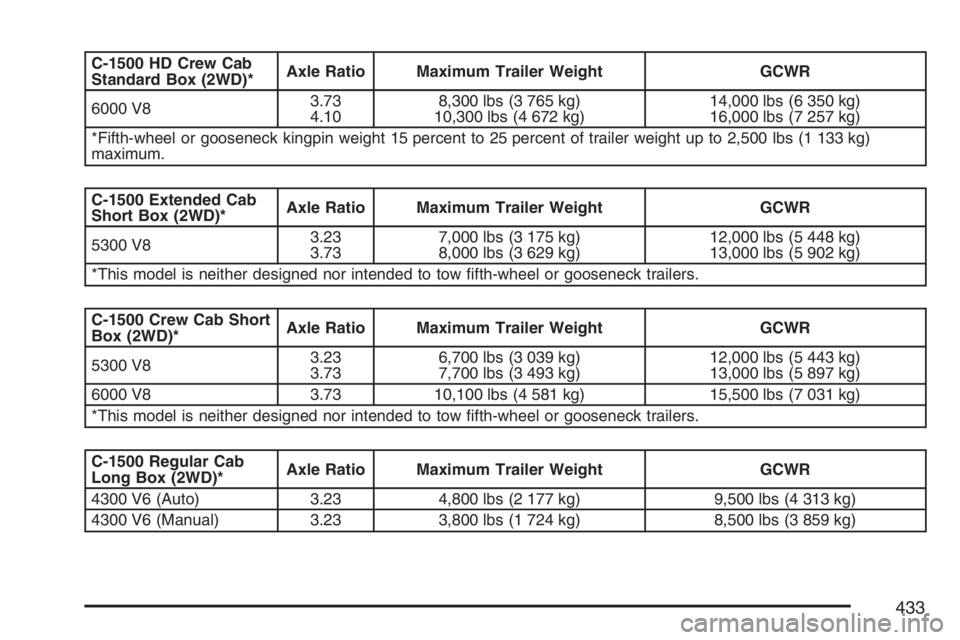
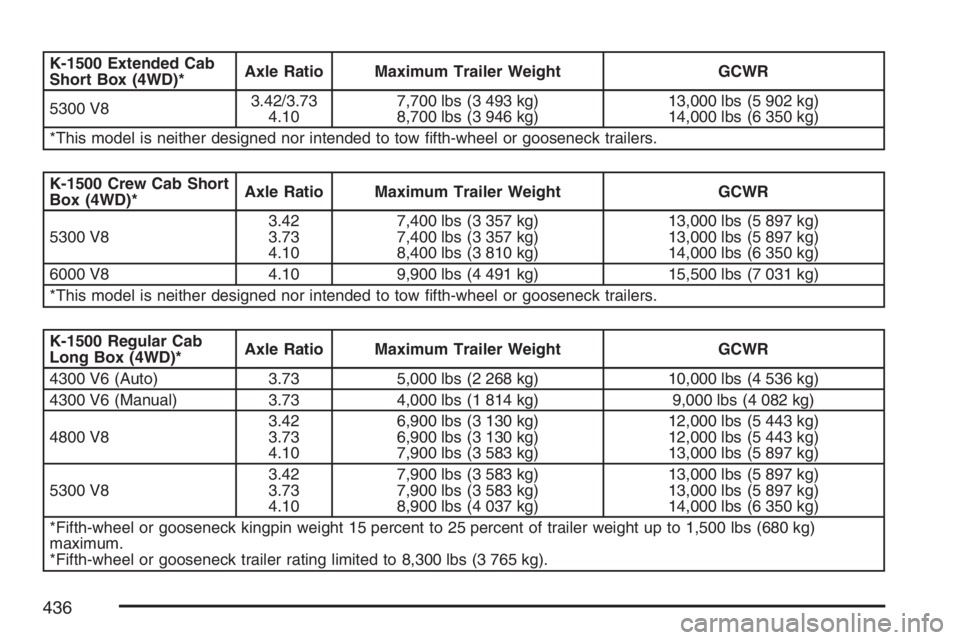
Weight of the Trailer
How heavy can a trailer safely be?
It depends on how you plan to use your rig.
For example, speed, altitude, road grades, outside
temperature and how much your vehicle is used
to pull a trailer are all important. It can also depend
on any special equipment that you have on your
vehicle, and the amount of tongue weight the
vehicle can carry. See “Weight of the Trailer
Tongue” later in this section for more information.
Maximum trailer weight is calculated assuming
only the driver is in the tow vehicle and it has all
the required trailering equipment. The weight
of additional optional equipment, passengers and
cargo in the tow vehicle must be subtracted
from the maximum trailer weight.
Above the 5,000 lbs (2 268 kg) trailer rating,
the handling/trailering suspension is required on
two-wheel drive 1500 series models and the
handling/trailering or off-road suspension is
required on four-wheel drive 1500 series models.
431
Page 433 of 674
C-1500 HD Crew Cab
Standard Box (2WD)*Axle Ratio Maximum Trailer Weight GCWR
6000 V83.73
4.108,300 lbs (3 765 kg)
10,300 lbs (4 672 kg)14,000 lbs (6 350 kg)
16,000 lbs (7 257 kg)
*Fifth-wheel or gooseneck kingpin weight 15 percent to 25 percent of trailer weight up to 2,500 lbs (1 133 kg)
maximum.
C-1500 Extended Cab
Short Box (2WD)*Axle Ratio Maximum Trailer Weight GCWR
5300 V83.23
3.737,000 lbs (3 175 kg)
8,000 lbs (3 629 kg)12,000 lbs (5 448 kg)
13,000 lbs (5 902 kg)
*This model is neither designed nor intended to tow fth-wheel or gooseneck trailers.
C-1500 Crew Cab Short
Box (2WD)*Axle Ratio Maximum Trailer Weight GCWR
5300 V83.23
3.736,700 lbs (3 039 kg)
7,700 lbs (3 493 kg)12,000 lbs (5 443 kg)
13,000 lbs (5 897 kg)
6000 V8 3.73 10,100 lbs (4 581 kg) 15,500 lbs (7 031 kg)
*This model is neither designed nor intended to tow fth-wheel or gooseneck trailers.
C-1500 Regular Cab
Long Box (2WD)*Axle Ratio Maximum Trailer Weight GCWR
4300 V6 (Auto) 3.23 4,800 lbs (2 177 kg) 9,500 lbs (4 313 kg)
4300 V6 (Manual) 3.23 3,800 lbs (1 724 kg) 8,500 lbs (3 859 kg)
433
Page 436 of 674
K-1500 Extended Cab
Short Box (4WD)*Axle Ratio Maximum Trailer Weight GCWR
5300 V83.42/3.73
4.107,700 lbs (3 493 kg)
8,700 lbs (3 946 kg)13,000 lbs (5 902 kg)
14,000 lbs (6 350 kg)
*This model is neither designed nor intended to tow fth-wheel or gooseneck trailers.
K-1500 Crew Cab Short
Box (4WD)*Axle Ratio Maximum Trailer Weight GCWR
5300 V83.42
3.73
4.107,400 lbs (3 357 kg)
7,400 lbs (3 357 kg)
8,400 lbs (3 810 kg)13,000 lbs (5 897 kg)
13,000 lbs (5 897 kg)
14,000 lbs (6 350 kg)
6000 V8 4.10 9,900 lbs (4 491 kg) 15,500 lbs (7 031 kg)
*This model is neither designed nor intended to tow fth-wheel or gooseneck trailers.
K-1500 Regular Cab
Long Box (4WD)*Axle Ratio Maximum Trailer Weight GCWR
4300 V6 (Auto) 3.73 5,000 lbs (2 268 kg) 10,000 lbs (4 536 kg)
4300 V6 (Manual) 3.73 4,000 lbs (1 814 kg) 9,000 lbs (4 082 kg)
4800 V83.42
3.73
4.106,900 lbs (3 130 kg)
6,900 lbs (3 130 kg)
7,900 lbs (3 583 kg)12,000 lbs (5 443 kg)
12,000 lbs (5 443 kg)
13,000 lbs (5 897 kg)
5300 V83.42
3.73
4.107,900 lbs (3 583 kg)
7,900 lbs (3 583 kg)
8,900 lbs (4 037 kg)13,000 lbs (5 897 kg)
13,000 lbs (5 897 kg)
14,000 lbs (6 350 kg)
*Fifth-wheel or gooseneck kingpin weight 15 percent to 25 percent of trailer weight up to 1,500 lbs (680 kg)
maximum.
*Fifth-wheel or gooseneck trailer rating limited to 8,300 lbs (3 765 kg).
436
Page 445 of 674
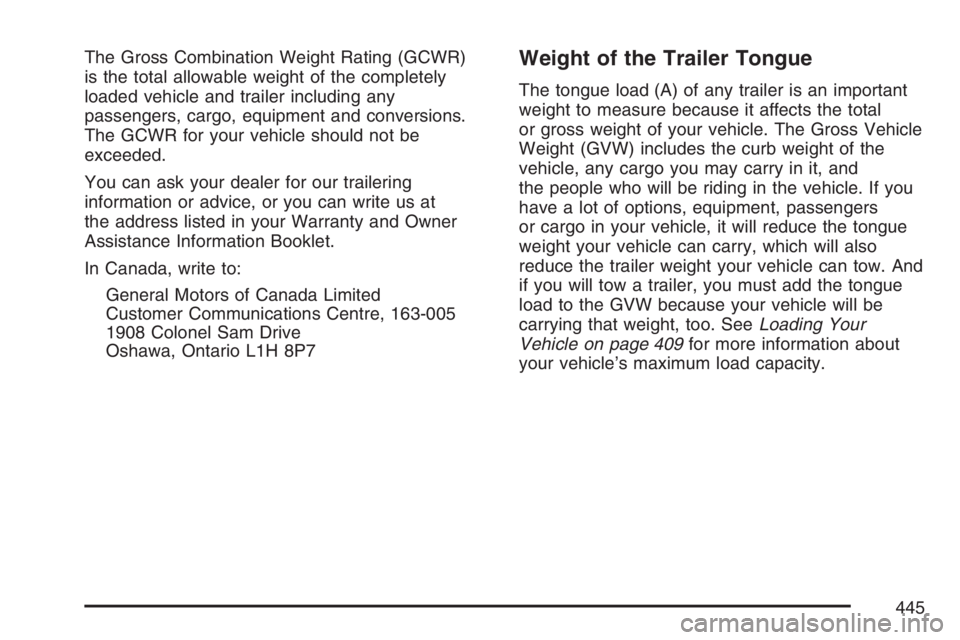
The Gross Combination Weight Rating (GCWR)
is the total allowable weight of the completely
loaded vehicle and trailer including any
passengers, cargo, equipment and conversions.
The GCWR for your vehicle should not be
exceeded.
You can ask your dealer for our trailering
information or advice, or you can write us at
the address listed in your Warranty and Owner
Assistance Information Booklet.
In Canada, write to:
General Motors of Canada Limited
Customer Communications Centre, 163-005
1908 Colonel Sam Drive
Oshawa, Ontario L1H 8P7Weight of the Trailer Tongue
The tongue load (A) of any trailer is an important
weight to measure because it affects the total
or gross weight of your vehicle. The Gross Vehicle
Weight (GVW) includes the curb weight of the
vehicle, any cargo you may carry in it, and
the people who will be riding in the vehicle. If you
have a lot of options, equipment, passengers
or cargo in your vehicle, it will reduce the tongue
weight your vehicle can carry, which will also
reduce the trailer weight your vehicle can tow. And
if you will tow a trailer, you must add the tongue
load to the GVW because your vehicle will be
carrying that weight, too. SeeLoading Your
Vehicle on page 409for more information about
your vehicle’s maximum load capacity.
445