Page 534 of 674
Front Turn Signal, Sidemarker and
Daytime Running Lamps
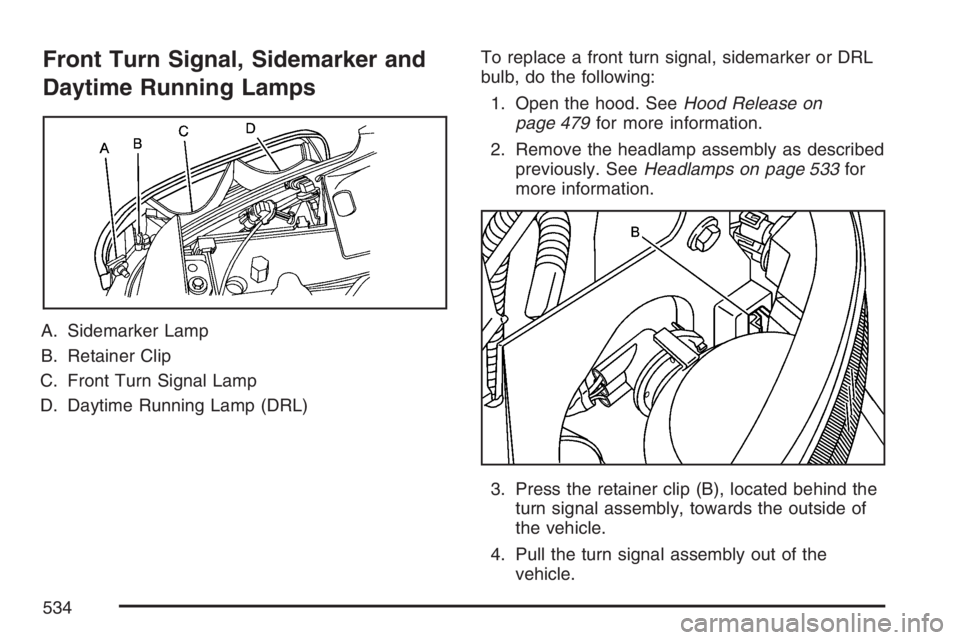
A. Sidemarker Lamp
B. Retainer Clip
C. Front Turn Signal Lamp
D. Daytime Running Lamp (DRL)To replace a front turn signal, sidemarker or DRL
bulb, do the following:
1. Open the hood. SeeHood Release on
page 479for more information.
2. Remove the headlamp assembly as described
previously. SeeHeadlamps on page 533for
more information.
3. Press the retainer clip (B), located behind the
turn signal assembly, towards the outside of
the vehicle.
4. Pull the turn signal assembly out of the
vehicle.
534
Page 555 of 674
{CAUTION:
Rust or dirt on a wheel, or on the parts to
which it is fastened, can make wheel nuts
become loose after a time. The wheel
could come off and cause an accident.
When you change a wheel, remove any
rust or dirt from places where the wheel
attaches to the vehicle. In an emergency,
you can use a cloth or a paper towel to do
this; but be sure to use a scraper or wire
brush later, if needed, to get all the rust
or dirt off. SeeChanging a Flat Tire on
page 564.
When It Is Time for New Tires
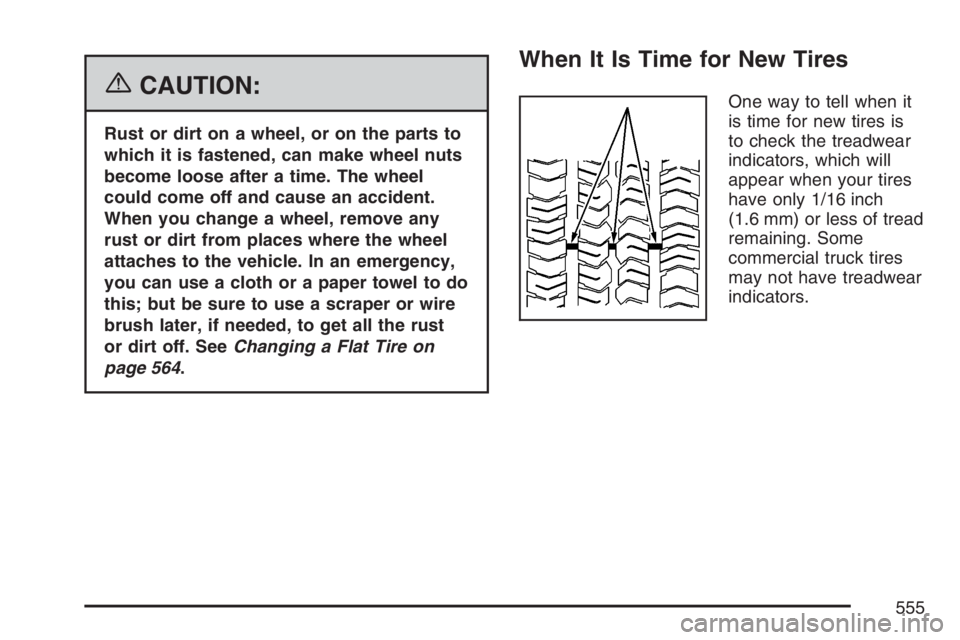
One way to tell when it
is time for new tires is
to check the treadwear
indicators, which will
appear when your tires
have only 1/16 inch
(1.6 mm) or less of tread
remaining. Some
commercial truck tires
may not have treadwear
indicators.
555
Page 563 of 674
CAUTION: (Continued)
Use another type of traction device
only if its manufacturer recommends
it for use on your vehicle and tire size
combination and road conditions. Follow
that manufacturer’s instructions. To help
avoid damage to your vehicle, drive
slowly, readjust or remove the device if it
is contacting your vehicle, and do not
spin your vehicle’s wheels.
If you do nd traction devices that will t,
install them on the rear tires.
Notice:If your vehicle does not have dual
wheels and is equipped with a tire size other
than P265/75R16, LT265/75R16, P265/70R17
or P275/55R20, use tire chains only where legal
and only when you must. Use chains that
are the proper size for your tires. Install them
on the tires of the rear axle. Don’t use
chains on the tires of the front axle.Tighten them as tightly as possible with the
ends securely fastened. Drive slowly and follow
the chain manufacturer’s instructions. If you
can hear the chains contacting your vehicle,
stop and retighten them. If the contact
continues, slow down until it stops. Driving
too fast or spinning the wheels with chains on
will damage your vehicle.
If a Tire Goes Flat
It is unusual for a tire to blowout while you are
driving, especially if you maintain your vehicle’s
tires properly. If air goes out of a tire, it is
much more likely to leak out slowly. But if you
should ever have a blowout, here are a few tips
about what to expect and what to do:
If a front tire fails, the at tire will create a drag
that pulls the vehicle toward that side. Take
your foot off the accelerator pedal and grip the
steering wheel rmly. Steer to maintain lane
position, and then gently brake to a stop well out
of the traffic lane.
563
Page 570 of 674
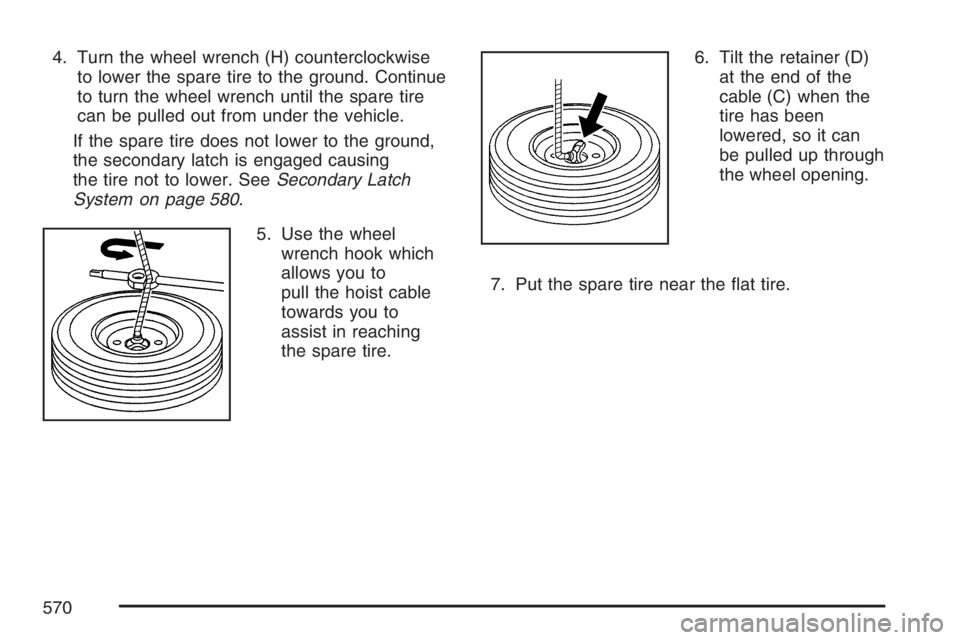
4. Turn the wheel wrench (H) counterclockwise
to lower the spare tire to the ground. Continue
to turn the wheel wrench until the spare tire
can be pulled out from under the vehicle.
If the spare tire does not lower to the ground,
the secondary latch is engaged causing
the tire not to lower. SeeSecondary Latch
System on page 580.
5. Use the wheel
wrench hook which
allows you to
pull the hoist cable
towards you to
assist in reaching
the spare tire.6. Tilt the retainer (D)
at the end of the
cable (C) when the
tire has been
lowered, so it can
be pulled up through
the wheel opening.
7. Put the spare tire near the at tire.
570
Page 576 of 674
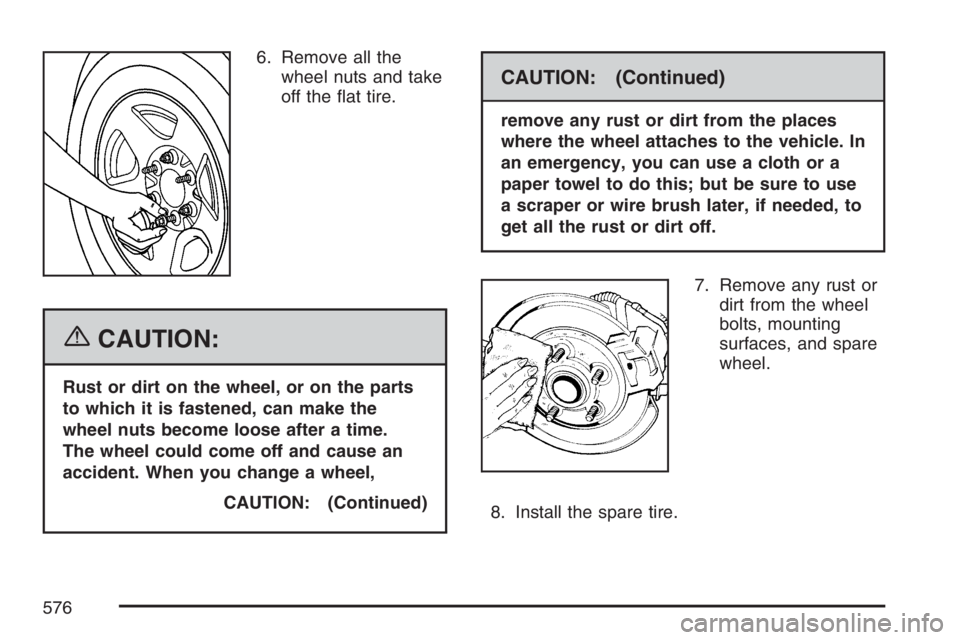
6. Remove all the
wheel nuts and take
off the at tire.
{CAUTION:
Rust or dirt on the wheel, or on the parts
to which it is fastened, can make the
wheel nuts become loose after a time.
The wheel could come off and cause an
accident. When you change a wheel,
CAUTION: (Continued)
CAUTION: (Continued)
remove any rust or dirt from the places
where the wheel attaches to the vehicle. In
an emergency, you can use a cloth or a
paper towel to do this; but be sure to use
a scraper or wire brush later, if needed, to
get all the rust or dirt off.
7. Remove any rust or
dirt from the wheel
bolts, mounting
surfaces, and spare
wheel.
8. Install the spare tire.
576
Page 577 of 674
{CAUTION:
Never use oil or grease on studs or nuts.
If you do, the nuts might come loose.
Your wheel could fall off, causing a
serious accident.
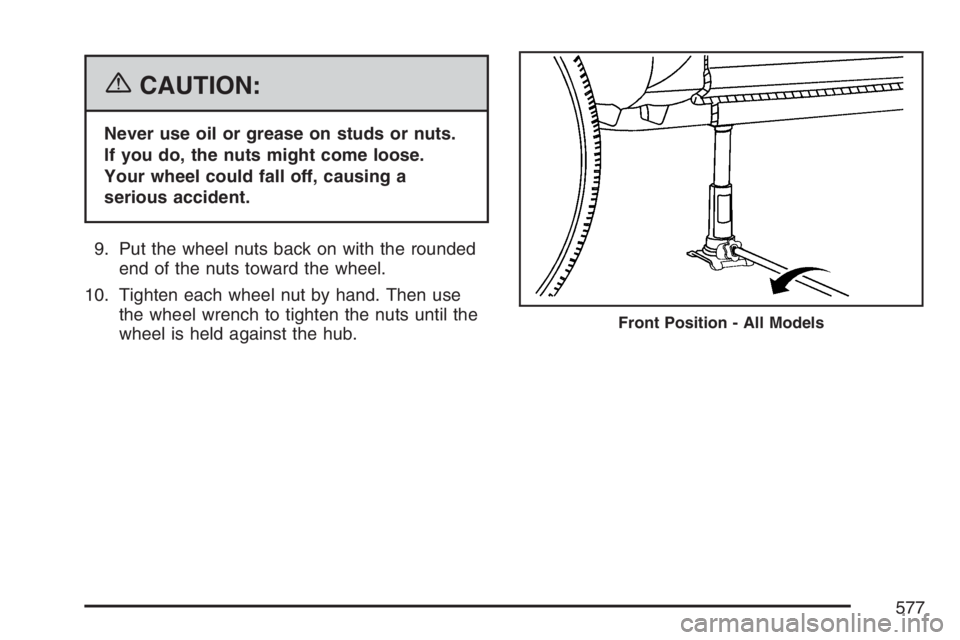
9. Put the wheel nuts back on with the rounded
end of the nuts toward the wheel.
10. Tighten each wheel nut by hand. Then use
the wheel wrench to tighten the nuts until the
wheel is held against the hub.
Front Position - All Models
577
Page 581 of 674
4. Repeat this procedure at least two times. If
the spare tire lowers to the ground, continue
with Step 5 ofRemoving the Spare Tire
and Tools on page 566.
5. Turn the wrench counterclockwise until
approximately 6 inches (15 cm) of cable
is exposed.
6. Stand the wheel blocks on their shortest ends,
with the backs facing each other.
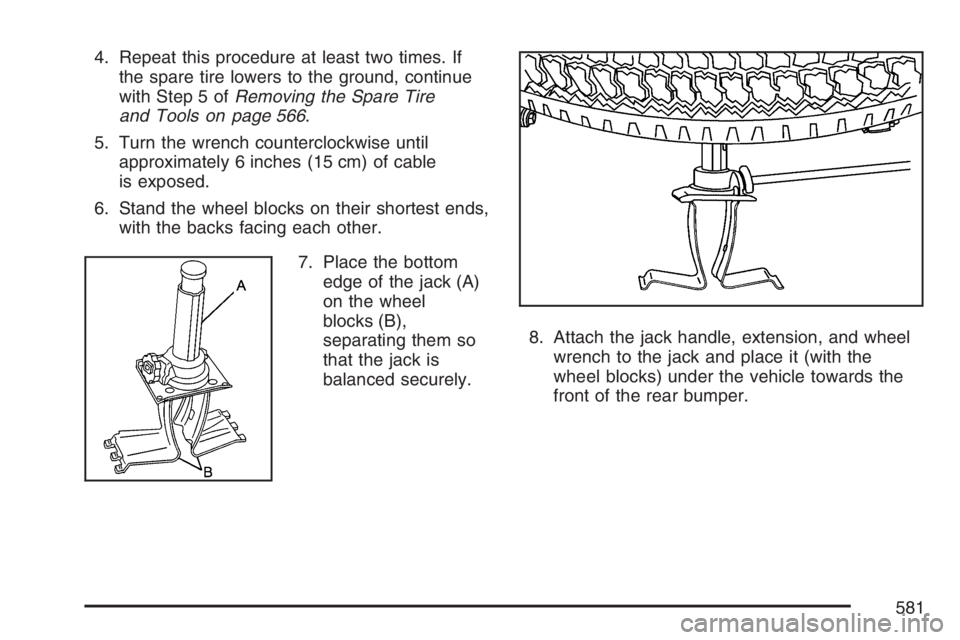
7. Place the bottom
edge of the jack (A)
on the wheel
blocks (B),
separating them so
that the jack is
balanced securely.8. Attach the jack handle, extension, and wheel
wrench to the jack and place it (with the
wheel blocks) under the vehicle towards the
front of the rear bumper.
581
Page 584 of 674
Storing a Flat or Spare Tire
and Tools
{CAUTION:
Storing a jack, a tire, or other equipment
in the passenger compartment of the
vehicle could cause injury. In a sudden
stop or collision, loose equipment could
strike someone. Store all these in the
proper place.
Notice:Storing an aluminum wheel with a
at tire under your vehicle for an extended
period of time or with the valve stem pointing
up may damage the wheel. Always stow
the wheel with the valve stem pointing down
and have the wheel/tire repaired as soon
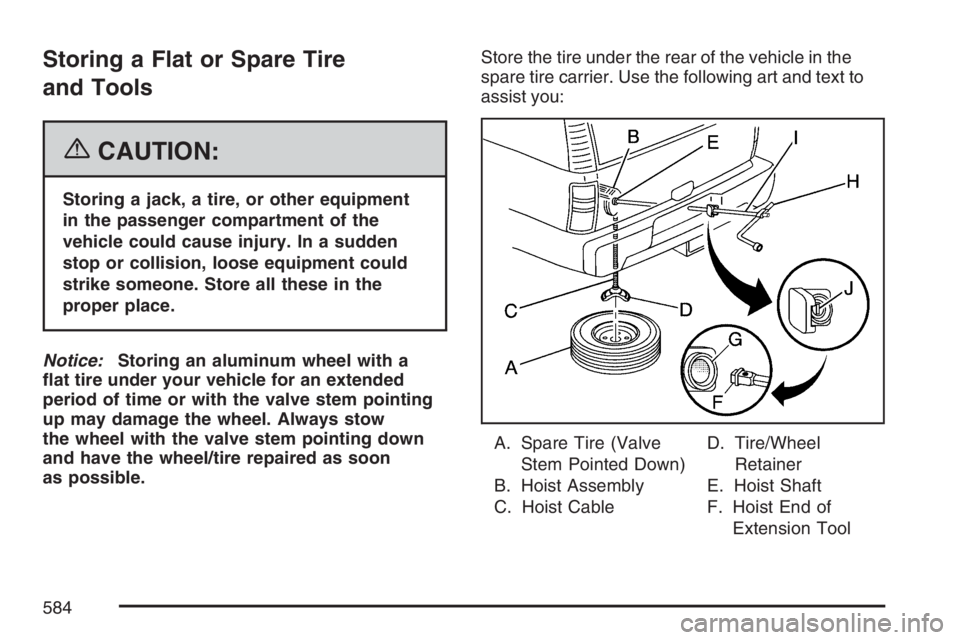
as possible.Store the tire under the rear of the vehicle in the
spare tire carrier. Use the following art and text to
assist you:
A. Spare Tire (Valve
Stem Pointed Down)
B. Hoist Assembly
C. Hoist CableD. Tire/Wheel
Retainer
E. Hoist Shaft
F. Hoist End of
Extension Tool
584