2007 GMC CANYON trailer
[x] Cancel search: trailerPage 311 of 492

Maintenance When Trailer Towing
Your vehicle will need service more often
when you’re pulling a trailer. SeeScheduled
Maintenance on page 437for more on this. Things
that are especially important in trailer operation
are automatic transmission uid (don’t overll),
engine oil, axle lubricant, belt, cooling system and
brake system. Each of these is covered in this
manual, and the Index will help you nd them
quickly. If you’re trailering, it’s a good idea
to review these sections before you start your trip.
Check periodically to see that all hitch nuts and
bolts are tight.
Trailer Wiring Harness
Your vehicle may be equipped with a four-pin
trailer towing harness. This harness has a four-pin
trailer connector that is attached to a bracket on
the hitch platform. The four-wire harness contains
the following trailer circuits:
Yellow: Left Stop/Turn Signal
Green: Right Stop/Turn Signal
Brown: Taillamps/Park lamps
White: Ground
Trailer Recommendations
You must subtract your hitch load from the
CWR for your vehicle. Weigh your vehicle with
your trailer attached, so that you won’t go over
the GVWR or the GAWR.
You’ll get the best performance if you spread out
the weight of your load the right way, and if
you choose the correct hitch and trailer brakes.
For more information, seeTowing a Trailer
on page 300later in this section.
311
Page 332 of 492

How to Check Automatic Transmission
Fluid
Because this operation can be a little difficult, you
may choose to have this done at the dealership
service department.
If you do it yourself, be sure to follow all the
instructions here, or you could get a false reading
on the dipstick.
Notice:Too much or too little uid can
damage your transmission. Too much can
mean that some of the uid could come out
and fall on hot engine parts or exhaust system
parts, starting a re. Too little uid could
cause the transmission to overheat. Be sure to
get an accurate reading if you check your
transmission uid.
Wait at least 30 minutes before checking the
transmission uid level if you have been driving:
When outside temperatures are above
90°F (32°C).
At high speed for quite a while.
In heavy traffic — especially in hot weather.
While pulling a trailer.To get the right reading, the uid should be at
normal operating temperature, which is 180°F to
200°F (82°C to 93°C).
Get the vehicle warmed up by driving about
15 miles (24 km) when outside temperatures are
above 50°F (10°C). If it is colder than 50°F (10°C),
drive the vehicle in THIRD (3) until the engine
temperature gage moves and then remains steady
for 10 minutes.
A cold uid check can be made after the vehicle has
been sitting for eight hours or more with the engine
off, but this is used only as a reference. Let the
engine run at idle for ve minutes if outside
temperatures are 50°F (10°C) or more. If it is colder
than 50°F (10°C), you may have to idle the engine
longer. Should the uid level be low during this cold
check, you must check the uid hot before adding
uid. Checking the uid hot will give you a more
accurate reading of the uid level.
Checking the Fluid Level
Prepare your vehicle as follows:
1. Park your vehicle on a level place. Keep the
engine running.
2. With the parking brake applied, place the shift
lever in PARK (P).
332
Page 341 of 492

If No Steam Is Coming From Your
Engine
If you get an engine overheat warning but see or
hear no steam, the problem may not be too serious.
Sometimes the engine can get a little too hot
when you:
Climb a long hill on a hot day.
Stop after high-speed driving.
Idle for long periods in traffic.
Tow a trailer. See “Driving on Grades” under
Towing a Trailer on page 300.
If you get the overheat warning with no sign of
steam, try this for a minute or so:
1. In heavy traffic, let the engine idle in NEUTRAL
while stopped. If it is safe to do so, pull off the
road, shift to PARK (P) or NEUTRAL and let
the engine idle.
2. Turn off the air conditioning.
3. Turn on your heater to full hot at the highest fan
speed and open the windows as necessary.If you no longer have the overheat warning, you
can drive. Just to be safe, drive slower for about
10 minutes. If the warning does not come back on,
you can drive normally.
If the warning continues, pull over, stop, and park
your vehicle right away.
If there is still no sign of steam, idle the engine for
three minutes while you are parked. Push down
the accelerator until the engine speed is about
twice as fast as normal idle speed for at least
three minutes while you are parked. If you
still have the warning, turn off the engine and get
everyone out of the vehicle until it cools down.
You may decide not to lift the hood but to
get service help right away.
341
Page 347 of 492
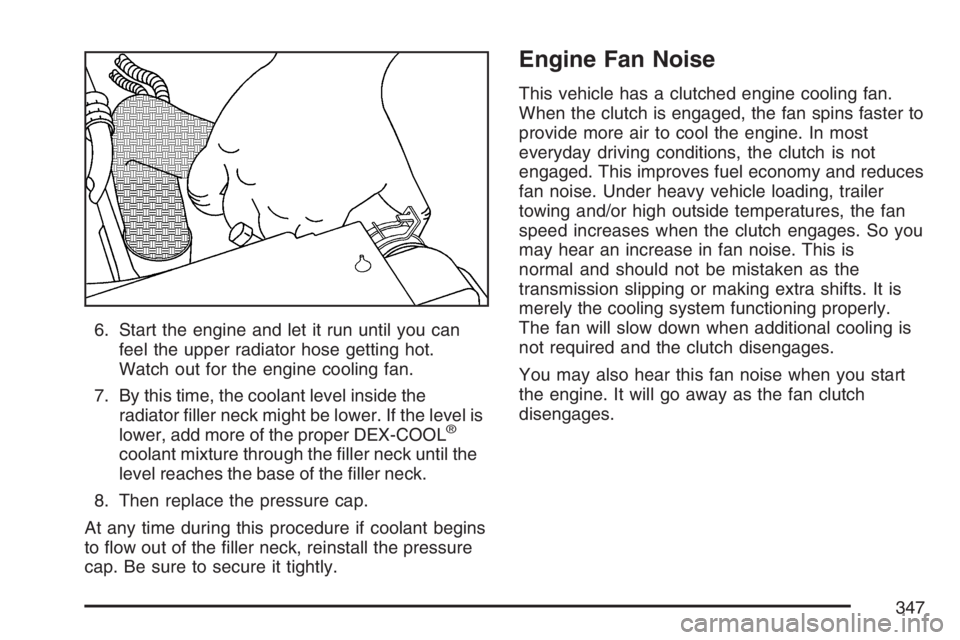
6. Start the engine and let it run until you can
feel the upper radiator hose getting hot.
Watch out for the engine cooling fan.
7. By this time, the coolant level inside the
radiator ller neck might be lower. If the level is
lower, add more of the proper DEX-COOL
®
coolant mixture through the ller neck until the
level reaches the base of the ller neck.
8. Then replace the pressure cap.
At any time during this procedure if coolant begins
to ow out of the ller neck, reinstall the pressure
cap. Be sure to secure it tightly.
Engine Fan Noise
This vehicle has a clutched engine cooling fan.
When the clutch is engaged, the fan spins faster to
provide more air to cool the engine. In most
everyday driving conditions, the clutch is not
engaged. This improves fuel economy and reduces
fan noise. Under heavy vehicle loading, trailer
towing and/or high outside temperatures, the fan
speed increases when the clutch engages. So you
may hear an increase in fan noise. This is
normal and should not be mistaken as the
transmission slipping or making extra shifts. It is
merely the cooling system functioning properly.
The fan will slow down when additional cooling is
not required and the clutch disengages.
You may also hear this fan noise when you start
the engine. It will go away as the fan clutch
disengages.
347
Page 442 of 492

(g)A uid loss in any vehicle system could
indicate a problem. Have the system inspected
and repaired and the uid level checked.
Add uid if needed.
(h)Change automatic transmission uid and
lter if the vehicle is mainly driven under one or
more of these conditions:
In heavy city traffic where the outside
temperature regularly reaches 90°F (32°C)
or higher.
In hilly or mountainous terrain.
When doing frequent trailer towing.
Uses such as found in taxi, police, or
delivery service.
(i)Drain, ush, and rell cooling system. This
service can be complex; you should have
your dealer perform this service. See Engine
Coolant on page 337 for what to use. Inspect
hoses. Clean radiator, condenser, pressure cap,
and ller neck. Pressure test the cooling
system and pressure cap.(j)If you drive regularly under dusty conditions,
inspect the lter at each engine oil change.
(k)Visually inspect belt for fraying, excessive
cracks, or obvious damage. Replace belt if
necessary.
Owner Checks and Services
These owner checks and services should be
performed at the intervals specied to help
ensure the safety, dependability, and emission
control performance of your vehicle. Your
GM Goodwrench
®dealer can assist you with
these checks and services.
Be sure any necessary repairs are completed at
once. Whenever any uids or lubricants are added
to your vehicle, make sure they are the proper
ones, as shown inRecommended Fluids and
Lubricants on page 447.
442
Page 491 of 492

Tires (cont.)
Tire Sidewall Labeling.............................. 370
Tire Terminology and Denitions............... 374
Uniform Tire Quality Grading.................... 389
Wheel Alignment and Tire Balance........... 390
Wheel Replacement................................. 390
When It Is Time for New Tires................. 385
Towing
Recreational Vehicle................................. 293
Towing a Trailer....................................... 300
Your Vehicle............................................. 292
Traction
Control System (TCS).............................. 249
Limited-Slip Rear Axle.............................. 250
Trailer
Recommendations.................................... 311
Transmission
Fluid, Automatic....................................... 331
Fluid, Manual........................................... 334
Up-Shift Light........................................... 185
Transmission Operation, Automatic.............. 120
Transmission Operation, Manual.................. 124
Trip Odometer............................................. 179
Truck-Camper Loading Information.............. 292Turn and Lane-Change Signals................... 160
Turn Signal/Multifunction Lever.................... 159
U
Understanding Radio Reception................... 238
Uniform Tire Quality Grading....................... 389
Up-Shift Light.............................................. 185
V
Vehicle
Control..................................................... 246
Damage Warnings....................................... 5
Loading.................................................... 286
Parking Your............................................ 134
Symbols...................................................... 5
Vehicle Data Collection and Event Data
Recorders................................................ 468
Vehicle Identication
Number (VIN).......................................... 424
Service Parts Identication Label.............. 425
Ventilation Adjustment.................................. 176
Visors.......................................................... 112
491