2007 GMC ACADIA belt
[x] Cancel search: beltPage 92 of 554
Restraint System Check
Checking the Restraint Systems
Safety Belts
Now and then, make sure the safety belt reminder
light and all your belts, buckles, latch plates,
retractors, and anchorages are working properly.
SeeSafety Belt Reminder Light on page 216
for more information.
Look for any other loose or damaged safety belt
system parts. If you see anything that might keep a
safety belt system from doing its job, have it
repaired. Keep safety belts clean and dry. See
Care of Safety Belts on page 482for more
information.
Torn or frayed safety belts may not protect you in
a crash. They can rip apart under impact forces.
If a belt is torn or frayed, get a new one right away.
Airbag System
The airbag system does not need regularly
scheduled maintenance or replacement. Make
sure the airbag readiness light is working.
SeeAirbag Readiness Light on page 217for more
information.
Notice:If an airbag covering is damaged,
opened, or broken, the airbag may not work
properly. Do not open or break the airbag
coverings. If there are any opened or broken
airbag covers, have the airbag covering and/or
airbag module replaced. For the location of
the airbag modules, seeWhat Makes an Airbag
Inflate? on page 83. See your dealer/retailer
for service.
92
Page 93 of 554
Replacing Restraint System Parts
After a Crash
{CAUTION:
A crash can damage the restraint systems
in your vehicle. A damaged restraint
system may not properly protect the
person using it, resulting in serious injury
or even death in a crash. To help make sure
your restraint systems are working
properly after a crash, have them inspected
and any necessary replacements made as
soon as possible.
If you have had a crash, do you need new belts or
LATCH system parts?
After a very minor collision, nothing may be
necessary. But if the belts were stretched, as they
would be if worn during a more severe crash,
then you need new parts.
If the LATCH system was being used during a
more severe crash, you may need new LATCH
system parts.If belts are cut or damaged, replace them.
Collision damage also may mean you will need to
have LATCH system, safety belt or seat parts
repaired or replaced. New parts and repairs may
be necessary even if the belt or LATCH system
was not being used at the time of the collision.
If an airbag inates, you will need to replace airbag
system parts. See the part on the airbag system
earlier in this section.
If any airbag inates, you will also need to replace
the driver and front passenger’s safety belt
retractor assembly. Be sure to do so. Then the
new retractor assembly will be there to help protect
you in a collision.
After a crash you may need to replace the driver
and front passenger’s safety belt retractor
assemblies, even if the frontal airbags have not
deployed. The driver and front passenger’s safety
belt retractor assemblies contain the safety belt
pretensioners. Have your safety belt pretensioners
checked if your vehicle has been in a collision,
or if your airbag readiness light stays on after you
start your vehicle or while you are driving. See
Airbag Readiness Light on page 217.
93
Page 106 of 554
Doors and Locks
Door Locks
{CAUTION:
Unlocked doors can be dangerous.
Passengers, especially children, can
easily open the doors and fall out of a
moving vehicle. When a door is
locked, the handle will not open it.
You increase the chance of being
thrown out of the vehicle in a crash if
the doors are not locked. So, wear
safety belts properly and lock the
doors whenever you drive.
CAUTION: (Continued)
CAUTION: (Continued)
Young children who get into unlocked
vehicles may be unable to get out. A
child can be overcome by extreme
heat and can suffer permanent injuries
or even death from heat stroke.
Always lock your vehicle whenever
you leave it.
Outsiders can easily enter through an
unlocked door when you slow down
or stop your vehicle. Locking your
doors can help prevent this from
happening.
The vehicle’s doors can be manually locked or
unlocked in the following ways:
From the outside, use the key in the
driver’s door.
From the inside, use the lock control on
the door.
106
Page 168 of 554
Warning Lights, Gages, and Indicators..... 214
Instrument Panel Cluster........................... 215
Speedometer and Odometer...................... 216
Tachometer............................................... 216
Safety Belt Reminder Light........................ 216
Passenger Safety Belt Reminder Light....... 217
Airbag Readiness Light............................. 217
Passenger Airbag Status Indicator............. 218
Charging System Light.............................. 220
Voltmeter Gage......................................... 221
Brake System Warning Light..................... 222
Anti-Lock Brake System Warning Light...... 223
StabiliTrak
®Indicator Light......................... 224
Engine Coolant Temperature Warning
Light...................................................... 224
Engine Coolant Temperature Gage............ 225
Tire Pressure Light.................................... 225
Malfunction Indicator Lamp........................ 226
Oil Pressure Light..................................... 229
Security Light............................................ 229
Fog Lamp Light......................................... 230Cruise Control Light.................................. 230
Highbeam On Light................................... 230
Tow/Haul Mode Light................................ 230
Fuel Gage................................................. 231
Driver Information Center (DIC).................. 232
DIC Operation and Displays
(With DIC Buttons)................................. 233
DIC Operation and Displays
(Without DIC Buttons)............................ 239
DIC Warnings and Messages.................... 244
DIC Vehicle Customization
(With DIC Buttons)................................. 255
Audio System(s)......................................... 264
Setting the Time........................................ 266
Radio with CD........................................... 268
Radio with CD and DVD........................... 278
Using an MP3 (Radio with CD or
Six-Disc CD Player)............................... 295
Using an MP3 (Radio with CD and
DVD Player)........................................... 301
Section 3 Instrument Panel
168
Page 216 of 554

Speedometer and Odometer
The speedometer lets you see your speed in
both miles per hour (mph) and kilometers per
hour (km/h).
The odometer shows how far your vehicle has
been driven, in either miles or kilometers.
Your vehicle has a tamper-resistant odometer.
If your vehicle needs a new odometer installed,
the new one will be set to the mileage total of the
old odometer. If this is not possible, it will be
set at zero and a label must be put on the driver’s
door to show the old mileage reading when the
new odometer was installed. If the mileage
is unknown, the label should then indicate
“previous mileage unknown”.
Tachometer
The tachometer displays the engine speed in
revolutions per minute (rpm).
Safety Belt Reminder Light
When the key is turned to ON or START, a chime
will come on for several seconds to remind
people to fasten their safety belts, unless the
driver’s safety belt is already buckled.
The safety belt light
will also come on
and stay on for
several seconds,
then it will ash for
several more.
This chime and light is repeated if the driver
remains unbuckled and the vehicle is in motion.
If the driver’s belt is already buckled, neither
the chime nor the light will come on.
216
Page 217 of 554
Passenger Safety Belt
Reminder Light
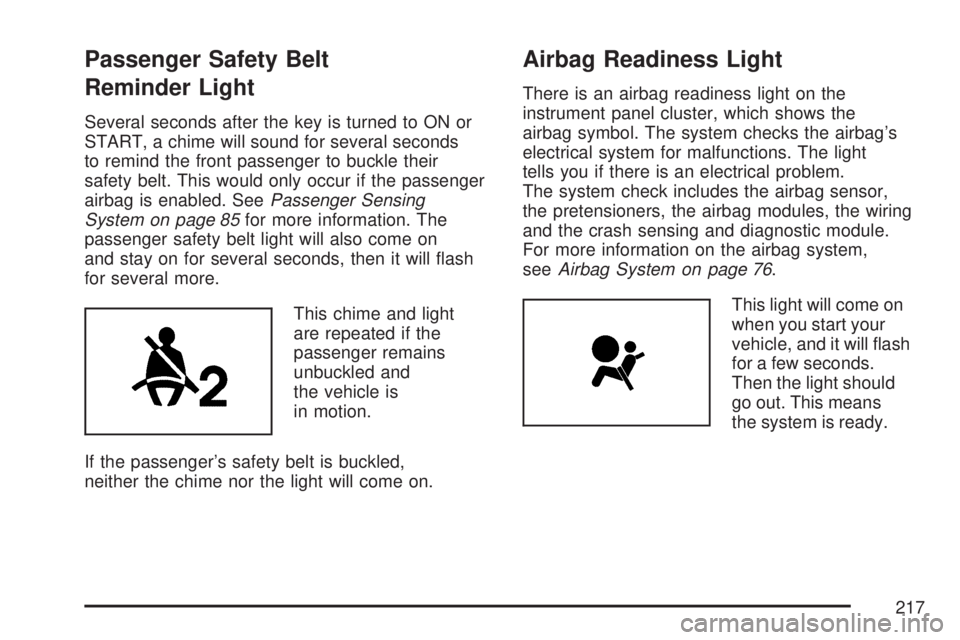
Several seconds after the key is turned to ON or
START, a chime will sound for several seconds
to remind the front passenger to buckle their
safety belt. This would only occur if the passenger
airbag is enabled. SeePassenger Sensing
System on page 85for more information. The
passenger safety belt light will also come on
and stay on for several seconds, then it will ash
for several more.
This chime and light
are repeated if the
passenger remains
unbuckled and
the vehicle is
in motion.
If the passenger’s safety belt is buckled,
neither the chime nor the light will come on.
Airbag Readiness Light
There is an airbag readiness light on the
instrument panel cluster, which shows the
airbag symbol. The system checks the airbag’s
electrical system for malfunctions. The light
tells you if there is an electrical problem.
The system check includes the airbag sensor,
the pretensioners, the airbag modules, the wiring
and the crash sensing and diagnostic module.
For more information on the airbag system,
seeAirbag System on page 76.
This light will come on
when you start your
vehicle, and it will ash
for a few seconds.
Then the light should
go out. This means
the system is ready.
217
Page 220 of 554

If, after several seconds, both status indicator
lights remain on, or if there are no lights at
all, there may be a problem with the lights
or the passenger sensing system. See your
dealer/retailer for service.
{CAUTION:
If the airbag readiness light in the
instrument panel cluster ever comes on
and stays on, it means that something may
be wrong with the airbag system. If this
ever happens, have the vehicle serviced
promptly, because an adult-size person
sitting in the right front passenger’s
seat may not have the protection of the
airbag(s). SeeAirbag Readiness Light
on page 217for more on this, including
important safety information.
Charging System Light
The charging system
light will come on briey
when you turn on the
ignition, but the engine is
not running, as a check
to show you it is working.
It should go out once the engine is running. If it
stays on, or comes on while you are driving, you
may have a problem with the charging system.
It could indicate that you have problems with a
generator drive belt, or another electrical problem.
Have it checked right away. Driving while this light
is on could drain your battery.
When this light comes on, the Driver Information
Center (DIC) will also display the SERVICE
BATTERY CHARGING SYSTEM message. See
DIC Warnings and Messages on page 244for more
information.
If you must drive a short distance with the light on,
be certain to turn off all your accessories, such as
the radio and air conditioner.
220
Page 330 of 554
Your Driving, the Road, and
Your Vehicle
Defensive Driving
The best advice anyone can give about driving
is: Drive defensively.
Please start with a very important safety device in
your vehicle: Buckle up. SeeSafety Belts: They
Are for Everyone on page 24.
{CAUTION:
Defensive driving really means “Be ready
for anything.” On city streets, rural roads,
or expressways, it means “Always expect
the unexpected.” Assume that pedestrians
or other drivers are going to be careless
and make mistakes. Anticipate what they
might do and be ready. Rear-end collisions
are about the most preventable of
accidents. Yet they are common. Allow
enough following distance. Defensive
driving requires that a driver concentrate
on the driving task. Anything that distracts
from the driving task makes proper
defensive driving more difficult and can
even cause a collision, with resulting
injury. Ask a passenger to help do these
things, or pull off the road in a safe place to
do them. These simple defensive driving
techniques could save your life.
330