2007 GMC ACADIA belt
[x] Cancel search: beltPage 506 of 554
Maintenance Footnotes
(a)Visually inspect brake lines and hoses for
proper hook-up, binding, leaks, cracks, chafing,
etc. Inspect disc brake pads for wear and rotors for
surface condition. Inspect other brake parts,
including calipers, parking brake, etc. Check
parking brake adjustment.
(b)Visually inspect front and rear suspension and
steering system for damaged, loose, or missing
parts or signs of wear. Inspect power steering lines
and hoses for proper hook-up, binding, leaks,
cracks, chafing, etc.
(c)Visually inspect hoses and have them replaced
if they are cracked, swollen, or deteriorated.
Inspect all pipes, fittings and clamps; replace with
genuine parts as needed. To help ensure
proper operation, a pressure test of the cooling
system and pressure cap and cleaning the outside
of the radiator and air conditioning condenser is
recommended at least once a year.(d)Inspect wiper blades for wear, cracking, or
contamination. Clean the windshield and
wiper blades, if contaminated. Replace wiper
blades that are worn or damaged. See Windshield
Wiper Blade Replacement on page 434and
Windshield, Backglass, and Wiper Blades on
page 484for more information.
(e)Make sure the safety belt reminder light and all
belts, buckles, latch plates, retractors, and
anchorages are working properly. Look for any
other loose or damaged safety belt system parts.
If you see anything that might keep a safety
belt system from doing its job, have it repaired.
Have any torn or frayed safety belts replaced. Also
look for any opened or broken airbag coverings,
and have them repaired or replaced. The airbag
system does not need regular maintenance.
(f)Lubricate all key lock cylinders, hood latch
assemblies, secondary latches, pivots, spring
anchor and release pawl, hood and door hinges,
rear folding seats, and liftgate hinges. More
frequent lubrication may be required when
exposed to a corrosive environment. Applying
silicone grease on weatherstrips with a clean cloth
will make them last longer, seal better, and not
stick or squeak.
506
Page 507 of 554
(g)A fluid loss in any vehicle system could
indicate a problem. Have the system inspected
and repaired and the fluid level checked. Add fluid
if needed.
(h)Change automatic transmission fluid if the
vehicle is mainly driven under one or more
of these conditions:
In heavy city traffic where the outside
temperature regularly reaches 90°F
(32°C) or higher.
In hilly or mountainous terrain.
When doing frequent trailer towing.
Uses such as found in taxi, police, or
delivery service.
(i)Drain, flush, and refill cooling system.
This service can be complex; you should have
your dealer/retailer perform this service. See
Engine Coolant on page 406 for what to use.
Inspect hoses. Clean radiator, condenser, pressure
cap, and filler neck. Pressure test the cooling
system and pressure cap.(j)Check system for interference or binding and
for damaged or missing parts. Replace parts
as needed. Replace any components that have
high effort or excessive wear. Do not lubricate
accelerator or cruise control cables.
(k)Visually inspect belt for fraying, excessive
cracks, or obvious damage. Replace belt if
necessary.
(l)If you drive regularly under dusty conditions,
inspect the filter at each engine oil change.
Owner Checks and Services
These owner checks and services should be
performed at the intervals specied to help ensure
the safety, dependability, and emission control
performance of your vehicle. Your dealer/retailer
can assist you with these checks and services.
Be sure any necessary repairs are completed
at once. Whenever any uids or lubricants are
added to your vehicle, make sure they are
the proper ones, as shown inRecommended
Fluids and Lubricants on page 511.
507
Page 513 of 554

Engine Drive Belt Routing
3.6L V6 Engine
513
Page 537 of 554

Event Data Recorders
Some information about your vehicle’s
performance and how it is driven may be recorded
on various modules if a crash occurs. Some
people refer to these modules asevent data
recorders (EDRs). These modules may record
several seconds of pre-crash and crash data, such
as data related toengine speed, brake
application, throttle position, vehicle speed,
yaw rate, steering wheel angle, lateral
acceleration, safety belt usage, airbag
readiness, airbag performanceandthe severity
of the collision.Unlike the ight data recorders
on airplanes, these modules do not record sounds
or conversations.To retrieve this data, special equipment and
access to the vehicle or the module that stores
the data are required. Certain data may also
be sent to or retrieved by OnStar®(see below).
GM will not access this information or share it with
others except: with the consent of the vehicle
owner or, if the vehicle is leased, with the consent
of the lessee; in response to an official request
of police or similar government office; as part
of GM’s defense of litigation through the discovery
process; or, as required by law. Data that GM
collects or receives may also be used for
GM research needs or may be made available to
others for research purposes, where a need is
shown and the data is not tied to a specic vehicle
or vehicle owner.
Others may be able to retrieve this data if they
have access to the vehicle and have the special
equipment necessary to download the data.
537
Page 539 of 554
A
Accessories and Modications..................... 385
Adding Equipment to Your
Airbag-Equipped Vehicle............................ 91
Additives, Fuel............................................ 389
Add-On Electrical Equipment....................... 489
Air Cleaner/Filter, Engine............................. 402
Air Conditioning..................................199, 203
Airbag
Passenger Status Indicator....................... 218
Readiness Light....................................... 217
Airbag System............................................... 76
What Will You See After an
Airbag Inates?...................................... 84
When Should an Airbag Inate?................. 81
Where Are the Airbags?............................. 79
Airbag Systems
Adding Equipment to Your
Airbag-Equipped Vehicle......................... 91
How Does an Airbag Restrain?.................. 83
Passenger Sensing System....................... 85
Servicing Your Airbag-Equipped Vehicle..... 90
What Makes an Airbag Inate?.................. 83All-Wheel Drive........................................... 430
All-Wheel-Drive (AWD) System.................... 339
Anti-Lock Brake System.............................. 335
Anti-Lock Brake, System Warning Light....... 223
Appearance Care
Aluminum or Chrome-Plated Wheels........ 484
Care of Safety Belts................................ 482
Chemical Paint Spotting........................... 486
Cleaning Exterior Lamps/Lenses.............. 483
Cleaning the Inside of Your Vehicle.......... 478
Fabric/Carpet........................................... 480
Finish Care.............................................. 483
Finish Damage......................................... 486
Instrument Panel, Vinyl, and
Other Plastic Surfaces.......................... 481
Leather.................................................... 481
Sheet Metal Damage............................... 486
Tires........................................................ 485
Underbody Maintenance........................... 486
Vehicle Care/Appearance Materials.......... 487
Washing Your Vehicle.............................. 482
Weatherstrips........................................... 482
Windshield, Backglass,
and Wiper Blades................................. 484
539
Page 541 of 554

C
Calibration................................................... 140
California Fuel............................................. 388
California Proposition 65 Warning................ 386
Canadian Owners........................................... 3
Capacities and Specications...................... 497
Carbon Monoxide..............110, 138, 356, 371
Care of
Safety Belts............................................. 482
Your CD and DVD Player........................ 328
Your CDs and DVDs................................ 328
Cargo Cover............................................... 163
Cargo Management System........................ 164
Cargo Tie Downs........................................ 163
CD, MP3 ............................................295, 301
Center Console Storage Area...................... 161
Chains, Tire................................................. 456
Charging System Light................................ 220
Check
Engine Light............................................ 226
Checking Things Under the Hood................ 394
Chemical Paint Spotting.............................. 486Child Restraints
Child Restraint Systems............................. 55
Infants and Young Children........................ 51
Lower Anchors and Tethers for Children..... 61
Older Children........................................... 48
Securing a Child Restraint in a
Rear Seat Position ................................. 69
Securing a Child Restraint in the
Right Front Seat Position........................ 72
Where to Put the Restraint........................ 60
Cleaning
Aluminum or Chrome-Plated Wheels........ 484
Exterior Lamps/Lenses............................. 483
Fabric/Carpet........................................... 480
Finish Care.............................................. 483
Inside of Your Vehicle.............................. 478
Instrument Panel, Vinyl,
and Other Plastic Surfaces................... 481
Leather.................................................... 481
Tires........................................................ 485
Underbody Maintenance........................... 486
Washing Your Vehicle.............................. 482
Weatherstrips........................................... 482
Windshield, Backglass,
and Wiper Blades................................. 484
541
Page 542 of 554
Climate Control System............................... 199
Dual Automatic......................................... 203
Outlet Adjustment..................................... 210
Rear Air Conditioning and
Heating System.................................... 211
Rear Air Conditioning and
Heating System, Electronic................... 212
Clock.......................................................... 266
Collision Damage Repair............................. 530
Comfort Guides, Rear Safety Belt................. 43
Compact Spare Tire.................................... 477
Compass..................................................... 140
Content Theft-Deterrent............................... 118
Control of a Vehicle..................................... 334
Convenience Net......................................... 163
Coolant
Engine Temperature Gage........................ 225
Engine Temperature Warning Light........... 224
Heater, Engine......................................... 127
Cooling System........................................... 413Courtesy Lamps.......................................... 186
Cruise Control............................................. 180
Cruise Control Light.................................... 230
Cupholder(s)................................................ 161
Customer Assistance Information
Courtesy Transportation........................... 527
Customer Assistance for
Text Telephone (TTY) Users................. 522
Customer Assistance Offices.................... 522
Customer Satisfaction Procedure.............. 518
GM Mobility Reimbursement Program...... 523
Reporting Safety Defects to
General Motors..................................... 534
Reporting Safety Defects to the
Canadian Government.......................... 534
Reporting Safety Defects to the
United States Government.................... 533
Roadside Assistance Program.................. 524
Service Publications
Ordering Information............................. 535
542
Page 543 of 554
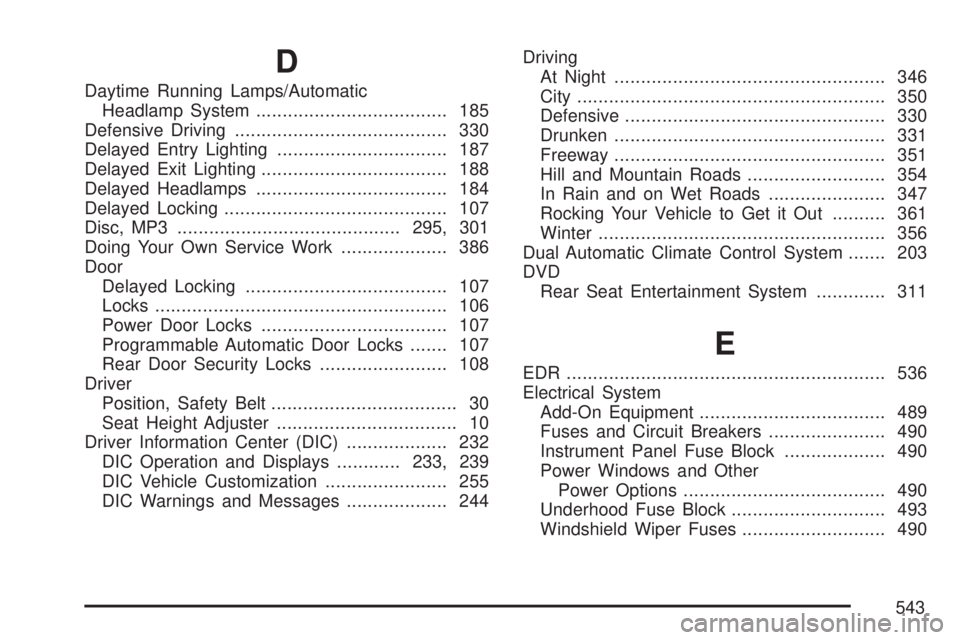
D
Daytime Running Lamps/Automatic
Headlamp System.................................... 185
Defensive Driving........................................ 330
Delayed Entry Lighting................................ 187
Delayed Exit Lighting................................... 188
Delayed Headlamps.................................... 184
Delayed Locking.......................................... 107
Disc, MP3..........................................295, 301
Doing Your Own Service Work.................... 386
Door
Delayed Locking...................................... 107
Locks....................................................... 106
Power Door Locks................................... 107
Programmable Automatic Door Locks....... 107
Rear Door Security Locks........................ 108
Driver
Position, Safety Belt................................... 30
Seat Height Adjuster.................................. 10
Driver Information Center (DIC)................... 232
DIC Operation and Displays............233, 239
DIC Vehicle Customization....................... 255
DIC Warnings and Messages................... 244Driving
At Night................................................... 346
City.......................................................... 350
Defensive................................................. 330
Drunken................................................... 331
Freeway................................................... 351
Hill and Mountain Roads.......................... 354
In Rain and on Wet Roads...................... 347
Rocking Your Vehicle to Get it Out.......... 361
Winter...................................................... 356
Dual Automatic Climate Control System....... 203
DVD
Rear Seat Entertainment System............. 311
E
EDR ............................................................ 536
Electrical System
Add-On Equipment................................... 489
Fuses and Circuit Breakers...................... 490
Instrument Panel Fuse Block................... 490
Power Windows and Other
Power Options...................................... 490
Underhood Fuse Block............................. 493
Windshield Wiper Fuses........................... 490
543