Page 251 of 464
This feature may be enabled using the following proce-
dure:
•Press and hold the Heated Rear Window and Auto HI
buttons for 5 seconds.
•The “DELAY” symbol will flash to indicate that the
feature as been enabled.
Power Button
This button turns the entire system ON/OFF. When the
system is turned on it will return to the previous settings.
Dual/Single Zone Operation
When�DUAL�is displayed in the ATC control unit, the
driver and passenger air outlet temperatures can be
individually adjusted from the two independent�TEMP�
buttons. When a front seat passenger is not present,
pressing the�DUAL�button will match the passenger’s
temperature setting to the driver’s temperature setting.
This will help equalize air outlet temperatures across theleft and right side of the instrument panel. The outside
temperature will replace the passenger’s temperature
setting in the display. Pressing the�DUAL�button a
second time or adjusting the passenger’s�TEMP�button
will return the system to dual independent temperature
operation.
Manual Operation
This system offers a full complement of manual override
features. The indicator light in both the�AUTO HI�or
�AUTO LO�buttons will turn off when the system is
being used in the manual mode. The fan speed, airflow
distribution, and outside air/recirculated air can be
manually adjusted.
NOTE:Each of these features operate independently
from each other. If any one feature is controlled manually,
the remaining features will continue to operate automati-
cally.
UNDERSTANDING YOUR INSTRUMENT PANEL 251
4
Page 253 of 464
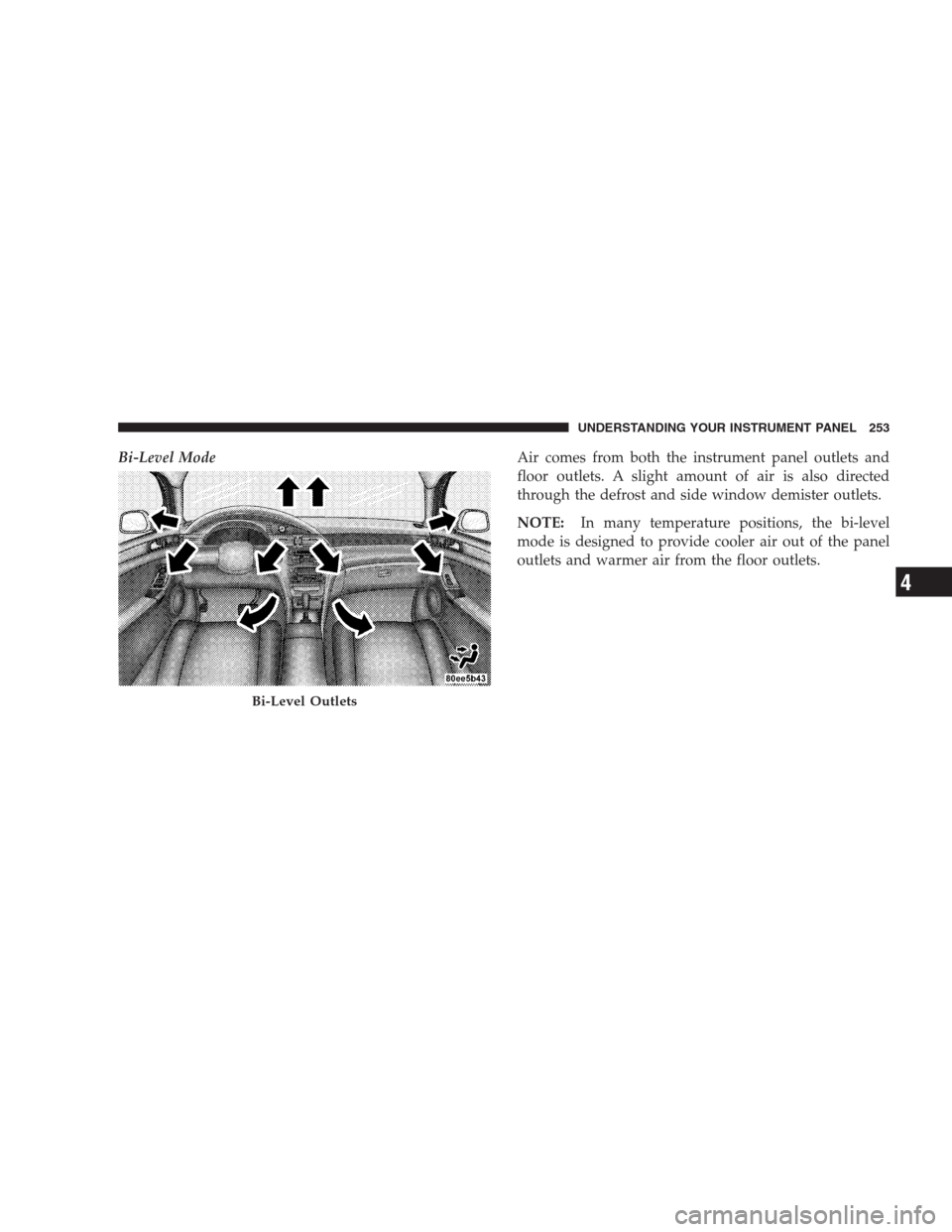
Bi-Level ModeAir comes from both the instrument panel outlets and
floor outlets. A slight amount of air is also directed
through the defrost and side window demister outlets.
NOTE:In many temperature positions, the bi-level
mode is designed to provide cooler air out of the panel
outlets and warmer air from the floor outlets.
Bi-Level Outlets
UNDERSTANDING YOUR INSTRUMENT PANEL 253
4
Page 254 of 464
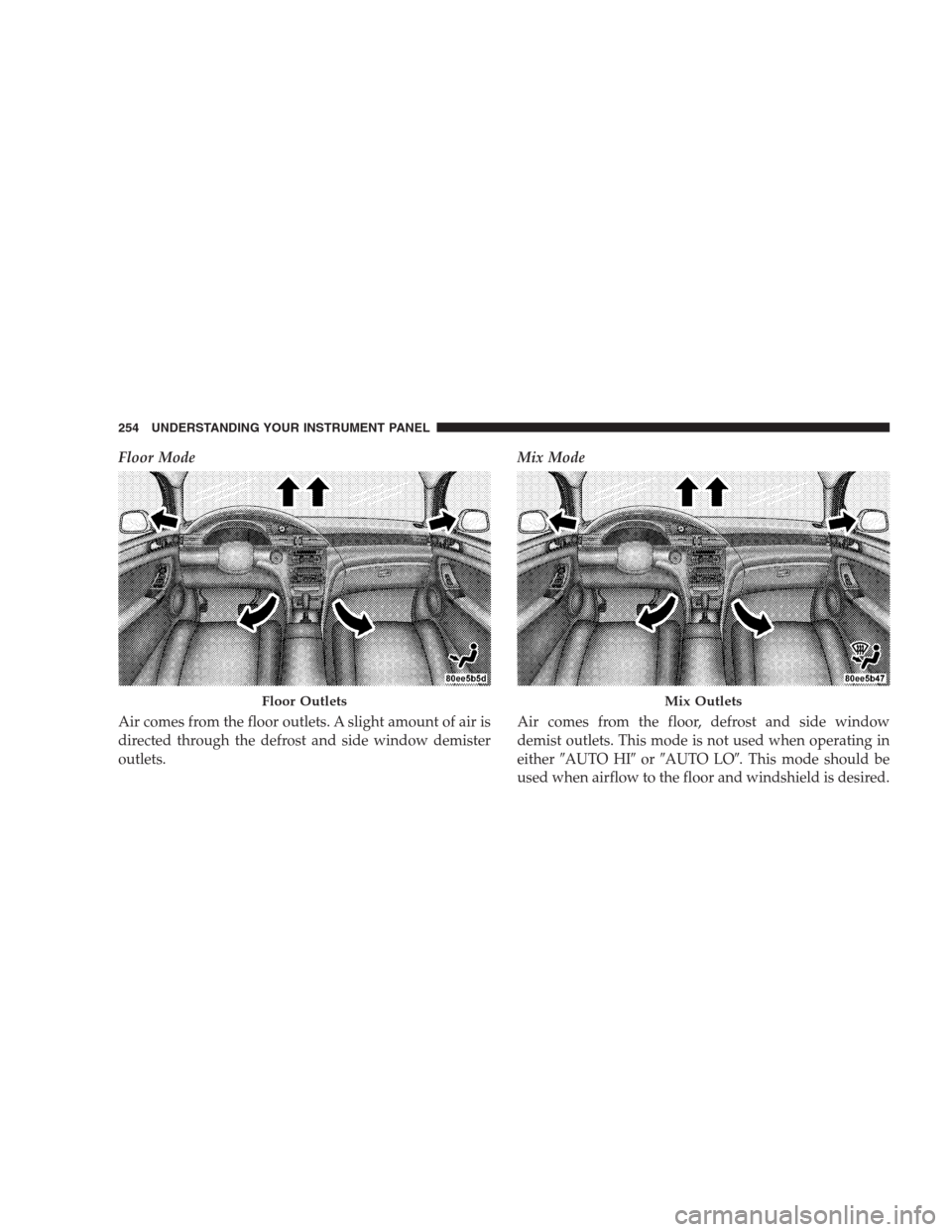
Floor Mode
Air comes from the floor outlets. A slight amount of air is
directed through the defrost and side window demister
outlets.Mix Mode
Air comes from the floor, defrost and side window
demist outlets. This mode is not used when operating in
either�AUTO HI�or�AUTO LO�. This mode should be
used when airflow to the floor and windshield is desired.
Floor OutletsMix Outlets
254 UNDERSTANDING YOUR INSTRUMENT PANEL
Page 259 of 464
A/C Air Filter — If Equipped
On vehicles equipped with Automatic Temperature Con-
trol (ATC), the climate control system filters out dust and
pollen from the air. Refer to section 7 “Air Conditioning”
for filter replacement instructions.
Outside Temperature Display
The outside temperature can be shown in the ATC
display by pressing the�OUTSIDE TEMP�button. After
pressing this button, the front seat passenger’s tempera-
ture setting display will be replaced with the current
outside temperature. Press the�OUTSIDE TEMP�button
again or press the passenger’s�TEMP�button to return
the display to the passenger’s temperature setting.
Electric Rear Window Defroster
Press this button to turn on the rear window
defroster and the heated side mirrors. A light inthe button will illuminate to indicate the rear window
defroster is ON. The defroster automatically turns off
after about 10 minutes of operation.
CAUTION!
To avoid damaging the electrical conductors of the
rear window defroster, do not use scrapers, sharp
instruments, or abrasive window cleaners on the
interior surface of the window.
Labels can be peeled off after soaking with warm
water.
UNDERSTANDING YOUR INSTRUMENT PANEL 259
4
Page 262 of 464
�Parking Brake.........................276
�Brake System..........................278
▫Anti-Lock Brake System................279
�Electronic Stability Program (ESP)...........281
▫ESP Has The Following Operating Modes....283
▫ESP/BAS Warning Lamp And
ESP/TCS Indicator Light................283
▫Brake Assist System (BAS)...............284
�Traction Control........................285
�Power Steering........................286
�Driving On Slippery Surfaces..............287
▫Acceleration.........................287
▫Traction............................288�Tire Safety Information...................288
▫Tire Markings........................288
▫Tire Identification Number (TIN)..........292
▫Tire Loading And Tire Pressure...........293
�Tires — General Information...............297
▫Tire Pressure.........................297
▫Tire Inflation Pressures.................298
▫Radial-Ply Tires......................300
▫Compact Spare Tire — If Equipped.........301
▫Limited Use Spare — If Equipped.........302
▫Tire Spinning........................302
▫Tread Wear Indicators..................303
▫Life Of Tire.........................304
262 STARTING AND OPERATING
Page 267 of 464
Automatic Transmission
The gear selector must be in the NEUTRAL or PARK
position before you can start the engine. Depress the
brake pedal before shifting into any driving gear.
Normal Starting (Above 32°F / 0°C)
1. Do not depress the accelerator.
2. Turn and hold the ignition key in the START position
and release when engine starts.
3. If engine does not start after 3 seconds, depress the
accelerator lightly (while still cranking the engine).
4. If engine does not start after 15 seconds, turn the
ignition key off.
5. Wait 10 to 15 seconds, and repeat steps 1 — 5 shown
above.NOTE: This vehicle is equipped with a transmission
shift interlocking system. The brake pedal must be
depressed to shift out of Park (P).
Extremely Cold Weather Starting (Below�20°F /
–29°C)
Follow the same instructions in the “Normal Starting
Process” as shown above.
To insure reliable starting at these temperatures, use of an
externally powered electric engine block heater (available
from your dealer) is recommended.
High Altitude Starting (Above 4,000 ft. / 1 219 m)
Follow the same instructions in the “Normal Starting
Process” as shown above.
To insure reliable starting at these temperatures, use of an
externally powered electric engine block heater (available
from your dealer) is recommended.
STARTING AND OPERATING 267
5
Page 276 of 464
•If the system detects a problem it will disable the
AutoStick mode and the transmission will return to
the automatic mode until the problem is corrected.
ALL WHEEL DRIVE — IF EQUIPPED
This feature provides full time, on-demand, All Wheel
Drive (AWD). The system is automatic with no driver
inputs or additional driving skills required. Under nor-
mal driving conditions, the front wheels provide most of
the traction. If the front wheels begin to lose traction,
power is shifted automatically to the rear wheels. The
greater the front wheel traction loss, the greater the
power transfer to the rear wheels.
CAUTION!
All wheels must have the same size and type tires.
Unequal tire sizes must not be used. Unequal tire
size may cause failure of the power transfer unit.
PARKING BRAKE
When the parking brake is applied with the ignition
switch on, the brake light in the instrument cluster will
turn on.
NOTE:This light only shows that the parking brake is
applied. It does not show the degree of brake application.
276 STARTING AND OPERATING
Page 280 of 464
The ABS light monitors the Anti-Lock Brake
System. The light will come on when the
ignition switch is turned to the ON position
and may stay on for as long as four seconds.
If the ABS light remains on or comes on while driving, it
indicates that the Anti-Lock portion of the brake system
is not functioning and that service is required. However,
the conventional brake system will continue to operate
normally if the BRAKE warning light is not on.
If the ABS light is on, the brake system should be serviced
as soon as possible to restore the benefits of Anti-Lock
brakes. If the ABS light does not come on when the
Ignition switch is turned to the ON position, have the
bulb repaired as soon as possible.
If both the Brake Warning Light and the ABS Light
remain on, the Anti-Lock brakes (ABS) and Electronic
Brake Force Distribution (EBD) systems are not function-
ing. Immediate repair to the ABS system is required.When the vehicle is driven over 7 mph (11 km/h), you
may also hear a slight clicking sound as well as some
related motor noises. These noises are the system per-
forming its self check cycle to ensure that the ABS system
is working properly. This self check occurs each time the
vehicle is started and accelerated past 7 mph (11 km/h).
ABS is activated during braking under certain road or
stopping conditions. ABS-inducing conditions can in-
clude ice, snow, gravel, bumps, railroad tracks, loose
debris, or panic stops.
You also may experience the following when the brake
system goes into Anti-lock:
•The ABS motor running (it may continue to run for a
short time after the stop),
•the clicking sound of solenoid valves,
•brake pedal pulsations,
280 STARTING AND OPERATING