Page 315 of 464

NOTE:A low spare tire will not cause the Tire Pressure
Monitoring System Telltale Lamp to illuminate or the
chime to sound.
Should a low tire condition occur on any of the four
active road tire(s), you should stop as soon as possible,
and inflate the low tire(s) that is/are flashing on the
graphic display to the vehicle’s recommended cold plac-
ard pressure value. The system will automatically up-
date, the graphic display of the pressure value(s) will
stop flashing, and the Tire Pressure Monitoring System
Lamp will extinguish once the updated tire pressure(s)
have been received.
NOTE:The vehicle may need to be driven for up to 10
minuets above 15 mph (25 km/h) to receive this infor-
mation.Service Tire System Soon
The Tire Pressure Monitoring Telltale Lamp will flash on
and off for 60 seconds in the instrument cluster, and an
audible chime when a system fault is detected. The flash
cycle will repeat every 10 minutes, without an audible
chime, until the fault condition not longer exists.
In addition the Electronic Vehicle Information Center
(EVIC) will display a“SERVICE TIRE SYSTEM SOON”
text message for 3 seconds. This text message is then
followed by “— —”, for the pressure value indicating
which of the Tire Pressure Monitoring Sensor(s) is not
being received.
If the ignition key is cycled, this sequence will repeat,
providing the system fault still exists. Iff the system fault
no longer exists, the Tire Pressure Monitoring System
Telltale Lamp will no longer flash, the“SERVICE TIRE
SYSTEM SOON”text message will no longer display,
and a pressure value will be displayed instead of dashes.
STARTING AND OPERATING 315
5
Page 316 of 464

NOTE:Your vehicle is equipped with a compact spare
wheel and tire assembly that does not have a tire pressure
monitoring sensor. Therefore, it will not be monitored by
the Tire Pressure Monitoring System. In the event that a
compact spare tire is used to replace a low pressure road
tire, the next ignition key cycle will still show the Tire
Pressure Monitoring Lamp to be ON, a Chime will
sound, and the Electronic Vehicle Information Center
(EVIC) will still show the low tire pressure value flashing
on the graphic display. This sequence will repeat for
every key cycle until the original Tire Pressure Monitor-
ing System (TPMS) tire has been properly repaired (or
replaced) and put back on the vehicle in place of the
compact spare tire.CAUTION!
The Tire Pressure Monitoring System (TPMS) has
been optimized for the original equipment tires and
wheels. TPMS pressures have been established for
the tire size equipped on your vehicle. Undesirable
system operation or sensor damage may result when
using replacement equipment that is not of the same
size, type, and/or style. After-market wheels can
cause sensor damage. Do not use tire sealant from a
can, or balance beads if your vehicle is equipped
with a TPMS, as damage to the sensors may result.
316 STARTING AND OPERATING
Page 320 of 464
Materials Added to Fuel
All gasoline sold in the United States is required to
contain effective detergent additives. Use of additional
detergents or other additives are not needed under
normal conditions and would result in additional cost.
Therefore you should not have to add anything to the
fuel.
Fuel System Cautions
CAUTION!
Follow these guidelines to maintain your vehicle’s
performance:
•The use of leaded gas is prohibited by Federal law.
Using leaded gasoline can impair engine performance,
damage the emission control system.
•An out-of-tune engine, or certain fuel or ignition
malfunctions, can cause the catalytic converter to
overheat. If you notice a pungent burning odor or
some light smoke, your engine may be out of tune or
malfunctioning and may require immediate service.
Contact your dealer for service assistance.
•The use of fuel additives which are now being sold as
octane enhancers is not recommended. Most of these
products contain high concentrations of methanol.
Fuel system damage or vehicle performance problems
resulting from the use of such fuels or additives is not
the responsibility of the manufacturer.
NOTE:Intentional tampering with emissions control
systems can result in civil penalties being assessed
against you.
320 STARTING AND OPERATING
Page 343 of 464
WHAT TO DO IN EMERGENCIES
CONTENTS
�Hazard Warning Flasher..................344
�If Your Engine Overheats.................345
�Jacking And Tire Changing................346
▫Jack Location........................346
▫Spare Tire Stowage....................348
▫Preparations For Jacking................349
▫Jacking Instructions....................350
�Jump-Starting Procedure..................354�Freeing A Stuck Vehicle..................356
�Towing A Disabled Vehicle................357
▫With Ignition Key.....................357
▫Without The Ignition Key...............358
▫Towing This Vehicle Behind Another Vehicle
(Flat Towing With All Four Wheels On The
Ground)............................358
▫Towing This Vehicle Behind Another Vehicle
With A Tow Dolly.....................359
6
Page 344 of 464
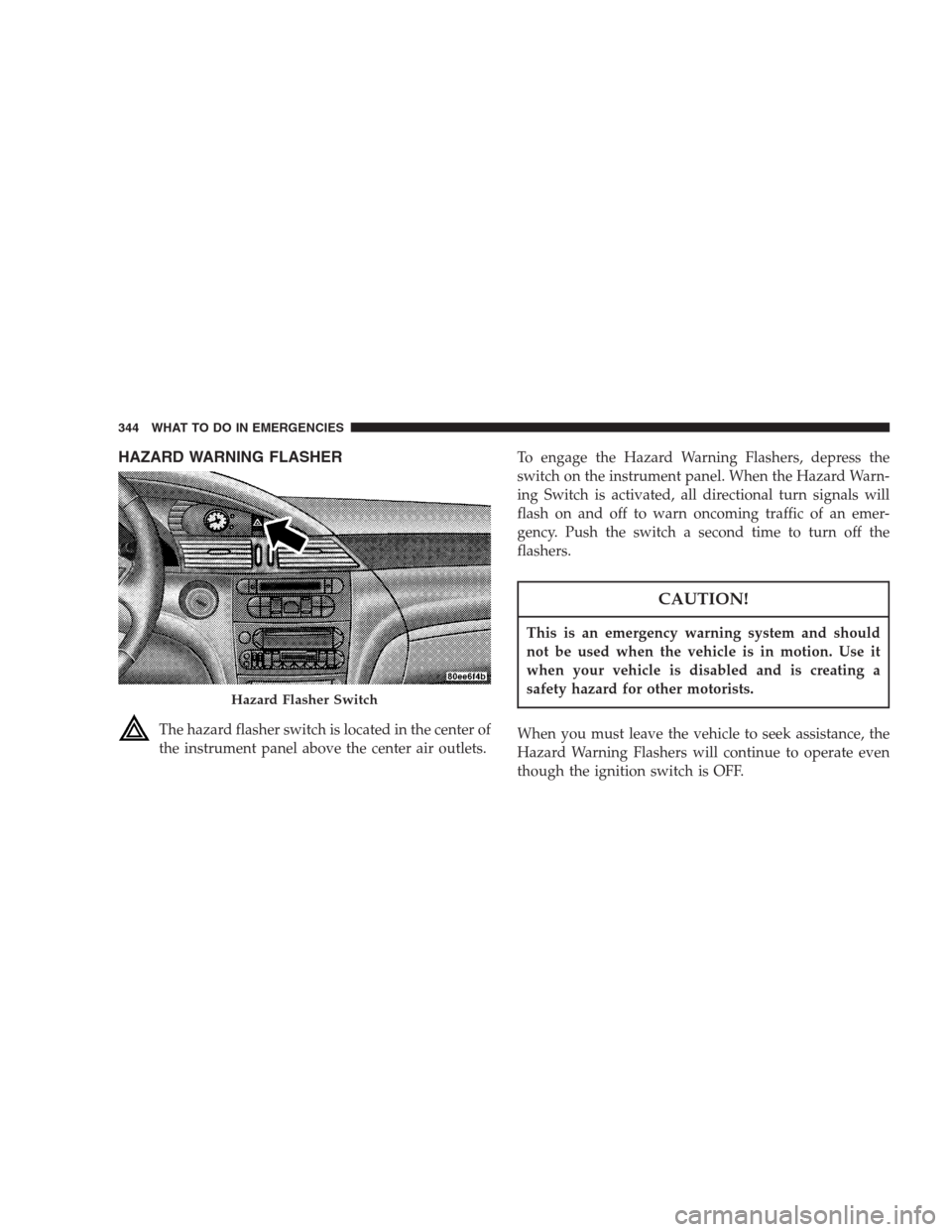
HAZARD WARNING FLASHER
The hazard flasher switch is located in the center of
the instrument panel above the center air outlets.To engage the Hazard Warning Flashers, depress the
switch on the instrument panel. When the Hazard Warn-
ing Switch is activated, all directional turn signals will
flash on and off to warn oncoming traffic of an emer-
gency. Push the switch a second time to turn off the
flashers.
CAUTION!
This is an emergency warning system and should
not be used when the vehicle is in motion. Use it
when your vehicle is disabled and is creating a
safety hazard for other motorists.
When you must leave the vehicle to seek assistance, the
Hazard Warning Flashers will continue to operate even
though the ignition switch is OFF.
Hazard Flasher Switch
344 WHAT TO DO IN EMERGENCIES
Page 349 of 464
CAUTION!
The winch mechanism is designed for use with the
jack handle only. Use of an air wrench or other
power tools is not recommended and can damage the
winch.
When the spare is clear, tilt the retainer at the end of the
cable and pull it through the center of the wheel.
Preparations For Jacking
Park the vehicle on a firm level surface, avoid ice or
slippery areas,set the parking brakeand place the gear
selector in PARK. Turn OFF the ignition.
WARNING!
Do not attempt to change a tire on the side of the
vehicle close to moving traffic. Pull far enough off
the road to avoid the danger of being hit when
operating the jack or changing the wheel.
•Turn on the Hazard Warning Flasher.
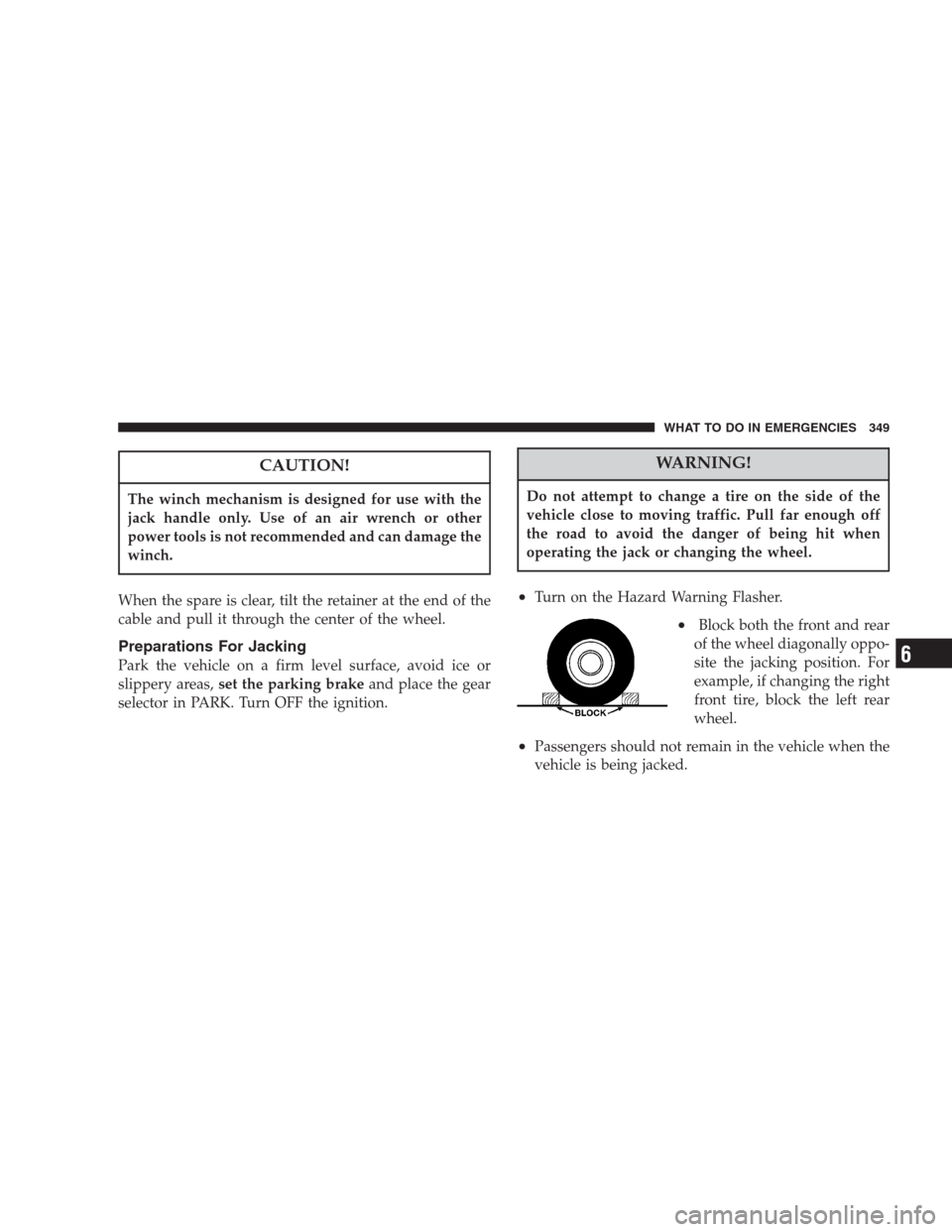
•Block both the front and rear
of the wheel diagonally oppo-
site the jacking position. For
example, if changing the right
front tire, block the left rear
wheel.
•Passengers should not remain in the vehicle when the
vehicle is being jacked.
WHAT TO DO IN EMERGENCIES 349
6
Page 354 of 464

NOTE:When reinstalling the wheel center cap, insure
that the valve stem symbol on the back of the cap is
pointed toward the wheel valve stem. Install the center
cap using hand pressure only. Do not use a hammer.
Wheel Nuts
All wheel nuts should be tightened occasionally to elimi-
nate the possibility of wheel studs being sheared or the
bolt holes in the wheels becoming elongated. This is
especially important during the first few hundred miles
of operation, and after each time a tire is changed, to
allow the wheel nuts to become properly set. All nuts
should first be firmly seated against the wheel. The nuts
should then be tightened to recommended torque.
Tighten the nuts to final torque in increments. Progress
around the bolt circle, tightening the nut opposite to the
nut just previously tightened until final torque is
achieved. Recommended torque is 130 N·m (95 ft. lbs).
JUMP-STARTING PROCEDURE
WARNING!
•Do not attempt to push or tow your vehicle to get it started.
Vehicles equipped with an automatic transmission cannot be
started this way. Unburned fuel could enter the catalytic
converter and once the engine has started, ignite and damage
the converter and vehicle. If the vehicle has a discharged
battery, booster cables may be used to obtain a start from
another vehicle. This type of start can be dangerous if done
improperly, so follow this procedure carefully.
•Battery fluid is a corrosive acid solution; do not allow battery
fluid to contact eyes, skin or clothing. Don’t lean over battery
when attaching clamps or allow the clamps to touch each other.
If acid splashes in eyes or on skin, flush contaminated area
immediately with large quantities of water.
•A battery generates hydrogen gas which is flammable and
explosive. Keep flame or spark away from the vent holes. Do
not use a booster battery or any other booster source with an
output that exceeds 12 volts.
•Take care to avoid the radiator cooling fan whenever the hood
is raised. It can start anytime the ignition switch is on. You can
be hurt by the fan.
354 WHAT TO DO IN EMERGENCIES
Page 355 of 464
Check the Battery Test Indicator (if equipped). If a light or
bright colored dot is visible in the indicator (if equipped),
DO NOT jump-start the battery.
If the indicator (if equipped) is dark or shows a green dot,
proceed as follows:
1. Wear eye protection and remove any metal jewelry
such as watch bands or bracelets that might make an
inadvertent electrical contact.
2. When boost is provided by a battery in another
vehicle, park that vehicle within booster cable reach and
without letting the vehicles touch. Set the parking brake,
place the automatic transmission in PARK and turn the
ignition switch to the OFF position for both vehicles.
3. Turn off the heater, radio and all unnecessary electrical
loads.4. Connect one end of a jumper cable to the positive
terminal of the discharged battery. Connect the other end
of the same cable to the positive terminal of the booster
battery.
WARNING!
Do not permit vehicles to touch each other as this
could establish a ground connection and personal
injury could result.
5. Connect the other cable, first to the negative terminal
of the booster battery andthen to the engine of the
vehicle with the discharged battery.Make sure you have
a good contact on the engine.
WHAT TO DO IN EMERGENCIES 355
6