2007 CHEVROLET TRAIL BLAZER warning
[x] Cancel search: warningPage 474 of 574
If a Tire Goes Flat
It is unusual for a tire to blowout while you are
driving, especially if you maintain your vehicle’s
tires properly. If air goes out of a tire, it is
much more likely to leak out slowly. But if you
should ever have a blowout, here are a few tips
about what to expect and what to do:
If a front tire fails, the at tire will create a drag
that pulls the vehicle toward that side. Take your
foot off the accelerator pedal and grip the
steering wheel rmly. Steer to maintain lane
position, and then gently brake to a stop well out
of the traffic lane.
A rear blowout, particularly on a curve, acts much
like a skid and may require the same correction
you would use in a skid. In any rear blowout
remove your foot from the accelerator pedal.
Get the vehicle under control by steering the
way you want the vehicle to go. It may be very
bumpy and noisy, but you can still steer. Gently
brake to a stop, well off the road if possible.{CAUTION:
Lifting a vehicle and getting under it to do
maintenance or repairs is dangerous
without the appropriate safety equipment
and training. The jack provided with your
vehicle is designed only for changing a
at tire. If it is used for anything else, you
or others could be badly injured or killed
if the vehicle slips off the jack. Use the
jack provided with your vehicle only for
changing a at tire.
If a tire goes at, the next part shows how to use
the jacking equipment to change a at tire safely.
Changing a Flat Tire
If a tire goes at, avoid further tire and wheel
damage by driving slowly to a level place. Turn on
your hazard warning ashers. SeeHazard Warning
Flashers on page 172for more information.
474
Page 519 of 574
When you go to your GM Goodwrench®dealer for
your service needs, you will know that GM-trained
and supported service technicians will perform
the work using genuine GM parts.
If you want to purchase service information, see
Service Publications Ordering Information on
page 554.
Owner Checks and Services on page 525tells you
what should be checked, when to check it, and
what you can easily do to help keep your vehicle in
good condition.
The proper replacement parts, uids, and
lubricants to use are listed inRecommended
Fluids and Lubricants on page 529andNormal
Maintenance Replacement Parts on page 532.
When your vehicle is serviced, make sure these
are used. All parts should be replaced and all
necessary repairs done before you or anyone else
drives the vehicle. We recommend the use of
genuine GM parts.Scheduled Maintenance
When the change engine oil light or CHANGE
ENGINE OIL DIC message comes on, it means
that service is required for your vehicle. See
Change Engine Oil Light on page 216orDIC
Warnings and Messages on page 224. Have your
vehicle serviced as soon as possible within the
next 600 miles (1 000 km). It is possible that, if you
are driving under the best conditions, the engine
oil life system may not indicate that vehicle service
is necessary for over a year. However, your
engine oil and lter must be changed at least once
a year and at this time the system must be
reset. Your dealer/retailer has trained service
technicians who will perform this work using
genuine parts and reset the system.
If the engine oil life system is ever reset
accidentally, you must service your vehicle within
3,000 miles (5 000 km) since your last service.
Remember to reset the oil life system whenever
the oil is changed. SeeEngine Oil Life System on
page 408for information on the Engine Oil Life
System and resetting the system.
519
Page 559 of 574
A
Accessories and Modications..................... 386
Adding a Snow Plow or Similar Equipment..... 362
Adding Equipment to Your Airbag-Equipped
Vehicle....................................................... 87
Additives, Fuel............................................ 389
Add-On Electrical Equipment....................... 502
Adjustable Throttle and Brake Pedal............ 115
Air Cleaner/Filter, Engine............................. 410
Air Conditioning..................................187, 190
Air Suspension............................................ 367
Airbag
Passenger Status Indicator....................... 203
Readiness Light....................................... 202
Airbag System............................................... 69
What Will You See After an Airbag
Inates?................................................. 78
When Should an Airbag Inate?................. 75
Where Are the Airbags?............................. 72
Airbag Systems
Adding Equipment to Your
Airbag-Equipped Vehicle......................... 87
How Does an Airbag Restrain?.................. 77
Passenger Sensing System....................... 80
Servicing Your Airbag-Equipped Vehicle..... 86
What Makes an Airbag Inate?.................. 77Airbag Systems (cont.)
All-Wheel Drive........................................... 438
All-Wheel-Drive (AWD) System.................... 318
Antenna, Fixed Mast................................... 303
Antenna, XM™ Satellite Radio Antenna
System.................................................... 303
Anti-Lock Brake System.............................. 311
Anti-Lock Brake, System Warning Light....... 209
Appearance Care
Aluminum Wheels.................................... 498
Care of Safety Belts................................ 495
Chemical Paint Spotting........................... 499
Cleaning Exterior Lamps/Lenses.............. 496
Cleaning the Inside of Your Vehicle.......... 491
Fabric/Carpet........................................... 493
Finish Care.............................................. 496
Finish Damage......................................... 499
Instrument Panel, Vinyl, and Other
Plastic Surfaces.................................... 494
Leather.................................................... 494
Sheet Metal Damage............................... 498
Tires........................................................ 498
Underbody Maintenance........................... 499
Vehicle Care/Appearance Materials.......... 500
Washing Your Vehicle.............................. 495
Weatherstrips........................................... 495
559
Page 560 of 574
Appearance Care (cont.)
Windshield, Backglass, and Wiper
Blades.................................................. 497
Ashtray....................................................... 187
Audio System.............................................. 238
Audio Steering Wheel Controls................. 300
Care of Your CD and DVD Player............ 302
Care of Your CDs and DVDs................... 302
Chime Level Adjustment........................... 303
Fixed Mast Antenna................................. 303
Navigation/Radio System, see
Navigation Manual................................ 284
Radio with CD................................240, 250
Radio with Six-Disc CD............................ 260
Rear Seat Audio (RSA)............................ 298
Setting the Time...................................... 239
Theft-Deterrent Feature............................ 300
Understanding Radio Reception............... 301
XM™ Satellite Radio Antenna System...... 303
Automatic Headlamp System....................... 182
Automatic Transmission
Fluid........................................................ 411
Operation................................................. 117B
Battery........................................................ 431
Electric Power Management..................... 185
Run-Down Protection............................... 186
Before Leaving on a Long Trip.................... 346
Brake
Emergencies............................................ 313
Parking.................................................... 126
Brakes........................................................ 428
System Warning Light.............................. 208
Braking....................................................... 310
Braking in Emergencies............................... 313
Break-In, New Vehicle................................. 111
Bulb Replacement....................................... 442
Halogen Bulbs......................................... 442
License Plate Lamps................................ 444
Replacement Bulbs.................................. 444
Taillamps and Turn Signal Lamps............. 442
Buying New Tires........................................ 466
560
Page 561 of 574
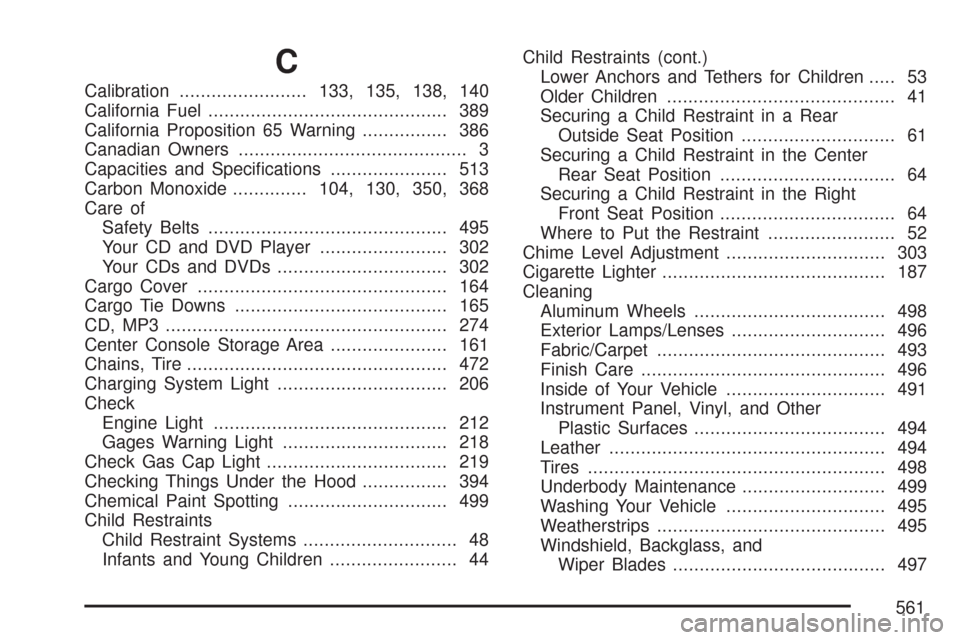
C
Calibration........................133, 135, 138, 140
California Fuel............................................. 389
California Proposition 65 Warning................ 386
Canadian Owners........................................... 3
Capacities and Specications...................... 513
Carbon Monoxide..............104, 130, 350, 368
Care of
Safety Belts............................................. 495
Your CD and DVD Player........................ 302
Your CDs and DVDs................................ 302
Cargo Cover............................................... 164
Cargo Tie Downs........................................ 165
CD, MP3 ..................................................... 274
Center Console Storage Area...................... 161
Chains, Tire................................................. 472
Charging System Light................................ 206
Check
Engine Light............................................ 212
Gages Warning Light............................... 218
Check Gas Cap Light.................................. 219
Checking Things Under the Hood................ 394
Chemical Paint Spotting.............................. 499
Child Restraints
Child Restraint Systems............................. 48
Infants and Young Children........................ 44Child Restraints (cont.)
Lower Anchors and Tethers for Children..... 53
Older Children........................................... 41
Securing a Child Restraint in a Rear
Outside Seat Position............................. 61
Securing a Child Restraint in the Center
Rear Seat Position ................................. 64
Securing a Child Restraint in the Right
Front Seat Position ................................. 64
Where to Put the Restraint........................ 52
Chime Level Adjustment.............................. 303
Cigarette Lighter.......................................... 187
Cleaning
Aluminum Wheels.................................... 498
Exterior Lamps/Lenses............................. 496
Fabric/Carpet........................................... 493
Finish Care.............................................. 496
Inside of Your Vehicle.............................. 491
Instrument Panel, Vinyl, and Other
Plastic Surfaces.................................... 494
Leather.................................................... 494
Tires........................................................ 498
Underbody Maintenance........................... 499
Washing Your Vehicle.............................. 495
Weatherstrips........................................... 495
Windshield, Backglass, and
Wiper Blades........................................ 497
561
Page 563 of 574
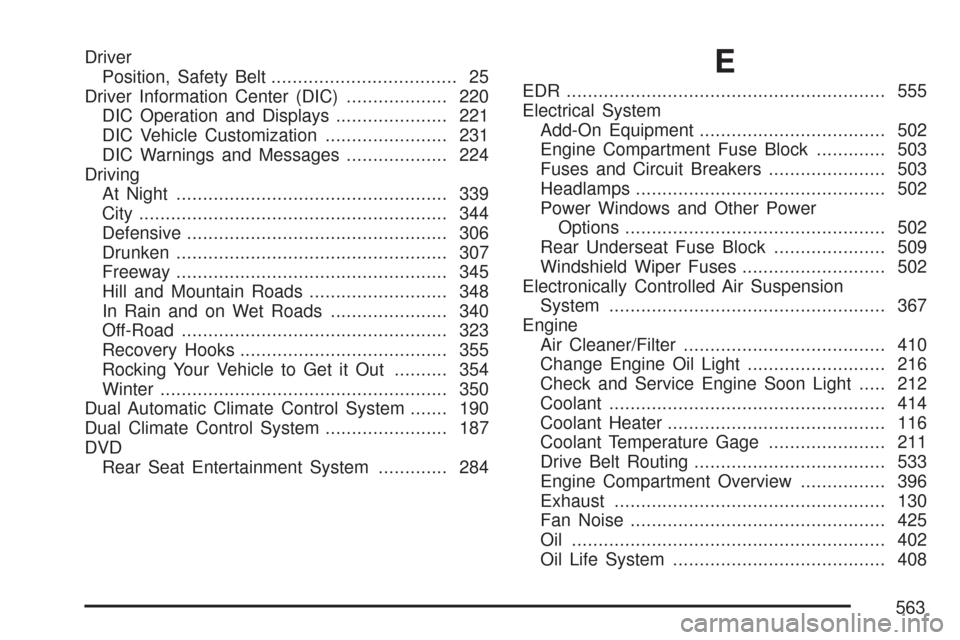
Driver
Position, Safety Belt................................... 25
Driver Information Center (DIC)................... 220
DIC Operation and Displays..................... 221
DIC Vehicle Customization....................... 231
DIC Warnings and Messages................... 224
Driving
At Night................................................... 339
City.......................................................... 344
Defensive................................................. 306
Drunken................................................... 307
Freeway................................................... 345
Hill and Mountain Roads.......................... 348
In Rain and on Wet Roads...................... 340
Off-Road.................................................. 323
Recovery Hooks....................................... 355
Rocking Your Vehicle to Get it Out.......... 354
Winter...................................................... 350
Dual Automatic Climate Control System....... 190
Dual Climate Control System....................... 187
DVD
Rear Seat Entertainment System............. 284E
EDR ............................................................ 555
Electrical System
Add-On Equipment................................... 502
Engine Compartment Fuse Block............. 503
Fuses and Circuit Breakers...................... 503
Headlamps............................................... 502
Power Windows and Other Power
Options................................................. 502
Rear Underseat Fuse Block..................... 509
Windshield Wiper Fuses........................... 502
Electronically Controlled Air Suspension
System.................................................... 367
Engine
Air Cleaner/Filter...................................... 410
Change Engine Oil Light.......................... 216
Check and Service Engine Soon Light..... 212
Coolant.................................................... 414
Coolant Heater......................................... 116
Coolant Temperature Gage...................... 211
Drive Belt Routing.................................... 533
Engine Compartment Overview................ 396
Exhaust................................................... 130
Fan Noise................................................ 425
Oil ........................................................... 402
Oil Life System........................................ 408
563
Page 564 of 574
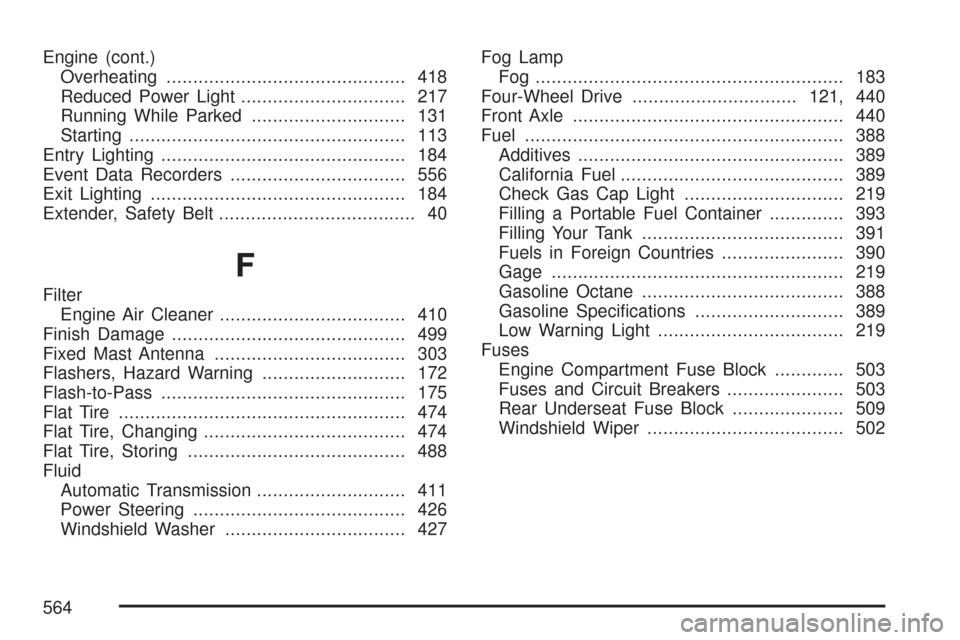
Engine (cont.)
Overheating............................................. 418
Reduced Power Light............................... 217
Running While Parked............................. 131
Starting.................................................... 113
Entry Lighting.............................................. 184
Event Data Recorders................................. 556
Exit Lighting................................................ 184
Extender, Safety Belt..................................... 40
F
Filter
Engine Air Cleaner................................... 410
Finish Damage............................................ 499
Fixed Mast Antenna.................................... 303
Flashers, Hazard Warning........................... 172
Flash-to-Pass.............................................. 175
Flat Tire...................................................... 474
Flat Tire, Changing...................................... 474
Flat Tire, Storing......................................... 488
Fluid
Automatic Transmission............................ 411
Power Steering........................................ 426
Windshield Washer.................................. 427Fog Lamp
Fog .......................................................... 183
Four-Wheel Drive...............................121, 440
Front Axle................................................... 440
Fuel............................................................ 388
Additives.................................................. 389
California Fuel.......................................... 389
Check Gas Cap Light.............................. 219
Filling a Portable Fuel Container.............. 393
Filling Your Tank...................................... 391
Fuels in Foreign Countries....................... 390
Gage....................................................... 219
Gasoline Octane...................................... 388
Gasoline Specications............................ 389
Low Warning Light................................... 219
Fuses
Engine Compartment Fuse Block............. 503
Fuses and Circuit Breakers...................... 503
Rear Underseat Fuse Block..................... 509
Windshield Wiper..................................... 502
564
Page 565 of 574
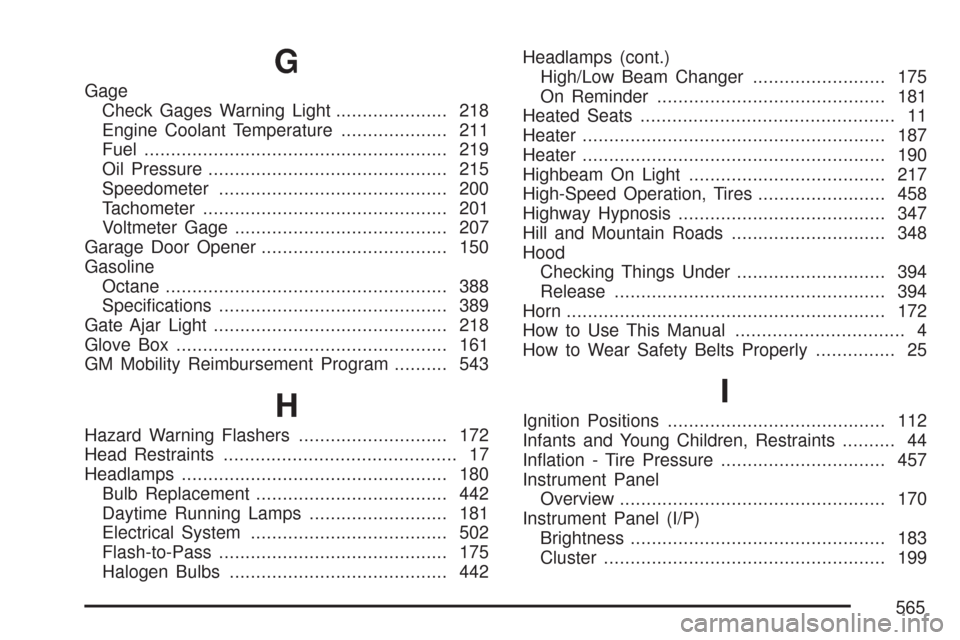
G
Gage
Check Gages Warning Light..................... 218
Engine Coolant Temperature.................... 211
Fuel......................................................... 219
Oil Pressure............................................. 215
Speedometer........................................... 200
Tachometer.............................................. 201
Voltmeter Gage........................................ 207
Garage Door Opener................................... 150
Gasoline
Octane..................................................... 388
Specications........................................... 389
Gate Ajar Light............................................ 218
Glove Box................................................... 161
GM Mobility Reimbursement Program.......... 543
H
Hazard Warning Flashers............................ 172
Head Restraints............................................ 17
Headlamps.................................................. 180
Bulb Replacement.................................... 442
Daytime Running Lamps.......................... 181
Electrical System..................................... 502
Flash-to-Pass........................................... 175
Halogen Bulbs......................................... 442Headlamps (cont.)
High/Low Beam Changer......................... 175
On Reminder........................................... 181
Heated Seats................................................ 11
Heater......................................................... 187
Heater......................................................... 190
Highbeam On Light..................................... 217
High-Speed Operation, Tires........................ 458
Highway Hypnosis....................................... 347
Hill and Mountain Roads............................. 348
Hood
Checking Things Under............................ 394
Release................................................... 394
Horn............................................................ 172
How to Use This Manual................................ 4
How to Wear Safety Belts Properly............... 25
I
Ignition Positions......................................... 112
Infants and Young Children, Restraints.......... 44
Ination - Tire Pressure............................... 457
Instrument Panel
Overview.................................................. 170
Instrument Panel (I/P)
Brightness................................................ 183
Cluster..................................................... 199
565