2007 CHEVROLET TRAIL BLAZER maintenance
[x] Cancel search: maintenancePage 225 of 574
CHANGE ENGINE OIL
This message displays when the engine oil needs
to be changed and service is required for your
vehicle. SeeScheduled Maintenance on page 519
andEngine Oil on page 402for more information.
Also seeEngine Oil Life System on page 408
for information on how to reset the message.
This message clears itself after 10 seconds until
the next ignition cycle.
CHECK TIRE PRESSURE
This message displays when the tire pressure in
one of the vehicle’s tires needs to be checked.
Press any of the DIC buttons, or the trip stem,
to acknowledge this message and clear it from the
DIC display.
If this message appears on the DIC, stop as soon
as you can. Have the tire pressures checked
and set to those shown on the Tire Loading
Information label. SeeTires on page 448,Loading
Your Vehicle on page 356, andInation - Tire
Pressure on page 457. If the tire pressure is low,
the low tire pressure warning light comes on.
SeeTire Pressure Light on page 211.
CHECK WASHER FLUID
This message displays if the washer uid level is
low. Adding washer uid to the windshield washer
uid reservoir clears this message. SeeWindshield
Washer Fluid on page 427. This message clears
itself after 10 seconds, or you can press any of the
DIC buttons, or the trip stem, to acknowledge this
message and clear it from the DIC display.
CURB VIEW ACTIVATED
This message displays when the passenger
outside rearview mirror moves into the curb view
position. SeeOutside Curb View Assist Mirror
on page 144for more information.
DRIVER DOOR AJAR
This message displays and a chime sounds if
the driver’s door is not fully closed. Stop and turn
off the vehicle, check the door for obstructions,
and close the door again. Check to see if the
message still appears on the DIC. Press any of
the DIC buttons, or the trip stem, to acknowledge
this message and clear it from the DIC display.
225
Page 324 of 574
The airbag system is designed to work properly
under a wide range of conditions, including off-road
usage. Observe safe driving speeds, especially
on rough terrain. As always, wear your safety belt.
Off-road driving can be great fun. But it does
have some denite hazards. The greatest of these
is the terrain itself.
“Off-roading” means you have left the great North
American road system behind. Traffic lanes
are not marked. Curves are not banked. There are
no road signs. Surfaces can be slippery, rough,
uphill, or downhill. In short, you have gone
right back to nature.
Off-road driving involves some new skills. And that
is why it is very important that you read this
guide. You will nd many driving tips and
suggestions. These will help make your off-road
driving safer and more enjoyable.Before You Go Off-Roading
There are some things to do before you go out.
For example, be sure to have all necessary
maintenance and service work done. Check to
make sure all underbody shields, if the vehicle has
them, are properly attached.
Be sure you read all the information about your
four-wheel-drive vehicle in this manual.
Is there enough fuel? Is the spare tire fully
inated? Are the uid levels up where they should
be? What are the local laws that apply to
off-roading where you will be driving? If you do not
know, you should check with law enforcement
people in the area. Will you be on someone’s
private land? If so, be sure to get the necessary
permission.
324
Page 338 of 574
Driving in Water
{CAUTION:
Driving through rushing water can be
dangerous. Deep water can sweep your
vehicle downstream and you and your
passengers could drown. If it is only
shallow water, it can still wash away the
ground from under your tires, and you
could lose traction and roll the vehicle
over. Do not drive through rushing water.
Heavy rain can mean ash ooding, and ood
waters demand extreme caution.
Find out how deep the water is before you drive
through it. If it is deep enough to cover the
wheel hubs, axles, or exhaust pipe, do not try
it — you probably will not get through. Also, water
that deep can damage the axle and other
vehicle parts.If the water is not too deep, drive slowly through it.
At faster speeds, water splashes on the ignition
system and your vehicle can stall. Stalling can also
occur if you get the tailpipe under water. And,
as long as the tailpipe is under water, you
will never be able to start the engine. When you
go through water, remember that when the brakes
get wet, it may take you longer to stop.
SeeDriving in Rain and on Wet Roads on page 340
for more information on driving through water.
After Off-Road Driving
Remove any brush or debris that has collected on
the underbody, chassis, or under the hood.
These accumulations can be a re hazard.
After operation in mud or sand, have the brake
linings cleaned and checked. These substances
can cause glazing and uneven braking. Check the
body structure, steering, suspension, wheels,
tires, and exhaust system for damage. Also, check
the fuel lines and cooling system for any leakage.
Your vehicle will require more frequent service
due to off-road use. Refer to the Maintenance
Schedule for additional information.
338
Page 380 of 574
When You Are Ready to Leave After
Parking on a Hill
1. Apply your regular brakes and hold the
pedal down while you:
start your engine,
shift into a gear, and
release the parking brake.
2. Let up on the brake pedal.
3. Drive slowly until the trailer is clear
of the chocks.
4. Stop and have someone pick up and
store the chocks.
Maintenance When Trailer Towing
Your vehicle will need service more often when
you’re pulling a trailer. See the Maintenance
Schedule for more on this. Things that are
especially important in trailer operation are
automatic transmission uid (don’t overll), engine
oil, axle lubricant, belt(s), cooling system and
brake system. Each of these is covered in
this manual, and the Index will help you nd them
quickly. If you’re trailering, it’s a good idea to
review these sections before you start your trip.
Check periodically to see that all hitch nuts
and bolts are tight.
380
Page 384 of 574
Windshield Wiper Blade Replacement....... 444
Tires............................................................ 448
Winter Tires.............................................. 449
Tire Sidewall Labeling............................... 450
Tire Terminology and Denitions............... 454
Ination - Tire Pressure............................. 457
High-Speed Operation............................... 458
Tire Pressure Monitor System................... 459
Tire Inspection and Rotation...................... 464
When It Is Time for New Tires.................. 466
Buying New Tires...................................... 466
Different Size Tires and Wheels................ 468
Uniform Tire Quality Grading..................... 469
Wheel Alignment and Tire Balance............ 470
Wheel Replacement.................................. 470
Tire Chains............................................... 472
Accessory Inator...................................... 472
If a Tire Goes Flat.................................... 474
Changing a Flat Tire................................. 474
Removing the Spare Tire and Tools.......... 476
Removing the Flat Tire and Installing
the Spare Tire....................................... 479Secondary Latch System........................... 484
Storing a Flat or Spare Tire and Tools...... 488
Spare Tire................................................. 491
Appearance Care........................................ 491
Cleaning the Inside of Your Vehicle.......... 491
Fabric/Carpet............................................. 493
Leather...................................................... 494
Instrument Panel, Vinyl, and Other
Plastic Surfaces..................................... 494
Care of Safety Belts.................................. 495
Weatherstrips............................................ 495
Washing Your Vehicle............................... 495
Cleaning Exterior Lamps/Lenses................ 496
Finish Care............................................... 496
Windshield, Backglass, and
Wiper Blades......................................... 497
Aluminum Wheels...................................... 498
Tires......................................................... 498
Sheet Metal Damage................................. 498
Finish Damage.......................................... 499
Underbody Maintenance............................ 499
Chemical Paint Spotting............................ 499
Vehicle Care/Appearance Materials............ 500
Section 5 Service and Appearance Care
384
Page 387 of 574
Doing Your Own Service Work
{CAUTION:
You can be injured and your vehicle could
be damaged if you try to do service work
on a vehicle without knowing enough
about it.
Be sure you have sufficient knowledge,
experience, the proper replacement
parts, and tools before you attempt any
vehicle maintenance task.
Be sure to use the proper nuts, bolts,
and other fasteners. English and metric
fasteners can be easily confused. If you
use the wrong fasteners, parts can later
break or fall off. You could be hurt.
If you want to do some of your own service work,
you should use the proper service manual.
It tells you much more about how to service your
vehicle than this manual can. To order the
proper service manual, seeService Publications
Ordering Information on page 554.Your vehicle has an airbag system. Before
attempting to do your own service work, see
Servicing Your Airbag-Equipped Vehicle on
page 86.
You should keep a record with all parts receipts
and list the mileage and the date of any service
work you perform. SeeMaintenance Record
on page 534.
Adding Equipment to the Outside
of Your Vehicle
Things you might add to the outside of your
vehicle can affect the airow around it. This may
cause wind noise and affect windshield washer
performance. Check with your dealer before
adding equipment to the outside of your vehicle.
387
Page 388 of 574
Fuel
Use of the recommended fuel is an important part
of the proper maintenance of your vehicle.
To help keep the engine clean and maintain
optimum vehicle performance, GM recommends
the use of gasoline advertised as TOP TIER
Detergent Gasoline.
The 8th digit of the Vehicle Identication Number
(VIN) shows the code letter or number that
identies your vehicle’s engine. The VIN is at the
top left of the instrument panel. SeeVehicle
Identication Number (VIN) on page 501.
Gasoline Octane
If your vehicle has the 4.2L L6 engine (VIN Code S)
or the 5.3L V8 engine (VIN Code M), use regular
unleaded gasoline with a posted octane rating
of 87 or higher. If the octane rating is less than 87,
you might notice an audible knocking noise when
you drive, commonly referred to as spark knock.If this occurs, use a gasoline rated at 87 octane or
higher as soon as possible. If you are using
gasoline rated at 87 octane or higher and you hear
heavy knocking, the engine needs service.
If your vehicle has the 6.0L V8 engine
(VIN Code H), use premium unleaded gasoline
with a posted octane rating of 91 or higher.
You can also use regular unleaded gasoline rated
at 87 octane or higher, but your vehicle’s
acceleration could be slightly reduced, and you
might notice a slight audible knocking noise,
commonly referred to as spark knock. If the
octane is less than 87, you might notice a heavy
knocking noise when you drive. If this occurs,
use a gasoline rated at 87 octane or higher
as soon as possible. Otherwise, you could damage
the engine. If you are using gasoline rated at
87 octane or higher and you hear heavy knocking,
the engine needs service.
388
Page 410 of 574
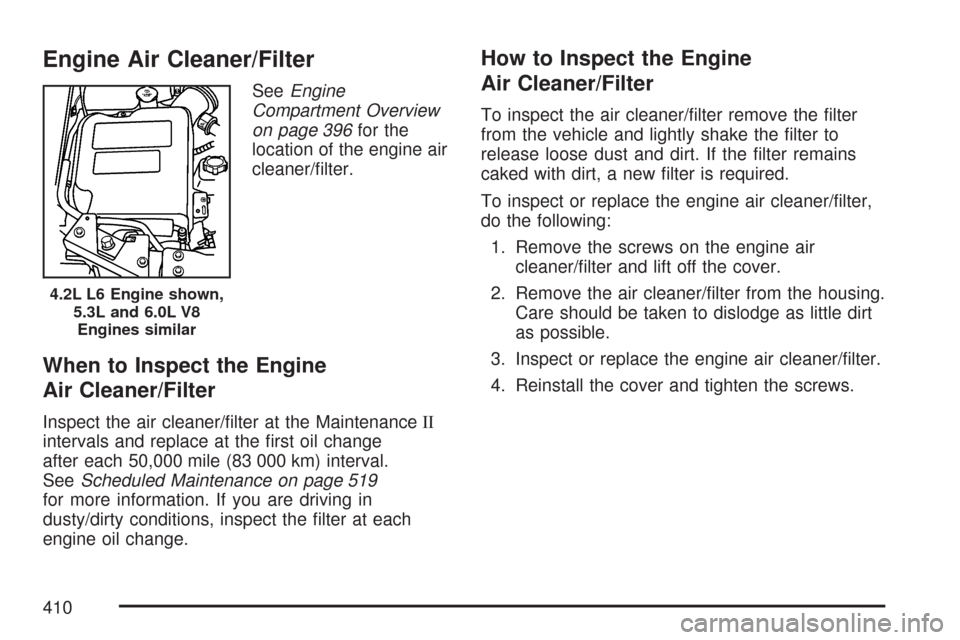
Engine Air Cleaner/Filter
SeeEngine
Compartment Overview
on page 396for the
location of the engine air
cleaner/lter.
When to Inspect the Engine
Air Cleaner/Filter
Inspect the air cleaner/lter at the MaintenanceII
intervals and replace at the rst oil change
after each 50,000 mile (83 000 km) interval.
SeeScheduled Maintenance on page 519
for more information. If you are driving in
dusty/dirty conditions, inspect the lter at each
engine oil change.
How to Inspect the Engine
Air Cleaner/Filter
To inspect the air cleaner/lter remove the lter
from the vehicle and lightly shake the lter to
release loose dust and dirt. If the lter remains
caked with dirt, a new lter is required.
To inspect or replace the engine air cleaner/lter,
do the following:
1. Remove the screws on the engine air
cleaner/lter and lift off the cover.
2. Remove the air cleaner/lter from the housing.
Care should be taken to dislodge as little dirt
as possible.
3. Inspect or replace the engine air cleaner/lter.
4. Reinstall the cover and tighten the screws.
4.2L L6 Engine shown,
5.3L and 6.0L V8
Engines similar
410