2007 CHEVROLET TRAIL BLAZER instrument cluster
[x] Cancel search: instrument clusterPage 72 of 574
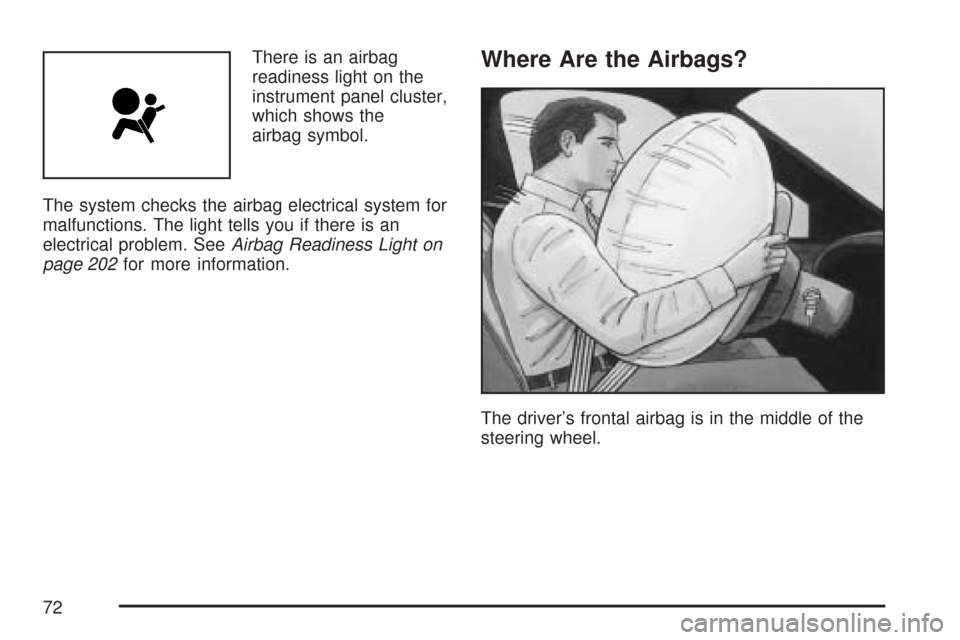
There is an airbag
readiness light on the
instrument panel cluster,
which shows the
airbag symbol.
The system checks the airbag electrical system for
malfunctions. The light tells you if there is an
electrical problem. SeeAirbag Readiness Light on
page 202for more information.Where Are the Airbags?
The driver’s frontal airbag is in the middle of the
steering wheel.
72
Page 85 of 574
{CAUTION:
If the airbag readiness light in the
instrument panel cluster ever comes on
and stays on, it means that something
may be wrong with the airbag system.
If this ever happens, have the vehicle
serviced promptly, because an adult-size
person sitting in the right front
passenger’s seat may not have the
protection of the airbag(s). SeeAirbag
Readiness Light on page 202for more on
this, including important safety
information.Aftermarket equipment, such as seat covers, can
affect how well the passenger sensing system
operates. You may want to consider not using seat
covers or other aftermarket equipment if your
vehicle has the passenger sensing system. See
Adding Equipment to Your Airbag-Equipped
Vehicle on page 87for more information about
modications that can affect how the system
operates.
{CAUTION:
Stowing of articles under the passenger’s
seat or between the passenger’s seat
cushion and seatback may interfere with
the proper operation of the passenger
sensing system.
85
Page 108 of 574
Sun Visors
Sun Visors with Slide Rod
Your vehicle may have this feature. Pull the sun
visor down to block glare. Detach the sun visor from
the center mount and slide it along the rod from
side-to-side to cover the driver or passenger side of
the front window. Swing the sun visor to the side to
cover the side window. It can also be moved along
the rod from side-to-side in this position.
Sun Visors with Fixed Rod and Pull-out
Extension
Your vehicle may have this feature. Pull the sun
visor down to block glare. Pull the sun visor
extender out for additional coverage. Detach the
sun visor from the center mount and swing it to the
side to cover the side window.
Visor Vanity Mirror
Pull the sun visor down to expose the vanity mirror.
You may have to lift a cover to expose the mirror.
Lighted Visor Vanity Mirror
Your vehicle may have this feature. Pull the sun
visor down and lift the mirror cover to turn on
the lamps. The lamps will turn off when the cover
is closed.
Theft-Deterrent Systems
Vehicle theft is big business, especially in some
cities. Although your vehicle has a number of
theft-deterrent features, we know that nothing we
put on it can make it impossible to steal.
Content Theft-Deterrent
Your vehicle may have a content theft-deterrent
alarm system.
The security light is
located on the
instrument panel cluster.
108
Page 123 of 574
{CAUTION:
Shifting the transfer case to NEUTRAL can
cause your vehicle to roll even if the
transmission is in PARK (P). You or
someone else could be seriously injured.
Be sure to set the parking brake before
placing the transfer case in NEUTRAL.
SeeParking Brake on page 126.
NEUTRAL:Shift the vehicle’s transfer case to
NEUTRAL only when towing your vehicle.
SeeRecreational Vehicle Towing on page 362for
more information.
An indicator light in the knob will show you which
position the transfer case is in. The indicator lights
will come on briey when you turn on the ignition
and one will stay on. If the lights do not come on,
you should take your vehicle to your dealer for
service. An indicator light will ash while shiftingthe transfer case. It will stay on when the shift is
complete. If for some reason the transfer case
cannot make a requested shift, it will return to the
last chosen setting.
If the service Four-Wheel Drive Warning Light on
the instrument panel cluster stays on, you
should take your vehicle to your dealer for service.
SeeService Four-Wheel Drive Warning Light on
page 218for further information.
Shifting Into Four-Wheel High or Automatic
Four-Wheel Drive
Turn the knob to Four-Wheel High or Automatic
Four-Wheel Drive. This can be done at any speed
unless you are shifting out of Four-Wheel Low.
The indicator light will ash while shifting.
It will remain on when the shift is complete.
Shifting Into Two-Wheel High
Turn the knob to Two-Wheel High. This can be
done at any speed unless you are shifting
out of Four-Wheel Low.
123
Page 126 of 574
Parking Brake
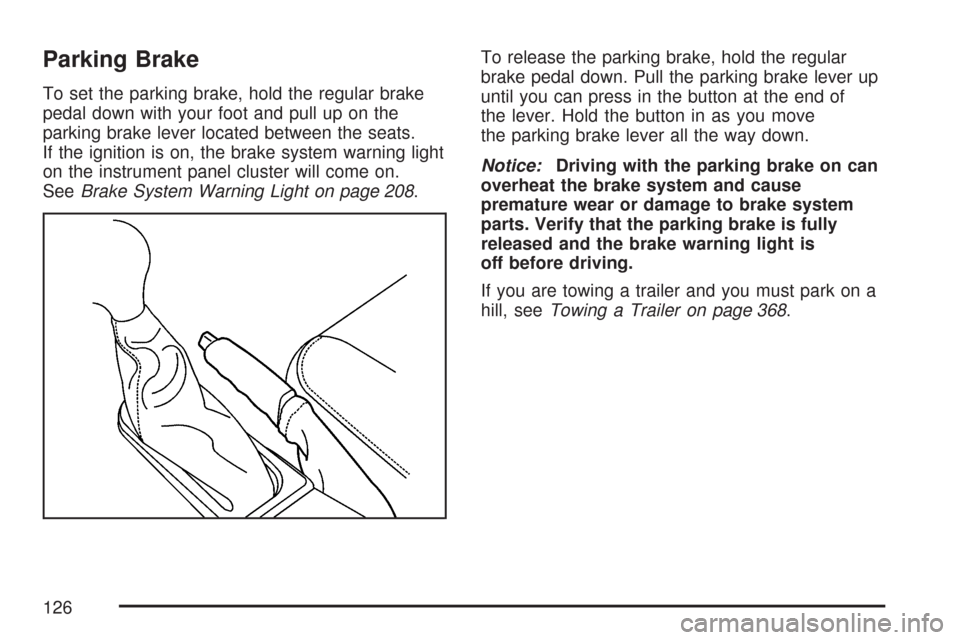
To set the parking brake, hold the regular brake
pedal down with your foot and pull up on the
parking brake lever located between the seats.
If the ignition is on, the brake system warning light
on the instrument panel cluster will come on.
SeeBrake System Warning Light on page 208.To release the parking brake, hold the regular
brake pedal down. Pull the parking brake lever up
until you can press in the button at the end of
the lever. Hold the button in as you move
the parking brake lever all the way down.
Notice:Driving with the parking brake on can
overheat the brake system and cause
premature wear or damage to brake system
parts. Verify that the parking brake is fully
released and the brake warning light is
off before driving.
If you are towing a trailer and you must park on a
hill, seeTowing a Trailer on page 368.
126
Page 167 of 574
Instrument Panel Overview........................ 170
Hazard Warning Flashers.......................... 172
Other Warning Devices............................. 172
Horn.......................................................... 172
Tilt Wheel.................................................. 173
Turn Signal/Multifunction Lever.................. 173
Turn and Lane-Change Signals................. 174
Headlamp High/Low-Beam Changer.......... 175
Flash-to-Pass............................................ 175
Windshield Wipers..................................... 175
Windshield Washer.................................... 176
Rear Window Wiper/Washer...................... 176
Cruise Control........................................... 177
Headlamps................................................ 180
Headlamps on Reminder........................... 181
Daytime Running Lamps (DRL)................. 181
Automatic Headlamp System..................... 182
Fog Lamps................................................ 183
Instrument Panel Brightness...................... 183
Dome Lamps............................................. 183
Dome Lamp Override................................ 184
Entry Lighting............................................ 184
Exit Lighting.............................................. 184
Reading Lamps......................................... 184Electric Power Management...................... 185
Battery Run-Down Protection..................... 186
Accessory Power Outlet(s)........................ 186
Ashtray(s) and Cigarette Lighter................ 187
Climate Controls......................................... 187
Dual Climate Control System..................... 187
Dual Automatic Climate Control System....... 190
Outlet Adjustment...................................... 195
Rear Climate Control System.................... 196
Warning Lights, Gages, and Indicators..... 198
Instrument Panel Cluster........................... 199
Speedometer and Odometer...................... 200
Trip Odometer........................................... 200
Tachometer............................................... 201
Safety Belt Reminder Light........................ 201
Passenger Safety Belt Reminder Light....... 202
Airbag Readiness Light............................. 202
Passenger Airbag Status Indicator............. 203
Charging System Light.............................. 206
Voltmeter Gage......................................... 207
Brake System Warning Light..................... 208
Anti-Lock Brake System Warning Light...... 209
StabiliTrak
®Service Light........................... 210
Section 3 Instrument Panel
167
Page 171 of 574
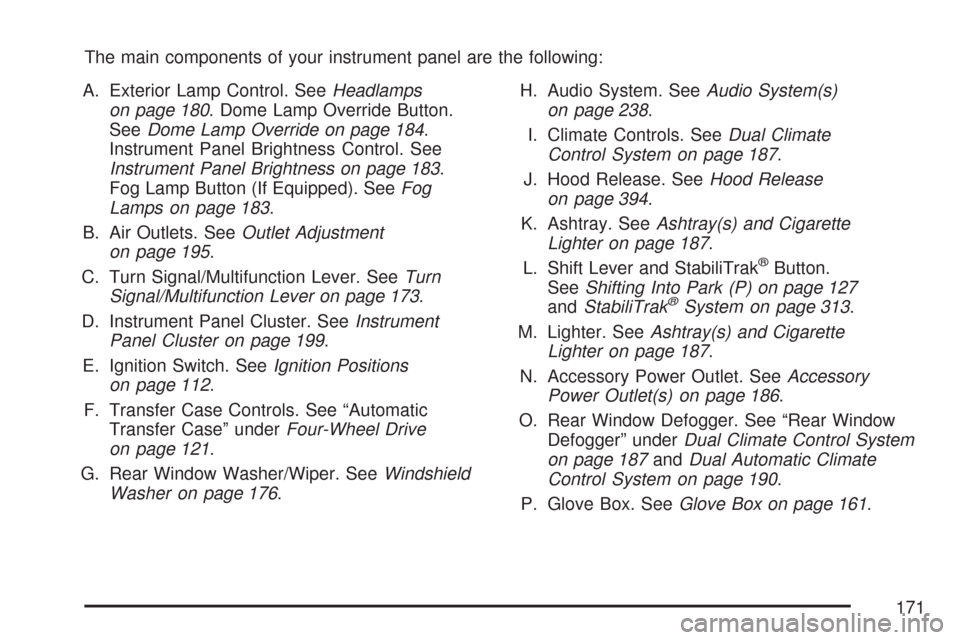
The main components of your instrument panel are the following:
A. Exterior Lamp Control. SeeHeadlamps
on page 180. Dome Lamp Override Button.
SeeDome Lamp Override on page 184.
Instrument Panel Brightness Control. See
Instrument Panel Brightness on page 183.
Fog Lamp Button (If Equipped). SeeFog
Lamps on page 183.
B. Air Outlets. SeeOutlet Adjustment
on page 195.
C. Turn Signal/Multifunction Lever. SeeTurn
Signal/Multifunction Lever on page 173.
D. Instrument Panel Cluster. SeeInstrument
Panel Cluster on page 199.
E. Ignition Switch. SeeIgnition Positions
on page 112.
F. Transfer Case Controls. See “Automatic
Transfer Case” underFour-Wheel Drive
on page 121.
G. Rear Window Washer/Wiper. SeeWindshield
Washer on page 176.H. Audio System. SeeAudio System(s)
on page 238.
I. Climate Controls. SeeDual Climate
Control System on page 187.
J. Hood Release. SeeHood Release
on page 394.
K. Ashtray. SeeAshtray(s) and Cigarette
Lighter on page 187.
L. Shift Lever and StabiliTrak
®Button.
SeeShifting Into Park (P) on page 127
andStabiliTrak
®System on page 313.
M. Lighter. SeeAshtray(s) and Cigarette
Lighter on page 187.
N. Accessory Power Outlet. SeeAccessory
Power Outlet(s) on page 186.
O. Rear Window Defogger. See “Rear Window
Defogger” underDual Climate Control System
on page 187andDual Automatic Climate
Control System on page 190.
P. Glove Box. SeeGlove Box on page 161.
171
Page 174 of 574
Turn and Lane-Change Signals
The turn signal has two upward (for right) and
two downward (for left) positions. These positions
let you signal a turn or a lane change.
To signal a turn, move the lever all the way up
or down. When the turn is nished, the lever
returns automatically.
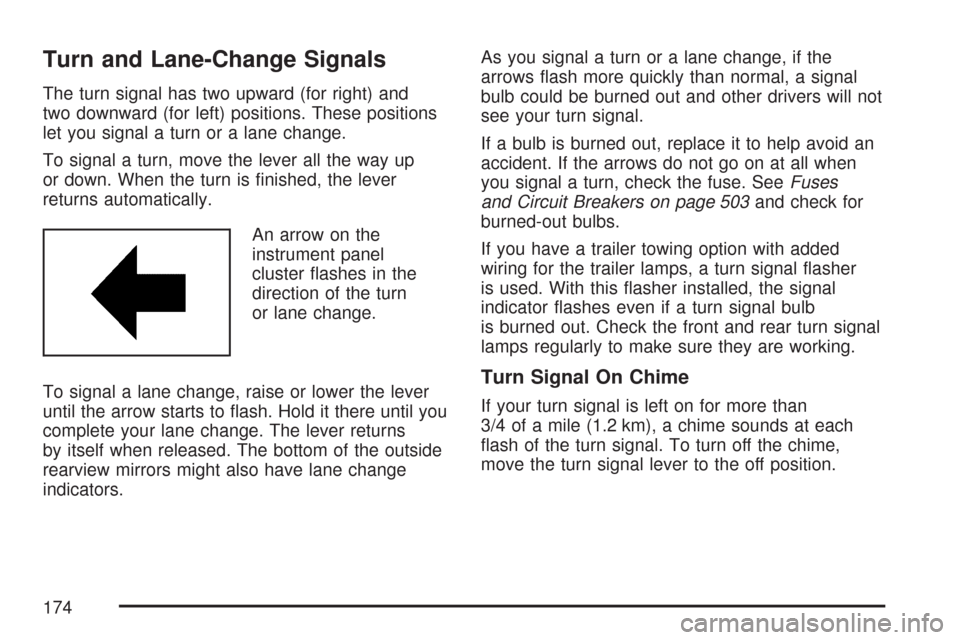
An arrow on the
instrument panel
cluster ashes in the
direction of the turn
or lane change.
To signal a lane change, raise or lower the lever
until the arrow starts to ash. Hold it there until you
complete your lane change. The lever returns
by itself when released. The bottom of the outside
rearview mirrors might also have lane change
indicators.As you signal a turn or a lane change, if the
arrows ash more quickly than normal, a signal
bulb could be burned out and other drivers will not
see your turn signal.
If a bulb is burned out, replace it to help avoid an
accident. If the arrows do not go on at all when
you signal a turn, check the fuse. SeeFuses
and Circuit Breakers on page 503and check for
burned-out bulbs.
If you have a trailer towing option with added
wiring for the trailer lamps, a turn signal asher
is used. With this asher installed, the signal
indicator ashes even if a turn signal bulb
is burned out. Check the front and rear turn signal
lamps regularly to make sure they are working.
Turn Signal On Chime
If your turn signal is left on for more than
3/4 of a mile (1.2 km), a chime sounds at each
ash of the turn signal. To turn off the chime,
move the turn signal lever to the off position.
174