{CAUTION:
Incorrect wheel nuts or improperly
tightened wheel nuts can cause the
wheel to come loose and even come off.
This could lead to an accident. Be sure to
use the correct wheel nuts. If you have to
replace them, be sure to get new original
equipment wheel nuts. Stop somewhere
as soon as you can and have the nuts
tightened with a torque wrench to the
proper torque specication. SeeCapacities
and Specifications on page 513for wheel
nut torque specication.Notice:Improperly tightened wheel nuts can
lead to brake pulsation and rotor damage.
To avoid expensive brake repairs, evenly
tighten the wheel nuts in the proper sequence
and to the proper torque specication.
SeeCapacities and Specifications on page 513
for the wheel nut torque specication.
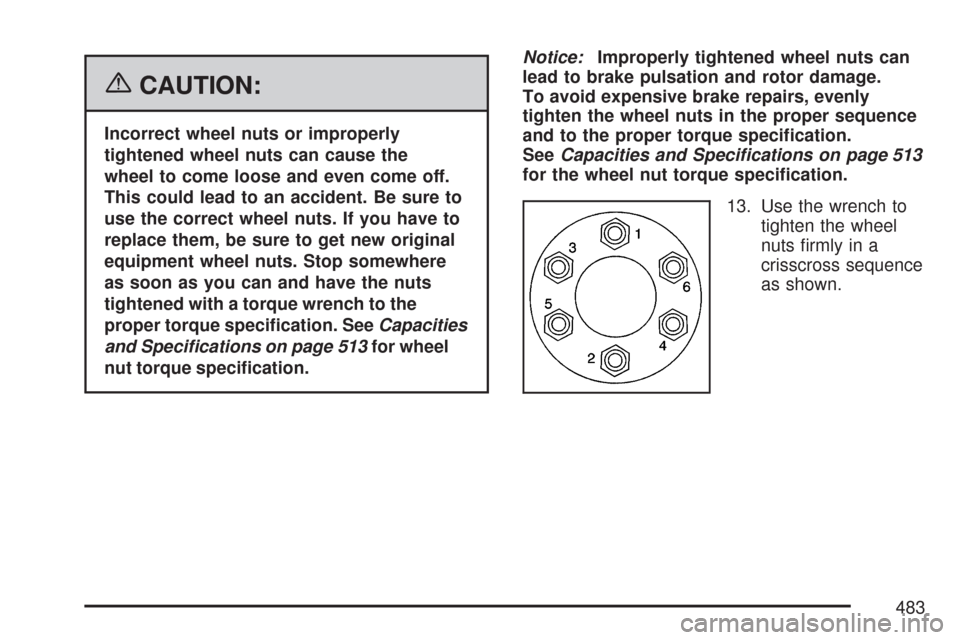
13. Use the wrench to
tighten the wheel
nuts rmly in a
crisscross sequence
as shown.
483
Additional Required Services (cont’d)
Service and Miles (Kilometers)25,000
(40 000)50,000
(80 000)75,000
(120 000)100,000
(160 000)125,000
(200 000)150,000
(240 000)
Engine cooling system service
(or every ve years, whichever occurs
rst).An Emission Control Service. See
footnote (i).•
Inspect engine accessory drive belt.
An Emission Control Service. See
footnote (l).•
Maintenance Footnotes
(a)Visually inspect brake lines and hoses for
proper hook-up, binding, leaks, cracks, chang,
etc. Inspect disc brake pads for wear and rotors for
surface condition. Inspect other brake parts,
including calipers, parking brake, etc.
(b)Visually inspect front and rear suspension and
steering system for damaged, loose, or missing
parts or signs of wear. Inspect power steering lines
and hoses for proper hook-up, binding, leaks,
cracks, chang, etc.(c)Visually inspect hoses and have them replaced
if they are cracked, swollen, or deteriorated.
Inspect all pipes, ttings and clamps; replace with
genuine parts as needed. To help ensure
proper operation, a pressure test of the cooling
system and pressure cap and cleaning the outside
of the radiator and air conditioning condenser is
recommended at least once a year.
(d)Inspect wiper blades for wear, cracking, or
contamination. Clean the windshield and
wiper blades, if contaminated. Replace wiper
blades that are worn or damaged. See Windshield
Wiper Blade Replacement on page 444and
Windshield, Backglass, and Wiper Blades on
page 497for more information.
523