Page 214 of 510
Did you just drive through a deep puddle of water?
If so, your electrical system may be wet. The
condition will usually be corrected when the
electrical system dries out. A few driving trips
should turn the light off.
Have you recently changed brands of fuel?
If so, be sure to fuel your vehicle with quality fuel.
SeeGasoline Octane on page 346. Poor fuel
quality will cause your engine not to run as
efficiently as designed. You may notice this as
stalling after start-up, stalling when you put
the vehicle into gear, misring, hesitation on
acceleration, or stumbling on acceleration.
(These conditions may go away once the engine
is warmed up.) This will be detected by the
system and cause the light to turn on.
If you experience one or more of these conditions,
change the fuel brand you use. It will require
at least one full tank of the proper fuel to turn
the light off.
If none of the above steps have made the light
turn off, your dealer can check the vehicle.
Your dealer has the proper test equipment and
diagnostic tools to x any mechanical or electrical
problems that may have developed.Emissions Inspection and
Maintenance Programs
Some state/provincial and local governments have
or may begin programs to inspect the emission
control equipment on your vehicle. Failure to pass
this inspection could prevent you from getting a
vehicle registration.
Here are some things you need to know to help
your vehicle pass an inspection:
Your vehicle will not pass this inspection if the
check engine light is on or not working properly.
Your vehicle will not pass this inspection if
the OBD (on-board diagnostic) system determines
that critical emission control systems have not
been completely diagnosed by the system.
The vehicle would be considered not ready for
inspection. This can happen if you have recently
replaced your battery or if your battery has
run down. The diagnostic system is designed
to evaluate critical emission control systems
during normal driving. This may take several
days of routine driving. If you have done this and
your vehicle still does not pass the inspection
for lack of OBD system readiness, your dealer
can prepare the vehicle for inspection.
214
Page 215 of 510
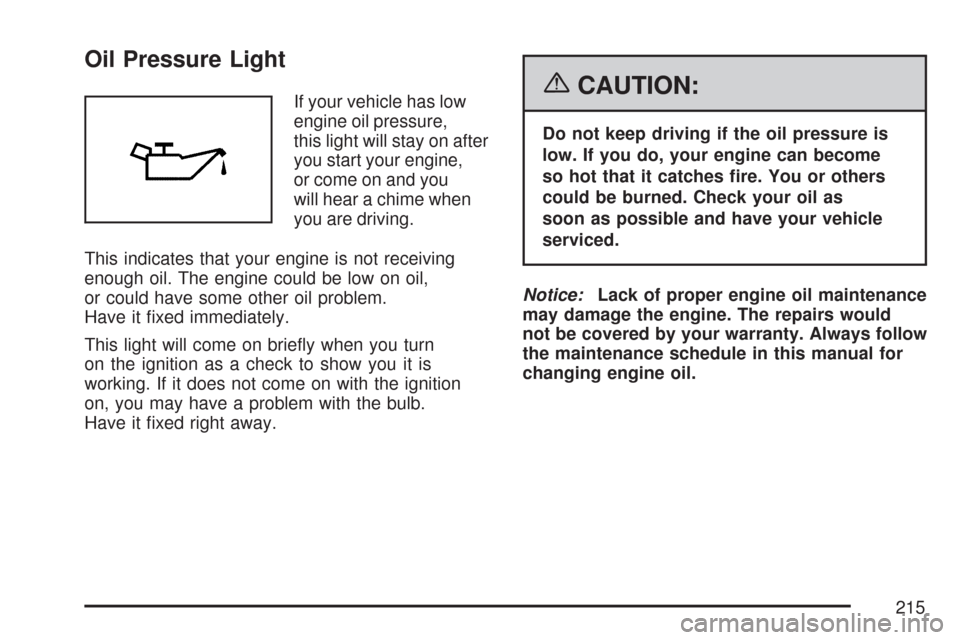
Oil Pressure Light
If your vehicle has low
engine oil pressure,
this light will stay on after
you start your engine,
or come on and you
will hear a chime when
you are driving.
This indicates that your engine is not receiving
enough oil. The engine could be low on oil,
or could have some other oil problem.
Have it xed immediately.
This light will come on briey when you turn
on the ignition as a check to show you it is
working. If it does not come on with the ignition
on, you may have a problem with the bulb.
Have it xed right away.{CAUTION:
Do not keep driving if the oil pressure is
low. If you do, your engine can become
so hot that it catches re. You or others
could be burned. Check your oil as
soon as possible and have your vehicle
serviced.
Notice:Lack of proper engine oil maintenance
may damage the engine. The repairs would
not be covered by your warranty. Always follow
the maintenance schedule in this manual for
changing engine oil.
215
Page 216 of 510
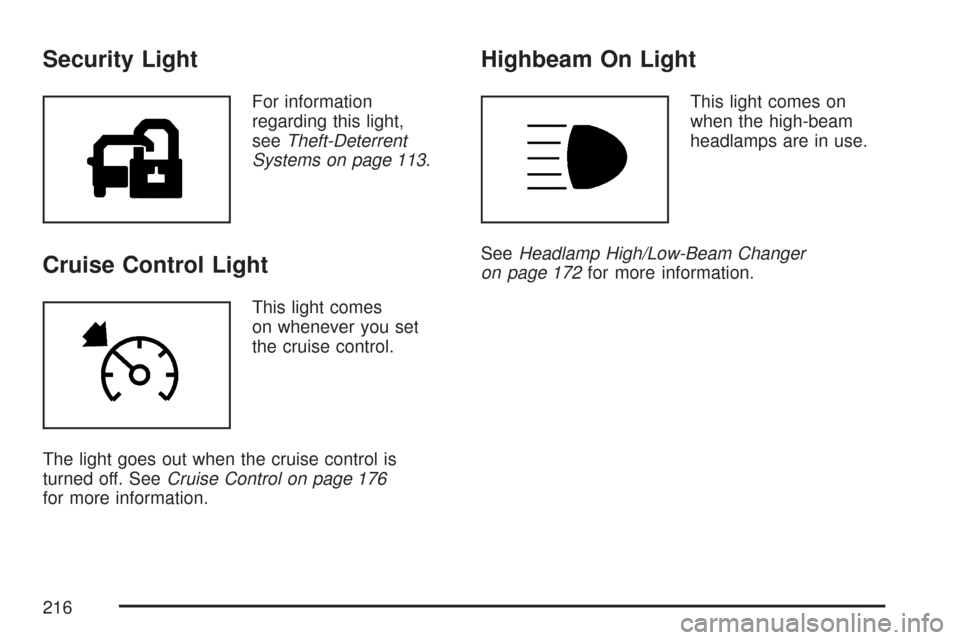
Security Light
For information
regarding this light,
seeTheft-Deterrent
Systems on page 113.
Cruise Control Light
This light comes
on whenever you set
the cruise control.
The light goes out when the cruise control is
turned off. SeeCruise Control on page 176
for more information.
Highbeam On Light
This light comes on
when the high-beam
headlamps are in use.
SeeHeadlamp High/Low-Beam Changer
on page 172for more information.
216
Page 217 of 510
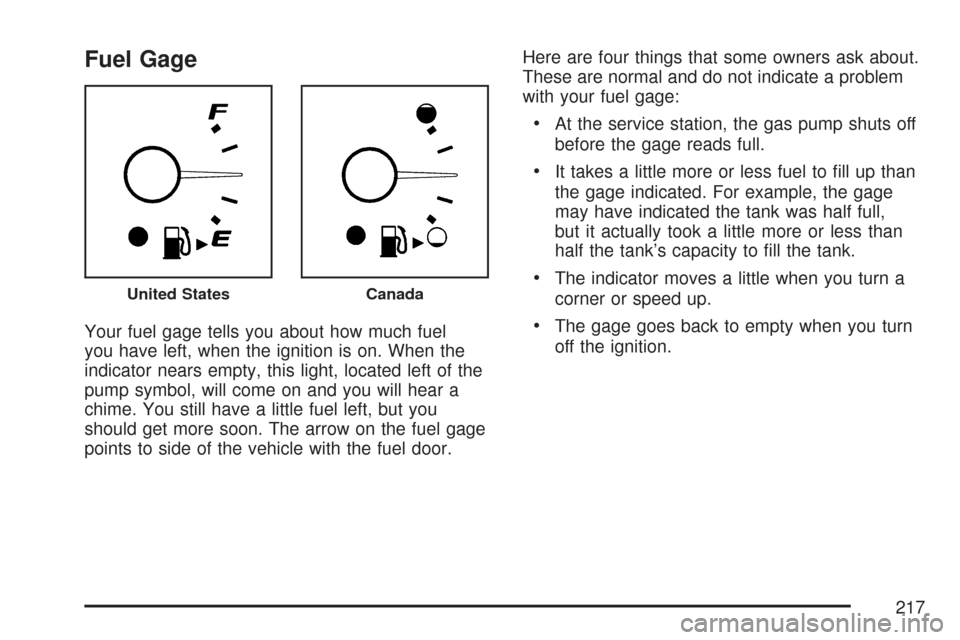
Fuel Gage
Your fuel gage tells you about how much fuel
you have left, when the ignition is on. When the
indicator nears empty, this light, located left of the
pump symbol, will come on and you will hear a
chime. You still have a little fuel left, but you
should get more soon. The arrow on the fuel gage
points to side of the vehicle with the fuel door.Here are four things that some owners ask about.
These are normal and do not indicate a problem
with your fuel gage:
At the service station, the gas pump shuts off
before the gage reads full.
It takes a little more or less fuel to ll up than
the gage indicated. For example, the gage
may have indicated the tank was half full,
but it actually took a little more or less than
half the tank’s capacity to ll the tank.
The indicator moves a little when you turn a
corner or speed up.
The gage goes back to empty when you turn
off the ignition.
United StatesCanada
217
Page 221 of 510
Exterior Light Flash During Remote Keyless
Entry Locking or Unlocking
Delayed Locking
Automatic Vehicle Unlocking: Specic Doors
Automatic Vehicle Unlocking: When Key is Off
or When Shift To Park
Exterior Perimeter Lighting During Remote
Keyless Entry Unlock
Select Language: (English, French, Spanish
or German)
When the desired option is reached, press the
enter button to toggle between the modes of
that option. To make a selection, press the
MENU button again.If no selection is made within 10 seconds,
the display reverts back to the previous
information displayed.
The MENU mode is exited when the information
button is pressed, a 10 second time period
has elapsed, the ignition is turned to OFF, or the
end of the MENU list is reached.
SeeDIC Vehicle Personalization on page 225for
more information on the personalization options.Enter
ENTER/r(Enter):Press this button to reset
certain functions and to turn off or acknowledge
messages on the DIC display. This button
also toggles through the options available in
each personalization menu.
221
Page 222 of 510
DIC Warnings and Messages
These messages appear if there is a problem
detected in one of your vehicle’s systems.
A message will clear when that condition is no
longer present on the vehicle. To acknowledge a
message and clear it from the display, press
any of the three DIC buttons. If the condition is
still present, the warning message will come back
on the next time the vehicle is turned off and
back on. With most messages, a warning chime
sounds when the message displays. Your
vehicle may have other warning messages.
AUTO (Automatic) LIGHTS OFF:This message
displays if the automatic headlamp system is
disabled with the headlamp switch.
AUTO (Automatic) LIGHTS ON:This message
displays if the automatic headlamp system is
enabled with the headlamp switch.BRAKE FLUID:This message displays to
inform the driver that the brake uid level is low
while the ignition is in ON. The brake system
warning light on the instrument panel cluster
also comes on. SeeBrake System Warning Light
on page 206for more information. Have the
brake system serviced by your dealer/retailer
as soon as possible.
CHANGE OIL SOON:This message displays
when the life of the engine oil has expired and it
should be changed.
When you acknowledge the CHANGE OIL SOON
message by clearing it from the display, you still
must reset the engine oil life system separately.
SeeEngine Oil Life System on page 362,Engine
Oil on page 359, andScheduled Maintenance
on page 460for more information.
222
Page 224 of 510
LOW FUEL:This message displays along with
a low fuel warning light on the instrument panel
cluster when your vehicle is low on fuel. Rell
the fuel tank as soon as possible. SeeFuel on
page 346andFilling the Tank on page 349.
LOW WASHER FLUID:This message displays
when your vehicle is low on windshield washer uid.
Rell the windshield washer uid reservoir as soon
as possible. See “Adding Washer Fluid” under
Windshield Washer Fluid on page 380.
POWER STEERING:This message displays
if a problem has been detected with the electric
power steering, if your vehicle has this feature.
Have your vehicle serviced immediately by your
dealer/retailer.PUSH PARK PEDAL:This message displays if
the parking brake is left engaged. SeeParking
Brake on page 132for more information.
SERVICE AIR BAG:This message displays
if there is a problem with the airbag system.
Have your vehicle serviced immediately by
your dealer/retailer.
TRUNK AJAR:If your vehicle has a trunk, this
message displays when the trunk lid is not closed
completely. Make sure that the trunk lid is closed
completely. SeeTrunk (Sedan) on page 108
for more information.
224
Page 226 of 510
UNLOCK HORN:If your vehicle has Remote
Keyless Entry (RKE), this option which allows
the vehicle’s horn to chirp every time the unlock
button on the RKE transmitter is pressed, can
be enabled or disabled. When UNLOCK HORN
appears on the display, press the enter button
to move between ON and OFF. When you have
made your choice, press the MENU button to
record your selection. The initial setting from
the factory is OFF.
LIGHT FLASH:If your vehicle has Remote
Keyless Entry (RKE), this option which allows
the vehicle’s exterior perimeter lighting to
ash every time the lock, unlock, or trunk release
buttons on the RKE transmitter are pressed,
can be enabled or disabled. When LIGHT FLASH
appears on the display, press the enter button
to move between OFF and ON. When you have
made your choice, press the MENU button to
record your selection. The initial setting from
the factory is ON.DELAY LOCK:The delayed locking option, which
delays the actual locking of the vehicle, can be
enabled or disabled. When DELAY LOCK appears
on the display, press the enter button to move
between OFF and ON. When you have made your
choice, press the MENU button to record your
selection. The initial setting from the factory is ON.
AUTO UNLK (Unlock):The automatic door
unlocking option, which allows the vehicle
to automatically unlock certain doors can
be enabled or disabled. When AUTO UNLK
appears on the display, press the enter button
to move between ALL, DRIVER, or NONE.
When you have made your choice, press and
the MENU button to record your selection.
The initial setting from the factory is ALL.
SeeProgrammable Automatic Door Locks
on page 106for more information.
226