2007 CHEVROLET EQUINOX light
[x] Cancel search: lightPage 113 of 492
PASS-Key®III+ Operation
Your vehicle has PASS-Key®III+ (Personalized
Automotive Security System) theft-deterrent
system. PASS-Key
®III+ is a passive
theft-deterrent system. This means you do not
have to do anything special to arm or disarm the
system. It works when you transition the key
to RUN, ACC or START from the LOCK position.
When the PASS-Key
®III+ system senses that
someone is using the wrong key, it prevents
the vehicle from starting. Anyone using a
trial-and-error method to start the vehicle will be
discouraged because of the high number of
electrical key codes.
If the engine does not start and the security light
on the instrument panel comes on when trying
to start the vehicle, the key may have a damaged
transponder. Turn the ignition off and try again.
If the engine still does not start, and the key
appears to be undamaged, try another ignition key.
At this time, you may also want to check the fuse,
seeFuses and Circuit Breakers on page 429.If the engine still does not start with the other key,
your vehicle needs service. If your vehicle does
start, the rst key may be faulty. See your dealer
who can service the PASS-Key
®III+ to have a new
key made. In an emergency, contact Roadside
Assistance.
It is possible for the PASS-Key
®III+ decoder
to “learn” the transponder value of a new
or replacement key. Up to nine additional keys
may be programmed for the vehicle. The following
procedure is for programming additional keys
only. If all the currently programmed keys are
lost or do not operate, you must see your dealer
or a locksmith who can service PASS-Key
®III+
to have keys made and programmed to the
system.
See your dealer or a locksmith who can service
PASS-Key
®III+ to get a new key blank that is cut
exactly as the ignition key that operates the system.
113
Page 114 of 492
To program the new additional key do the
following:
1. Verify that the new key has a
1stamped on it.
2. Insert the original, already programmed, key in
the ignition and start the engine. If the engine
will not start, see your dealer for service.
3. After the engine has started, turn the key to
LOCK, and remove the key.
4. Insert the new key to be programmed and turn
it to the RUN position within ve seconds of
removing the original key.
5. The security light will turn off once the key
has been programmed.
6. Repeat Steps 1 through 5 if additional keys
are to be programmed.
If you are driving and the security light comes on
and stays on, you may be able to restart your
engine. Your PASS-Key
®III+ system, however,
may not be working properly and must be serviced
by your dealer.
If you lose or damage your PASS-Key
®III+ key,
see your dealer or a locksmith who can service
PASS-Key
®III+ to have a new key made.
Starting and Operating
Your Vehicle
New Vehicle Break-In
Notice:Your vehicle does not need an
elaborate break-in. But it will perform better in
the long run if you follow these guidelines:
Do not drive at any one constant speed,
fast or slow, for the rst 500 miles (805 km).
Do not make full-throttle starts. Avoid
downshifting to brake, or slow, the vehicle.
Avoid making hard stops for the rst
200 miles (322 km) or so. During this time
your new brake linings are not yet broken
in. Hard stops with new linings can mean
premature wear and earlier replacement.
Follow this breaking-in guideline every
time you get new brake linings.
Do not tow a trailer during break-in. See
Towing a Trailer on page 322for the trailer
towing capabilities of your vehicle and
more information.
Following break-in, engine speed and load
can be gradually increased.
114
Page 115 of 492
Ignition Positions
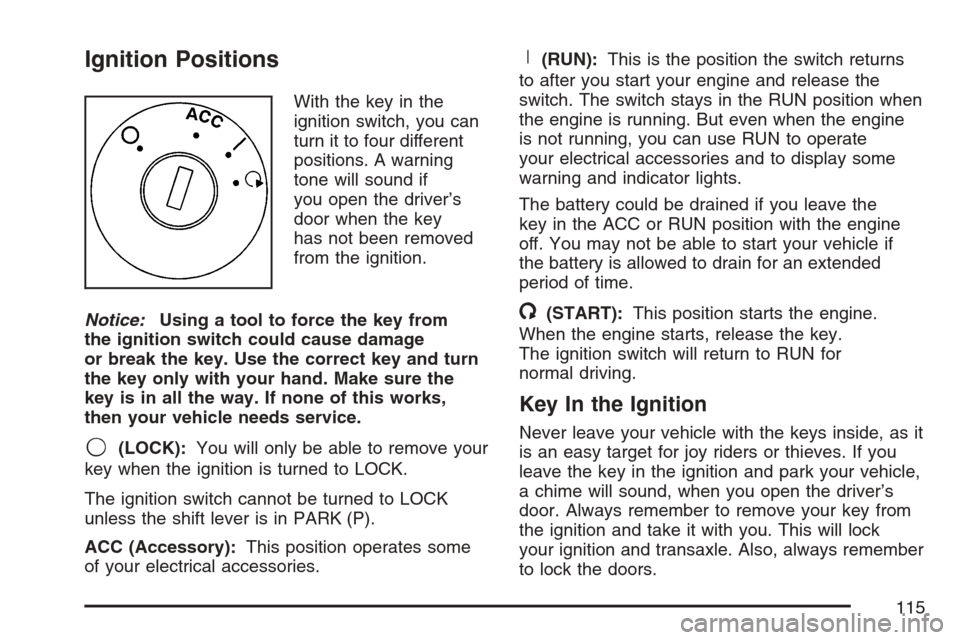
With the key in the
ignition switch, you can
turn it to four different
positions. A warning
tone will sound if
you open the driver’s
door when the key
has not been removed
from the ignition.
Notice:Using a tool to force the key from
the ignition switch could cause damage
or break the key. Use the correct key and turn
the key only with your hand. Make sure the
key is in all the way. If none of this works,
then your vehicle needs service.
9(LOCK):You will only be able to remove your
key when the ignition is turned to LOCK.
The ignition switch cannot be turned to LOCK
unless the shift lever is in PARK (P).
ACC (Accessory):This position operates some
of your electrical accessories.
R(RUN):This is the position the switch returns
to after you start your engine and release the
switch. The switch stays in the RUN position when
the engine is running. But even when the engine
is not running, you can use RUN to operate
your electrical accessories and to display some
warning and indicator lights.
The battery could be drained if you leave the
key in the ACC or RUN position with the engine
off. You may not be able to start your vehicle if
the battery is allowed to drain for an extended
period of time.
/(START):This position starts the engine.
When the engine starts, release the key.
The ignition switch will return to RUN for
normal driving.
Key In the Ignition
Never leave your vehicle with the keys inside, as it
is an easy target for joy riders or thieves. If you
leave the key in the ignition and park your vehicle,
a chime will sound, when you open the driver’s
door. Always remember to remove your key from
the ignition and take it with you. This will lock
your ignition and transaxle. Also, always remember
to lock the doors.
115
Page 121 of 492
Notice:Shifting out of PARK (P) or
NEUTRAL (N) while the engine is running at
high speed may damage the transaxle.
The repairs would not be covered by your
warranty. Be sure the engine is not running
at high speeds when shifting your vehicle.
Notice:Shifting to a drive gear from
NEUTRAL (N) while the vehicle is moving
could damage the transaxle. Make sure
the vehicle is stopped before shifting from
NEUTRAL (N) into a drive gear.
DRIVE (D):This position is for normal driving with
the automatic transaxle. It provides the best fuel
economy for your vehicle. If you need more power
for passing, and you are:
Going less than about 35 mph (55 km/h), push
your accelerator pedal about halfway down.
Going about 35 mph (55 km/h), push
your accelerator all the way down.
Downshifting the transaxle in slippery road
conditions could result in skidding, see “Skidding”
underLoss of Control on page 299.INTERMEDIATE (I):This position is also used
for normal driving. However, it reduces vehicle
speed without using your brakes for slight
downgrades where the vehicle would otherwise
accelerate due to steepness of grade. If constant
upshifting or downshifting occurs while driving
up steep hills, this position can be used to prevent
repetitive types of shifts. You might choose
INTERMEDIATE (I) instead of DRIVE (D) when
driving on hilly, winding roads and when towing
a trailer, so that there is less shifting between
gears.
LOW (L):This position reduces vehicle speed
more than INTERMEDIATE (I) without actually
using your brakes. You can use it on very steep
hills, or in deep snow or mud. If the shift lever
is put in LOW (L), the transaxle will not shift into
LOW (L) until the vehicle is going slowly enough.
Notice:Spinning the tires or holding the
vehicle in one place on a hill using only the
accelerator pedal may damage the transaxle.
If you are stuck, do not spin the tires. When
stopping on a hill, use the brakes to hold
the vehicle in place.
121
Page 122 of 492
Transaxle Overheating
If the transaxle uid temperature rises above
284°F (140°C) or rises rapidly, the Engine
Coolant Temperature Warning Light will ash. See
Engine Coolant Temperature Warning Light on
page 181for more information. When the transaxle
overheats it will go into a protection mode and
will default shift into fth gear if in the DRIVE (D)
position, or second gear if in the LOW (L)
position. Continue driving the vehicle in either
position depending on the required vehicle speed
and load. Once the uid temperature lowers to
the normal temperature range, the transaxle
will return to the normal shift patterns. Towing or
driving on long hills can cause the transaxle
uid temperature to be higher than normal. If the
transaxle uid temperature will not cool, you
may need to pull over and check the transaxle
uid level. You should also check the engine
coolant temperature. If it is hot, seeEngine
Overheating on page 355.
Parking Brake
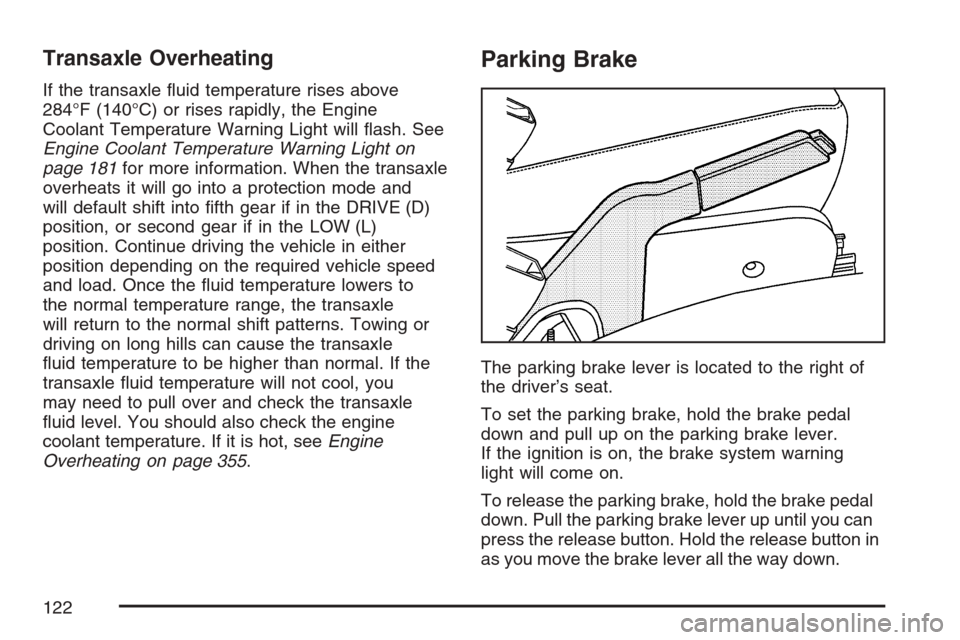
The parking brake lever is located to the right of
the driver’s seat.
To set the parking brake, hold the brake pedal
down and pull up on the parking brake lever.
If the ignition is on, the brake system warning
light will come on.
To release the parking brake, hold the brake pedal
down. Pull the parking brake lever up until you can
press the release button. Hold the release button in
as you move the brake lever all the way down.
122
Page 123 of 492
Make sure to release the parking brake before
driving the vehicle.
If the parking brake is applied and the vehicle is
moving at least 4 mph (6 km/h), a chime will
activate to remind you to release the parking brake.
Notice:Driving with the parking brake on
can overheat the brake system and cause
premature wear or damage to brake system
parts. Verify that the parking brake is fully
released and the brake warning light is
off before driving.
Shifting Into Park (P)
{CAUTION:
It can be dangerous to get out of your
vehicle if the shift lever is not fully in
PARK (P) with the parking brake rmly set.
CAUTION: (Continued)
CAUTION: (Continued)
Your vehicle can roll. If you have left the
engine running, the vehicle can move
suddenly. You or others could be injured.
To be sure your vehicle will not move, even
when you are on fairly level ground, use
the steps that follow. If you are pulling a
trailer, seeTowing a Trailer on page 322.
1. Hold the brake pedal down and set the
parking brake.
2. Move the shift lever into the PARK (P)
position by holding in the button on the
shift lever and pushing it all the way
toward the front of the vehicle.
3. Turn the ignition key to LOCK.
4. Remove the key and take it with you.
If you can leave your vehicle with the
ignition key in your hand, your vehicle
is in PARK (P).
123
Page 129 of 492
Mirrors
Manual Rearview Mirror
To adjust the angle of the mirror, move the mirror to
a position that allows you see to out of the back
window. To adjust the height of the mirror, adjust
the arm that connects the mirror to the windshield.
To reduce glare from lights behind you, move the
lever toward you to the night position.
Manual Rearview Mirror with OnStar®
To adjust the angle of the mirror, move the mirror
to a position that allows you see to out of the back
window. To adjust the height of the mirror, adjust
the arm that connects the mirror to the windshield.
To reduce glare from lights behind you, move the
lever toward you to the night position.
There are also OnStar
®buttons located at the
bottom of the mirror face. See your dealer for more
information on the system and how to subscribe
to OnStar
®. SeeOnStar®System on page 133
for more information about the services OnStar®
provides.
Automatic Dimming Rearview Mirror
with OnStar
®and Compass
If your vehicle has this feature, an automatic
dimming mirror automatically dims to the proper
level to minimize glare at night from lights
behind your vehicle. For more information about
OnStar
®, seeOnStar®System on page 133.
The mirror includes a display in the upper right
corner of the mirror face that shows the compass
reading.
O(On/Off):Press this button to operate the
automatic dimming and compass features.
Automatic Dimming Mirror Operation
The automatic dimming mirror function is turned on
each time the ignition is started. A light near the
on/off button will come on to indicate the automatic
dimming is on.
Press and hold the on/off button for about
four seconds to manually turn the automatic
dimming function on or off.
129
Page 131 of 492
Compass Calibration
The compass may need calibration if one of the
following occurs:
After approximately ve seconds, the
display does not show a compass heading
(N for North, for example), there may be
a strong magnetic eld interfering with
the compass. Such interference may be
caused by a magnetic antenna mount,
magnetic note pad holder, or a similar
magnetic item.
The compass does not display the correct
heading and the compass zone variance
is set correctly.
In order to calibrate, CAL must be displayed in
the mirror compass windows. If CAL is not
displayed, push the on/off button for approximately
12 seconds or until CAL is displayed.
The compass can be calibrated by driving the
vehicle in circles at 5 mph (8 km/h) or less until
the display reads a direction.
Cleaning the Mirror
When cleaning the mirror, use a paper towel or
similar material dampened with glass cleaner.
Do not spray glass cleaner directly on the mirror
as that may cause the liquid cleaner to enter
the mirror housing.
Automatic Dimming Rearview
Mirror with Compass
If the vehicle has this feature, the automatic
dimming mirror automatically dims to the proper
level to minimize glare at night from lights
behind your vehicle.
The mirror also has a display in the upper right
corner of the mirror that shows the compass
reading.
OOn/Off:Press this button to operate the
automatic dimming and compass features.
Automatic Dimming Mirror Operation
SeeAutomatic Dimming Rearview Mirror with
OnStar®and Compass on page 129for information
on Automatic Dimming Mirror Operation and
Compass Operation.
131