Page 285 of 436
How to Add Automatic Transaxle Fluid
Refer to the Maintenance Schedule to determine
what kind of transaxle fluid to use. SeePart D:
Recommended Fluids and Lubricants on page 396.
If the fluid level is low, add only enough of the
proper fluid to bring the level into the area between
the two dimples in the hot range on the dipstick.
1. Pull out the dipstick.
2. Using a long-neck funnel, add enough fluid at
the dipstick hole to bring it to the proper level.
It does not take much fluid, generally less
than one pint (0.5 L). Do not overfill.Notice:Use of the incorrect automatic
transaxle uid may damage your vehicle, and
the damages may not be covered by your
warranty. Always use the automatic transaxle
uid listed inPart D: Recommended Fluids
and Lubricants on page 396.
3. After adding fluid, recheck the fluid level as
described under “How to Check Automatic
Transaxle Fluid,” earlier in this section.
4. When the correct fluid level is obtained, push
the dipstick back in all the way.
Manual Transaxle Fluid
It is not necessary to check the transaxle fluid level.
A transaxle fluid leak is the only reason for fluid
loss. If a leak occurs, take the vehicle to the
dealership service department and have it repaired
as soon as possible. SeePart D: Recommended
Fluids and Lubricants on page 396for the proper
fluid to use.
285
Page 309 of 436
Headlamp Aiming
Headlamp aim has been preset at the factory and
should need no further adjustment.
However, if your vehicle is damaged in an accident,
the headlamp aim may be affected. Aim adjustment
to the low-beam headlamps may be necessary if it
is difficult to see the lane markers (for horizontal
aim), or if oncoming drivers flash their high-beam
headlamps at you (for vertical aim).
If you believe your headlamps need to be
re-aimed, it is recommend that you take the vehicle
to your dealer for service.
Bulb Replacement
For the proper type of replacement bulbs, see
Replacement Bulbs on page 317.
For any bulb changing procedure not listed in this
section, contact your dealer.
Halogen Bulbs
{CAUTION:
Halogen bulbs have pressurized gas
inside and can burst if you drop or
scratch the bulb. You or others could be
injured. Be sure to read and follow the
instructions on the bulb package.
309
Page 320 of 436
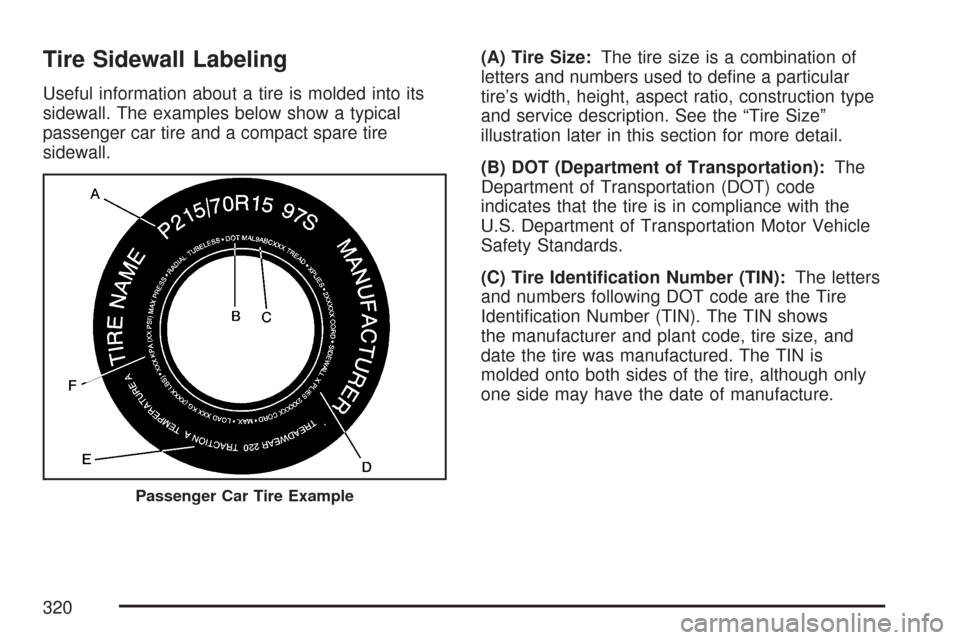
Tire Sidewall Labeling
Useful information about a tire is molded into its
sidewall. The examples below show a typical
passenger car tire and a compact spare tire
sidewall.(A) Tire Size:The tire size is a combination of
letters and numbers used to define a particular
tire’s width, height, aspect ratio, construction type
and service description. See the “Tire Size”
illustration later in this section for more detail.
(B) DOT (Department of Transportation):The
Department of Transportation (DOT) code
indicates that the tire is in compliance with the
U.S. Department of Transportation Motor Vehicle
Safety Standards.
(C) Tire Identication Number (TIN):The letters
and numbers following DOT code are the Tire
Identification Number (TIN). The TIN shows
the manufacturer and plant code, tire size, and
date the tire was manufactured. The TIN is
molded onto both sides of the tire, although only
one side may have the date of manufacture.
Passenger Car Tire Example
320
Page 322 of 436
(B) Tire Ply Material:The type of cord and
number of plies in the sidewall and under the tread.
(C) Tire Identication Number (TIN):The Tire
Identification Number (TIN). The TIN shows
the manufacturer and plant code, tire size, and
date the tire was manufactured. The TIN is
molded onto both sides of the tire, although only
one side may have the date of manufacture.
(D) Maximum Cold Ination Load
Limit:Maximum load that can be carried and the
maximum pressure needed to support that
load. SeeCompact Spare Tire on page 344and
Loading Your Vehicle on page 249.
(E) Tire Ination:The temporary use tire or
compact spare tire should be inflated to 60 psi
(420 kPa). For more information on tire pressure
and inflation seeInflation - Tire Pressure on
page 326.
(F) Tire Size:A combination of letters and
numbers define a tire’s width, height, aspect ratio,
construction type and service description. The
letter T as the first character in the tire size means
the tire is for temporary use only.Tire Size
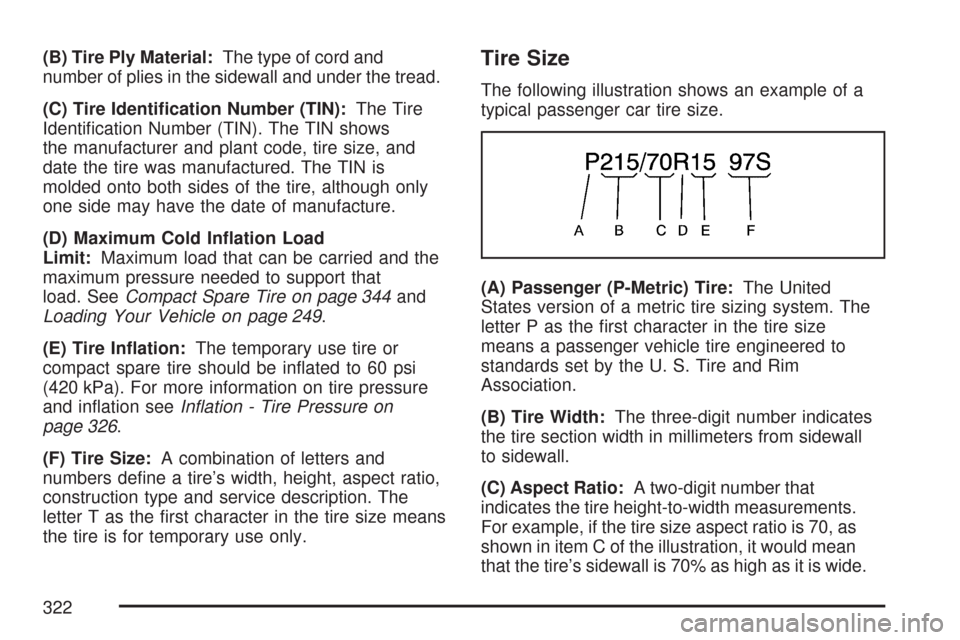
The following illustration shows an example of a
typical passenger car tire size.
(A) Passenger (P-Metric) Tire:The United
States version of a metric tire sizing system. The
letter P as the first character in the tire size
means a passenger vehicle tire engineered to
standards set by the U. S. Tire and Rim
Association.
(B) Tire Width:The three-digit number indicates
the tire section width in millimeters from sidewall
to sidewall.
(C) Aspect Ratio:A two-digit number that
indicates the tire height-to-width measurements.
For example, if the tire size aspect ratio is 70, as
shown in item C of the illustration, it would mean
that the tire’s sidewall is 70% as high as it is wide.
322
Page 371 of 436

Maintenance Schedule................................ 372
Introduction............................................... 372
Maintenance Requirements........................ 372
Your Vehicle and the Environment............ 372
How This Section is Organized................. 373
Part A: Scheduled Maintenance Services.... 374
Using the Maintenance Schedule............... 374
Selecting the Right Schedule..................... 375
Short Trip/City Scheduled Maintenance..... 376
Long Trip/Highway Scheduled
Maintenance.......................................... 384
Part B: Owner Checks and Services......... 389
At Each Fuel Fill....................................... 389At Least Once a Month............................. 389
At Least Twice a Year.............................. 389
At Least Once a Year............................... 390
Part C: Periodic Maintenance Inspections.... 394
Steering, Suspension and Front Drive
Axle Boot and Seal Inspection............... 394
Exhaust System Inspection........................ 394
Fuel System Inspection............................. 395
Engine Cooling System Inspection............. 395
Brake System Inspection........................... 395
Part D: Recommended Fluids and
Lubricants.............................................. 396
Part E: Maintenance Record...................... 398
Section 6 Maintenance Schedule
371
Page 373 of 436
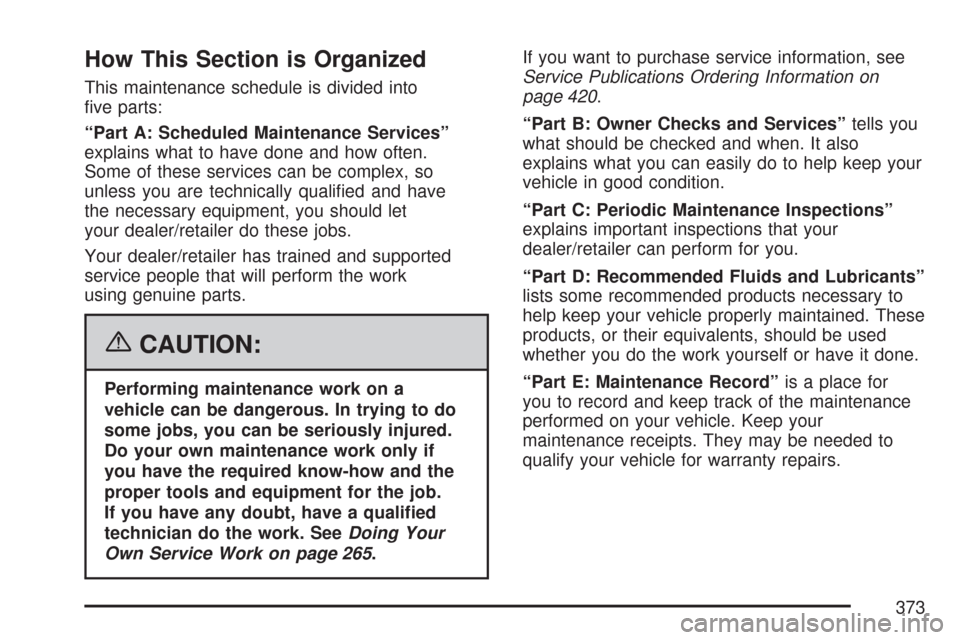
How This Section is Organized
This maintenance schedule is divided into
five parts:
“Part A: Scheduled Maintenance Services”
explains what to have done and how often.
Some of these services can be complex, so
unless you are technically qualified and have
the necessary equipment, you should let
your dealer/retailer do these jobs.
Your dealer/retailer has trained and supported
service people that will perform the work
using genuine parts.
{CAUTION:
Performing maintenance work on a
vehicle can be dangerous. In trying to do
some jobs, you can be seriously injured.
Do your own maintenance work only if
you have the required know-how and the
proper tools and equipment for the job.
If you have any doubt, have a qualied
technician do the work. SeeDoing Your
Own Service Work on page 265.If you want to purchase service information, see
Service Publications Ordering Information on
page 420.
“Part B: Owner Checks and Services”tells you
what should be checked and when. It also
explains what you can easily do to help keep your
vehicle in good condition.
“Part C: Periodic Maintenance Inspections”
explains important inspections that your
dealer/retailer can perform for you.
“Part D: Recommended Fluids and Lubricants”
lists some recommended products necessary to
help keep your vehicle properly maintained. These
products, or their equivalents, should be used
whether you do the work yourself or have it done.
“Part E: Maintenance Record”is a place for
you to record and keep track of the maintenance
performed on your vehicle. Keep your
maintenance receipts. They may be needed to
qualify your vehicle for warranty repairs.
373
Page 401 of 436
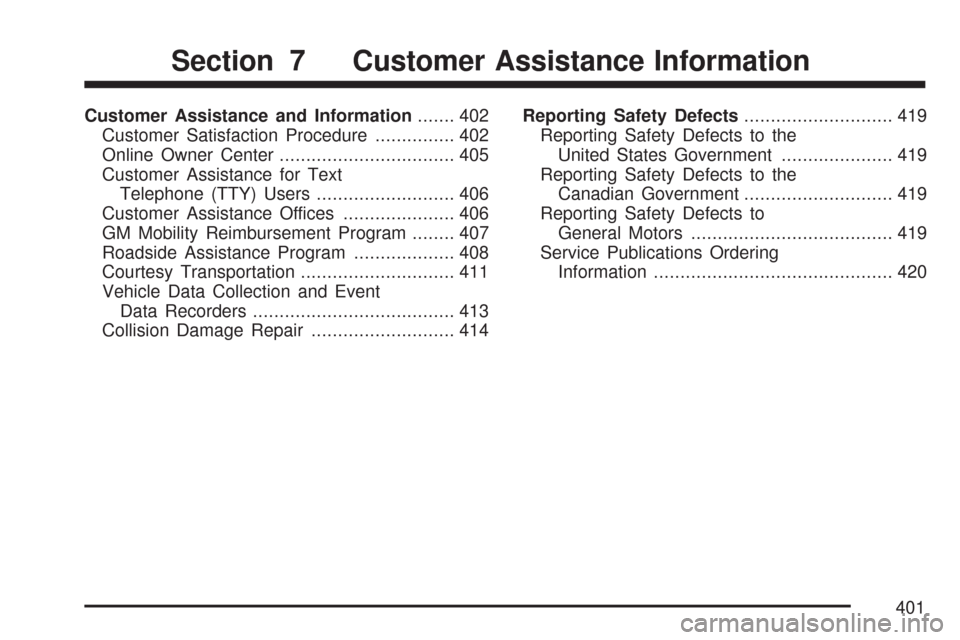
Customer Assistance and Information....... 402
Customer Satisfaction Procedure............... 402
Online Owner Center................................. 405
Customer Assistance for Text
Telephone (TTY) Users.......................... 406
Customer Assistance Offices..................... 406
GM Mobility Reimbursement Program........ 407
Roadside Assistance Program................... 408
Courtesy Transportation............................. 411
Vehicle Data Collection and Event
Data Recorders...................................... 413
Collision Damage Repair........................... 414Reporting Safety Defects............................ 419
Reporting Safety Defects to the
United States Government..................... 419
Reporting Safety Defects to the
Canadian Government............................ 419
Reporting Safety Defects to
General Motors...................................... 419
Service Publications Ordering
Information............................................. 420
Section 7 Customer Assistance Information
401
Page 405 of 436
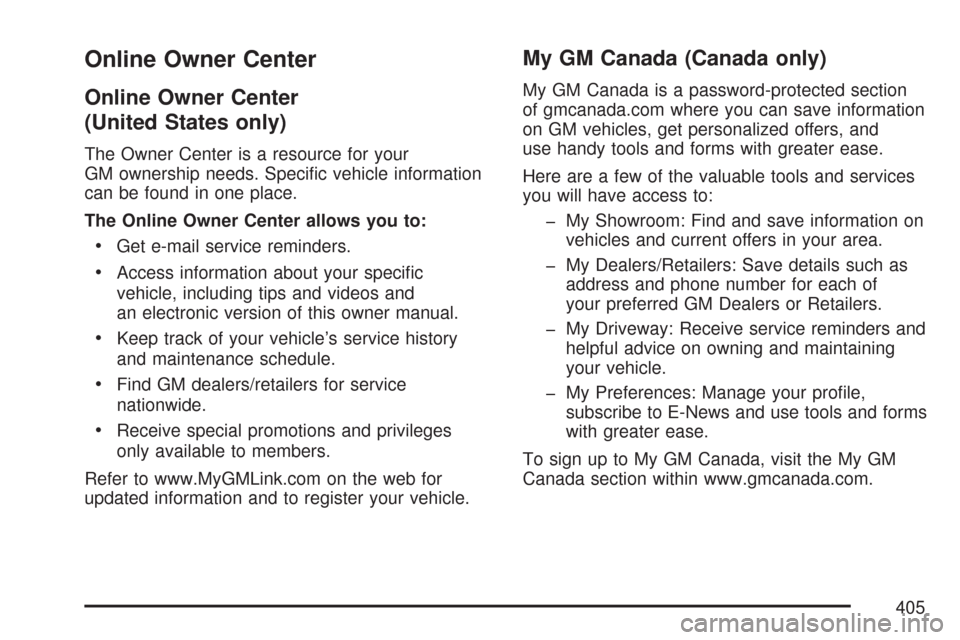
Online Owner Center
Online Owner Center
(United States only)
The Owner Center is a resource for your
GM ownership needs. Specific vehicle information
can be found in one place.
The Online Owner Center allows you to:
•Get e-mail service reminders.
•Access information about your specific
vehicle, including tips and videos and
an electronic version of this owner manual.
•Keep track of your vehicle’s service history
and maintenance schedule.
•Find GM dealers/retailers for service
nationwide.
•Receive special promotions and privileges
only available to members.
Refer to www.MyGMLink.com on the web for
updated information and to register your vehicle.
My GM Canada (Canada only)
My GM Canada is a password-protected section
of gmcanada.com where you can save information
on GM vehicles, get personalized offers, and
use handy tools and forms with greater ease.
Here are a few of the valuable tools and services
you will have access to:
- My Showroom: Find and save information on
vehicles and current offers in your area.
- My Dealers/Retailers: Save details such as
address and phone number for each of
your preferred GM Dealers or Retailers.
- My Driveway: Receive service reminders and
helpful advice on owning and maintaining
your vehicle.
- My Preferences: Manage your profile,
subscribe to E-News and use tools and forms
with greater ease.
To sign up to My GM Canada, visit the My GM
Canada section within www.gmcanada.com.
405