Page 238 of 436
City Driving
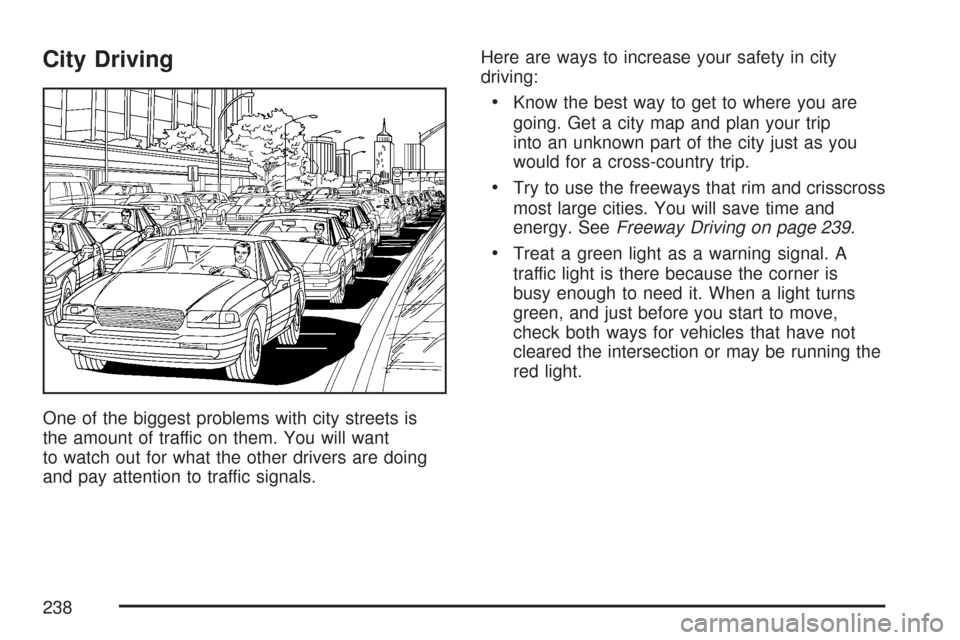
One of the biggest problems with city streets is
the amount of traffic on them. You will want
to watch out for what the other drivers are doing
and pay attention to traffic signals.Here are ways to increase your safety in city
driving:
•Know the best way to get to where you are
going. Get a city map and plan your trip
into an unknown part of the city just as you
would for a cross-country trip.
•Try to use the freeways that rim and crisscross
most large cities. You will save time and
energy. SeeFreeway Driving on page 239.
•Treat a green light as a warning signal. A
traffic light is there because the corner is
busy enough to need it. When a light turns
green, and just before you start to move,
check both ways for vehicles that have not
cleared the intersection or may be running the
red light.
238
Page 250 of 436
Tire and Loading Information
Label - United States
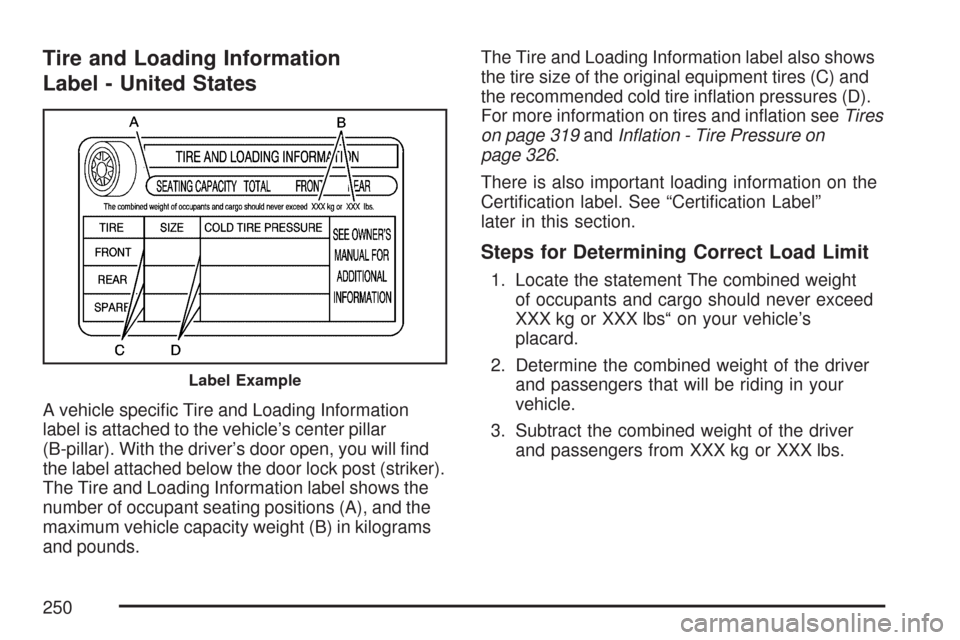
A vehicle specific Tire and Loading Information
label is attached to the vehicle’s center pillar
(B-pillar). With the driver’s door open, you will find
the label attached below the door lock post (striker).
The Tire and Loading Information label shows the
number of occupant seating positions (A), and the
maximum vehicle capacity weight (B) in kilograms
and pounds.The Tire and Loading Information label also shows
the tire size of the original equipment tires (C) and
the recommended cold tire inflation pressures (D).
For more information on tires and inflation seeTires
on page 319andInflation - Tire Pressure on
page 326.
There is also important loading information on the
Certification label. See “Certification Label”
later in this section.
Steps for Determining Correct Load Limit
1. Locate the statement The combined weight
of occupants and cargo should never exceed
XXX kg or XXX lbs“ on your vehicle’s
placard.
2. Determine the combined weight of the driver
and passengers that will be riding in your
vehicle.
3. Subtract the combined weight of the driver
and passengers from XXX kg or XXX lbs.
Label Example
250
Page 253 of 436
Tire and Loading Information
Label - Canada
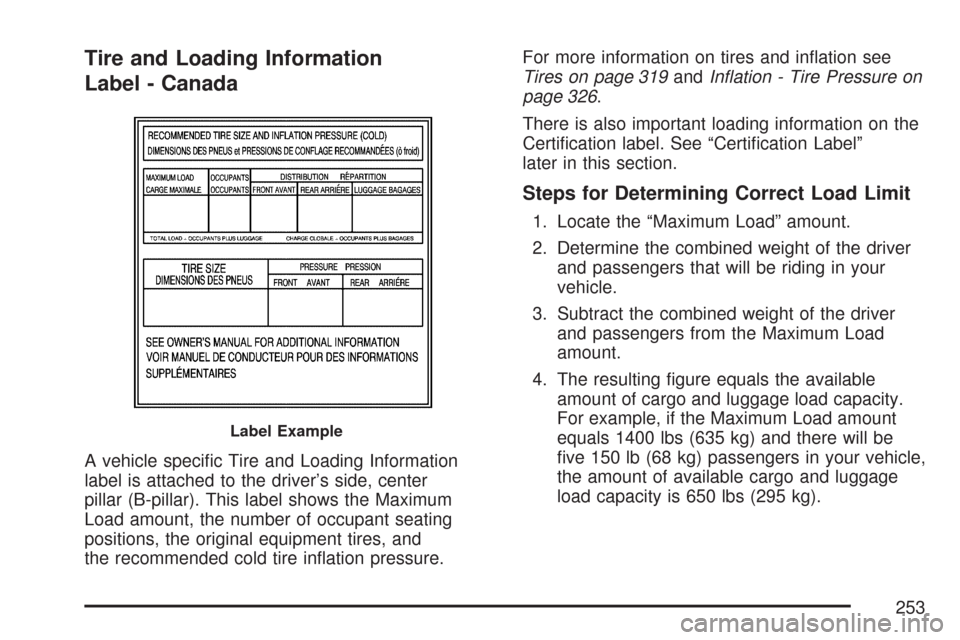
A vehicle specific Tire and Loading Information
label is attached to the driver’s side, center
pillar (B-pillar). This label shows the Maximum
Load amount, the number of occupant seating
positions, the original equipment tires, and
the recommended cold tire inflation pressure.For more information on tires and inflation see
Tires on page 319andInflation - Tire Pressure on
page 326.
There is also important loading information on the
Certification label. See “Certification Label”
later in this section.
Steps for Determining Correct Load Limit
1. Locate the “Maximum Load” amount.
2. Determine the combined weight of the driver
and passengers that will be riding in your
vehicle.
3. Subtract the combined weight of the driver
and passengers from the Maximum Load
amount.
4. The resulting figure equals the available
amount of cargo and luggage load capacity.
For example, if the Maximum Load amount
equals 1400 lbs (635 kg) and there will be
five 150 lb (68 kg) passengers in your vehicle,
the amount of available cargo and luggage
load capacity is 650 lbs (295 kg).
Label Example
253
Page 256 of 436
Certication Label
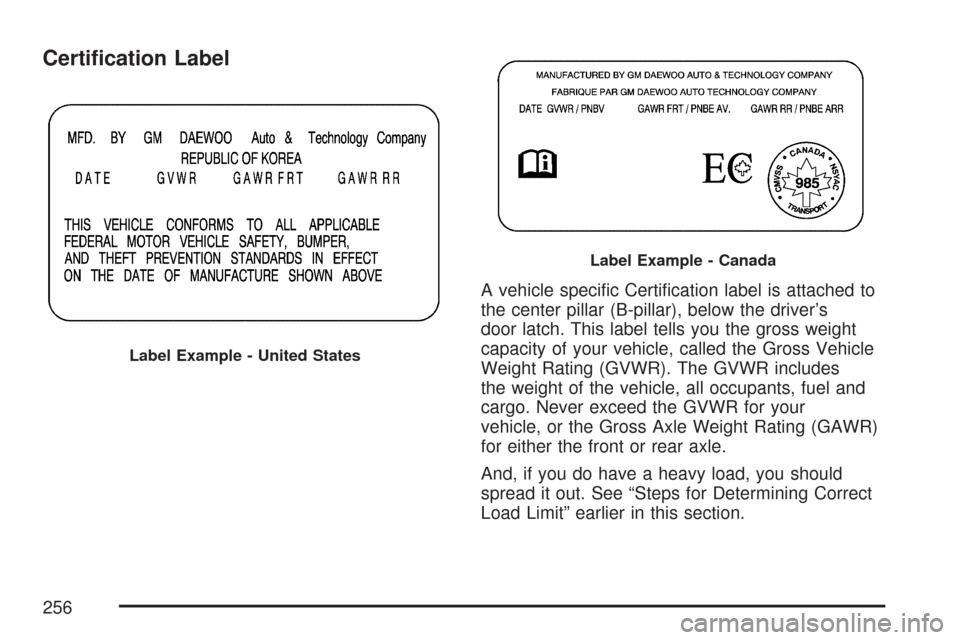
A vehicle specific Certification label is attached to
the center pillar (B-pillar), below the driver’s
door latch. This label tells you the gross weight
capacity of your vehicle, called the Gross Vehicle
Weight Rating (GVWR). The GVWR includes
the weight of the vehicle, all occupants, fuel and
cargo. Never exceed the GVWR for your
vehicle, or the Gross Axle Weight Rating (GAWR)
for either the front or rear axle.
And, if you do have a heavy load, you should
spread it out. See “Steps for Determining Correct
Load Limit” earlier in this section.
Label Example - United States
Label Example - Canada
256
Page 261 of 436

Service........................................................ 264
Accessories and Modifications................... 264
California Proposition 65 Warning.............. 265
Doing Your Own Service Work.................. 265
Adding Equipment to the Outside of
Your Vehicle.......................................... 266
Fuel............................................................. 266
Gasoline Octane........................................ 266
Gasoline Specifications.............................. 266
California Fuel........................................... 267
Additives................................................... 267
Fuels in Foreign Countries........................ 268
Filling the Tank......................................... 269
Filling a Portable Fuel Container............... 272
Checking Things Under the Hood.............. 273
Hood Release........................................... 274
Engine Compartment Overview.................. 276
Engine Oil................................................. 277
Engine Air Cleaner/Filter............................ 281
Automatic Transaxle Fluid......................... 283Manual Transaxle Fluid............................. 285
Hydraulic Clutch........................................ 286
Engine Coolant.......................................... 287
Coolant Surge Tank Pressure Cap............ 290
Engine Overheating................................... 290
Cooling System......................................... 292
Power Steering Fluid................................. 297
Windshield Washer Fluid........................... 298
Brakes...................................................... 299
Battery...................................................... 303
Jump Starting............................................ 304
Headlamp Aiming........................................ 309
Bulb Replacement....................................... 309
Halogen Bulbs........................................... 309
Headlamps (Hatchback)............................. 310
Headlamps (Sedan)................................... 311
Front Turn Signal and Parking Lamps
(Hatchback)............................................ 312
Front Turn Signal and Parking Lamps
(Sedan).................................................. 313
Section 5 Service and Appearance Care
261
Page 262 of 436
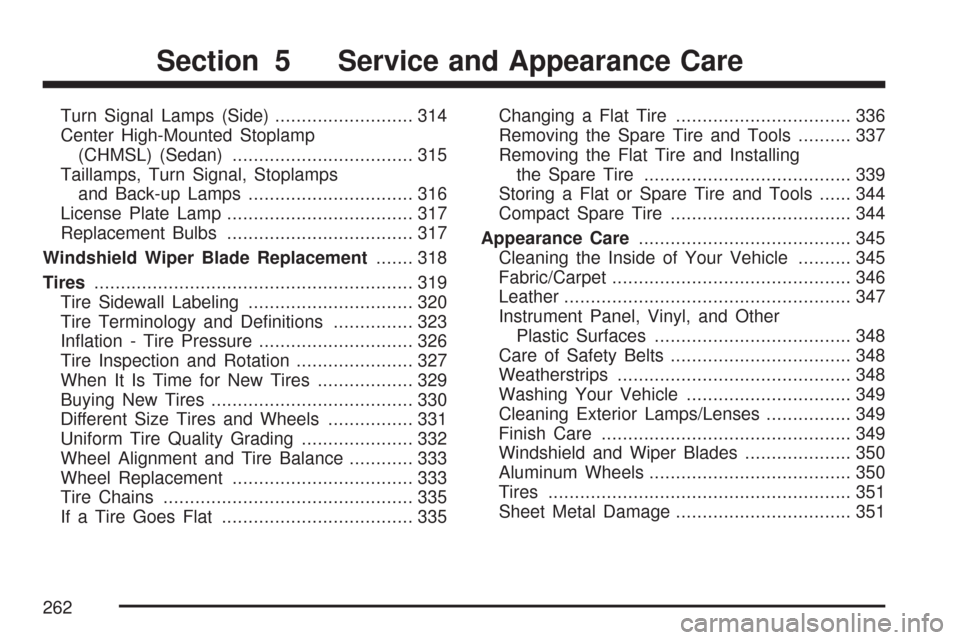
Turn Signal Lamps (Side).......................... 314
Center High-Mounted Stoplamp
(CHMSL) (Sedan).................................. 315
Taillamps, Turn Signal, Stoplamps
and Back-up Lamps............................... 316
License Plate Lamp................................... 317
Replacement Bulbs................................... 317
Windshield Wiper Blade Replacement....... 318
Tires............................................................ 319
Tire Sidewall Labeling............................... 320
Tire Terminology and Definitions............... 323
Inflation - Tire Pressure............................. 326
Tire Inspection and Rotation...................... 327
When It Is Time for New Tires.................. 329
Buying New Tires...................................... 330
Different Size Tires and Wheels................ 331
Uniform Tire Quality Grading..................... 332
Wheel Alignment and Tire Balance............ 333
Wheel Replacement.................................. 333
Tire Chains............................................... 335
If a Tire Goes Flat.................................... 335Changing a Flat Tire................................. 336
Removing the Spare Tire and Tools.......... 337
Removing the Flat Tire and Installing
the Spare Tire....................................... 339
Storing a Flat or Spare Tire and Tools...... 344
Compact Spare Tire.................................. 344
Appearance Care........................................ 345
Cleaning the Inside of Your Vehicle.......... 345
Fabric/Carpet............................................. 346
Leather...................................................... 347
Instrument Panel, Vinyl, and Other
Plastic Surfaces..................................... 348
Care of Safety Belts.................................. 348
Weatherstrips............................................ 348
Washing Your Vehicle............................... 349
Cleaning Exterior Lamps/Lenses................ 349
Finish Care............................................... 349
Windshield and Wiper Blades.................... 350
Aluminum Wheels...................................... 350
Tires......................................................... 351
Sheet Metal Damage................................. 351
Section 5 Service and Appearance Care
262
Page 263 of 436
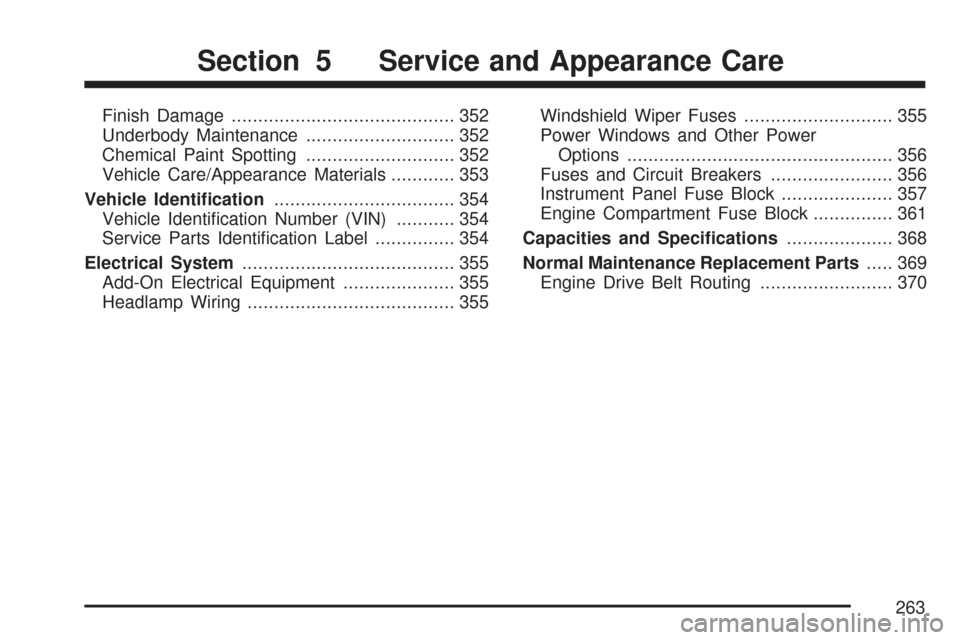
Finish Damage.......................................... 352
Underbody Maintenance............................ 352
Chemical Paint Spotting............................ 352
Vehicle Care/Appearance Materials............ 353
Vehicle Identication.................................. 354
Vehicle Identification Number (VIN)........... 354
Service Parts Identification Label............... 354
Electrical System........................................ 355
Add-On Electrical Equipment..................... 355
Headlamp Wiring....................................... 355Windshield Wiper Fuses............................ 355
Power Windows and Other Power
Options.................................................. 356
Fuses and Circuit Breakers....................... 356
Instrument Panel Fuse Block..................... 357
Engine Compartment Fuse Block............... 361
Capacities and Specications.................... 368
Normal Maintenance Replacement Parts..... 369
Engine Drive Belt Routing......................... 370
Section 5 Service and Appearance Care
263
Page 278 of 436
Checking Engine Oil
It is a good idea to check the engine oil every time
you get fuel. In order to get an accurate reading,
the oil must be warm and the vehicle must be
on level ground.
The engine oil dipstick handle is a yellow loop.
SeeEngine Compartment Overview on page 276
for the location of the engine oil dipstick.
1. Turn off the engine and give the oil several
minutes to drain back into the oil pan. If you
do not do this, the oil dipstick might not
show the actual level.
2. Pull the dipstick and clean it with a paper
towel or cloth, then push it back in all the
way. Remove it again, keeping the tip down
and check the level.
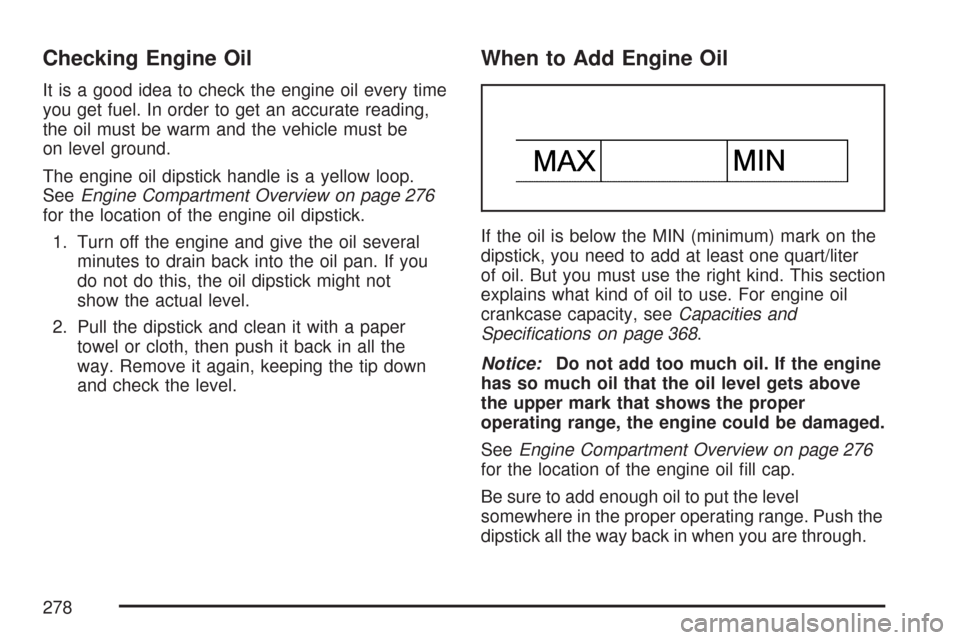
When to Add Engine Oil
If the oil is below the MIN (minimum) mark on the
dipstick, you need to add at least one quart/liter
of oil. But you must use the right kind. This section
explains what kind of oil to use. For engine oil
crankcase capacity, seeCapacities and
Specifications on page 368.
Notice:Do not add too much oil. If the engine
has so much oil that the oil level gets above
the upper mark that shows the proper
operating range, the engine could be damaged.
SeeEngine Compartment Overview on page 276
for the location of the engine oil fill cap.
Be sure to add enough oil to put the level
somewhere in the proper operating range. Push the
dipstick all the way back in when you are through.
278