2007 AUDI R8 lock
[x] Cancel search: lockPage 4 of 210

Contents 2ContentsNotes on this Owner's
Manual
. . . . . . . . . . . . . . . . . . . . . .
Controls
. . . . . . . . . . . . . . . . . . . . .
Controls and displays
. . . . . . . . . .
Overview . . . . . . . . . . . . . . . . . . . . . .
Instruments and
warning/indicator lamps
. . . . . . .
Instruments . . . . . . . . . . . . . . . . . . . .
Warning and indicator lamps . . . . .
Driver information system
. . . . . .
Introduction . . . . . . . . . . . . . . . . . . . .
Service interval display . . . . . . . . . .
On-board computer . . . . . . . . . . . . .
Menus . . . . . . . . . . . . . . . . . . . . . . . . .
Lap timer . . . . . . . . . . . . . . . . . . . . . .
Speed warning function . . . . . . . . .
Notes and symbols . . . . . . . . . . . . .
Doors and windows
. . . . . . . . . . . .
Remote control keys . . . . . . . . . . . .
Central locking system . . . . . . . . . .
Luggage lid . . . . . . . . . . . . . . . . . . . .
Anti-theft alarm system . . . . . . . . . .
Electric windows . . . . . . . . . . . . . . .
Lights and vision
. . . . . . . . . . . . . .
Lights . . . . . . . . . . . . . . . . . . . . . . . . .
Interior lights . . . . . . . . . . . . . . . . . .
Clear vision . . . . . . . . . . . . . . . . . . . .
Windscreen wipers . . . . . . . . . . . . .
Rear-view mirrors . . . . . . . . . . . . . .
Digital compass . . . . . . . . . . . . . . . .
Seats and storage
. . . . . . . . . . . . .
Manually adjustable front seats . .
Electrically adjustable front seats
Bucket seats . . . . . . . . . . . . . . . . . . .
Head restraints . . . . . . . . . . . . . . . .
Cup holders . . . . . . . . . . . . . . . . . . .
Ashtray . . . . . . . . . . . . . . . . . . . . . . .
Cigarette lighter and electrical
socket . . . . . . . . . . . . . . . . . . . . . . . .
Storage compartments . . . . . . . . .
Heating and cooling
. . . . . . . . . . .
Air conditioner . . . . . . . . . . . . . . . . .
Rear window heating . . . . . . . . .
Seat heating . . . . . . . . . . . . . . . . . . .
Driving
. . . . . . . . . . . . . . . . . . . . . . . . .
Steering . . . . . . . . . . . . . . . . . . . . . . .
Ignition lock . . . . . . . . . . . . . . . . . . .
Starting the engine . . . . . . . . . . . . .
Switching off the engine . . . . . . . .
Handbrake . . . . . . . . . . . . . . . . . . . .
Parking aid . . . . . . . . . . . . . . . . . . . .
Cruise control system . . . . . . . . . .
Audi magnetic ride . . . . . . . . . . . . .
Automatic gearbox
. . . . . . . . . . . .
Description . . . . . . . . . . . . . . . . . . . .
Manual mode . . . . . . . . . . . . . . . . . .
Automatic mode . . . . . . . . . . . . . . .
Kick-down feature . . . . . . . . . . . . . . Launch control programme . . . . . .
Steering wheel with paddle levers
Backup programme . . . . . . . . . . . . .
HomeLink
. . . . . . . . . . . . . . . . . . . . . .
Universal transmitter . . . . . . . . . . . .
Safety
. . . . . . . . . . . . . . . . . . . . . . .
Safe driving
. . . . . . . . . . . . . . . . . . . .
General notes . . . . . . . . . . . . . . . . . .
Correct sitting positions . . . . . . . . .
Pedal area . . . . . . . . . . . . . . . . . . . . .
Stowing luggage safely . . . . . . . . .
Seat belts
. . . . . . . . . . . . . . . . . . . . . .
Why is it so important to use seat
belts? . . . . . . . . . . . . . . . . . . . . . . . . .
Forces acting in a collision . . . . . .
How to wear seat belts properly .
Belt tensioners . . . . . . . . . . . . . . . . .
Airbag system
. . . . . . . . . . . . . . . . . .
Description of airbag system . . . .
Front airbags . . . . . . . . . . . . . . . . . .
Side airbags . . . . . . . . . . . . . . . . . . .
Deactivating the airbags . . . . . . . . 5
7
9
9
10
10
15
20
20
21
22
24
27
31
33
40
40
42
47
48
5052
52
57
58
59
63
65
67
67
68
70
71
72
72
72
73
75
75
79
80
81
81
81
82
83
83
85
86
88
90
90
91
92
9293
93
94
95
95
101
102
102
104
107
108
109
109
110
112
114
115
115
116
118
120
document_0900452a816e6cc9.book Seite 2 Mittwoch, 21. Februar 2007 1:32 13
Page 11 of 210

Controls and displays9
Controls
Safety
Driving tips
General maintenance
Self-help
Technical data
Controls and displaysOverview
Electric windows . . . . . . . . . . . . . . . . . . . . . . . . . . . . . . .
Door handle
Central locking switch . . . . . . . . . . . . . . . . . . . . . . . . . . .
Electric adjuster for exterior mirrors . . . . . . . . . . . . . . .
Switches for
−Unlocking the luggage lid . . . . . . . . . . . . . . . . . . . . .
−Unlocking the fuel tank flap . . . . . . . . . . . . . . . . . . . .
Air outlets . . . . . . . . . . . . . . . . . . . . . . . . . . . . . . . . . . . . .
Light switch . . . . . . . . . . . . . . . . . . . . . . . . . . . . . . . . . . .
Lever for turn signals and main beam headlights . . . .
Steering wheel with:
−Horn
−Driver's airbag . . . . . . . . . . . . . . . . . . . . . . . . . . . . . . .
−Controls for audio, telephone and speech dialogue
system
−Paddle levers for manual gearshift (R tronic) . . . . . .
Instrument cluster . . . . . . . . . . . . . . . . . . . . . . . . . . . . . .
Levers and switches for:
−Windscreen wipers and washer . . . . . . . . . . . . . . . . .
−On-board computer . . . . . . . . . . . . . . . . . . . . . . . . . . .
−Menu display . . . . . . . . . . . . . . . . . . . . . . . . . . . . . . . .
−Lap timer . . . . . . . . . . . . . . . . . . . . . . . . . . . . . . . . . . .
−Speed warning function . . . . . . . . . . . . . . . . . . . . . . .
Navigation system
Lockable glove box . . . . . . . . . . . . . . . . . . . . . . . . . . . . .
Front passenger's airbag . . . . . . . . . . . . . . . . . . . . . . . .
Switch for heated rear window . . . . . . . . . . . . . . . . . . . Air conditioner . . . . . . . . . . . . . . . . . . . . . . . . . . . . . . . . .
Gear lever/selector lever for:
−Manual gearbox
−R tronic . . . . . . . . . . . . . . . . . . . . . . . . . . . . . . . . . . . . .
Controls for:
−Audi magnetic ride . . . . . . . . . . . . . . . . . . . . . . . . . . .
−Electronic Stabilisation Program (ESP) . . . . . . . . . . .
−Hazard warning lights . . . . . . . . . . . . . . . . . . . . . . . . .
−Automatic rear spoiler . . . . . . . . . . . . . . . . . . . . . . . . .
−Audi parking system . . . . . . . . . . . . . . . . . . . . . . . . . .
Ashtray, cigarette lighter/socket
Handbrake . . . . . . . . . . . . . . . . . . . . . . . . . . . . . . . . . . . . .
Ignition lock . . . . . . . . . . . . . . . . . . . . . . . . . . . . . . . . . . .
Adjustable steering column . . . . . . . . . . . . . . . . . . . . . .
Lever for cruise control . . . . . . . . . . . . . . . . . . . . . . . . . .
Instrument lighting . . . . . . . . . . . . . . . . . . . . . . . . . . . . .
Engine lid lock release . . . . . . . . . . . . . . . . . . . . . . . . . . .
Note
•
Separate operating instructions are enclosed if the vehicle is
equipped with a factory-fitted navigation system.
•
The arrangement of switches and controls on right-hand drive
models* may be slightly different from the layout shown in
⇒page 8, fig. 1. However, the symbols used to identify the controls
are the same.
A1
50
A2A3
45
A4
64
A5
47
152
A6
77
A7
52
A8
56
A9
116
93
A10
10
A11
59
22
24
27
31
A12A13
73
A14
116
A15
79
A16
75
A17
90
A18
88
132
56
134
85
A19A20
83
A21
81
A22
81
A23
86
A24
55
A25
155
document_0900452a816e6cc9.book Seite 9 Mittwoch, 21. Februar 2007 1:32 13
Page 12 of 210

Instruments and warning/indicator lamps 10Instruments and warning/indicator lampsInstrumentsInstrument cluster overview
The instrument cluster is the driver's information centre.Fig. 2 Instrument cluster
Engine oil temperature gauge . . . . . . . . . . . . . . . . . . . .
Rev counter incorporating digital clock and date . . . .
Warning and indicator lamps . . . . . . . . . . . . . . . . . . . .
Coolant temperature gauge . . . . . . . . . . . . . . . . . . . . . .
Fuel gauge . . . . . . . . . . . . . . . . . . . . . . . . . . . . . . . . . . . .
Speedometer with mileage recorder . . . . . . . . . . . . . .
Voltmeter . . . . . . . . . . . . . . . . . . . . . . . . . . . . . . . . . . . . .
Adjuster/test button . . . . . . . . . . . . . . . . . . . . . . . . . . . . Driver information system . . . . . . . . . . . . . . . . . . . . . . .
Reset button for trip recorder . . . . . . . . . . . . . . . . . . . .
The needles on the dials in the instrument cluster are illuminated
when the ignition is switched on. The main instrument lighting (for
the dials and needles) comes on when the vehicle's lights are
switched on.
Engine oil temperature gaugeThe engine oil temperature gauge ⇒fig. 2 only works when the igni-
tion is switched on. In order to avoid possible damage to the engine,
please read the following notes for the different temperature
ranges.
Engine cold
If the needle is still in the lower range of the dial, this indicates that
the engine oil has not yet reached operating temperature. Avoid
high engine speeds, full acceleration and heavy engine loads.
Normal temperature
In normal operation the needle will settle somewhere in the centre
of the dial once the engine has reached operating temperature. The
needle may also go further up when the engine is working hard at
high outside temperatures. This is no cause for concern provided
the warning lamp
in the display does not start flashing.
Warning lamp
If the symbol
in the display flashes, either the engine oil temper-
ature is too high, or the engine oil level is too low ⇒page 157.
If the needle is at the top end of the dial, this means the engine oil
temperature is too high. Stop the vehicle, switch off the engine and
wait for it to cool down. If the warning lamp starts flashing again
after just a short distance, contact a qualified workshop.
A1
10
A2
11, 12
A3
15
A4
12
A5
13
A6
13
A7
14
A8
12, 34
A9
20
A10
13
document_0900452a816e6cc9.book Seite 10 Mittwoch, 21. Februar 2007 1:32 13
Page 13 of 210

Instruments and warning/indicator lamps11
Controls
Safety
Driving tips
General maintenance
Self-help
Technical data
Rev counter
The rev counter indicates the number of engine revolu-
tions per minute.You should select a lower gear if the engine speed drops below
1500 rpm. The start of the red zone on the dial indicates the
maximum engine speed which may be used briefly when the engine
is warm and after it has been run in properly. However, it is advisable
to change up a gear or lift your foot off the accelerator (or shift out
of the R tronic sport mode) before the needle reaches the red zone.
Caution
Never allow the rev counter needle ⇒page 10, fig. 2 to go into
the red zone on the scale for more than a very brief period: there is
a risk of damaging the engine. The start of the red zone on the dial
is different for some engine versions.Radio-controlled clockWhen the clock is in “radio-control” mode the signal recep-
tion symbol (a radio tower with radio waves) appears in the
display ⇒fig. 3. It is then not possible to change the
minutes or the date manually. If you take your vehicle into a different time zone, the hour display will need to be
adjusted manually to local time using the adjuster button.
Setting the time zone
– Keep pulling the button ⇒fig. 3 briefly until the time
zone display flashes (select setting “0” if you do not wish
to change the time zone).
– Then turn the button to the left (to set an earlier time
zone: -1/-2) or to the right (to set a later time zone: +1/+2).
Switching date display on and off
– Keep pulling the button briefly until the date display
flashes.
– Then turn the button to the left or right.
When the display stops flashing, this means the setting you are
performing is completed and the time zone has been successfully
stored.
If the clock does not receive a radio signal for three consecutive
days, it will automatically switch to “quartz” mode. The signal recep-
tion symbol will then disappear. If you need to reset the time and
date, proceed as described on ⇒page 12.
A2
Fig. 3 Detail of the
instrument cluster:
Display with signal
reception symbol, time
and date
document_0900452a816e6cc9.book Seite 11 Mittwoch, 21. Februar 2007 1:32 13
Page 14 of 210
Instruments and warning/indicator lamps 12Digital clock with date display
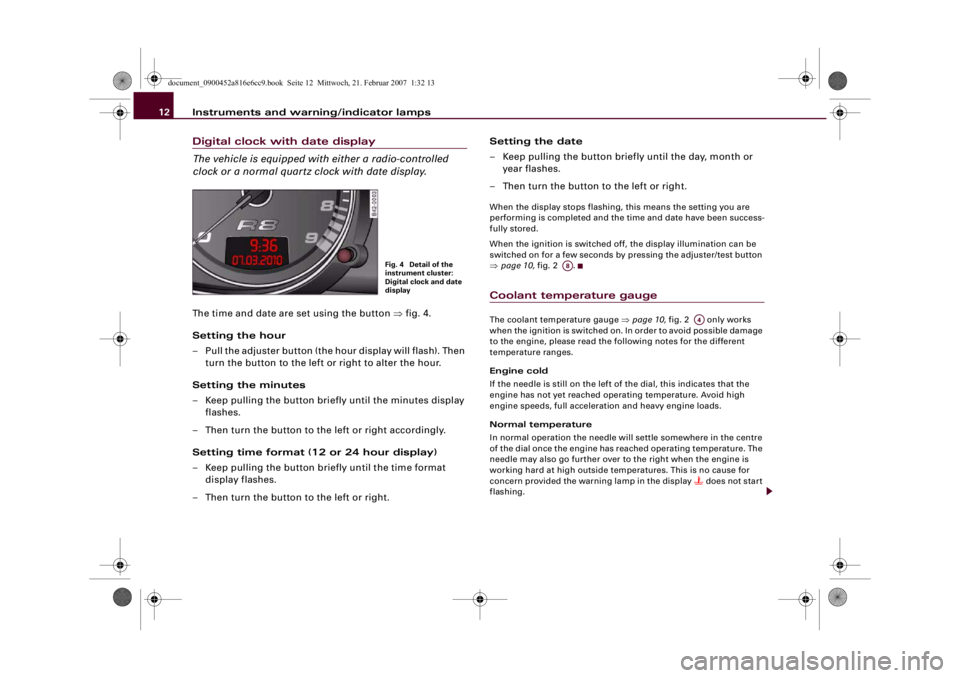
The vehicle is equipped with either a radio-controlled
clock or a normal quartz clock with date display.The time and date are set using the button ⇒fig. 4.
Setting the hour
– Pull the adjuster button (the hour display will flash). Then
turn the button to the left or right to alter the hour.
Setting the minutes
– Keep pulling the button briefly until the minutes display
flashes.
– Then turn the button to the left or right accordingly.
Setting time format (12 or 24 hour display)
– Keep pulling the button briefly until the time format
display flashes.
– Then turn the button to the left or right.Setting the date
– Keep pulling the button briefly until the day, month or
year flashes.
– Then turn the button to the left or right.
When the display stops flashing, this means the setting you are
performing is completed and the time and date have been success-
fully stored.
When the ignition is switched off, the display illumination can be
switched on for a few seconds by pressing the adjuster/test button
⇒page 10, fig. 2 .Coolant temperature gaugeThe coolant temperature gauge ⇒page 10, fig. 2 only works
when the ignition is switched on. In order to avoid possible damage
to the engine, please read the following notes for the different
temperature ranges.
Engine cold
If the needle is still on the left of the dial, this indicates that the
engine has not yet reached operating temperature. Avoid high
engine speeds, full acceleration and heavy engine loads.
Normal temperature
In normal operation the needle will settle somewhere in the centre
of the dial once the engine has reached operating temperature. The
needle may also go further over to the right when the engine is
working hard at high outside temperatures. This is no cause for
concern provided the warning lamp in the display
does not start
flashing.
Fig. 4 Detail of the
instrument cluster:
Digital clock and date
display
A8
A4
document_0900452a816e6cc9.book Seite 12 Mittwoch, 21. Februar 2007 1:32 13
Page 18 of 210

Instruments and warning/indicator lamps 16
Note•
Yellow symbols are accompanied by one warning chime. The
function indicated should be checked as soon as possible.
•
A red symbol is accompanied by three warning chimes. The
symbol will keep flashing until the fault is corrected.
Applies to vehicles: with Audi magnetic rideAudi magnetic ride
This warning lamp monitors the damping effect of the
shock absorbers.The warning lamp
lights up when the ignition is switched on.
Note
If the warning lamp lights up while the vehicle is moving, this indi-
cates a vehicle damping malfunction. The suspension should be
checked immediately by a qualified workshop.Applies to vehicles: with tyre pressure monitoring systemTyre pressure monitoring system
Th e t y re p re s s u re s h o u l d b e c o rre c t e d as s o o n as p o s s i b l e
if it is too low.If the
symbol appears, the tyre pressure on at least one
of the wheels is too low.–Stop the vehicle.
– Check the tyre(s).
– Adjust the tyre pressure ⇒page 167.
For more detailed information on the tyre pressure monitoring
system please refer to ⇒page 172.Engine management
This warning lamp monitors the engine management
system.The
warning lamp (Electronic Power Control) lights up when the
ignition is switched on to show that the lamp is working properly.Note
If the warning lamp lights up while the vehicle is moving, this indi-
cates a fault in the engine management system. The engine should
be serviced by a qualified workshop without delay.Electronic stabilisation program (ESP)
This warning lamp monitors the electronic stabilisation
program.The warning lamp
has the following functions:
•
It flashes when the ESP or traction control system (ASR) inter-
venes while the vehicle is in motion.
•
It lights up when the ignition is switched on and should go out
again after about 2 seconds. This signals that the lamp is working
properly.
•
It will light up continuously if there is a malfunction in the ESP.
•
It will light up continuously if the ESP is switched off.
Seat belt warning lamp
⇒page 18
Fault in brake system / handbrake is
applied
⇒page 18
Anti-lock brake system (ABS)
⇒page 19
document_0900452a816e6cc9.book Seite 16 Mittwoch, 21. Februar 2007 1:32 13
Page 20 of 210

Instruments and warning/indicator lamps 18If the warning lamp does not go out, or if it lights up, flashes or
flickers when the vehicle is moving, this indicates a malfunction in
the system. This is also the case if the warning lamp does not light
up when the ignition is switched on.
WARNING
If a malfunction should occur, have the system checked immedi-
ately by a qualified workshop. If this is neglected, there is a risk
that the airbag system and/or belt tensioners may not be acti-
vated in an accident.Alternator
The warning lamp signals a fault in the alternator or in
the vehicle's electrical system.The warning lamp
lights up when the ignition is switched on. It
should go out when the engine starts running.
If the warning lamp lights up when you are driving, you can
normally continue as far as the nearest qualified workshop.
However, you should avoid using electrical equipment that is not
absolutely necessary because this will drain the battery.
Caution
If the coolant warning lamp
in the instrument display lights up
as well while driving ⇒page 35, stop the vehicle immediately and
switch off the engine. In this case the coolant pump is no longer
being driven, and there is a risk of engine damage.
Seat belt warning lamp
The warning lamp acts as a reminder to fasten the seat
belts.After switching on the ignition, the warning lamp
will remain lit
until the driver has fastened his seat belt. When the vehicle has
gathered speed you will also hear a warning chime.
For further information on the seat belts ⇒page 109.
Brake system
The warning lamp flashes if the brake fluid level is too low
or if there is a fault in the ABS system.If the warning lamp
flashes (and the handbrake is not applied),
stop the vehicle and obtain professional assistance ⇒.
If a failure should occur in the ABS, the ABS warning lamp
will
light up together with the brake warning lamp
⇒.
Handbrake applied
The warning lamp
also lights up when the handbrake is applied.
If you drive by mistake with the handbrake still applied, you will hear
a warning buzzer.
WARNING
•
If the brake warning lamp does not go out, or if it lights up
when driving, the brake fluid level in the reservoir is too low – this
may cause an increased accident risk. Stop the vehicle and do not
drive on. You should obtain professional assistance.
•
If the brake warning lamp lights up together with the ABS
warning lamp, this can mean that the control function of the ABS
is out of action. As a result the rear wheels can lock relatively
easily when braking. This could cause the tail of the vehicle to skid
document_0900452a816e6cc9.book Seite 18 Mittwoch, 21. Februar 2007 1:32 13
Page 21 of 210

Instruments and warning/indicator lamps19
Controls
Safety
Driving tips
General maintenance
Self-help
Technical data sideways. Drive carefully to the nearest qualified workshop and
have the fault rectified.
Anti-lock brake system (ABS)
The warning lamp monitors the ABS and the electronic
differential lock (EDL).The warning lamp
lights up for a few seconds when the ignition
is switched on and while the engine is being started. The lamp goes
out again once the system has run through an automatic test
sequence.
There is a fault in the ABS if:
•
the warning lamp
does not light up when the ignition is
switched on,
•
the warning lamp does not go out again after a few seconds,
•
the warning lamp lights up when the vehicle is moving.
The vehicle can still be braked in the normal way (except that the
ABS control function is out of action). Please take the vehicle to a
qualified workshop as soon as possible. For further information on
the ABS ⇒page 132.
If a fault occurs in the ABS, the ESP warning lamp will also light up.
Fault in the main brake system
If the ABS warning lamp
lights up together with the brake
warning lamp
⇒page 35, this indicates a fault in the ABS func-
tion, and possibly a malfunction in the main brake system as well
⇒.
If there is a malfunction in the brake system the symbol
will light
up in the instrument cluster. Please refer to ⇒page 18.Fault on the electronic differential lock (EDL)
The EDL works in conjunction with the ABS. If a malfunction should
occur in the EDL, this is indicated by the ABS warning lamp
.
Please take the vehicle to a qualified workshop as soon as possible.
For further information on the EDL ⇒page 132.
WARNING
•
If the brake warning lamp
lights up together with the ABS
warning lamp
, the brake fluid level in the reservoir is too low
and this may cause an accident. Stop the vehicle and do not drive
on. You should obtain professional assistance.
•
If the brake fluid level is OK, the fault in the brake system may
have been caused by a failure of the ABS control function. As a
result the rear wheels can lock relatively easily when braking. This
could cause the tail of the vehicle to skid sideways. Drive carefully
to the nearest qualified workshop and have the fault rectified.
WARNING (continued)
document_0900452a816e6cc9.book Seite 19 Mittwoch, 21. Februar 2007 1:32 13