2007 AUDI R8 lock
[x] Cancel search: lockPage 83 of 210
Driving81
Controls
Safety
Driving tips
General maintenance
Self-help
Technical data
DrivingSteeringAdjusting the steering wheel position
The height and reach of the steering wheel can be
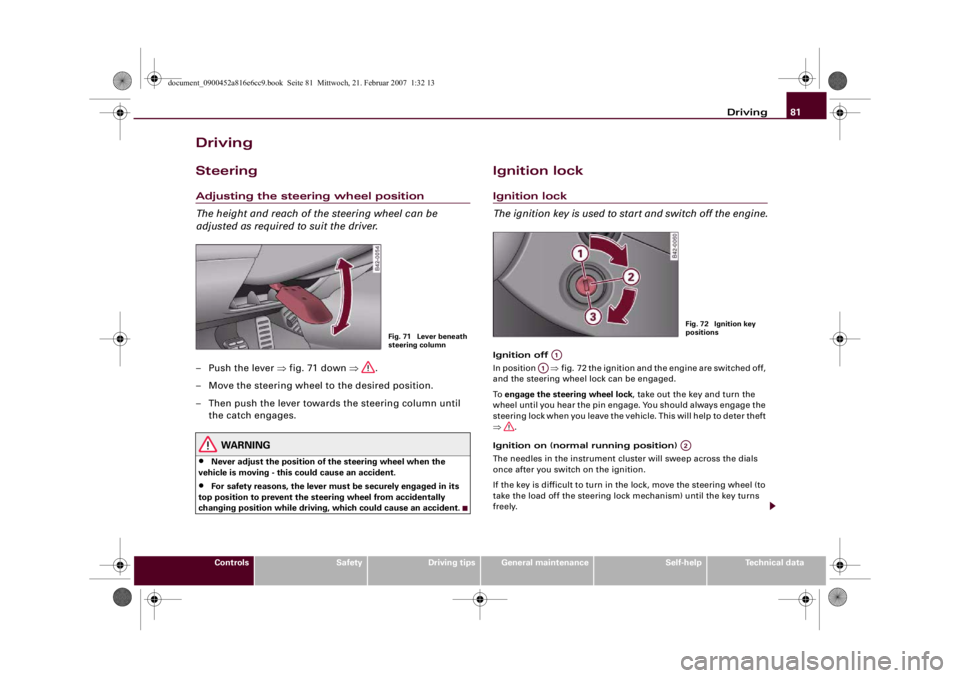
adjusted as required to suit the driver.–Push the lever ⇒fig. 71 down ⇒.
– Move the steering wheel to the desired position.
– Then push the lever towards the steering column until
the catch engages.
WARNING
•
Never adjust the position of the steering wheel when the
vehicle is moving - this could cause an accident.
•
For safety reasons, the lever must be securely engaged in its
top position to prevent the steering wheel from accidentally
changing position while driving, which could cause an accident.
Ignition lockIgnition lock
The ignition key is used to start and switch off the engine.Ignition off
In position ⇒fig. 72 the ignition and the engine are switched off,
and the steering wheel lock can be engaged.
To engage the steering wheel lock, take out the key and turn the
wheel until you hear the pin engage. You should always engage the
steering lock when you leave the vehicle. This will help to deter theft
⇒.
Ignition on (normal running position)
The needles in the instrument cluster will sweep across the dials
once after you switch on the ignition.
If the key is difficult to turn in the lock, move the steering wheel (to
take the load off the steering lock mechanism) until the key turns
freely.
Fig. 71 Lever beneath
steering column
Fig. 72 Ignition key
positions
A1
A1
A2
document_0900452a816e6cc9.book Seite 81 Mittwoch, 21. Februar 2007 1:32 13
Page 84 of 210

Driving 82Starting the engine
Turn the key to this position to start the engine. While the engine is
being started the headlights are switched back to side lights and
other major electrical equipment is switched off. After the engine
has started the ignition key returns to position by itself.
The ignition key has to be turned back to position before re-
starting the engine. The starter inhibitor in the ignition lock
prevents the starter motor from engaging when the engine is
running, as this could cause damage.
WARNING
•
Wait for the vehicle to come to a standstill before removing the
ignition key from the lock. Otherwise the steering lock could
engage suddenly, which could cause an accident.
•
Always take the key with you when leaving the vehicle – even
if you only intend to be gone for a short time. This is especially
important if children are left in the car. They might otherwise be
able to start the engine or use power-operated equipment such as
the electric windows - this could lead to injuries.Note
If the battery has been disconnected and then reconnected it will be
necessary to leave the key in position for about 5 seconds before
starting the engine.Starting the engineThe engine can only be started with an original Audi key.On vehicles with R tronic, the engine can be started in
neutral (N) or in any gear (1 - 6 or R).
– Apply the handbrake firmly ⇒.– Push the clutch pedal all the way down (vehicles with
manual gearbox).
– Press and hold the brake pedal.
– Turn the ignition key to position ⇒page 81, fig. 72
without pressing the accelerator.
– Release the ignition key as soon as the engine starts; the
starter motor must not be allowed to run on with the
engine. Neutral gear (N) will be engaged on vehicles with
Rtronic.
When starting from cold the engine may be a little noisy for the first
few seconds until oil pressure has built up in the hydraulic tappets.
This is quite normal, and no cause for concern.
If the engine fails to start straight-away, switch off the starter after
about 10 seconds and try again after about half a minute.
WARNING
•
Never run the engine in confined spaces. The exhaust gases are
toxic.
•
If the engine is running and a gear is engaged, you will need to
hold the car with the footbrake.Caution
Avoid high engine speeds, full throttle and extreme load conditions
until the engine has reached its normal operating temperature,
otherwise this can damage the engine.
For the sake of the environment
Do not warm up the engine when the vehicle is stationary. You
should drive off immediately whenever possible. This will help avoid
unnecessary exhaust emissions.
A3
A2A1
A2
A3
document_0900452a816e6cc9.book Seite 82 Mittwoch, 21. Februar 2007 1:32 13
Page 86 of 210

Driving 84
WARNING
Please note that the handbrake should be released all the way. If it
is only partially released this will cause overheating of the rear
brakes, which can impair the function of the brake system and
could lead to an accident.
Caution
Once the vehicle has come to a standstill, always apply the hand-
brake firmly and then engage a gear.Parking the car
Please note the following points to ensure there is no risk
of the car rolling away accidentally after it is parked.– Use the foot brake to stop the vehicle.
– Apply the handbrake firmly.
– Switch the engine off.
– Engage a gear ⇒.When parking on gradients
Turn the steering wheel so that the vehicle would roll into the kerb
if it did start to move accidentally.
WARNING
•
Do not leave anyone (especially children) in the vehicle when it
is locked. Locked doors could delay assistance in an emergency,
potentially putting lives at risk.
•
Never leave children unsupervised in the vehicle. They could,
for example, release the handbrake or put the gearbox in neutral.
The vehicle could then start moving and cause an accident.
Applies to vehicles: with hill hold assistDriving away on a slopeThe hill hold assist function makes it easier to drive away on a slope.
The system is activated when you press and hold the brake pedal for
a few seconds.
When you release the brake pedal the braking force will be main-
tained for a moment in order to hold the vehicle and make it easier
for you to drive away.
WARNING
•
If you do not drive away immediately after releasing the brake
pedal the vehicle could start to roll back. You should therefore
immediately press the brake pedal or apply the handbrake.
•
If the engine should stall you must immediately press the brake
pedal or apply the handbrake firmly.
•
If you are driving away on a slope in stop-and-go traffic press
and hold the brake pedal for a few seconds before driving off. This
will prevent the vehicle from rolling back unintentionally.Note
To find out whether your vehicle is equipped with the “hill hold
assist” function please contact an Audi R8 dealership or qualified
workshop.
document_0900452a816e6cc9.book Seite 84 Mittwoch, 21. Februar 2007 1:32 13
Page 106 of 210

Safe driving 104Correct sitting positionsCorrect sitting position for driver
The correct driving position is important for safe and
fatigue-free driving.For your own safety, and to reduce the risk of injury in the
event of an accident, we recommend the following driving
position.
– Adjust the steering wheel so there is a distance of at least
25 cm between the steering wheel and your breastbone
⇒fig. 82.– Move the driver's seat forwards or backwards so that you
can press the accelerator, brake and clutch pedals all the
way to the floor with your knees slightly bent ⇒.
– Make sure that you can comfortably reach the top of the
steering wheel.
– Adjust the head restraint so that the top of the head
restraint is level with the top of your head ⇒fig. 83.
– Adjust the backrest to an upright position so that your
back remains in contact with the upholstery.
– Fasten your seat belt correctly ⇒page 109.
– Keep both feet in the footwell so that you are in full
control of the vehicle at all times.
For detailed information on how to adjust the driver's seat, see
⇒page 67, “Seats and storage”.
WARNING
An incorrect driver sitting position can result in serious personal
injury.•
Adjust the driver's seat so there is a distance of at least 25 cm
between your breastbone and the centre of the steering wheel
⇒fig. 82. The airbag system will not be able to protect you prop-
erly if you sit closer than 25 cm.
•
If physical limitations prevent you from maintaining the
minimum distance of 25 cm, please consult a qualified workshop.
The workshop will be able to tell you whether your vehicle can be
suitably modified.
•
While driving, always hold the steering wheel with both hands
on the outside of the rim at about the 9 o'clock and 3 o'clock posi-
tion. This reduces the risk of injury if the driver's airbag inflates.
Fig. 82 Minimum
distance between
driver and steering
wheelFig. 83 Correct head
restraint position for
the driver
document_0900452a816e6cc9.book Seite 104 Mittwoch, 21. Februar 2007 1:32 13
Page 107 of 210

Safe driving105
Controls
Safety
Driving tips
General maintenance
Self-help
Technical data
•
Never hold the steering wheel at the 12 o'clock position, or
with your hands inside the rim or on the steering wheel hub. This
could result in serious injuries to the arms, hands and head if the
driver's airbag inflates.
•
To reduce any risk of injury to the driver during a sudden brake
application or in an accident, never drive with the backrest tilted
too far back. The airbag system and seat belts can only provide
proper protection when the backrest is in an upright position and
the driver is wearing the seat belt in the correct position. The
further the backrest is tilted back, the greater the risk of injury due
to incorrect positioning of the belt webbing or an incorrect sitting
position.
•
Adjust the head restraint properly so that it can give maximum
protection.
Correct sitting position for front passenger
The front seat passenger must sit at least 25 cm away
from the dash panel so that the airbag has enough room
to inflate and give maximum protection in an accident.For your own safety and to reduce the risk of injury in the
event of an accident, we recommend adjusting the front
passenger's seat as follows:
– Move the front passenger's seat as far back as possible
⇒.
– Adjust the backrest to an upright position so that your
back remains in contact with the upholstery.
– Adjust the head restraint so that the top of the head
restraint is level with the top of your head ⇒page 106.
– Keep both feet in the footwell in front of the seat.– Fasten your seat belt correctly ⇒page 112.
In exceptional cases you can disable the front passenger's airbag
⇒page 120.
For detailed information on how to adjust the front passenger's
seat, see ⇒page 67, “Seats and storage”.
WARNING
A passenger sitting out of position in the front seat can suffer
serious injuries.•
Adjust the front passenger's seat so there is a distance of at
least 25 cm between your breastbone and the dash panel. The
airbag system will not be able to protect you properly if you sit
closer than 25 cm.
•
If physical limitations prevent you from maintaining the
minimum distance of 25 cm, please consult a qualified workshop.
The workshop will be able to tell you whether your vehicle can be
suitably modified.
•
Always keep your feet on the floor when the vehicle is moving;
never rest them on the instrument panel, out of the window or on
the seat. If you sit in an incorrect position, you increase your risk
of injury in the event of sudden braking or an accident. If the airbag
is triggered, you could sustain potentially fatal injuries by sitting
out of position.
•
To reduce the risk of injury to the front passenger in the case of
sudden braking or an accident, the passenger should never travel
in a moving vehicle with the backrest reclined. The airbag system
and seat belt can only provide proper protection when the back-
rest is in an upright position and the passenger is wearing the seat
belt in the correct position. The further the backrest is tilted back,
the greater the risk of injury due to incorrect positioning of the belt
webbing or an incorrect sitting position.
•
Always adjust the head restraints properly for maximum
protection.
WARNING (continued)
document_0900452a816e6cc9.book Seite 105 Mittwoch, 21. Februar 2007 1:32 13
Page 110 of 210

Safe driving 108Use only floor mats that leave the pedal area unobstructed and are
firmly secured to prevent them from slipping. You can obtain suit-
able floor mats from your dealer or a specialist retailer.
WARNING
Any obstructions that restrict pedal travel can cause loss of
vehicle control and increase the risk of serious personal injury. •
Always make sure that floor mats are properly secured.
•
Never lay or install additional floor mats or other floor cover-
ings over the existing floor mats; this would restrict the pedal area
and possibly obstruct the pedals, which could cause an
accident.
Stowing luggage safelyNotes
All luggage and objects must be securely stowed.Loose items can cause a safety hazard or impair the handling of the
vehicle by changing the weight distribution.
During a collision or an accident, even small and light objects can
possess so much energy that they can cause very severe injuries.
The amount of this “kinetic energy” depends on the speed of the
vehicle and the weight of the object. The most significant factor,
however, is the speed of the vehicle.
An example: An object weighing 4.5 kg is lying unsecured in the
vehicle. During a frontal collision at a speed of 50 km/h, this object
generates a force corresponding to 20 times its weight. That means
that the effective weight of the object increases to about 90 kg. You
can imagine the severity of the injuries which might be sustained if
this “projectile” strikes an occupant as it flies through the
passenger compartment.
WARNING
•
Always stow objects in the luggage compartment.
•
Transporting heavy objects may affect the vehicle's handling by
shifting the centre of gravity – this could cause an accident. Take
extra care when driving and adjust your speed accordingly.
•
Never exceed the maximum axle loads or the maximum gross
weight for the vehicle ⇒page 198, “Performance, weights and
dimensions”. Exceeding the permitted axle loads or gross weight
limit can affect the vehicle's handling characteristics, and increase
the risk of accidents, personal injuries or damage to the vehicle.
•
Never leave your vehicle unattended when the luggage lid is
open. Children could climb into the luggage compartment and
close the luggage lid from the inside. In this case the child would
be unable to get out of the vehicle without help. This could have
fatal consequences.
•
Never allow children to play in or around the vehicle. Always
close and lock the luggage lid and all the doors when you leave the
vehicle.
•
Never let passengers ride in the luggage compartment. All
occupants must be properly restrained by the seat belts at all
times ⇒page 109.
document_0900452a816e6cc9.book Seite 108 Mittwoch, 21. Februar 2007 1:32 13
Page 112 of 210

Seat belts 110Important safety instructions for using seat belts
There are a number of safety points concerning the seat
belts which you should remember. This will help to reduce
the risk of injury in an accident.
WARNING
•
The seat belts can only provide maximum protection if the
seats are adjusted properly ⇒page 67, “Seats and storage”.
•
To ensure proper protection, it is important to wear the seat
belts in the correct position ⇒page 112, “How to wear seat belts
properly”. Ensure that the seat belts are worn exactly as recom-
mended in this chapter. Belts which are not worn properly can
increase the risk of injury in accidents considerably.
•
Do not allow the seat belt to become twisted or jammed, or to
rub on any sharp edges.
•
Never allow two passengers (even children) to share the same
seat belt. It is especially dangerous to place a seat belt over a child
sitting on your lap.
•
Do not wear the belt over hard or fragile objects (such as
glasses or pens, etc.) because this can cause injuries.
•
Loose, bulky clothing (such as an overcoat over a jacket)
impairs the proper fit and function of the belts.
•
The belts must be kept clean, otherwise the retractors may not
work properly ⇒page 150, “Seat belts”.
•
The slot in the seat belt buckle must not be blocked with paper
or other objects, as this can prevent the latch plate from engaging
properly.
•
The latch plate of the belt must always be engaged in the
correct buckle for that seat, otherwise the belt will not be fully
effective.
•
Check the condition of the seat belts at regular intervals. If you
notice that the belt webbing, fittings, retractor mechanism or buckle of any of the belts is damaged, the belt must be replaced
by a qualified workshop.
•
The seat belts must not be removed or modified in any way. Do
not attempt to repair a damaged belt yourself.
•
Seat belts which have been worn in an accident and stretched
must be replaced by a qualified workshop. The belt anchorages
should also be checked.
Forces acting in a collisionThe physical principles involved in a frontal impact
Very large forces are generated during a collision; these
forces have to be absorbed.
WARNING (continued)
F i g . 8 7 P a s s e n g e r s o f a
vehicle which is
headed for a brick wall.
They are not using seat
belts.
document_0900452a816e6cc9.book Seite 110 Mittwoch, 21. Februar 2007 1:32 13
Page 114 of 210
Seat belts 112How to wear seat belts properlyPutting on the three-point seat belts
Always fasten your seat belts before driving off.– Adjust the front seat and head restraint correctly before
putting on the seat belt ⇒page 67, “Seats and storage”.
– To fasten the belt, take hold of the latch plate and pull it
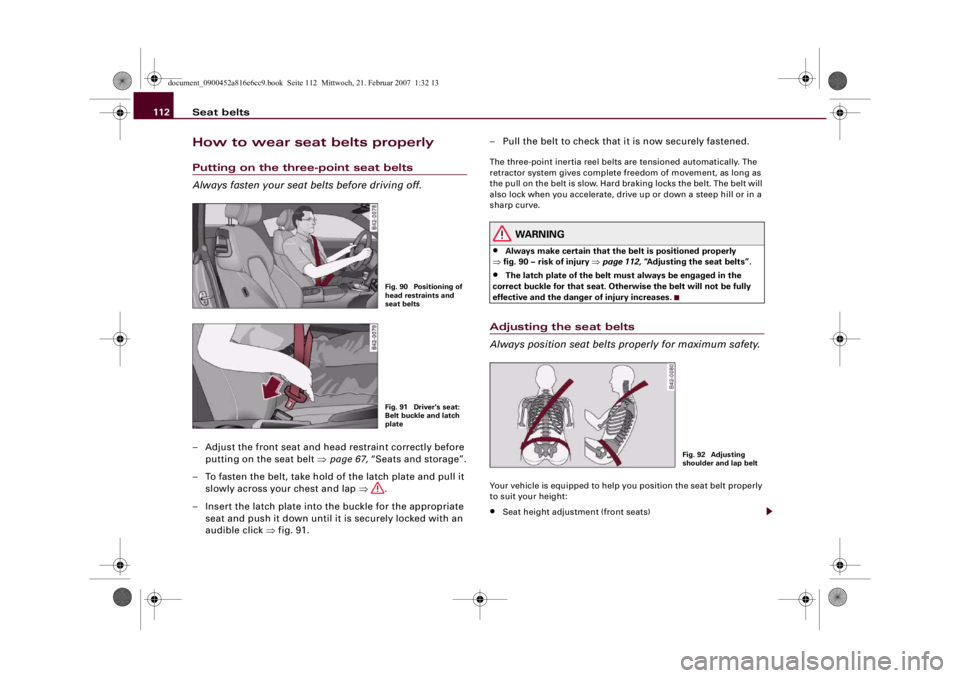
slowly across your chest and lap ⇒.
– Insert the latch plate into the buckle for the appropriate
seat and push it down until it is securely locked with an
audible click ⇒fig. 91.– Pull the belt to check that it is now securely fastened.
The three-point inertia reel belts are tensioned automatically. The
retractor system gives complete freedom of movement, as long as
the pull on the belt is slow. Hard braking locks the belt. The belt will
also lock when you accelerate, drive up or down a steep hill or in a
sharp curve.
WARNING
•
Always make certain that the belt is positioned properly
⇒fig. 90 – risk of injury ⇒page 112, “Adjusting the seat belts”.
•
The latch plate of the belt must always be engaged in the
correct buckle for that seat. Otherwise the belt will not be fully
effective and the danger of injury increases.
Adjusting the seat belts
Always position seat belts properly for maximum safety.Your vehicle is equipped to help you position the seat belt properly
to suit your height:•
Seat height adjustment (front seats)
Fig. 90 Positioning of
head restraints and
seat beltsFig. 91 Driver's seat:
Belt buckle and latch
plate
Fig. 92 Adjusting
shoulder and lap belt
document_0900452a816e6cc9.book Seite 112 Mittwoch, 21. Februar 2007 1:32 13