2007 AUDI R8 height
[x] Cancel search: heightPage 120 of 210

Airbag system 118
WARNING
•
It is important for the driver and front passenger to maintain a
distance of at least 25 cm from the steering wheel or dashboard
⇒page 117, fig. 98. The airbag system will not be able to give the
required protection if you sit too close to the steering wheel or
dashboard. There is also a risk of injury if the airbags are inflated.
The front seats and head restraints must always be positioned
correctly for the height of the occupant.
•
If you do not wear a seat belt, if you lean forward or to the side,
or are not seated correctly while the vehicle is in motion, you are
at greater risk of injury. Should the airbag system be triggered in
an accident there is an even greater risk of injury.
•
Never let a child travel on the front seat without an appropriate
restraint system. If the airbag is triggered in an accident, the child
could sustain serious or fatal injuries ⇒page 122, “Child safety”.
•
Never install a rearward-facing child safety seat on the front
passenger's seat unless the front passenger's airbag has been
deactivated. However, if you have no alternative but to use a rear-
ward-facing child seat on the front passenger's seat, the front
passenger's airbag must be deactivated beforehand by means of
the key-operated switch ⇒page 120, “Deactivating the airbags”.
Failure to observe this precaution could result in serious or poten-
tially fatal injury.
•
Occupants sitting in the front of the car must never carry any
objects or pets in the space between them and the airbags, or
allow children or other passengers to travel in this position.
•
Do not cover or stick anything on the steering wheel hub or the
soft plastic surface of the airbag unit on the passenger's side of
the dashboard, and do not obstruct or modify them in any way.
These parts should only be cleaned with a dry cloth (or with a
cloth moistened with plain water). It is also important not to
attach any objects such as cup holders or telephone mountings to
the surfaces covering the airbag units.
•
Any work on the airbag system or removal and installation of
the airbag components for other repairs (such as repairs to the
steering wheel) should be performed by a qualified workshop.Note
If necessary, you can deactivate the front passenger's airbag by
means of the key-operated switch ⇒page 120, “Deactivating the
airbags”.Side airbagsDescription of side airbags
The airbag system is not a substitute for the seat belts.The side airbags are located in the backrest padding of the front
seats ⇒fig. 99. The locations of the airbags are marked with the
word “AIRBAG”.
In conjunction with the three-point seat belts, the side airbags give
the occupants additional protection for the whole upper part of the
body (i.e. the chest, stomach and pelvis) in the event of a severe side
WARNING (continued)
Fig. 99 Location of
side airbag in driver's
seat
document_0900452a816e6cc9.book Seite 118 Mittwoch, 21. Februar 2007 1:32 13
Page 129 of 210
Child safety127
Controls
Safety
Driving tips
General maintenance
Self-help
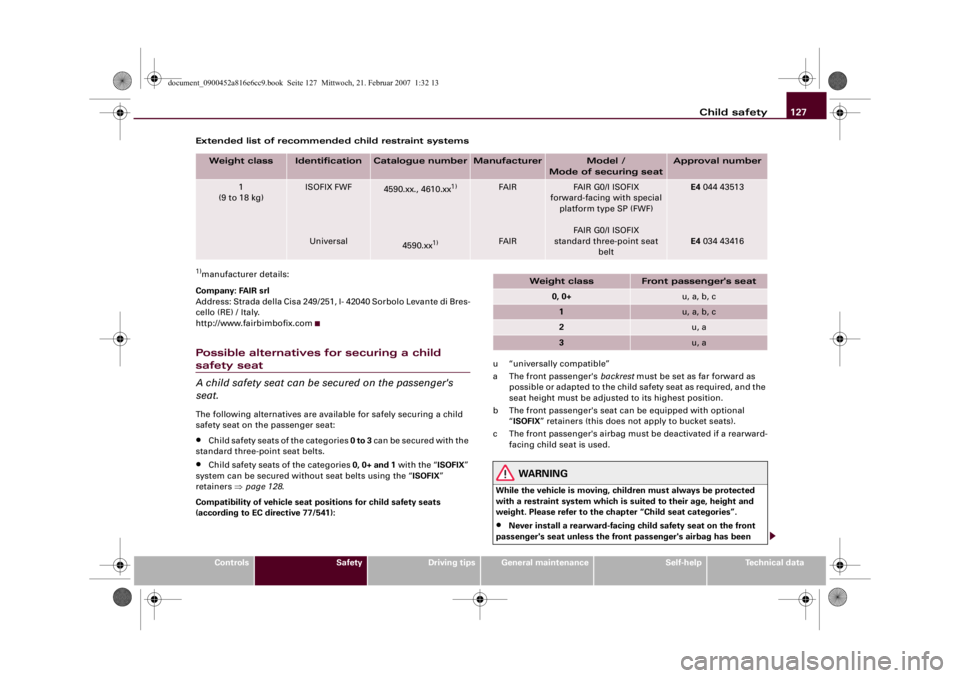
Technical data Extended list of recommended child restraint systems
1)manufacturer details:
Company: FAIR srl
Address: Strada della Cisa 249/251, I- 42040 Sorbolo Levante di Bres-
cello (RE) / Italy.
http://www.fairbimbofix.comPossible alternatives for securing a child safety seat
A child safety seat can be secured on the passenger's
seat.The following alternatives are available for safely securing a child
safety seat on the passenger seat:•
Child safety seats of the categories 0 to 3 can be secured with the
standard three-point seat belts.
•
Child safety seats of the categories 0, 0+ and 1 with the “ISOFIX”
system can be secured without seat belts using the “ISOFIX”
retainers ⇒page 128.
Compatibility of vehicle seat positions for child safety seats
(according to EC directive 77/541):u “universally compatible”
a The front passenger's backrest must be set as far forward as
possible or adapted to the child safety seat as required, and the
seat height must be adjusted to its highest position.
b The front passenger's seat can be equipped with optional
“ISOFIX” retainers (this does not apply to bucket seats).
c The front passenger's airbag must be deactivated if a rearward-
facing child seat is used.
WARNING
While the vehicle is moving, children must always be protected
with a restraint system which is suited to their age, height and
weight. Please refer to the chapter “Child seat categories”.•
Never install a rearward-facing child safety seat on the front
passenger's seat unless the front passenger's airbag has been
Weight class
Identification
Catalogue number
Manufacturer
Model /
Mode of securing seat
Approval number
1
(9 to 18 kg)
ISOFIX FWF
Universal
4590.xx., 4610.xx
1)
4590.xx
1)
FAIR
FAIR
FAIR G0/I ISOFIX
forward-facing with special
platform type SP (FWF)
FAIR G0/I ISOFIX
standard three-point seat
belt
E4 044 43513
E4 034 43416
Weight class
Front passenger's seat
0, 0+
u, a, b, c
1
u, a, b, c
2
u, a
3
u, a
document_0900452a816e6cc9.book Seite 127 Mittwoch, 21. Februar 2007 1:32 13
Page 147 of 210

Care of vehicle and cleaning145
Controls
Safety
Driving tips
General maintenance
Self-help
Technical data
WARNING
•
Do not wash the vehicle with the ignition switched on – risk of
accident.
•
Do not clean the underside of the car or inside the wheel arches
without protecting your hands and arms. You may cut yourself on
sharp metal parts.
•
Take care when washing the car during the winter: moisture
and ice on the brakes may affect braking efficiency – this could
cause an accident.Caution
•
Compare the track width of your vehicle with the distance
between the guide rails for the wheels in the car wash. Otherwise
there may be a risk of damaging the wheel rims and tyres.
•
Compare the ground clearance of your vehicle with the height of
the guide rails for the wheels in the car wash to prevent any damage
to the underside.
•
Compare the width of your vehicle with the available width when
entering and driving through the car wash.
•
Retract the exterior mirrors to avoid damage. Electrically retract-
able exterior mirrors must NOT be folded in or out by hand. Always
use the electrical power control.
•
Do not wash the vehicle in direct sunlight – otherwise the paint
can be damaged.
•
Do not use insect sponges, or abrasive household sponges, etc.
– they can damage the surfaces.
•
The headlights should only be washed with water – do not wipe
them with a dry cloth or sponge. It is best to use soapy water.
•
Never wash tyres with a jet that sprays the water out in a direct
stream. This could damage the tyres – even if the spray is kept at a
distance and only used for a very short time.
For the sake of the environment
The car should only be washed in special wash bays. This prevents
oily water from getting into the public drains. In some districts,
washing vehicles anywhere else may be prohibited.Waxing and polishingWaxi ng
Waxing protects the paintwork. It is time to apply a good coat of wax
when water no longer forms droplets and rolls off the clean paint-
work.
Even if a wax solution is used regularly in the car wash, it is advis-
able to protect the paint with a coat of wax at least twice a year.
In the summer, you will find it is much easier to remove dead insects
(which accumulate on the bumper and front lid) if the car has been
waxed recently.
Polishing
Polishing is only necessary if the paint has lost its shine, and the
gloss cannot be brought back by putting on wax.
The car must be waxed after polishing if the polish used does not
contain wax compounds to seal the paint.
Caution
Matt painted and plastic parts must not be treated with wax or
polish.Ornamental trim and mouldingsThe metal brightwork on the body is made of aluminium rather than
chrome (for environmental reasons).
document_0900452a816e6cc9.book Seite 145 Mittwoch, 21. Februar 2007 1:32 13
Page 171 of 210

Wheels and tyres169
Controls
Safety
Driving tips
General maintenance
Self-help
Technical data Understanding the tyre designations makes it easier to choose the
correct tyres. For example, radial ply tyres have the following tyre
designations marked on the sidewall:
235 / 35 R 18 91 Y
This contains the following information:
The manufacturing date is also indicated on the tyre sidewall
(possibly only on the inner side of the wheel):
DOT ... 1010...
means, for example, that the tyre was produced in the 10th week of
2010.
Please note that with some types of tyres, the actual tyre size can
differ from the nominal size marked on the tyre (for instance 235/35
R 18 91 Y), and there may be significant differences in the contours
of the tyres, even though the tyres are marked with the same
nominal size designation. When replacing the tyres, it is therefore
important to make sure that the actual size of the new tyres does
not exceed the dimensions of the factory-approved makes of tyre.
Failure to observe this requirement can affect the clearance needed
for the tyres. This could result in contact between the tyres and
suspension components or bodywork. The brake lines could also be
damaged and the vehicle's safety could be severely impaired ⇒.
When using tyres with the maximum permitted nominal dimen-
sions, this can also void the vehicle's registration.If you use tyres that are approved by Audi you can be sure that the
actual tyre dimensions will be correct for your vehicle. If you decide
to fit a different type of tyre, you must obtain the appropriate manu-
facturer's certificate from the tyre retailer to confirm that the tyres
are suitable for your vehicle. Keep this certificate in a safe place.
Your local Audi R8 dealer will be able to advise you on which tyres
may be fitted to your vehicle.
On vehicles with four-wheel drive, all four tyres must always be
fitted with tyres of the same type, make and tread pattern, as other-
wise the driveline can be damaged by continuous variations in the
wheel speeds. For the same reason, only use a spare wheel with the
same tyre dimensions as the normal road wheels.
It is not permissible to use a wheel which is of a type different to
those already fitted on the vehicle (for instance when using winter
tyres) - even if you have a puncture.
It is best to have all servicing of wheels and tyres performed by a
qualified workshop. They have the necessary special tools and
replacement parts, trained personnel and facilities for disposing of
the old tyres.
WARNING
•
It is very important to ensure that the tyres you have chosen
have adequate clearance. When selecting replacement tyres, do
not rely entirely on the nominal tyre size marked on the tyre; with
some makes of tyre the effective tyre size can differ significantly
from the nominal dimensions, even though the tyres have the
same size designation. Inadequate tyre clearance can result in
damage to the tyres or the vehicle, causing a serious safety risk. It
may also invalidate the vehicle's type approval for use on public
roads.
•
Avoid running the car on tyres that are more than 6 years old.
If you have no alternative, you should drive slowly and with extra
care at all times.
235
Tyre width in mm
35
Height/width ratio in %
R
Tyre construction: Radial
18
Rim diameter in inches
91
Load rating code
Y
Speed rating code letter
document_0900452a816e6cc9.book Seite 169 Mittwoch, 21. Februar 2007 1:32 13
Page 200 of 210

Performance, weights and dimensions 198Performance, weights and dimensionsR8 4.2 quattroEngine data
Performance figures
WeightsEngine oil
MG = Manual gearbox / AG = Automatic gearbox (R tronic)
1) With slight loss of powerDimensions1) The height of the vehicle depends on the tyres and suspension.
Take care not to damage low-mounted parts of the car (such as the
spoiler or exhaust system) on steep ramps, uneven road surfaces or
roadside kerbs, etc.
Take particular care if the car has lowered (sports) suspension or if
it is fully laden.
Power output
309 kW at 7800 rpm
Maximum torque
430 Nm at 4500 to 6000 rpm
Cylinders, capacity
8 cylinders, 4163 cm
3
Valves per cylinder
4
Bore
mm
84.5
Stroke
mm
92.8
Compression ratio
12.5:1
Firing order
1-5-4-8-6-3-7-2
Fuel
Super Plus unleaded 98 RON or
premium unleaded not less than
95 RON
1)
Maximum speed
km/h
301
Acceleration from 0 - 100 km/h
sec.
4.6
Acceleration from 0 - 200 km/h
sec.
14.9
Gross vehicle weight
kg
MG = 1860
AG = 1865
Kerb weight (unladen weight)
kg
MG = 1560
AG = 1565
Maximum front axle weight
kg
MG = 890
AG = 890
Maximum rear axle weight
kg
MG = 1050
AG = 1055
LongLife Service
VW 504 00
Inspection Service
VW 502 00, VW 504 00
Engine oil capacity
(including filter change)
approx. 10 litres
Length
mm
4431
Width
mm
1904
Width across mirrors
mm
2029
Height, unladen
1)
mm
1252
Turning circle diameter
m
11.80
document_0900452a816e6cc9.book Seite 198 Mittwoch, 21. Februar 2007 1:32 13
Page 209 of 210

Index207
Controls
Safety
Driving tips
General maintenance
Self-help
Technical data Radio display . . . . . . . . . . . . . . . . . . . . . . . . 20
Radio transmitters
Fixed installation . . . . . . . . . . . . . . . . . 175
Mobile equipment . . . . . . . . . . . . . . . . 175
Radio-controlled clock . . . . . . . . . . . . . . . . 11
Radio-operated remote control
SeeRemote control keys . . . . . . . . . . . 41
Rain sensor . . . . . . . . . . . . . . . . . . . . . . . . . 59
Rain sensor defective . . . . . . . . . . . . . . . . . 38
Rear fog light . . . . . . . . . . . . . . . . . . . . . . . . 54
Rear lights defective . . . . . . . . . . . . . . . . . . 37
Rear spoiler . . . . . . . . . . . . . . . . . . . . . . . . 134
Rear view mirrors
SeeMirrors . . . . . . . . . . . . . . . . . . . . . . . 63
Rear window heating . . . . . . . . . . . . . . . . . 79
Remote control keys . . . . . . . . . . . . . . . . . . 40
Indicator lamp . . . . . . . . . . . . . . . . . . . . 40
Replacing the battery . . . . . . . . . . . 40, 41
Synchronisation . . . . . . . . . . . . . . . . . . . 41
Unlocking and locking . . . . . . . . . . . . . 43
Repairs . . . . . . . . . . . . . . . . . . . . . . . . . . . . 174
Replacement keys . . . . . . . . . . . . . . . . . . . . 40
Replacement parts . . . . . . . . . . . . . . . . . . 174
Rev counter . . . . . . . . . . . . . . . . . . . . . . . . . 11
Reverse gear
R tronic . . . . . . . . . . . . . . . . . . . . . . . . . . 90
Running in . . . . . . . . . . . . . . . . . . . . . . . . . 138
SSAFE . . . . . . . . . . . . . . . . . . . . . . . . . . . . . . . 42
Safe driving . . . . . . . . . . . . . . . . . . . . . . . . 102Safety . . . . . . . . . . . . . . . . . . . . . . . . . . . . . 103
Safety features . . . . . . . . . . . . . . . . . . . . . 102
Seat adjustment
Bucket seats . . . . . . . . . . . . . . . . . . . . . . 70
Electrically adjustable seat . . . . . . . . . . 68
Manually adjustable seat . . . . . . . . . . . 67
Seat belts . . . . . . . . . . . . . . . . . . . . . . . . . . 109
Adjusting seat belts . . . . . . . . . . . . . . . 112
Belt tensioners . . . . . . . . . . . . . . . . . . . 114
Cleaning . . . . . . . . . . . . . . . . . . . . . . . . 150
During pregnancy . . . . . . . . . . . . . . . . 113
Putting on . . . . . . . . . . . . . . . . . . . . . . . 112
Safety notes . . . . . . . . . . . . . . . . . . . . . 110
Taking off . . . . . . . . . . . . . . . . . . . . . . . 113
Warning lamp . . . . . . . . . . . . . . . . . . . . . 18
Seat heating . . . . . . . . . . . . . . . . . . . . . . . . . 80
Security central locking . . . . . . . . . . . . . . . 46
Selector lever defective . . . . . . . . . . . . . . . 38
Service interval display . . . . . . . . . . . . . . . . 21
Service position for windscreen wipers . . 61
Setting time . . . . . . . . . . . . . . . . . . . . . . . . . 12
Setting time format . . . . . . . . . . . . . . . . . . . 12
Side lights . . . . . . . . . . . . . . . . . . . . . . . . . . 52
Sitting position
Driver . . . . . . . . . . . . . . . . . . . . . . . . . . . 104
Front passenger . . . . . . . . . . . . . . . . . . 105
Incorrect sitting position . . . . . . . . . . 106
Snow chains . . . . . . . . . . . . . . . . . . . . . . . 171
Spare key . . . . . . . . . . . . . . . . . . . . . . . . . . . 40
Speed warning . . . . . . . . . . . . . . . . . . . 31, 37
Speedometer . . . . . . . . . . . . . . . . . . . . . . . . 13
Spoiler . . . . . . . . . . . . . . . . . . . . . . . . . . . . 134Starting the engine . . . . . . . . . . . . . . . . . . . 82
Starting with jump leads . . . . . . . . . . . . . 185
Steering
Locking the steering . . . . . . . . . . . . . . . 81
Steering wheel height adjustment
(manual) . . . . . . . . . . . . . . . . . . . . . . . . 81
Steering lock . . . . . . . . . . . . . . . . . . . . . . . . 81
Stowing luggage safely . . . . . . . . . . . . . . 108
Sun visors . . . . . . . . . . . . . . . . . . . . . . . . . . . 58
Switching off the engine . . . . . . . . . . . . . . 83
Symbols
Red symbols in central display . . . . . . 33
Yellow symbols in central display . . . . 33
TTank capacity . . . . . . . . . . . . . . . . . . . . . . . 199
Temperature . . . . . . . . . . . . . . . . . . . . . . . . 76
Tool kit . . . . . . . . . . . . . . . . . . . . . . . . . . . . 178
Tools . . . . . . . . . . . . . . . . . . . . . . . . . . . . . . 178
Tow-away protection . . . . . . . . . . . . . . . . . 49
Towing away . . . . . . . . . . . . . . . . . . . . . . . 187
Towline anchorage . . . . . . . . . . . . . . . . . . 188
Tow-starting . . . . . . . . . . . . . . . . . . . . . . . . 187
Traction control system . . . . . . . . . . . . . . 132
Tread depth . . . . . . . . . . . . . . . . . . . . . . . . 168
Trip recorder . . . . . . . . . . . . . . . . . . . . . 13, 14
Trips, checklist . . . . . . . . . . . . . . . . . . . . . . 102
Turn signals . . . . . . . . . . . . . . . . . . . . . . . . . 56
Two-way radios . . . . . . . . . . . . . . . . . . . . . 175
Type plate . . . . . . . . . . . . . . . . . . . . . . . . . . 196
Tyre Mobility System . . . . . . . . . . . . . . . . 178
document_0900452a816e6cc9.book Seite 207 Mittwoch, 21. Februar 2007 1:32 13