Page 48 of 2000
ENGINE - 2AZ-FE ENGINE
198EG35
Va n e
Rotation DirectionOil PressureECM
IN Drain
198EG36
Va n e
Rotation DirectionOil Pressure
Drain INECMEG-51
Operation
1) Advance
When the camshaft timing oil control valve is operated as illustrated below by the advance signals from
the ECM, the resultant oil pressure is applied to the advance side vane chamber to rotate the camshaft
in the advance direction.
2) Retard
When the camshaft timing oil control valve is operated as illustrated below by the retard signals from
the ECM, the resultant oil pressure is applied to the retard side vane chamber to rotate the camshaft in
the retard direction.
3) Hold
After reaching the target timing, the valve timing is held by keeping the camshaft timing oil control valve
in the neutral position unless the traveling state changes.
This adjusts the valve timing at the desired target position and prevents the engine oil from running out
when it is unnecessary.
Page 82 of 2000
ENGINE - 2GR-FE ENGINE
285EG24
Timing Chain Cover
Oil Pump
Housing
Oil Pump Rotors
(Cycloid Rotor)Crankshaft
To Cylinder
Block
From Oil
Filter
To
Oil FilterFrom
Oil Strainer
Oil passage in the oil pump
285EG25
Oil Jet Cross Section
Oil JetsCheck
Va l v eEngine Oil EG-86
2. Oil Pump
A compact cycloid rotor type oil pump directly driven by the crankshaft is used.
This oil pump has used an internal relief method which circulates relief oil to the suction passage in the
oil pump. This aims to minimize oil level change in the oil pan, reduce friction, and reduce air mixing rate
in the oil.
3. Oil Jet
Oil jets for cooling and lubricating the pistons have been provided in the cylinder block, in the center of
the right and left banks.
These oil jets contain a check valve to prevent oil from being fed when the oil pressure is low. This prevents
the overall oil pressure in the engine from dropping.
Page 108 of 2000

ENGINE - 2GR-FE ENGINE
271EG160
Timing Rotor
Intake VVT
Sensor
VC
VV1+
VV1 -ECM
Intake VVT Sensor (Bank 1) EG-112
2) MRE Type VVT Sensor
The MRE type VVT sensor consists of an MRE, a magnet and a sensor. The direction of the magnetic
field changes due to the different shapes (protruded and non-protruded portions) of the timing rotor,
which passes by the sensor. As a result, the resistance of the MRE changes, and the output voltage to
the ECM changes to Hi or Lo. The ECM detects the camshaft position based on this output voltage.
The differences between the MRE type VVT sensor and the pick-up coil type VVT sensor used on
the conventional models are as follows.
ItemSensor TypeItemMREPick-up Coil
Signal OutputConstant digital output starts from
low engine speeds.Analog output changes with the
engine speed.
Camshaft Position
Detection
Detection is made by comparing
the NE signals with the Hi / Lo
output switch timing due to the
protruded / non-protruded portions
of the timing rotor, or made based
on the number of the input NE
signals during Hi / Lo outputs.
Detection is made by comparing
the NE signals with the change of
waveform that is output when the
protruded portion of the timing
rotor passes.
Wiring Diagram
Page 121 of 2000
ENGINE - 2GR-FE ENGINE
238EG64
Rotational Direction
Va n e
Drain INOil PressureECM
281EG49
Rotational Direction
Va n eECM
Drain INOil Pressure
EG-125
2) Retard
When the camshaft timing oil control valve is positioned as illustrated below by the retard signals from
the ECM, the resultant oil pressure is applied to the timing retard side vane chamber to rotate the camshaft
in the timing retard direction.
Intake Side
Exhaust Side
3) Hold
After reaching the target timing, the valve timing is held by keeping the camshaft timing oil control valve
in the neutral position unless the traveling state changes.
This adjusts the valve timing at the desired target position and prevents the engine oil from running out
when it is unnecessary.
Page 303 of 2000
PREPARATION – 2AZ-FE LUBRICATIONPP–25
PP
LUBRICANT
Item Condition Capacity Classification
Oil grade - - Use API grade SL "Energy-
Conserving" or ILSAC multigrade
engine oil. SAE 5W-20 and SAE
0W-20 engine oil may be used.
However, SAE0W-20 is the best
choice for good fuel economy and
good starting in cold weather.
Drain and refill with oil filter change 4.3 liters (4.5 US qts, 3.8 Imp.
qts)-
without oil filter change 4.1 liters (4.3 US qts, 3.6 Imp.
qts)-
Dry fill Dry fill 5.0 liters (5.3 US qts, 4.4 Imp.
qts)-
Page 306 of 2000
PP–26PREPARATION – 2GR-FE LUBRICATION
PP
LUBRICANT
Item Capacity Classification
Oil grade - ILSAC multigrade engine oil is
recommended. SAE 5W-30 is the
best choice for good fuel
economy and good starting in
cold weather.
Drain and refill With oil filter change 6.1 liters ( 6.4 US qts, 5.4 Imp.
qts)-
Without oil filter change 5.7 liters ( 6.0 US qts, 5.0 Imp.
qts)-
Dry fill 6.5 liters ( 6.9 US qts, 5.7 Imp.
qts)-
Page 1448 of 2000
DF–44DIFFERENTIAL – REAR DIFFERENTIAL CARRIER ASSEMBLY
DF
INSTALLATION
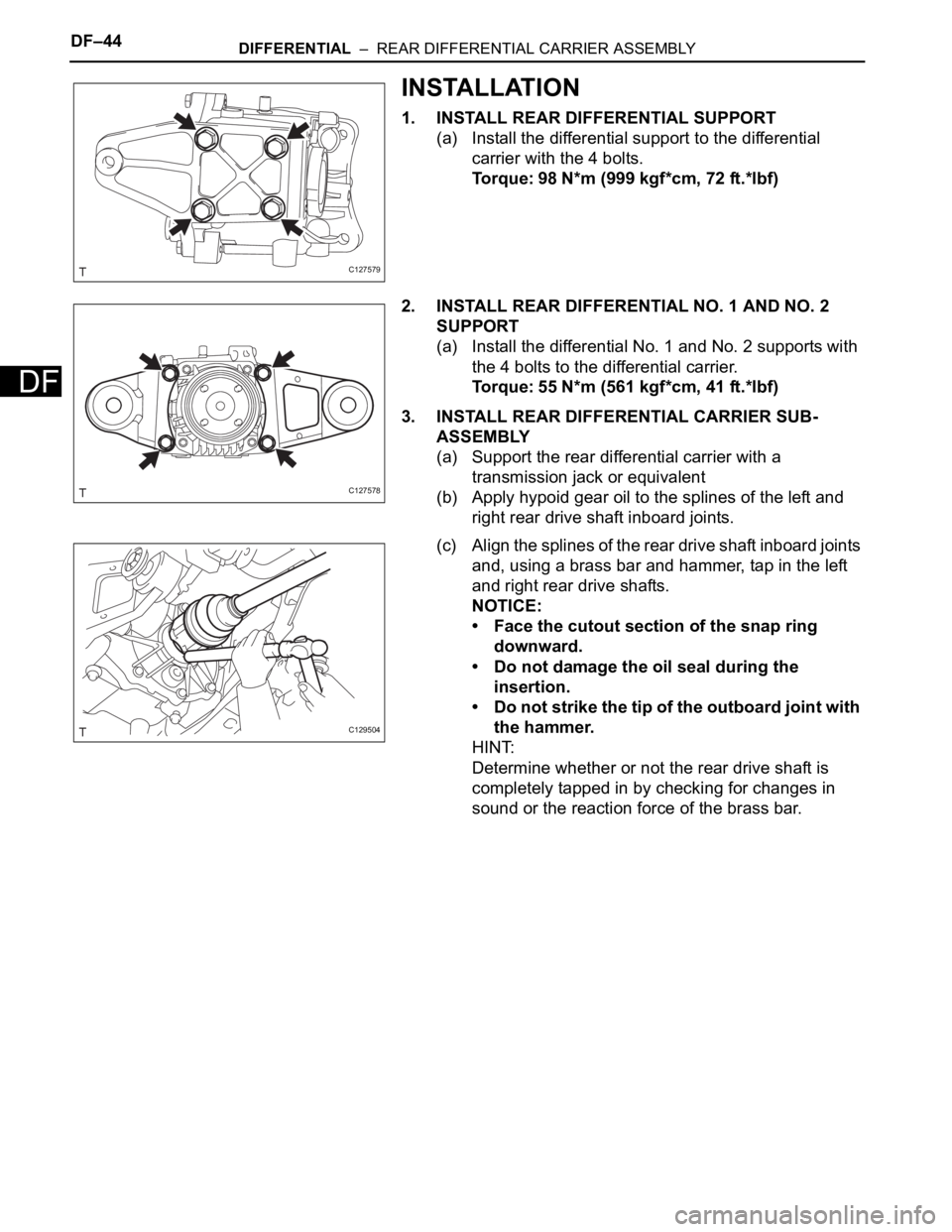
1. INSTALL REAR DIFFERENTIAL SUPPORT
(a) Install the differential support to the differential
carrier with the 4 bolts.
Torque: 98 N*m (999 kgf*cm, 72 ft.*lbf)
2. INSTALL REAR DIFFERENTIAL NO. 1 AND NO. 2
SUPPORT
(a) Install the differential No. 1 and No. 2 supports with
the 4 bolts to the differential carrier.
Torque: 55 N*m (561 kgf*cm, 41 ft.*lbf)
3. INSTALL REAR DIFFERENTIAL CARRIER SUB-
ASSEMBLY
(a) Support the rear differential carrier with a
transmission jack or equivalent
(b) Apply hypoid gear oil to the splines of the left and
right rear drive shaft inboard joints.
(c) Align the splines of the rear drive shaft inboard joints
and, using a brass bar and hammer, tap in the left
and right rear drive shafts.
NOTICE:
• Face the cutout section of the snap ring
downward.
• Do not damage the oil seal during the
insertion.
• Do not strike the tip of the outboard joint with
the hammer.
HINT:
Determine whether or not the rear drive shaft is
completely tapped in by checking for changes in
sound or the reaction force of the brass bar.
C127579
C127578
C129504
Page 1662 of 2000
AIR CONDITIONING – COMPRESSOR AND PULLEY (for 2AZ-FE)AC–217
AC
INSTALLATION
1. ADJUST ADJUST COMPRESSOR OIL
(a) When replacing the compressor and magnetic
clutch with a new one, gradually discharge the
refrigerant gas from the service valve, and drain the
following amount of oil from the new compressor
and magnetic clutch before installation.
Standard:
(Oil capacity inside the new compressor and
magnetic clutch: 130 + 15 cc (4.6 + 0.51 fl.oz.) )
-(Remaining oil amount in the removed
compressor and magnetic clutch) = (Oil
amount to be removed from the new
compressor when replacing)
NOTICE:
• When checking the compressor oil level,
observe the precautions on the cooler
removal/installation.
• If a new compressor and magnetic clutch is
installed without removing some oil
remaining in the pipes of the vehicle, the oil
amount will be too large. This prevents heat
exchange in the refrigerant cycle and causes
refrigerant failure.
• If the volume of oil remaining in the removed
compressor and magnetic clutch is too small,
check for oil leakage.
• Be sure to use ND-OIL 8 or equivalent for
compressor oil.
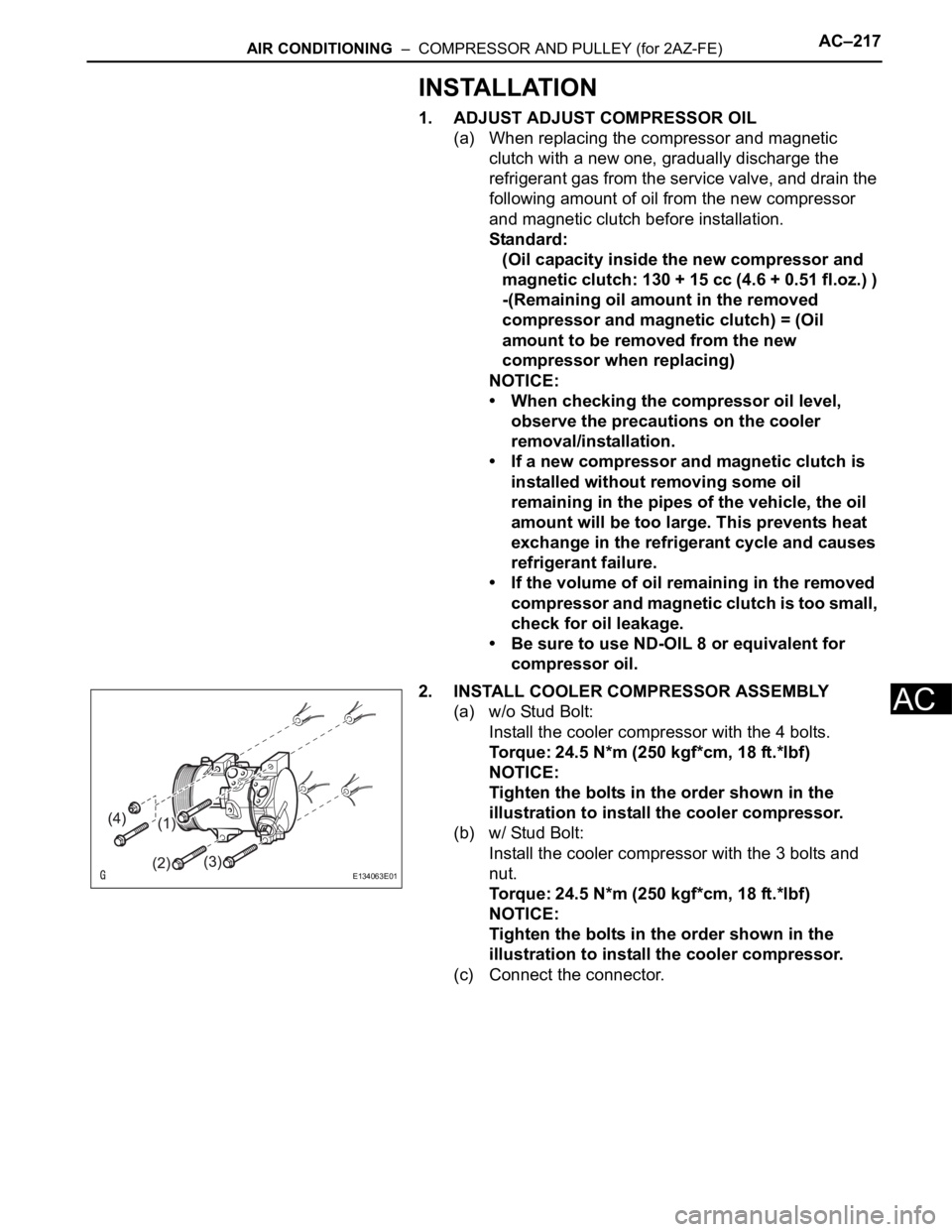
2. INSTALL COOLER COMPRESSOR ASSEMBLY
(a) w/o Stud Bolt:
Install the cooler compressor with the 4 bolts.
Torque: 24.5 N*m (250 kgf*cm, 18 ft.*lbf)
NOTICE:
Tighten the bolts in the order shown in the
illustration to install the cooler compressor.
(b) w/ Stud Bolt:
Install the cooler compressor with the 3 bolts and
nut.
Torque: 24.5 N*m (250 kgf*cm, 18 ft.*lbf)
NOTICE:
Tighten the bolts in the order shown in the
illustration to install the cooler compressor.
(c) Connect the connector.
E134063E01