2006 TOYOTA RAV4 warning light
[x] Cancel search: warning lightPage 1479 of 2000

TIRE AND WHEEL – TIRE PRESSURE WARNING SYSTEMTW–7
TW
(b) Under the following conditions, the system may not
function properly;
• Areas, facilities or devices that use similar radio
frequencies are located in the vicinity of the
vehicle.
• Devices using similar radio frequencies are used
in the vehicle.
• Large amounts of snow or ice are stuck to the
vehicle, especially on the wheels and around the
wheel houses.
• The battery of the transmitter is depleted.
• Tires and wheels without tire pressure warning
valves and transmitters are used.
• Snow tires and tire chains are used.
• If wheels other than the specified ones are used,
the system may not function properly because
different radio waves are transmitted from the tire
pressure warning valve and transmitter.
• Depending on the tire type, the tire pressure
warning valve and transmitter may not function
properly even though the specified wheels are
used.
• The system may not function properly if it is
initialized with tire pressures which are not the
specified values.
(c) The average life of the grommet of the tire pressure
warning antenna and receiver is approximately 5
years, at which time it must be replaced. Retighten
the valve nut if the valve is leaking air, if it is less
than 5 years old, and there is no problem with the
grommets.
(d) After removing and installing the ECU or a sensor,
output a diagnosis code and check that it is a
normal code.
3. FUNCTION OF COMPONENTS
Components Function
Tire pressure warning antenna and receiver • Combined as a single unit with a disc wheel air valve, it measures
tire pressure and temperature, and transmits an ID number for
measurement value and identification
• Battery is built into valve
Tire pressure warning antenna and receiver Receives necessary signals from tire pressure warning antenna and
receiver and transmits them to tire pressure warning ECU
Tire pressure warning ECU • Receives signal from receiver and identifies it as vehicle's own
signal.
• If measurement value is equal to or lower than specified value, it
transmits a signal so that the air pressure warning light on
combination meter turns on.
Tire pressure warning light Located in the combination meter, it informs driver of lowered tire air
pressure and system failure
Page 1480 of 2000
TW–8TIRE AND WHEEL – TIRE PRESSURE WARNING SYSTEM
TW
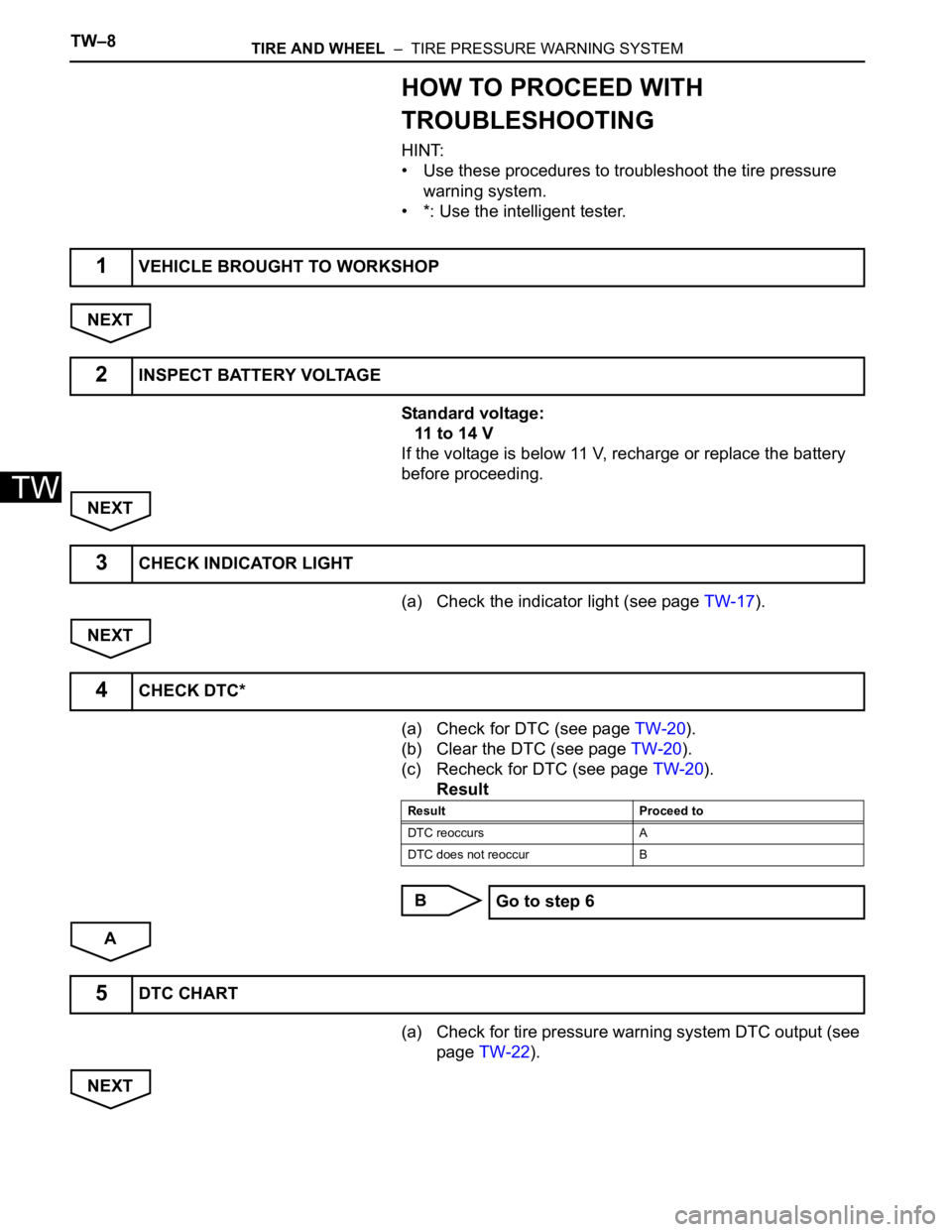
HOW TO PROCEED WITH
TROUBLESHOOTING
HINT:
• Use these procedures to troubleshoot the tire pressure
warning system.
• *: Use the intelligent tester.
NEXT
Standard voltage:
11 to 14 V
If the voltage is below 11 V, recharge or replace the battery
before proceeding.
NEXT
(a) Check the indicator light (see page TW-17).
NEXT
(a) Check for DTC (see page TW-20).
(b) Clear the DTC (see page TW-20).
(c) Recheck for DTC (see page TW-20).
Result
B
A
(a) Check for tire pressure warning system DTC output (see
page TW-22).
NEXT
1VEHICLE BROUGHT TO WORKSHOP
2INSPECT BATTERY VOLTAGE
3CHECK INDICATOR LIGHT
4CHECK DTC*
Result Proceed to
DTC reoccurs A
DTC does not reoccur B
Go to step 6
5DTC CHART
Page 1487 of 2000
TIRE AND WHEEL – TIRE PRESSURE WARNING SYSTEMTW–15
TW
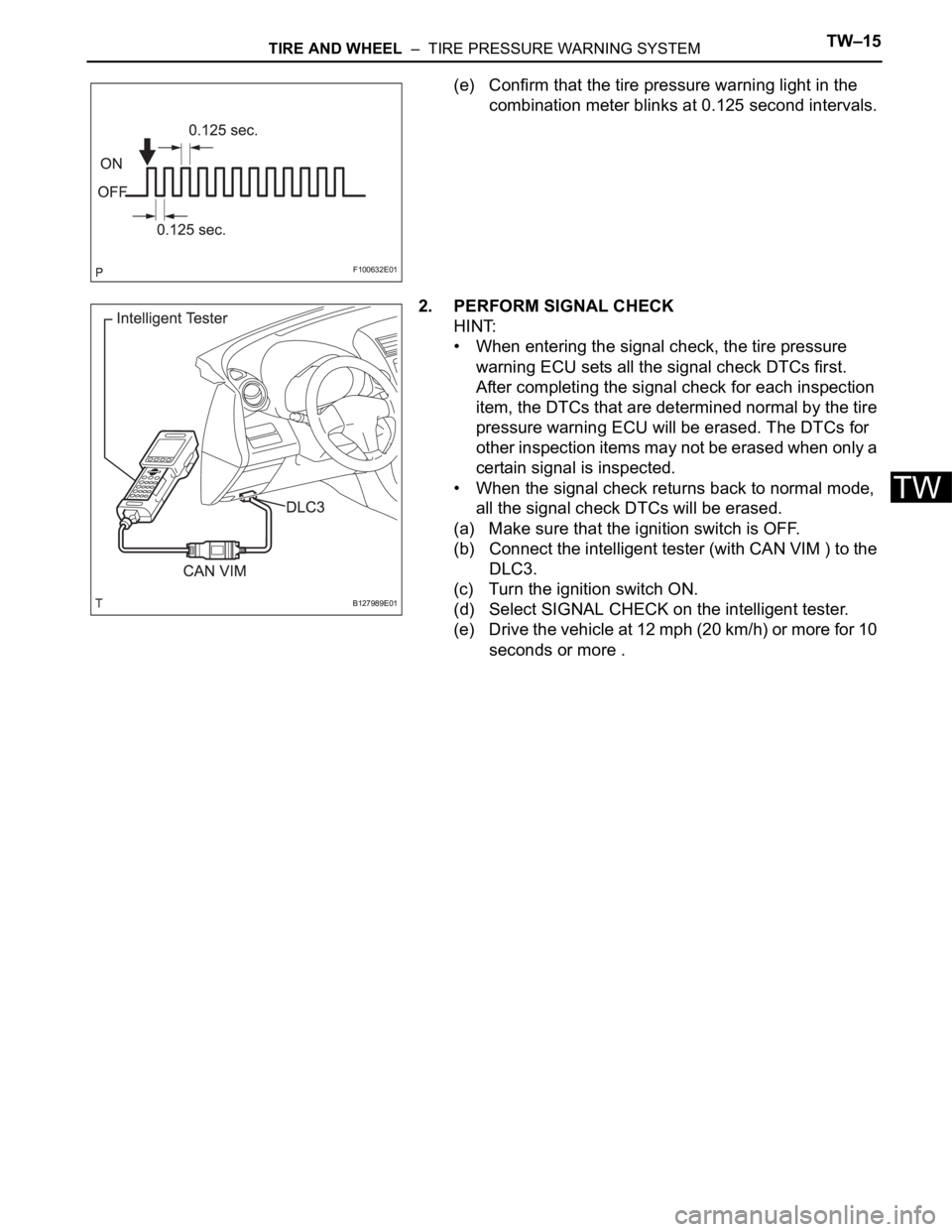
(e) Confirm that the tire pressure warning light in the
combination meter blinks at 0.125 second intervals.
2. PERFORM SIGNAL CHECK
HINT:
• When entering the signal check, the tire pressure
warning ECU sets all the signal check DTCs first.
After completing the signal check for each inspection
item, the DTCs that are determined normal by the tire
pressure warning ECU will be erased. The DTCs for
other inspection items may not be erased when only a
certain signal is inspected.
• When the signal check returns back to normal mode,
all the signal check DTCs will be erased.
(a) Make sure that the ignition switch is OFF.
(b) Connect the intelligent tester (with CAN VIM ) to the
DLC3.
(c) Turn the ignition switch ON.
(d) Select SIGNAL CHECK on the intelligent tester.
(e) Drive the vehicle at 12 mph (20 km/h) or more for 10
seconds or more .
F100632E01
B127989E01
Page 1490 of 2000
TW–18TIRE AND WHEEL – TIRE PRESSURE WARNING SYSTEM
TW
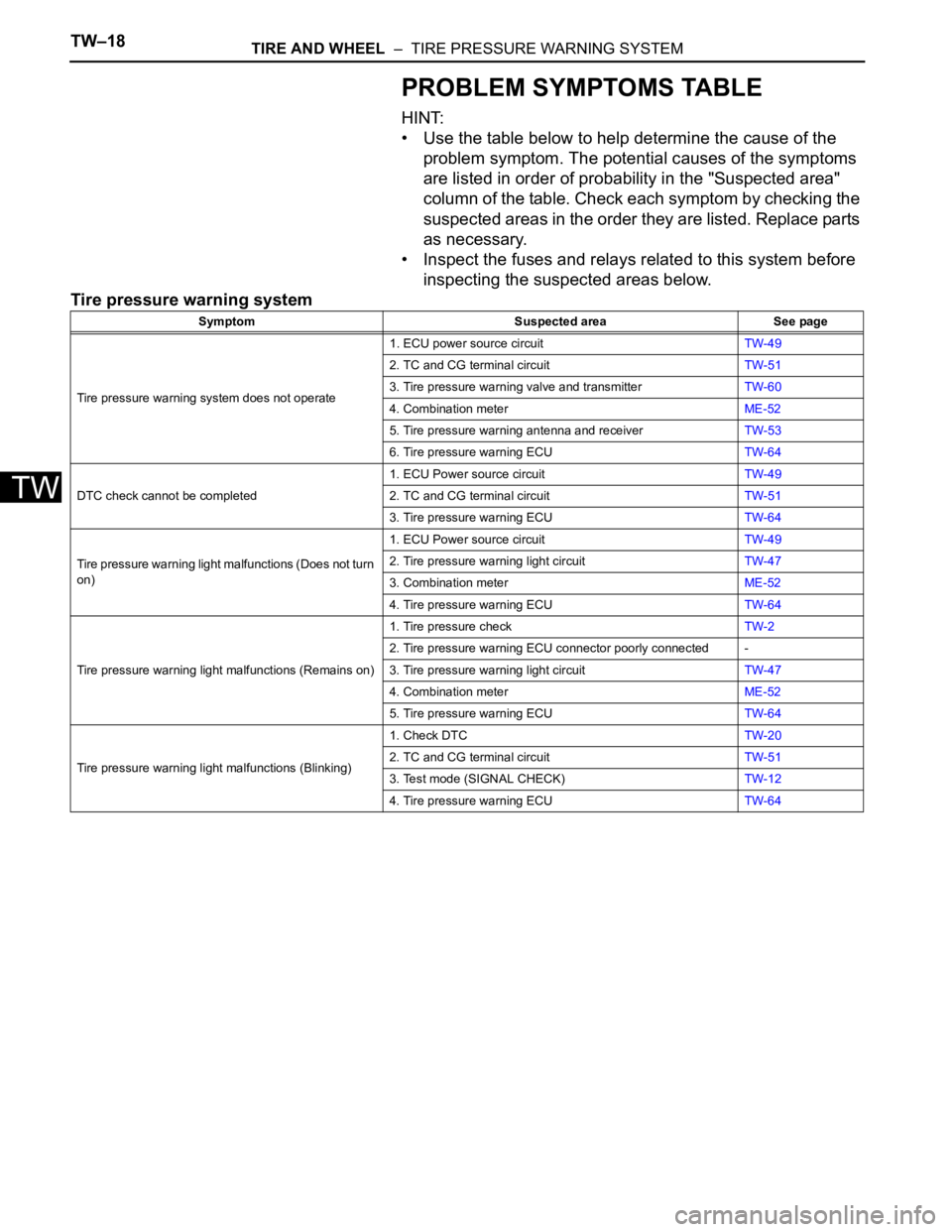
PROBLEM SYMPTOMS TABLE
HINT:
• Use the table below to help determine the cause of the
problem symptom. The potential causes of the symptoms
are listed in order of probability in the "Suspected area"
column of the table. Check each symptom by checking the
suspected areas in the order they are listed. Replace parts
as necessary.
• Inspect the fuses and relays related to this system before
inspecting the suspected areas below.
Tire pressure warning system
Symptom Suspected area See page
Tire pressure warning system does not operate1. ECU power source circuitTW-49
2. TC and CG terminal circuitTW-51
3. Tire pressure warning valve and transmitterTW-60
4. Combination meterME-52
5. Tire pressure warning antenna and receiverTW-53
6. Tire pressure warning ECUTW-64
DTC check cannot be completed1. ECU Power source circuitTW-49
2. TC and CG terminal circuitTW-51
3. Tire pressure warning ECUTW-64
Tire pressure warning light malfunctions (Does not turn
on)1. ECU Power source circuitTW-49
2. Tire pressure warning light circuitTW-47
3. Combination meterME-52
4. Tire pressure warning ECUTW-64
Tire pressure warning light malfunctions (Remains on)1. Tire pressure checkTW-2
2. Tire pressure warning ECU connector poorly connected -
3. Tire pressure warning light circuitTW-47
4. Combination meterME-52
5. Tire pressure warning ECUTW-64
Tire pressure warning light malfunctions (Blinking)1. Check DTCTW-20
2. TC and CG terminal circuitTW-51
3. Test mode (SIGNAL CHECK)TW-12
4. Tire pressure warning ECUTW-64
Page 1491 of 2000
TIRE AND WHEEL – TIRE PRESSURE WARNING SYSTEMTW–19
TW
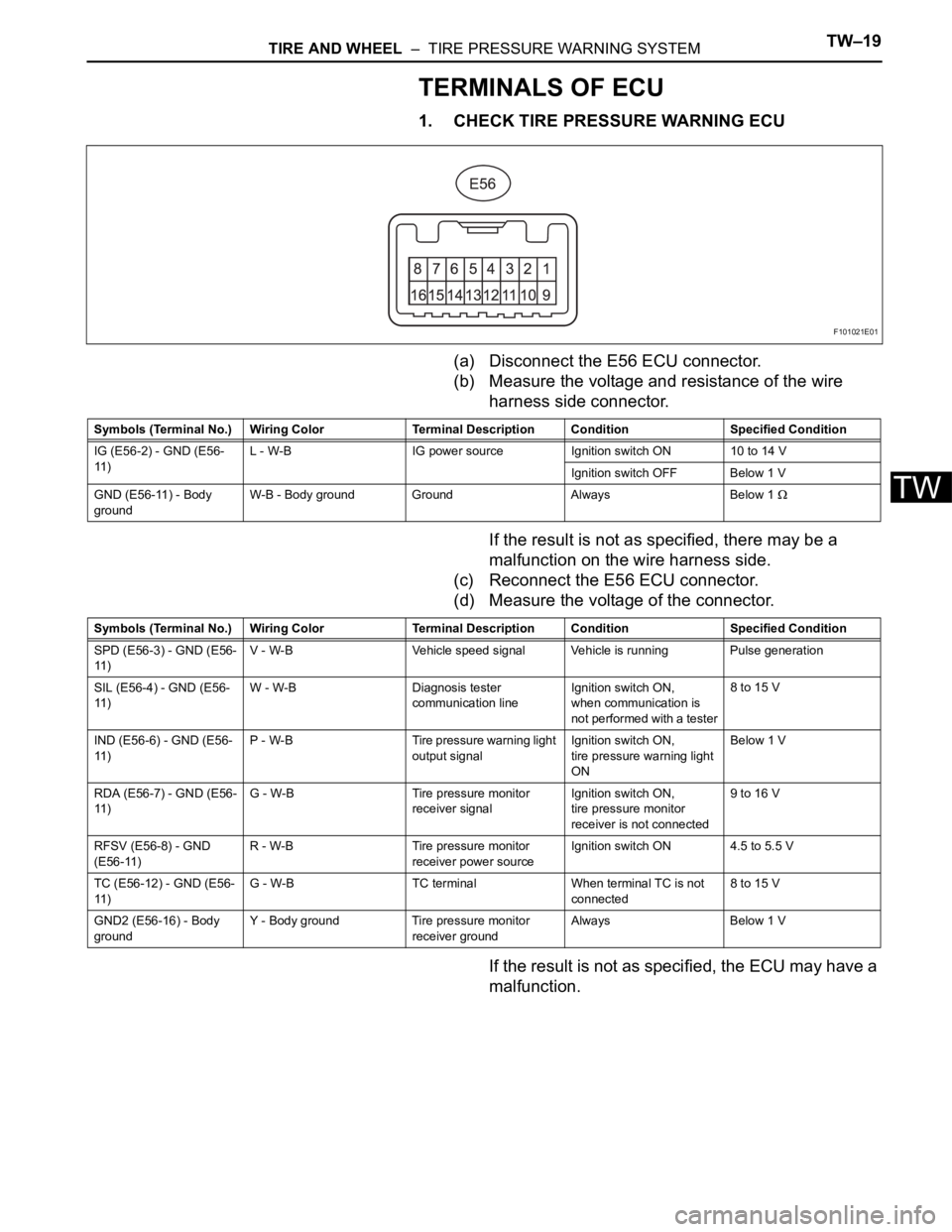
TERMINALS OF ECU
1. CHECK TIRE PRESSURE WARNING ECU
(a) Disconnect the E56 ECU connector.
(b) Measure the voltage and resistance of the wire
harness side connector.
If the result is not as specified, there may be a
malfunction on the wire harness side.
(c) Reconnect the E56 ECU connector.
(d) Measure the voltage of the connector.
If the result is not as specified, the ECU may have a
malfunction.
F101021E01
Symbols (Terminal No.) Wiring Color Terminal Description ConditionSpecified Condition
IG (E56-2) - GND (E56-
11 )L - W-B IG power source Ignition switch ON 10 to 14 V
Ignition switch OFF Below 1 V
GND (E56-11) - Body
groundW-B - Body ground Ground Always Below 1
Symbols (Terminal No.) Wiring Color Terminal Description ConditionSpecified Condition
SPD (E56-3) - GND (E56-
11 )V - W-B Vehicle speed signal Vehicle is running Pulse generation
SIL (E56-4) - GND (E56-
11 )W - W-B Diagnosis tester
communication lineIgnition switch ON,
when communication is
not performed with a tester8 to 15 V
IND (E56-6) - GND (E56-
11 )P - W-B Tire pressure warning light
output signalIgnition switch ON,
tire pressure warning light
ONBelow 1 V
RDA (E56-7) - GND (E56-
11 )G - W-B Tire pressure monitor
receiver signalIgnition switch ON,
tire pressure monitor
receiver is not connected9 to 16 V
RFSV (E56-8) - GND
(E56-11)R - W-B Tire pressure monitor
receiver power sourceIgnition switch ON 4.5 to 5.5 V
TC (E56-12) - GND (E56-
11 )G - W-B TC terminal When terminal TC is not
connected8 to 15 V
GND2 (E56-16) - Body
groundY - Body ground Tire pressure monitor
receiver groundAlways Below 1 V
Page 1492 of 2000
TW–20TIRE AND WHEEL – TIRE PRESSURE WARNING SYSTEM
TW
DIAGNOSIS SYSTEM
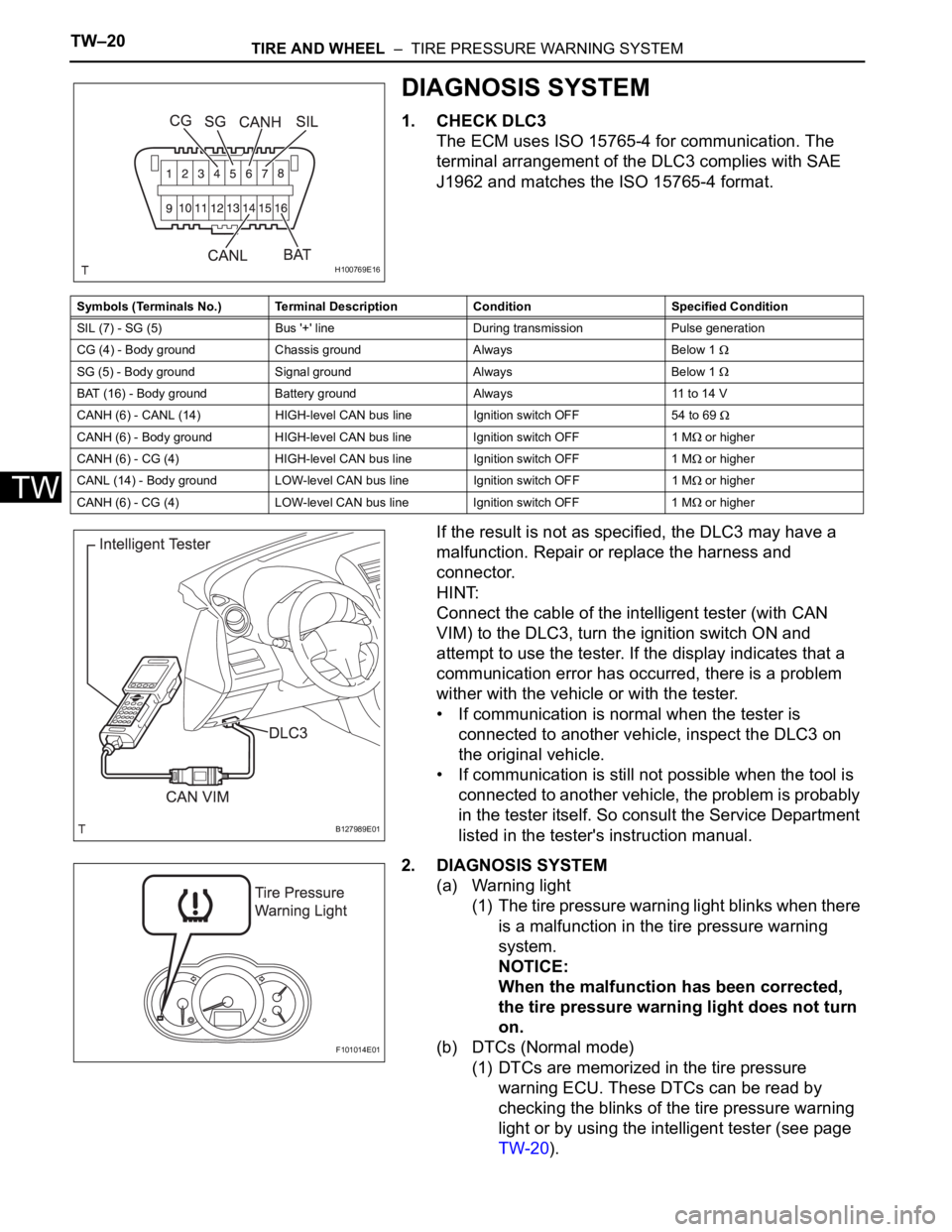
1. CHECK DLC3
The ECM uses ISO 15765-4 for communication. The
terminal arrangement of the DLC3 complies with SAE
J1962 and matches the ISO 15765-4 format.
If the result is not as specified, the DLC3 may have a
malfunction. Repair or replace the harness and
connector.
HINT:
Connect the cable of the intelligent tester (with CAN
VIM) to the DLC3, turn the ignition switch ON and
attempt to use the tester. If the display indicates that a
communication error has occurred, there is a problem
wither with the vehicle or with the tester.
• If communication is normal when the tester is
connected to another vehicle, inspect the DLC3 on
the original vehicle.
• If communication is still not possible when the tool is
connected to another vehicle, the problem is probably
in the tester itself. So consult the Service Department
listed in the tester's instruction manual.
2. DIAGNOSIS SYSTEM
(a) Warning light
(1) The tire pressure warning light blinks when there
is a malfunction in the tire pressure warning
system.
NOTICE:
When the malfunction has been corrected,
the tire pressure warning light does not turn
on.
(b) DTCs (Normal mode)
(1) DTCs are memorized in the tire pressure
warning ECU. These DTCs can be read by
checking the blinks of the tire pressure warning
light or by using the intelligent tester (see page
TW-20).
H100769E16
Symbols (Terminals No.) Terminal Description Condition Specified Condition
SIL (7) - SG (5) Bus '+' line During transmission Pulse generation
CG (4) - Body ground Chassis ground Always Below 1
SG (5) - Body ground Signal ground Always Below 1
BAT (16) - Body ground Battery ground Always 11 to 14 V
CANH (6) - CANL (14) HIGH-level CAN bus line Ignition switch OFF 54 to 69
CANH (6) - Body ground HIGH-level CAN bus line Ignition switch OFF1 M or higher
CANH (6) - CG (4) HIGH-level CAN bus line Ignition switch OFF 1 M
or higher
CANL (14) - Body ground LOW-level CAN bus line Ignition switch OFF1 M
or higher
CANH (6) - CG (4) LOW-level CAN bus line Ignition switch OFF 1 M
or higher
B127989E01
F101014E01
Page 1493 of 2000
TIRE AND WHEEL – TIRE PRESSURE WARNING SYSTEMTW–21
TW
(c) Test mode
(1) By switching from normal mode to test mode
(input signal check), you can inspect the tire
pressure monitor receiver, each tire pressure
warning valve and transmitter and vehicle speed
sensor (see page TW-12).
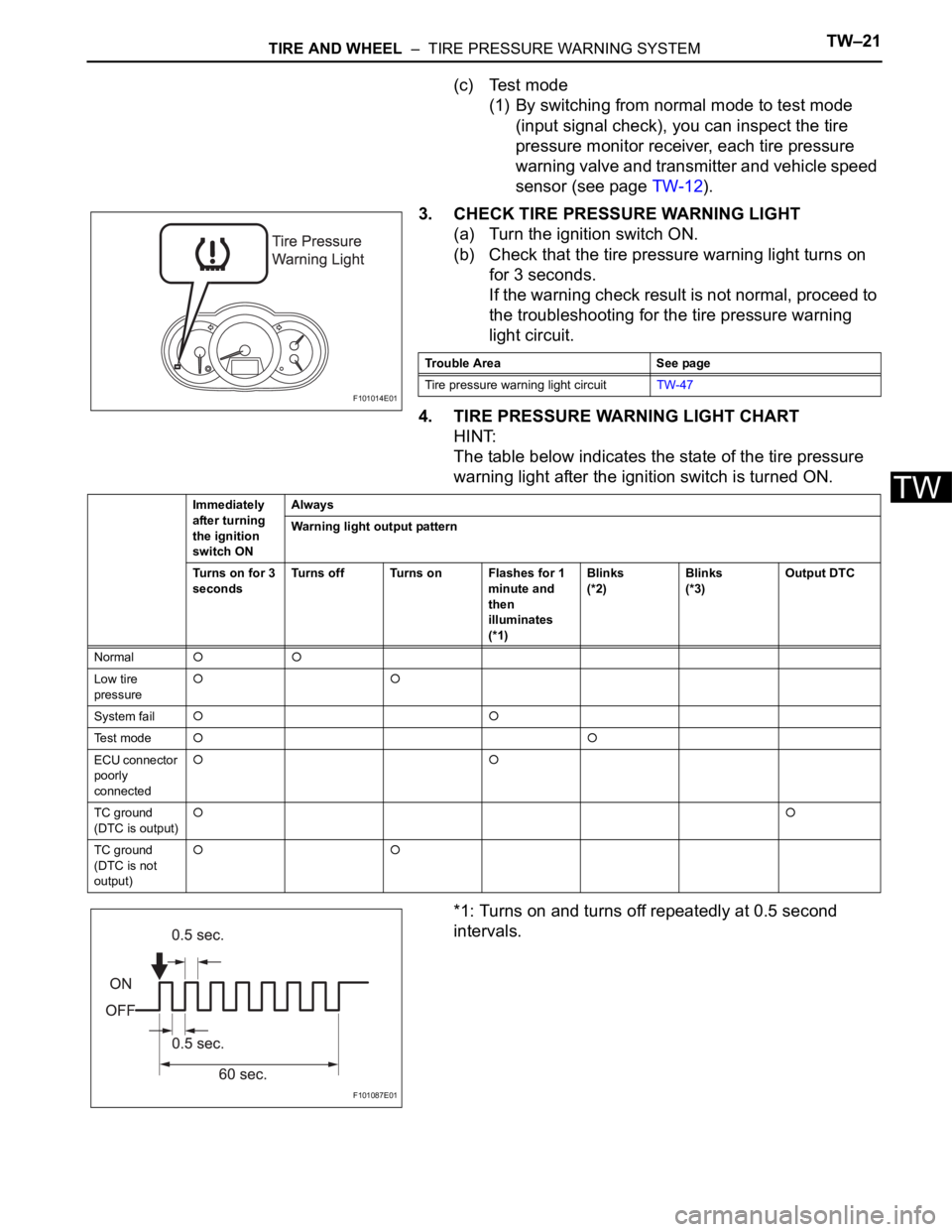
3. CHECK TIRE PRESSURE WARNING LIGHT
(a) Turn the ignition switch ON.
(b) Check that the tire pressure warning light turns on
for 3 seconds.
If the warning check result is not normal, proceed to
the troubleshooting for the tire pressure warning
light circuit.
4. TIRE PRESSURE WARNING LIGHT CHART
HINT:
The table below indicates the state of the tire pressure
warning light after the ignition switch is turned ON.
*1: Turns on and turns off repeatedly at 0.5 second
intervals.
F101014E01
Trouble Area See page
Tire pressure warning light circuitTW-47
Immediately
after turning
the ignition
switch ONAlways
Warning light output pattern
Turns on for 3
secondsTurns off Turns on Flashes for 1
minute and
then
illuminates
(*1)Blinks
(*2)Blinks
(*3)Output DTC
Normal
Low tire
pressure
System fail
Te s t m o d e
ECU connector
poorly
connected
TC ground
(DTC is output)
TC ground
(DTC is not
output)
F101087E01
Page 1495 of 2000
TIRE AND WHEEL – TIRE PRESSURE WARNING SYSTEMTW–23
TW
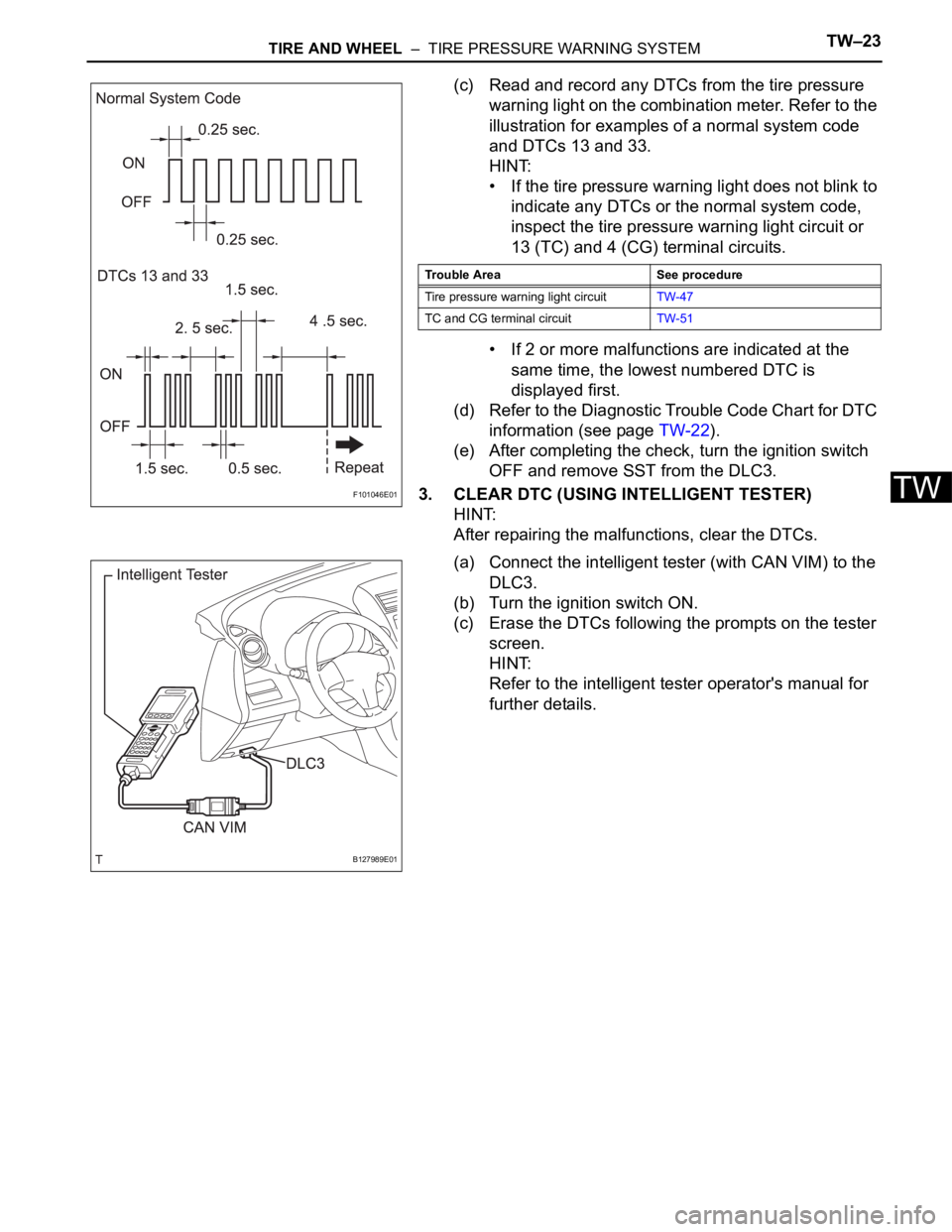
(c) Read and record any DTCs from the tire pressure
warning light on the combination meter. Refer to the
illustration for examples of a normal system code
and DTCs 13 and 33.
HINT:
• If the tire pressure warning light does not blink to
indicate any DTCs or the normal system code,
inspect the tire pressure warning light circuit or
13 (TC) and 4 (CG) terminal circuits.
• If 2 or more malfunctions are indicated at the
same time, the lowest numbered DTC is
displayed first.
(d) Refer to the Diagnostic Trouble Code Chart for DTC
information (see page TW-22).
(e) After completing the check, turn the ignition switch
OFF and remove SST from the DLC3.
3. CLEAR DTC (USING INTELLIGENT TESTER)
HINT:
After repairing the malfunctions, clear the DTCs.
(a) Connect the intelligent tester (with CAN VIM) to the
DLC3.
(b) Turn the ignition switch ON.
(c) Erase the DTCs following the prompts on the tester
screen.
HINT:
Refer to the intelligent tester operator's manual for
further details.
F101046E01
Trouble Area See procedure
Tire pressure warning light circuitTW-47
TC and CG terminal circuitTW-51
B127989E01