2006 TOYOTA RAV4 turn signal
[x] Cancel search: turn signalPage 439 of 2000

ENGINE IMMOBILISER – ENGINE IMMOBILISER SYSTEMEI–3
EI
SYSTEM DESCRIPTION
1. ENGINE IMMOBILISER SYSTEM DESCRIPTION
The engine immobiliser system is designed to prevent
the vehicle from being stolen. This system uses a
transponder key ECU that stores the key codes of
authorized ignition keys. If an attempt is made to start
the engine using an unauthorized key, the ECU sends a
signal to the ECM to prohibit fuel delivery and ignition,
effectively disabling the engine.
2. FUNCTION OF MAIN COMPONENT
3. SYSTEM FUNCTION
• When the transponder key ECU detects that the
unlock warning switch is ON, the ECU provides
current to the transponder key coil and produces a
faint electric wave. A transponder chip in the key grip
receives the wave and outputs a key ID code signal.
The transponder key coil receives this signal, the
transponder key amplifier amplifies it, and then the
signal is transmitted to the ECU. The ECU matches
the key's ID code with the vehicle's ID code, which
was previously registered in the ECU and then
communicates the results to the ECM using SFI
communication.
• After the identification results show that the key's ID
code matches the vehicle's ID code and the ECU has
confirmed their match: 1) the engine immobiliser
system is canceled and the engine starting controls
(fuel injection control and ignition control) enter
standby mode; and 2) the ECU receives a security
indicator light signal, and turns the security indicator
light OFF.
Component Outline
Transponder key coil/amplifierWhen key is inserted into ignition key cylinder, key coil receives key
code. Then amplifier amplifies ID code and outputs it to transponder
key ECU.
Unlock warning switch assemblyDetects whether key is in ignition key cylinder and outputs results to
transponder key ECU
ECMThrough SFI communication, ECM receives ID verification results
from transponder key ECU. ECM also verifies ECUs. Then ECM
judges whether or not to immobilize engine.
Security indicator lightDepending on operation of transponder key ECU, interior security
indicator light comes on or starts blinking
Page 456 of 2000

DL–4DOOR LOCK – POWER DOOR LOCK CONTROL SYSTEM
DL
SYSTEM DESCRIPTION
1. POWER DOOR LOCK SYSTEM DESCRIPTION
(a) The power door lock system locks / unlocks all
doors with a one-touch operation.
• The door control switch of the power window
regulator master switch or door control switch on
passenger side sends lock / unlock request
signals to the main body ECU. Then, the main
body ECU sends these requests to the lock
motors in each door to lock / unlock all the doors
simultaneously.
• Operating the driver side door lock using a key
sends lock / unlock request signals to the main
body ECU.
2. COMPONENTS
3. FUNCTIONS
This system is controlled by the main body ECU. The
main body ECU outputs signals to each door lock motor.
The door lock control system in the vehicle has the
following functions:
Components Function
Door control switch on power window regulator master switch Locks / unlocks all doors
Door control switch Locks / unlocks all doors
Door courtesy switch • Placed on each door.
• Detects door status (open or closed) and outputs data to main
body ECU.
• Turns on when door is open and off when door is closed.
Driver door lock • Built-in motor locks / unlocks door.
• Built-in door control switch (key-linked) detects door key
operation's door status (locked or unlocked) and outputs data to
main body ECU.
• Built-in position switch detects door status (locked or unlocked)
and outputs data to main body ECU. This switch turns off when
door is locked and on when door is unlocked.
• Front passenger door lock
• Rear door lock LH
• Rear door lock RH
• Back door lockBuilt-in motor locks / unlocks door.
Functions Outlines
Key-linked lock and unlock function Linked with key cylinder. Locks / unlocks all doors when lock / unlock
operation is possible.
Key lock-in prevention function When key is inserted in ignition key cylinder and door lock operation is
performed, all doors are unlocked.
Manual unlock prohibition function Performing door lock operation with transmitter or key disables unlock
operation by door control switch.
2-step unlock function Unlocks only driver door by turning key cylinder once and unlocks
other doors by turning it twice.
Page 492 of 2000

ES–382AZ-FE ENGINE CONTROL SYSTEM – SFI SYSTEM
ES
DIAGNOSIS SYSTEM
1. DESCRIPTION
When troubleshooting OBD II (On-Board Diagnostics)
vehicles, the intelligent tester (complying with SAE
J1987) must be connected to the DLC3 (Data Link
Connector 3) of the vehicle. Various data in the vehicle's
ECM (Engine Control Module) can be then read.
OBD II regulations require that the vehicle's on-board
computer illuminate the MIL (Malfunction Indicator
Lamp) on the instrument panel when the computer
detects a malfunction in:
(a) The emission control system components.
(b) The powertrain control components (which affect
vehicle emissions).
(c) The computer itself.
In addition, if the applicable DTCs (Diagnostic Trouble
Codes) prescribed by SAE J2012 are not recorded on 3
consecutive trips, the MIL turns off automatically but the
DTCs remain recorded in the ECM memory.
To check DTCs, connect the intelligent tester to the
DLC3. The tester displays DTCs, freeze frame data, and
a variety of the engine data. The DTCs and freeze frame
data can be erased with the tester (see page ES-35).
In order to enhance OBD function on vehicles and
develop the Off-Board diagnosis system, CAN
(Controller Area Network) communication is introduced
in this system. It minimizes the gap between technician
skills and vehicle technology. CAN is a network, which
uses a pair of data transmission lines, spanning multiple
computers and sensors. It allows high speed
communication between the systems and simplifies the
wire harness connection.
Since this system is equipped with the CAN
communication, connecting the CAN VIM (Vehicle
Interface Module) to the intelligent tester is necessary to
display any information from the ECM. (Also the
communication between the intelligent tester and the
ECM uses CAN communication signals.) When
confirming the DTCs and any data of the ECM, connect
the CAN VIM between the DLC3 and the intelligent
tester.
2. NORMAL MODE AND CHECK MODE
The diagnosis system operates in normal mode during
normal vehicle use. In normal mode, 2 trip detection
logic is used to ensure accurate detection of
malfunctions. Check mode is also available as an option
for technicians. In check mode, 1 trip detection logic is
used for simulating malfunction symptoms and
increasing the system's ability to detect malfunctions,
including intermittent problems (intelligent tester only)
(see page ES-38).
FI00534
B127989E01
Page 493 of 2000
2AZ-FE ENGINE CONTROL SYSTEM – SFI SYSTEMES–39
ES
3. 2 TRIP DETECTION LOGIC
When a malfunction is first detected, the malfunction is
temporarily stored in the ECM memory (1st trip). If the
same malfunction is detected during the next
subsequent drive cycle, the MIL is illuminated (2nd trip).
4. FREEZE FRAME DATA
Freeze frame data records the engine conditions (fuel
system, calculated engine load, engine coolant
temperature, fuel trim, engine speed, vehicle speed,
etc.) when malfunctions are detected. When
troubleshooting, freeze frame data can help determine if
the vehicle was moving or stationary, if the engine was
warmed up or not, if the air-fuel ratio was lean or rich,
and other data from the time the malfunction occurred.
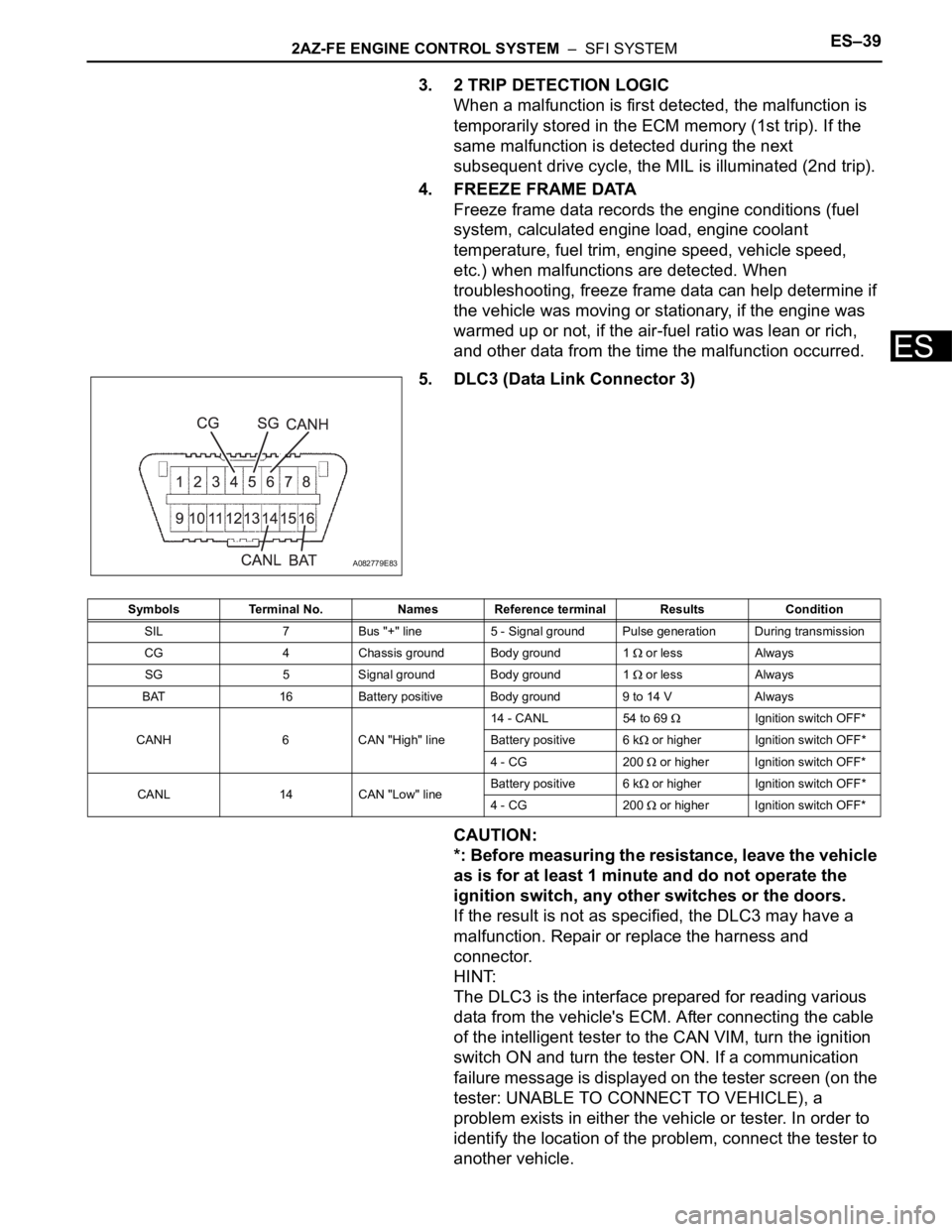
5. DLC3 (Data Link Connector 3)
CAUTION:
*: Before measuring the resistance, leave the vehicle
as is for at least 1 minute and do not operate the
ignition switch, any other switches or the doors.
If the result is not as specified, the DLC3 may have a
malfunction. Repair or replace the harness and
connector.
HINT:
The DLC3 is the interface prepared for reading various
data from the vehicle's ECM. After connecting the cable
of the intelligent tester to the CAN VIM, turn the ignition
switch ON and turn the tester ON. If a communication
failure message is displayed on the tester screen (on the
tester: UNABLE TO CONNECT TO VEHICLE), a
problem exists in either the vehicle or tester. In order to
identify the location of the problem, connect the tester to
another vehicle.
A082779E83
Symbols Terminal No. Names Reference terminal Results Condition
SIL 7 Bus "+" line 5 - Signal ground Pulse generation During transmission
CG 4 Chassis ground Body ground 1
or less Always
SG 5 Signal ground Body ground 1
or less Always
BAT 16 Battery positive Body ground 9 to 14 V Always
CANH 6 CAN "High" line14 - CANL 54 to 69
Ignition switch OFF*
Battery positive 6 k
or higher Ignition switch OFF*
4 - CG 200
or higher Ignition switch OFF*
CANL 14 CAN "Low" lineBattery positive 6 k
or higher Ignition switch OFF*
4 - CG 200
or higher Ignition switch OFF*
Page 497 of 2000

2AZ-FE ENGINE CONTROL SYSTEM – SFI SYSTEMES–43
ES
KNOCK FB VAL Feedback value of knocking -
ACCEL POS #1Absolute Accelerator Pedal Position (APP)
No.1-
ACCEL POS #2 Absolute APP No. 2 -
THROTTLE POS Throttle sensor positioning -
THROTTLE POS Throttle position -
THROTTLE POS #2 Throttle sensor positioning #2 -
THROTTLE MOT Throttle motor -
O2S B1 S2 Heated oxygen sensor outputPerforming INJ VOL or A/F CONTROL
function of ACTIVE TEST enables technician
to check output voltage of sensor
AFS B1 S1 A/F sensor outputPerforming INJ VOL or A/F CONTROL
function of ACTIVE TEST enables technician
to check output voltage of sensor
TOTAL FT #1 Total fuel trim -
SHORT FT #1 Short-term fuel trimShort-term fuel compensation used to
maintain air-fuel ratio at stoichiometric air-fuel
ratio
LONG FT #1 Long-term fuel trimOverall fuel compensation carried out in long-
term to compensate a continual deviation of
short-term fuel trim from central valve
FUEL SYS #1 Fuel system status• OL (Open Loop): Has not yet satisfied
conditions to go closed loop
• CL (Closed Loop): Using A/F sensor as
feedback for fuel control
• OL DRIVE: Open loop due to driving
conditions (fuel enrichment)
• OL FAULT: Open loop due to detected
system fault
• CL FAULT: Closed loop but A/F sensor,
which used for fuel control malfunctioning
O2FT B1 S2 Fuel trim at heated oxygen sensor -
AF FT B1 S1 Fuel trim at A/F sensor -
AFS B1 S1 A/F sensor current -
CAT TEMP B1S1 Estimated catalyst temperature (sensor 1) -
CAT TEMP B1S2 Estimated catalyst temperature (sensor 2) -
S O2S B1S2Sub heated oxygen sensor impedance
(sensor 2)-
INI COOL TEMP Engine coolant temperature at engine start -
INI INTAKE TEMP Intake air temperature at engine start -
INJ VOL Injection volume -
STARTER SIG Starter switch (STSW) signal -
PS SW Power steering signal -
PS SIGNAL Power steering signal (history)Signal status usually ON until ignition switch
turned OFF
CTP SW Closed throttle position switch -
A/C SIGNAL A/C signal -
PNP SW (NSW) Park/Neutral Position (PNP) switch signal -
ELECT LOAD SIG Electrical load signal -
STOP LIGHT SW Stop light switch -
BATTERY VOLTAGE Battery voltage -
ATM PRESSURE Atmosphere pressure -
EVAP (Purge) VSV EVAP Purge VSV -
FUEL PUMP/SPD Fuel pump/speed status -LABEL
(Intelligent Tester Display)Measurement Item Diagnostic Note
Page 566 of 2000

ES–422GR-FE ENGINE CONTROL SYSTEM – SFI SYSTEM
ES
DIAGNOSIS SYSTEM
1. DESCRIPTION
When troubleshooting OBD II (On-Board Diagnostics)
vehicles, the intelligent tester (complying with SAE
J1987) must be connected to the DLC3 (Data Link
Connector 3) of the vehicle. Various data in the vehicle's
ECM (Engine Control Module) can be then read.
OBD II regulations require that the vehicle's on-board
computer illuminate the MIL (Malfunction Indicator
Lamp) on the instrument panel when the computer
detects a malfunction in:
(a) The emission control system components.
(b) The powertrain control components (which affect
vehicle emissions).
(c) The computer itself.
In addition, if the applicable DTCs (Diagnostic Trouble
Codes) prescribed by SAE J2012 are not recorded on 3
consecutive trips, the MIL turns off automatically but the
DTCs remain recorded in the ECM memory.
To check DTCs, connect the intelligent tester to the
DLC3. The tester displays DTCs, freeze frame data, and
a variety of the engine data. The DTCs and freeze frame
data can be erased with the tester (see page ES-39).
In order to enhance OBD function on vehicles and
develop the Off-Board diagnosis system, CAN
(Controller Area Network) communication is introduced
in this system. It minimizes the gap between technician
skills and vehicle technology. CAN is a network, which
uses a pair of data transmission lines, spanning multiple
computers and sensors. It allows high speed
communication between the systems and simplifies the
wire harness connection.
Since this system is equipped with the CAN
communication, connecting the CAN VIM (Vehicle
Interface Module) to the intelligent tester is necessary to
display any information from the ECM. (Also the
communication between the intelligent tester and the
ECM uses CAN communication signals.) When
confirming the DTCs and any data of the ECM, connect
the CAN VIM between the DLC3 and the intelligent
tester.
2. NORMAL MODE AND CHECK MODE
The diagnosis system operates in normal mode during
normal vehicle use. In normal mode, 2 trip detection
logic is used to ensure accurate detection of
malfunctions. Check mode is also available as an option
for technicians. In check mode, 1 trip detection logic is
used for simulating malfunction symptoms and
increasing the system's ability to detect malfunctions,
including intermittent problems (intelligent tester only)
(see page ES-42).
FI00534E01
B127989E01
Page 567 of 2000
2GR-FE ENGINE CONTROL SYSTEM – SFI SYSTEMES–43
ES
3. 2 TRIP DETECTION LOGIC
When a malfunction is first detected, the malfunction is
temporarily stored in the ECM memory (1st trip). If the
same malfunction is detected during the next
subsequent drive cycle, the MIL is illuminated (2nd trip).
4. FREEZE FRAME DATA
Freeze frame data records the engine conditions (fuel
system, calculated engine load, engine coolant
temperature, fuel trim, engine speed, vehicle speed,
etc.) when malfunctions are detected. When
troubleshooting, freeze frame data can help determine if
the vehicle was moving or stationary, if the engine was
warmed up or not, if the air-fuel ratio was lean or rich,
and other data from the time the malfunction occurred.
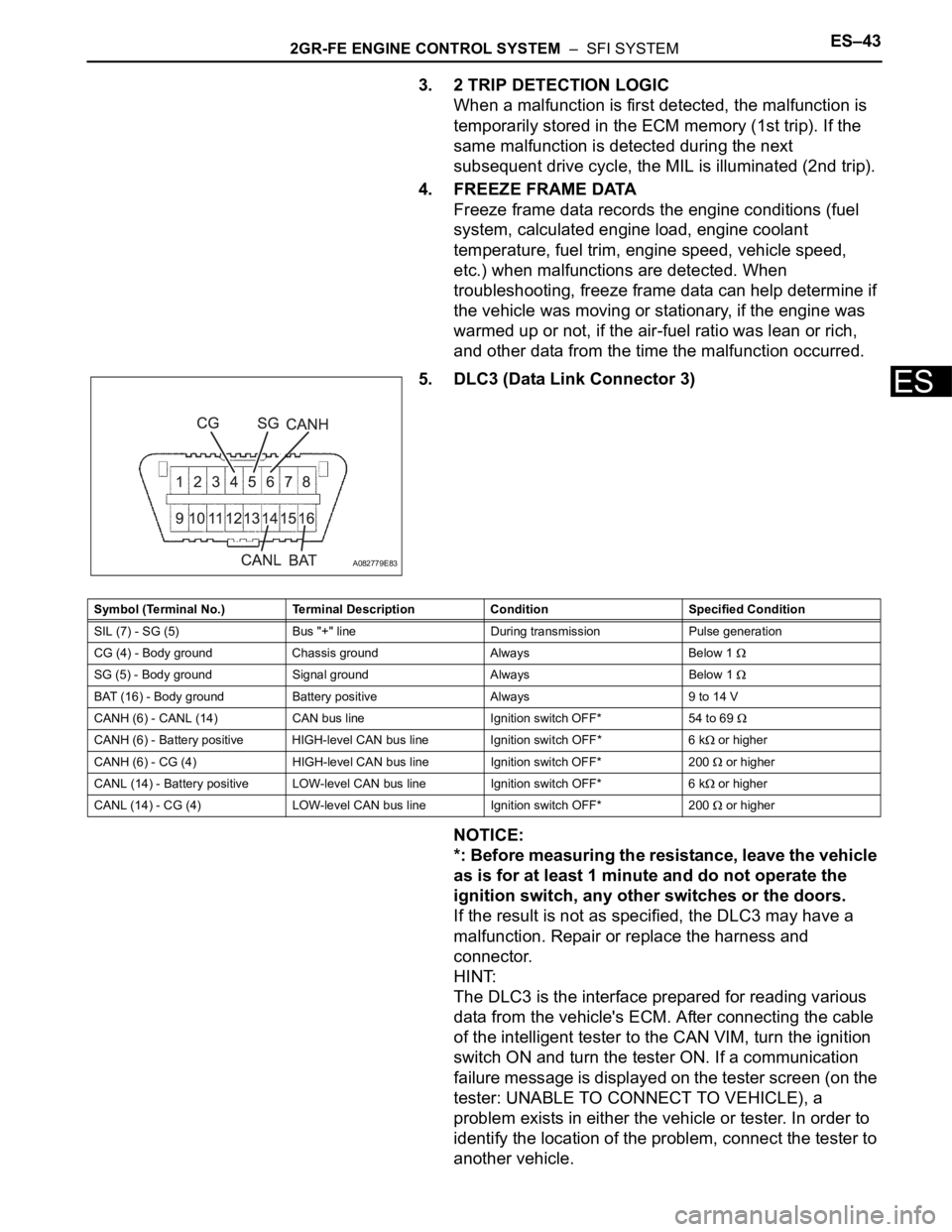
5. DLC3 (Data Link Connector 3)
NOTICE:
*: Before measuring the resistance, leave the vehicle
as is for at least 1 minute and do not operate the
ignition switch, any other switches or the doors.
If the result is not as specified, the DLC3 may have a
malfunction. Repair or replace the harness and
connector.
HINT:
The DLC3 is the interface prepared for reading various
data from the vehicle's ECM. After connecting the cable
of the intelligent tester to the CAN VIM, turn the ignition
switch ON and turn the tester ON. If a communication
failure message is displayed on the tester screen (on the
tester: UNABLE TO CONNECT TO VEHICLE), a
problem exists in either the vehicle or tester. In order to
identify the location of the problem, connect the tester to
another vehicle.
A082779E83
Symbol (Terminal No.) Terminal Description Condition Specified Condition
SIL (7) - SG (5) Bus "+" line During transmission Pulse generation
CG (4) - Body ground Chassis ground Always Below 1
SG (5) - Body ground Signal ground Always Below 1
BAT (16) - Body ground Battery positive Always 9 to 14 V
CANH (6) - CANL (14) CAN bus line Ignition switch OFF* 54 to 69
CANH (6) - Battery positive HIGH-level CAN bus line Ignition switch OFF* 6 k or higher
CANH (6) - CG (4) HIGH-level CAN bus line Ignition switch OFF* 200
or higher
CANL (14) - Battery positive LOW-level CAN bus line Ignition switch OFF* 6 k
or higher
CANL (14) - CG (4) LOW-level CAN bus line Ignition switch OFF* 200
or higher
Page 571 of 2000

2GR-FE ENGINE CONTROL SYSTEM – SFI SYSTEMES–47
ES
KNOCK FB VAL Feedback value of knocking -
ACCEL POS #1Absolute Accelerator Pedal Position (APP)
No.1-
ACCEL POS #2 Absolute APP No. 2 -
THROTTLE POS Throttle sensor positioning -
THROTTLE POS Throttle position -
THROTTLE POS #2 Throttle sensor positioning #2 -
THROTTLE MOT Throttle motor -
O2S B1 S2
O2S B2 S2Heated oxygen sensor outputPerforming INJ VOL or A/F CONTROL
function of ACTIVE TEST enables technician
to check output voltage of sensor
AFS B1 S1
AFS B2 S1A/F sensor outputPerforming INJ VOL or A/F CONTROL
function of ACTIVE TEST enables technician
to check output voltage of sensor
TOTAL FT #1
TOTAL FT #2Total fuel trim -
SHORT FT #1
SHORT FT #2Short-term fuel trimShort-term fuel compensation used to
maintain air-fuel ratio at stoichiometric air-fuel
ratio
LONG FT #1
LONG FT #2Long-term fuel trimOverall fuel compensation carried out in long-
term to compensate a continual deviation of
short-term fuel trim from central valve
O2FT B1 S2
O2FT B2 S2Fuel trim at heated oxygen sensor -
AF FT B1 S1
AF FT B2 S1Fuel trim at A/F sensor-
AFS B1 S1
AFS B2 S1A/F sensor current-
CAT TEMP B1S1
CAT TEMP B2S1Estimated catalyst temperature (sensor 1)-
CAT TEMP B1S2
CAT TEMP B2S2Estimated catalyst temperature (sensor 2)-
S O2S B1S2
S O2S B2S2Sub heated oxygen sensor impedance
(sensor 2)-
INI COOL TEMP Engine coolant temperature at engine start -
INI INTAKE TEMP Intake air temperature at engine start -
INJ VOL Injection volume -
STARTER SIG Starter switch (STSW) signal -
PS SW Power steering signal -
PS SIGNAL Power steering signal (history)Signal status usually ON until ignition switch
turned OFF
CTP SW Closed throttle position switch -
A/C SIGNAL A/C signal -
PNP SW (NSW) Park/Neutral Position (PNP) switch signal -
ELECT LOAD SIG Electrical load signal -
STOP LIGHT SW Stop light switch -
BATTERY VOLTAGE Battery voltage -
ATM PRESSURE Atmosphere pressure -
FUEL PMP SP CTL Fuel pump speed control status -
ACIS VSVVSV for Acoustic Control Induction System
(ACIS)-
EVAP (Purge) VSV EVAP Purge VSV -
FUEL PUMP/SPD Fuel pump/speed status -LABEL
(Intelligent Tester Display)Measurement Item Diagnostic Note