2006 SUZUKI SX4 Abs module
[x] Cancel search: Abs modulePage 219 of 1556

Downloaded from www.Manualslib.com manuals search engine Engine General Information and Diagnosis: 1A-169
3CAN line check
1) Turn ignition switch to OFF position.
2) Disconnect connectors of all control module
communicated by CAN.
3) Check all the following CAN lines for open, short to
power circuit, short to ground circuit, short to other CAN
line and high resistance.
• Between BCM connector and DLC
• Between BCM connector and ABS control module
connector
• Between ABS control module connector and ECM
connector
• Between ECM connector and TCM connector
• Between BCM connector and keyless start control
module connector
• Between combination meter connector and 4WD
control module connector
• Between BCM connector and combination meter
connector
Are all CAN lines in good condition?Go to Step 4. Repair CAN line.
4Power and ground circuits check of BCM, ECM, ABS
control module and combination meter
1) Check power and ground circuits of the following control
module.
•ECM:
Refer to “ECM Power and Ground Circuit Check”.
•BCM:
Refer to “BCM Power Circuit and Ground Circuit
Check in Section 10B”.
• Combination meter:
Refer to “Combination Meter Circuit Diagram in
Section 9C”.
• ABS control module:
Refer to “ABS Hydraulic Unit / Control Module
Assembly Power and Ground Circuit Check in Section
4E”.
Are they in good condition?Go to Step 5. Repair power and/or
ground circuit.
5CAN communication check of BCM, ECM, ABS control
module and combination meter
1) Turn ignition switch to OFF position.
2) Connect BCM, ECM, ABS control module and
combination meter connectors.
3) Perform “Communication Bus Check” under “Bus
Check” using SUZUKI-SDT with ignition switch turned
ON.
Are all of BCM, ECM, ABS control module and combination
meter normally displayed?Go to Step 12. Go to Step 6. Step Action Yes No
Page 220 of 1556
Downloaded from www.Manualslib.com manuals search engine 1A-170 Engine General Information and Diagnosis:
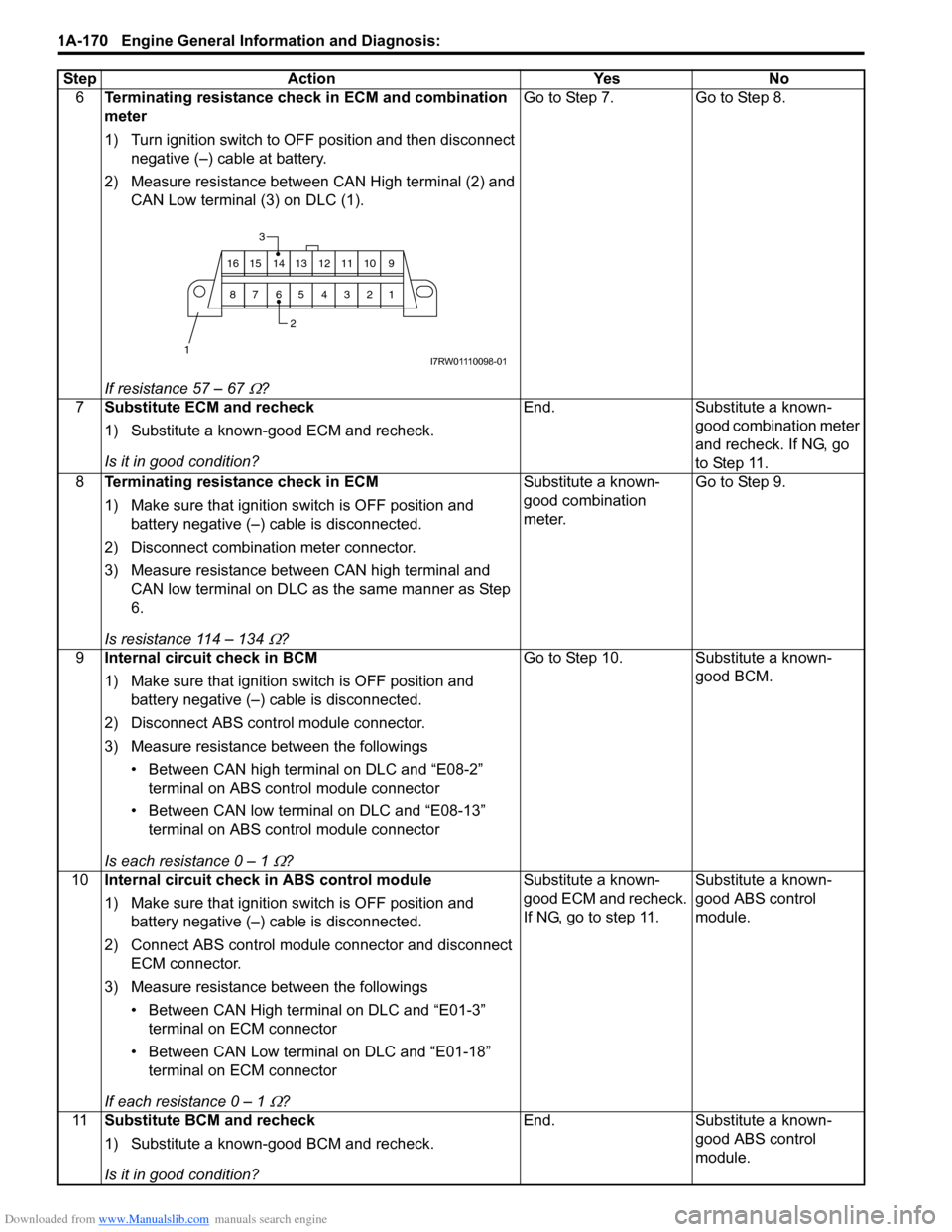
6Terminating resistance check in ECM and combination
meter
1) Turn ignition switch to OFF position and then disconnect
negative (–) cable at battery.
2) Measure resistance between CAN High terminal (2) and
CAN Low terminal (3) on DLC (1).
If resistance 57 – 67
Ω?Go to Step 7. Go to Step 8.
7Substitute ECM and recheck
1) Substitute a known-good ECM and recheck.
Is it in good condition?End. Substitute a known-
good combination meter
and recheck. If NG, go
to Step 11.
8Terminating resistance check in ECM
1) Make sure that ignition switch is OFF position and
battery negative (–) cable is disconnected.
2) Disconnect combination meter connector.
3) Measure resistance between CAN high terminal and
CAN low terminal on DLC as the same manner as Step
6.
Is resistance 114 – 134
Ω?Substitute a known-
good combination
meter.Go to Step 9.
9Internal circuit check in BCM
1) Make sure that ignition switch is OFF position and
battery negative (–) cable is disconnected.
2) Disconnect ABS control module connector.
3) Measure resistance between the followings
• Between CAN high terminal on DLC and “E08-2”
terminal on ABS control module connector
• Between CAN low terminal on DLC and “E08-13”
terminal on ABS control module connector
Is each resistance 0 – 1
Ω?Go to Step 10. Substitute a known-
good BCM.
10Internal circuit check in ABS control module
1) Make sure that ignition switch is OFF position and
battery negative (–) cable is disconnected.
2) Connect ABS control module connector and disconnect
ECM connector.
3) Measure resistance between the followings
• Between CAN High terminal on DLC and “E01-3”
terminal on ECM connector
• Between CAN Low terminal on DLC and “E01-18”
terminal on ECM connector
If each resistance 0 – 1
Ω?Substitute a known-
good ECM and recheck.
If NG, go to step 11.Substitute a known-
good ABS control
module.
11Substitute BCM and recheck
1) Substitute a known-good BCM and recheck.
Is it in good condition?End. Substitute a known-
good ABS control
module. Step Action Yes No
2
1
9 10 11 12 13 14 15 16
1 2 3 4 5 6 7 8
3
I7RW01110098-01
Page 221 of 1556

Downloaded from www.Manualslib.com manuals search engine Engine General Information and Diagnosis: 1A-171
12CAN communication check of TCM
1) Turn ignition switch to OFF position.
2) Connect TCM connectors.
3) Perform “Communication Bus Check” under “Bus
Check” using SUZUKI-SDT with ignition switch turned
ON.
Are all of BCM, ECM, ABS control module, combination
meter and TCM normally displayed?Go to Step 13. Check power and
ground circuits of TCM
referring to “TCM Power
and Ground Circuit
Check in Section 5A”. If
OK, substitute a known-
good TCM.
13CAN communication check of keyless start control
module
1) Turn ignition switch to OFF position.
2) Connect keyless start control module connector.
3) Perform “Communication Bus Check” under “Bus
Check” using SUZUKI-SDT with ignition switch turned
ON.
Are all of BCM, ECM, ABS control module, combination
meter, TCM and keyless start control module normally
displayed?Go to Step 14. Check power and
ground circuits of
keyless start control
module referring to
“Keyless Start Control
Module Power and
Ground Circuit Check in
Section 10E”. If OK,
substitute a known-
good keyless start
control module.
14CAN communication check of 4WD control module
1) Turn ignition switch to OFF position.
2) Connect combination meter connector and 4WD control
module.
3) Perform “Communication Bus Check” under “Bus
Check” on SUZUKI-SDT with ignition switch turned ON.
Are all of BCM, ECM, ABS control module, combination
meter, TCM, keyless start control module, combination
meter and 4WD control module normally displayed?Recheck DTC. Check power and
ground circuits of 4WD
control module referring
to “Step 2” and “Step 3”
under “DTC C1240:
4WD Control Module
Power Supply Circuit
Malfunction in Section
3B”. If OK, substitute a
known-good 4WD
control module. Step Action Yes No
Page 227 of 1556

Downloaded from www.Manualslib.com manuals search engine Engine General Information and Diagnosis: 1A-177
C01-48YEL/
GRNStarting motor
signal0 – 1 V Ignition switch turned ON.
—
6 – 14 V While engine cranking.
C01-49 — — — — —
C01-50WHT/
BLUGround of ECM for
shield wireBelow 0.3 V Ignition switch turned ON. —
C01-51 — — — — —
C01-52 — — — — —
C01-53RED/
BLKManifold absolute
pressure (MAP)
sensor signal (if
equipped)Approx. 4 V
(“Reference
waveform No.17: ”)Ignition switch turned ON
with barometric pressure
at 100 kPa, 760 mmHg.
—
0.4 – 2.0 V
(“Reference
waveform No.18: ”)While engine running at
specified idle speed after
warmed up with
barometric pressure at
100 kPa, 760 mmHg.
C01c01-
54GRNThrottle position
sensor (main)
signal0.75 – 1.08 VIgnition switch turned ON
and accelerator pedal at
idle position after warmed
up engine.
—
3.67 – 4.24 V
(“Reference
waveform No.29: ”)Ignition switch turned ON
and accelerator pedal at
full depressed position
after warmed up engine.
C01-55GRY/
BLUGround for sensors Below 0.3 V Ignition switch turned ON. —
C01-56 REDKnock sensor
signal2 – 3 V
(“Reference
waveform No.19: ”
and “Reference
waveform No.20: ”)Ignition switch turned ON.
— Engine running at 4000 r/
min. after warmed up.
C01-57 ORN Ground for sensors Below 0.3 V Ignition switch turned ON. —
C01-58BLK/
ORNGround for ECM Below 0.3 V Ignition switch turned ON. —
C01-59GRN/
WHTOil control valve
ground (for engine
with VVT system)Below 1.3 V Ignition switch turned ON. —
C01-60GRN/
REDOil control valve
output (for engine
with VVT system)*0 – 0.6 V
↑↓
10 – 14 V
(“Reference
waveform No.21: ”
and “Reference
waveform No.22: ”)At the moment of ignition
switch turned ON.Output signal is active
high pulse. Duty ratio
varies depending on
vehicle condition. Terminal
No.Wire
colorCircuit Normal voltage Condition Remarks
Terminal
No.Wire
colorCircuit Normal voltage Condition Remarks
E01-1BLK/
REDMain power supply 10 – 14 V Ignition switch turned ON. —
E01-2WHT/
REDPower source for
ECM internal
memory10 – 14 V Ignition switch turned ON. —
E01-3 REDCAN (high)
communication line
(active high signal)
to ABS control
module*2.5 – 4.5 V
(“Reference
waveform No.23: ”)Ignition switch turned ON
with engine at stop.CAN communication line
signal is pulse. Pulse
signal displayed with a
regular frequency with
varies depending on
engine condition.
Page 228 of 1556

Downloaded from www.Manualslib.com manuals search engine 1A-178 Engine General Information and Diagnosis:
E01-4 BRNEngine revolution
signal output for P/
S control module0 – 0.8 VIgnition switch turned ON
with engine at stop.—
*0 – 1 V
↑↓
8 – 14 V
(“Reference
waveform No.24: ”
and “Reference
waveform No.25: ”)While engine running.Output signal is pulse.
Pulse frequency varies
depending on engine
speed.
(2 pulses are generated
per 1 crankshaft
revolution.)
(3000 r/min. = 100 Hz)
E01-5 — — — — —
E01-6 — — — — —
E01-7 — — — — —
E01-8 — — — — —
E01-9 — — — — —
E01-10 — — — — —
E01-11 — — — — —
E01-12 — — — — —
E01-13YEL/
REDClock signal for
immobilizer coil
antenna10 – 14 V Ignition switch turned ON. —
E01-14 — — — — —
E01-15GRN/
WHTFuel pump relay
output0 – 2.5 VFor 2 sec. from the time
ignition switch is turned
ON or while engine is
running.
—
10 – 14 VOn and after 2 sec. from
the time ignition switch is
turned ON or while engine
is at stop.
E01-16BLK/
REDMain power supply 10 – 14 V Ignition switch turned ON. —
E01-17 — — — — —
E01-18 WHTCAN (low)
communication line
(active low signal)
to ABS control
module*0.5 – 2.5 V
(“Reference
waveform No.23: ”)Ignition switch turned ON
with engine at stop.CAN communication line
signal is pulse. Pulse
signal displayed with a
regular frequency which
varies depending on
engine condition.
E01-19 BLU/
WHTElectric load signal
for heater blower
motor10 – 14 VIG switch: ON Blower
selector < 3rd position
(Manual A/C model)
— IG switch: ON Blower
selector < 2nd position
(Auto A/C model)
0 – 1 VIG switch: ON Blower
selector > 2nd position
E01-20GRN/
WHTBrake light switch
signal0 – 1 VIgnition switch turned ON,
stop lamp not lit up.
—
10 – 14 VIgnition switch turned ON,
stop lamp lit up.
E01-21 — — — — —
E01-22 — — — — —
E01-23 — — — — —
E01-24YEL/
REDFuel level sensor
signal0 – 6 VIgnition switch turned ON.
Voltage varies depends on
fuel level.—
E01-25 — — — — — Terminal
No.Wire
colorCircuit Normal voltage Condition Remarks
Page 239 of 1556

Downloaded from www.Manualslib.com manuals search engine Engine General Information and Diagnosis: 1A-189
Reference waveform No.23
CAN communication line signal from ABS / ESP®
control module assembly or TCM with ignition switch
turned ONReference waveform No.24
Ignition pulse (engine revolution) signal (2) with engine
idling
Measurement
terminalCH1: “E01-3” to “C01-58” / CH1:
“C01-13” to “C01-58”
CH2: “E01-18” to “C01-58” / CH2:
“C01-12” to “C01-58”
Oscilloscope
settingCH1: 1 V/DIV, CH2: 1 V/DIV
TIME: 40 µs/DIV
Measurement
conditionIgnition switch turned ON
(Signal pattern is depending on
engine condition)
1. CAN communication line signal (High)
2. CAN communication line signal (Low)
I4RS0B110076-01
Measurement
terminalCH1: “C01-20” to “C01-58”
CH2: “E01-4” to “C01-58”
Oscilloscope
settingCH1: 5 V/DIV, CH2: 5 V/DIV
TIME: 40 ms/DIV
Measurement
condition• After warmed up to normal
operating temperature
• Engine at specified idle speed
[A]: For VVT model
[B]: For non-VVT model
1. Cylinder reference signal (CMP reference signal)
3. 720° crank angle
I4RS0B110077-01
Page 255 of 1556

Downloaded from www.Manualslib.com manuals search engine Engine General Information and Diagnosis: 1A-205
A/C System Circuits CheckS6RW0D1104078
Wiring Diagram
BLU/WHT
BLU/WHTE01-19
E01-19
21
E01C01
3 4
18 19 5 6 7 10 11
17 20
47 46 49 50 51 21 22
5216 259
24 14
29
55 57 54 53 59
60 582
26 27 28 15
30
56 4832 31 34 35 36 37 40 42 39 38 44
45 43 41 331 12 13
238 3 4
18 19 5 6 7 10 11
17 20
47 46 49 50 51 21 22
5216 259
24 14
29
55 57 54 53 59
60 582
26 27 28 15
30
56 4832 31 34 35 36 37 40 42 39 38 44
45 43 41 331 12 13
238
BLK/RED
BRN/WHT
12V5V
17
10
8
E01-1
E01-60
BLK/YEL
REDBLK11
WHT9
34
RED/BLK
BLK/REDE01-47
E01-58
BLU/YELGRY
19
2 1
20
5 15
WHT
RED
WHT
RED
WHT
RED
WHT
RED
E01-18E01-3
WHT/BLK
C01-14
E01-57
E01-54
E01-55RED/BLU
ORN
GRY/RED
BLK/YEL
GRN/WHT
BLK/WHT
WHT
1423
24
6
22 18
80A
1316 7 12
GRN
25
BLK/RED
BLU/YEL
YEL
WHT/BLU
BLK/YELBLK/YEL
BLU
I6RW0D110056-01
1. BCM 10. A/C condenser cooling fan motor relay 19. A/C switch
2. ABS control module 11. A/C condenser cooling fan motor 20. Blower motor
3. Blower speed selector (Auto A/C model) 12. “FI” fuse 21. Blower speed selector (Manual A/C model)
4. ECM 13. “IGN” fuse 22. Blower motor relay
5. A/C evaporator outlet air temp. sensor (Manual
A/C model)14. Ignition switch 23. “IG2 SIG” fuse
6. “IG COIL” fuse 15. A/C refrigerant pressure sensor 24. “BACK” fuse
7. “A/C” fuse 16. “BLW” fuse 25. Individual circuit fuse box No.1
8. A/C compressor relay 17. Main relay
9. A/C compressor 18. Junction block assembly
Page 259 of 1556

Downloaded from www.Manualslib.com manuals search engine Engine General Information and Diagnosis: 1A-209
Electric Load Signal Circuit CheckS6RW0D1104079
Wiring Diagram
E01 C01
3 4
18 19 5 6 7 10 11
17 20
47 46 49 50 51 21 22
5216 259
24 14
29
55 57 54 53 59
60 582
26 27 28 15
30
56 4832 31 34 35 36 37 40 42 39 38 44
45 43 41 331 12 13
238 3 4
18 19 5 6 7 10 11
17 20
47 46 49 50 51 21 22
5216 259
24 14
29
55 57 54 53 59
60 582
26 27 28 15
30
56 4832 31 34 35 36 37 40 42 39 38 44
45 43 41 331 12 13
238
BLK/WHT
BLK/RED
WHT
BRN/WHT
12V5V
10
E01-29
E01-1
E01-60BLK/YEL
BLK/YEL
139BLK/REDE01-16
BLU/WHT
BLU/WHTE01-19
E01-19
14
3 4
YEL
2
12
BLK/WHT
BLKBLK/YEL
GRN
WHT/BLU
BLU
1 56
11 7
8
C01-58
C01-15C01-30
BLK/ORN
BLKBLKE01-31BLK
17 16
WHTREDE01-18E01-3 15WHTREDWHTREDWHTRED [A]
17
WHTRED
18E01-18E01-3 1615WHTREDWHTRED
[B]
19
I6RW0D110057-02
[A]: Junction block with BCM model 6. Junction block assembly 13. Blower speed selector (Auto A/C model)
[B]: Junction block without BCM model 7. “IG COIL” fuse 14. Blower speed selector (Manual A/C model)
1. Individual circuit fuse box No.1 8. “IG2 SIG” fuse 15. Electric load signal (rear defogger signal and headlight
signal), etc.
2. “BLW” fuse 9. ECM 16. BCM
3. “FI” fuse 10. Main relay 17. ABS control module
4. “IGN” fuse 11. Blower motor relay 18. CAN junction connector
5. Ignition switch 12. Blower motor 19. To other control module connected CAN